Results by title
124 books match the query 'Twenty - First Century' and 10 start with m
Mapping Feminist Anthropology in the Twenty-First Century
Lewin, Ellen
Rutgers University Press, 2016
Mapping Feminist Anthropology in the Twenty-First Century
Lewin, Ellen
Rutgers University Press, 2016
Mapping Medical Anthropology for the Twenty-First Century
Matthew J. Wolf-Meyer
Rutgers University Press, 2026
Mapping Medical Anthropology for the Twenty-First Century provides readers with a comprehensive survey of topics, methodologies, and theories in the discipline, drawing on contributions from leading anthropologists around the world. As a discipline, medical anthropology provides situational analysis of health, disease, and disability to show how the experiences of medical experts, patients, and their broader communities are informed by their social and cultural contexts. Adopting a keywords-driven approach, Mapping Medical Anthropology for the Twenty-First Century provides readers with an introduction to the concepts and approaches that have animated medical anthropology over the course of the twentieth century. Authors put these keywords into dialogue with their ethnographic and archival research to demonstrate how these concepts can be expanded to address contemporary phenomena related to health, disease, and disability. Mapping Medical Anthropology for the Twenty-First Century provides newcomers to medical anthropology with a robust introduction to the discipline, while providing experienced readers a set of chapters that explore the discipline in novel and exciting ways.

Maryat Lee's EcoTheater
A Theater for the Twenty-first CenturyWILLIAM W. FRENCH
West Virginia University Press, 1998
Maryat Lee : a life in the theater, Dope!, and salt -- EcoTheater : the one thing willed -- EcoTheater's significance to the twenty-first century -- The EcoTheater process -- Sample EcoTheater scenes -- Some sayings and writings of Maryat Lee -- Maryat Lee : personal reminiscences -- Chronology
Measuring and Accounting for Innovation in the Twenty-First Century
Edited by Carol Corrado, Jonathan Haskel, Javier Miranda, and Daniel Sichel
University of Chicago Press, 2021

Mexican Foreign Policy at the Turn of the Twenty-first Century
How Domestic a Foreign Policy?Ana Covarrubias
University of London Press, 2005

Mission Unaccomplished
American War Films in the Twenty-First CenturyAlan Nadel
University of Texas Press, 2025
An analysis of how post-9/11 war movies changed from following soldiers on specific missions to chronicling war as a day-to-day occupation.
In 2003, the United States began a war in Iraq without a mission. Instead of fighting to restore peace—the traditional objective of warfare—servicemembers faced the grim reality that there was no goal. Lacking even certainty as to who was the enemy, soldiers discovered that their task was simply to survive.
Mission Unaccomplished explores how Hollywood grasped the experience of Iraq from the perspective of US soldiers, reinventing the war film in the process. Historically, films such as Saving Private Ryan valorized the goals of war by chronicling missions that unambiguously contribute to the defeat of the enemy and the restoration of peace. But in The Hurt Locker, American Sniper, Green Zone, and other recent dramas, soldiers just try to outlast the chaos. Dramatizing the aimlessness of the war, events occur in random order, and soldiers have no sense of how their actions contribute to victory or peace. Looking to recent WWII movies such as Dunkirk and Hacksaw Ridge, which use this same cinematic vocabulary to position soldiering as merely a deadly job to be endured, Alan Nadel argues that the disillusionment of Iraq has influenced cinema broadly, inspiring a newly critical war film genre.
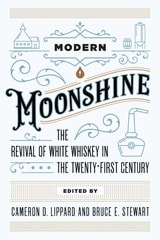
Modern Moonshine
The Revival of White Whiskey in the Twenty-First CenturyCameron D. Lippard
West Virginia University Press, 2019
The craft of making moonshine—an unaged white whiskey, often made and consumed outside legal parameters—nearly went extinct in the late twentieth century as law enforcement cracked down on illicit producers, and cheaper, lawful alcohol became readily available. Yet the twenty-first century has witnessed a resurgence of artisanal distilling, as both connoisseurs and those reconnecting with their heritage have created a vibrant new culture of moonshine. While not limited to Appalachia, moonshine is often entwined with the region in popular understandings.
The first interdisciplinary examination of the legal moonshine industry, Modern Moonshine probes the causes and impact of the so-called moonshine revival. What does the moonshine revival tell us about our national culture? How does it shape the image of Appalachia and rural America? Focusing mostly on southern Appalachia, the book’s eleven essays chronicle such popular figures as Popcorn Sutton and explore how and why distillers promote their product as “traditional” and “authentic.” This edited collection draws from scholars across the disciplines of anthropology, history, geography, and sociology to make sense of the legal, social, and historical shifts behind contemporary production and consumption of moonshine, and offers a fresh perspective on an enduring topic of Appalachian myth and reality.
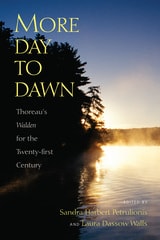
More Day to Dawn
Thoreau's Walden for the Twenty-first CenturySandra Harbert Petrulionis
University of Massachusetts Press, 2007
Thoreau asserted that the leaves of the earth's strata were not page upon page to be studied by geologists and antiquaries chiefly, "but living poetry like the leaves of a tree." The continuing vitality of Walden shows that it, too, is not a fossil but a living book, still putting out green leaves of insight.
Each decade since Walden was published in 1854 has seen the world grow more crowded and less "simple." What, in our consumerist, speed-of-light, hypermediated world would Thoreau have found worth pursuing? How would he structure his life so as to shut out the phones ringing, the cars honking, the litter trashing his beloved haunts? Readers still seek answers to such questions by picking up their dog-eared copy of Walden and immersing themselves yet again in its pages. Students convince us that this book still holds the power to change lives. These essays are written with the expectation that Thoreau in the new century can help us realize that there are more lives to live and more day to dawn—that "the sun is but a morning star."
Contributors include Nina Baym, Robert Cummings, Robert Oscar López, Lance Newman, H. Daniel Peck, Dana Phillips, Larry J. Reynolds, David M. Robinson, William Rossi, Robert Sattelmeyer, Sarah Ann Wider, and Michael G. Ziser.

More or Less Afraid of Nearly Everything
Homeland Security, Borders, and Disasters in the Twenty-First CenturyBenjamin Rohrbaugh
University of Michigan Press, 2020
Throughout the twentieth century, the United States did not experience national security domestically; it defended its borders by conducting military, foreign policy, and intelligence operations internationally, and then separated these activities from domestic law enforcement with bright legal lines. In the twenty-first century, U.S. national security no longer occurs exclusively outside of the nation. The U.S. government is beginning to respond to this change, and the establishment of the Department of Homeland Security is merely the first step in an organizational and strategic realignment that will be a long, difficult, and mistake-filled process. More or Less Afraid of Nearly Everything is an accessible and engaging guide to homeland security, particularly migration and border security, that makes innovative arguments about the American government and keeping citizens safe, and provides practical solutions to real-world problems.