Results by title
60 books match the query 'Ukraine' and 5 start with m

Makhno and Memory
Anarchist and Mennonite Narratives of Ukraine's Civil War, 1917–1921Sean Patterson
University of Manitoba Press, 2020
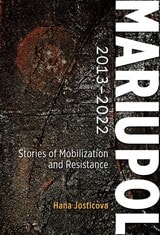
Mariupol 2013-2022
Stories of Mobilization and ResistanceHana Josticova
Central European University Press, 2024
The chapters in this book represent successive phases of one story – that of Mariupol, formerly Ukraine’s tenth largest city, and the second largest in the Donbas region. The author, a young Slovak academic, conducted her ethnographic fieldwork in this coastal town between November 2018 and August 2021. She was one of the last academics to do research in Mariupol before its invasion and eventual occupation by Russia.
During these years, Hana Jošticová was overwhelmed by acts of mobilization and resistance that went in opposite directions: support for a Western direction of Ukraine’s future, and support for the status quo that the victory of the Euromaidan seemed to threaten.
She noted the sequence of events presented in the media and through the lens of individual frames and narratives. Her book is a collection and interpretation of memories and testimonies from both sides: those who actively resisted Russian influence; and those who sparked their own revolution, the ‘Russian Spring.’ Her focus is on self-mobilized individuals who resorted to action outside of established organizational structures spontaneously, autonomously, without resources and guarantees of safety. Her evidence indicates that popular support for the Russian Spring had less to do with Russia than with the social, economic, or cultural characteristics of the Donetsk region.
Years of immersive research convinced the author that individuals are as important as masses, ideas are as powerful as material resources, and beliefs and emotions are as critical as weapons.
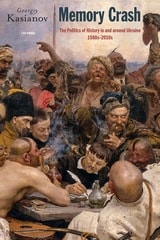
Memory Crash
Politics of History in and around Ukraine, 1980s–2010sGeorgiy Kasianov
Central European University Press, 2022
This account of historical politics in Ukraine, framed in a broader European context, shows how social, political, and cultural groups have used and misused the past from the final years of the Soviet Union to 2020. Georgiy Kasianov details practices relating to history and memory by a variety of actors, including state institutions, non-governmental organizations, political parties, historians, and local governments. He identifies the main political purposes of these practices in the construction of nation and identity, struggles for power, warfare, and international relations.
Kasianov considers the Ukrainian case in the context of a global increase in the politics of history and memory, with particular emphasis on a distinctive East-European variety. He pays special attention to the use and abuse of history in relations between Ukraine, Russia, and Poland.
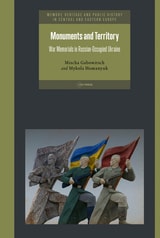
Monuments and Territory
War Memorials in Russian-Occupied UkraineMischa Gabowitsch
Central European University Press, 2025
From the very first weeks of Russia’s large-scale attack on Ukraine in February 2022, Russian soldiers, politicians, and proxy administrators expended considerable effort interacting with monuments on newly occupied territory. Why did the invaders care enough about war memorials to divert scarce resources to destroying, maintaining, or building them amid a massive war? Why did they remove some memorials and spare others? What was the point of commemorating past victories and defeats while bombing Ukrainian cities, and how did commemorative ceremonies in the occupied territories
change over the first year of the war? What was the broader impact of monument-related practices beyond the local settings in which they occurred? And what does the Ukrainian case teach us more generally about how memorials to past wars can be used to justify new conquests? These are some of the questions this book explores, based on fieldwork in occupied Ukraine and online research.
Monuments to Faith
Ukrainian Churches in ManitobaBasil Rotoff
University of Manitoba Press, 1990