Results by title
97 books match the query 'Urbanization' and 6 start with m
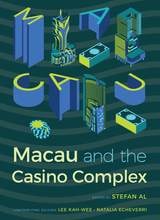
Macau and the Casino Complex
Stefan Al
University of Nevada Press, 2018
Special Award of the Jury Winner — 2018 Gourmand World Cookbook Awards
In only a decade, Macau has exploded from a sleepy backwater to the world’s casino capital. It was bound to happen. Macau, a former Portuguese colony that became a special administrative region within the People’s Republic of China in 1999, was the only place in China where gambling was legal. With a consumer base of 1.3 billion mainland Chinese deprived of casino gambling, and the world’s largest growing consumer class, international corporations rushed in to enter the games. As a result, the casino influx has permanently transformed the Macau peninsula: its ocean reclaimed, hillside excavated, roads congested, air polluted, and glimmering hotel towers tossed into the skyline, dwarfing the 19th century church towers.
Essays by a number of experts give a deeper insight on topics ranging from the myth of the Chinese gambler, the role of feng shui in casino design, the city’s struggle with heritage conservation, the politics of land reclamation, and the effect of the casino industry on the public realm. Drawings and photographs in vivid color visualize Macau’s patchwork of distinct urban enclaves: from downtown casinos, their neon-blasting storefronts eclipsing adjacent homes and schools, to the palatial complexes along a new highway, a Las Vegas-style strip. They also reveal how developers go to great lengths to impress the gambler with gimmicks such as fluorescent lighting, botanic gardens, feng shui dragon statues, cast members’ costumes, Chinese art imitations, and crystal chandelier-decked elevators. It is a book that helps readers grasp the complex process of the development of the casino industry and its overall impact on the social and architectural fabric of the first and last colonial enclave in China.
[more]
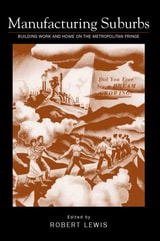
Manufacturing Suburbs
Building Work And Homeedited by Robert Lewis
Temple University Press, 2004
Urban historians have long portrayed suburbanization as the result of a bourgeois exodus from the city, coupled with the introduction of streetcars that enabled the middle class to leave the city for the more sylvan surrounding regions. Demonstrating that this is only a partial version of urban history, Manufacturing Suburbs reclaims the history of working-class suburbs by examining the development of industrial suburbs in the United States and Canada between 1850 and 1950. Contributors demonstrate that these suburbs developed in large part because of the location of manufacturing beyond city limits and the subsequent building of housing for the workers who labored within those factories. Through case studies of industrial suburbanization and industrial suburbs in several metropolitan areas (Chicago, Baltimore, Detroit, Pittsburgh, Los Angeles, San Francisco, Toronto, and Montreal), Manufacturing Suburbs sheds light on a key phenomenon of metropolitan development before the Second World War.
[more]
Metropolis 1890-1940
Edited by Anthony Sutcliffe
University of Chicago Press, 1984
An ideal and welcome reference and reader for students of urbanism, Metropolis 1890-1940 examines perceptions of the city during the dramatic urban growth of this period. Metropolis looks at the policies adopted to deal with the new city and at the views of the city expressed in the art, architecture, literature, cinema, music, and ideology of the time. Internationally known experts discuss case studies of London, Paris, Berlin, the Ruhr, New York, Moscow, and Tokyo, and a postscript brings the reader up to date with a survey of postwar urbanism.
[more]
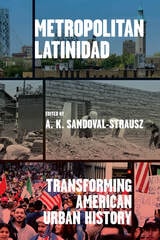
Metropolitan Latinidad
Transforming American Urban HistoryEdited by A. K. Sandoval-Strausz
University of Chicago Press, 2025
A wide-ranging collection of essays that centers Latinos in the history of American cities and suburbs.
Latino urban history has been underappreciated not only in its own right but for the centrality of its narratives to urban history as a field. A scholarly discipline that has long scrutinized economics, politics, and the built environment has too often framed race as literally Black and white. This has resulted in a fundamental misunderstanding of the full social canvas of American cities since at least the early twentieth century.
Traversing metropolitan areas like Atlanta, Chicago, El Paso, Fort Worth, Los Angeles, Miami, and New York, this collection of essays brings together both established and emerging scholars, including long-time urbanists and academics working in the fields of Latino, borderlands, political, landscape, and religious history. Organized at different scales—including city, suburb, neighborhood, and hemisphere—this impressive body of work challenges long-standing narratives about metropolitan America. The contributors—Llana Barber, Mauricio Castro, Eduardo Contreras, Sandra I. Enríquez, Monika Gosin, Cecilia Sánchez Hill, Felipe Hinojosa, Michael Innis-Jiménez, Max Krochmal, Becky M. Nicolaides, Pedro A. Regalado, Iliana Yamileth Rodriguez, and Thomas J. Sugrue—engage a diverse range of subjects, such as urban rebellions, the suburbanization of Latinos, affordable housing, labor, the built environment, transnationalism, place-making, and religious life. The scholars also explore race within Latino communities, as well as the role that political and economic dynamics have played in creating Latino urban spaces. After reading this book, you will never see American cities the same way again.
[more]
Mobile Urbanism
Cities and Policymaking in the Global AgeEugene McCann
University of Minnesota Press, 2010
Mobile Urbanism provides a unique set of perspectives on the current global-urban condition. Drawing on cutting-edge theoretical work, leading geographers reveal that cities are not isolated objects of study; rather, they are dynamic, global–local assemblages of policies, practices, and ideas.
The essays in this volume argue for a theorizing of both urban policymaking and place-making that understands them as groups of territorial and relational geographies. It broadens our comprehension of agents of transference, reconceiving how policies are made mobile, and acknowledging the importance of interlocal policy mobility. Through the richness of its empirical examples from Europe, North America, South America, Africa, Asia, and Australia, contributors bring to light the significant methodological challenges that researchers face in the study of an urban–global, territorial–relational conceptualization of cities and suggest productive new approaches to understanding urbanism in a networked world.
Contributors: S. Harris Ali, York U, Toronto; Allan Cochrane, Open U; Roger Keil , York U, Toronto; Doreen Massey, Open U; Donald McNeill, U of Western Sydney; Jamie Peck, U of British Columbia; Jennifer Robinson, University College London.
[more]
Monstrous Politics
Geography, Rights, and the Urban Revolution in Mexico CityBen Gerlofs
Vanderbilt University Press, 2022
The birth of the world’s great megacities is the surest and starkest harbinger of the “urban age” inaugurated in the twentieth century. As the world’s urban population achieves majority for the first time in recorded history, theories proliferate on the nature of urban politics, including the shape and quality of urban democracy, the role of urban social and political movements, and the prospects for progressive and emancipatory change from the corridors of powerful states to the routinized rhythms of everyday life. At stake are both the ways in which the rapidly changing urban world is understood and the urban futures being negotiated by the governments and populations struggling to contend with these changes and forge a place in contemporary cities.
Transdisciplinary by design, Monstrous Politics first moves historically through Mexico City’s turbulent twentieth century, driven centrally by the contentious imbrication of the Institutional Revolutionary Party (PRI) and its capital city. Participant observation, expert interviews, and archival materials demonstrate the shifting strategies and alliances of recent decades, provide the reader with a sense of the texture of contemporary political life in the city during a time of unprecedented change, and locate these dynamics within the history and geography of twentieth-century urbanization and political revolution. Substantive ethnographic chapters trace the emergence and decline of the political language of “the right to the city,” the establishment and contestation of a “postpolitical” governance regime, and the culmination of a century of urban politics in the processes of “political reform” by which Mexico City finally wrested back significant political autonomy and local democracy from the federal state.
A four-fold transection of the revolutionary structure of feeling that pervades the city in this historic moment illustrates the complex and contradictory sentiments, appraisals, and motivations through which contemporary politics are understood and enacted. Drawing on theories of social revolution that embrace complexity, and espousing a methodology that foregrounds the everyday nature of politics, Monstrous Politics develops an understanding of revolutionary urban politics at once contextually nuanced and conceptually expansive, and thus better able to address the realities of politics in the “urban age” even beyond Mexico City.
[more]