Results by title
99 books match the query 'Vietnam' and 2 start with m
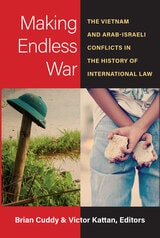
Making Endless War
The Vietnam and Arab-Israeli Conflicts in the History of International LawBrian Cuddy and Victor Kattan, Editors
University of Michigan Press, 2023
Making Endless War is built on the premise that any attempt to understand how the content and function of the laws of war changed in the second half of the twentieth century should consider two major armed conflicts, fought on opposite edges of Asia, and the legal pathways that link them together across time and space. The Vietnam and Arab-Israeli conflicts have been particularly significant in the shaping and attempted remaking of international law from 1945 right through to the present day. This carefully curated collection of essays by lawyers, historians, philosophers, sociologists, and political geographers of war explores the significance of these two conflicts, including their impact on the politics and culture of the world’s most powerful nation, the United States of America. The volume foregrounds attempts to develop legal rationales for the continued waging of war after 1945 by moving beyond explaining the end of war as a legal institution, and toward understanding the attempted institutionalization of endless war.
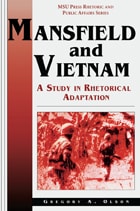
Mansfield and Vietnam
A Study in Rhetorical AdaptationGregory A. Olson
Michigan State University Press, 1995
Mansfield and Vietnam: A Study in Rhetorical Adaptation is the first major work to examine the role played by Senate Majority Leader Mike Mansfield, Democrat from Montana, in the formulation and execution of U.S. Vietnam policy. Drawing upon material from the Mansfield Papers, personal interviews, public speeches, and recently declassified documents, Olson traces Mansfield's journey from ardent supporter of Diem in the late 1950s to quiet critic of LBJ in the mid-1960s, and finally, to outspoken opponent of the Vietnam War in the late 1960s and early 1970s.
Olson focuses his attention on Mansfield's speaking ability and his use of the written word, analyzing the ways in which they proved crucial in shaping the policies of the Eisenhower, Kennedy, Johnson, Nixon, and Ford presidential administrations. He also examines the way personal and political situations converged to force Mansfield into the center of the stormy Vietnam controversy, and eventually into a position of leadership in the campaign to end America's military presence in Southeast Asia. To date, little has been done to evaluate the roles played by key congressional figures in the Vietnam War debate; thus, Mansfield and Vietnam is bound to become a significant contribution, not only to rhetorical studies, but also to twentieth-century diplomatic history and to the study of congressional-presidential relations.