Results by title
71 books match the query 'Voice' and 3 start with m

Maternal Body and Voice in Toni Morrison, Bobbie Ann Mason, and Lee Smith
Paula Gallant Eckard
University of Missouri Press, 2002
Throughout human history, motherhood and maternal experience have been largely defined and written by patriarchal culture. Religion, art, medicine, psychoanalysis, and other bastions of male power have objectified the maternal and have disregarded female subjectivity. As a result, maternal perspectives have been ignored and the mother’s voice silenced. In recent literary texts, however, more substantial attention has been given to motherhood and to the physical, psychological, social, and cultural dynamics affecting maternal experience. In Maternal Body and Voice in Toni Morrison, Bobbie Ann Mason, and Lee Smith, Paula Gallant Eckard examines how maternal experience is depicted in selected novels by three American writers, emphasizing how they focus on the body and the voice of the mother. These novels include: The Bluest Eye, Sula, and Beloved by Morrison; In Country, Spence + Lila, and Feather Crowns by Mason; and Oral History, Fair and Tender Ladies, and Saving Grace by Smith.
By employing this focus, these writers lessen the objectification the maternal has received and restore a rich subjectivity that foregrounds the mother’s perspective. Moreover, their fiction reflects a deep concern for history and culture and for a woman’s experience of her world. They challenge the traditional representations of black and white motherhood that have appeared in southern literature and society, rendering complex portrayals of motherhood that defy cultural stereotypes.
Eckard incorporates historical perspectives on African American and southern motherhood, utilizing the works of Elizabeth Fox-Genovese, Sally McMillen, Deborah White, Jacqueline Jones, and others. She draws upon the feminist criticism of Adrienne Rich, Elaine Showalter, Naomi Schor, Tillie Olsen, Karla F. C. Holloway, Barbara Christian, and others, and the linguistic and psychoanalytic theories of Julia Kristeva, Hélène Cixous, and Luce Irigaray. The author also addresses the cross-cultural connections shared by Morrison, Mason, and Smith, showing that, despite their racial and cultural differences, striking similarities can be found in their renderings of maternity.
The three women writers employ related image patterns, metaphors, and symbols involving the maternal body. By centering maternity so strongly in their novels, Morrison, Mason, and Smith establish the primacy of the mother and obviate the neglect to which maternal perspectives have been subjected. They restore the mother’s lost voice and her diminished subjectivity. Together they depict the maternal as a powerful force that shapes human lives and communities.
[more]
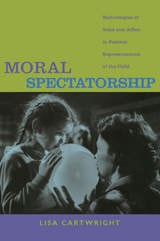
Moral Spectatorship
Technologies of Voice and Affect in Postwar Representations of the ChildLisa Cartwright
Duke University Press, 2008
Why were theories of affect, intersubjectivity, and object relations bypassed in favor of a Lacanian linguistically oriented psychoanalysis in feminist film theory in the 1980s and 1990s? In Moral Spectatorship, Lisa Cartwright rethinks the politics of spectatorship in film studies. Returning to impasses reached in late-twentieth-century psychoanalytic film theory, she focuses attention on theories of affect and object relations seldom addressed during that period. Cartwright offers a new theory of spectatorship and the human subject that takes into account intersubjective and affective relationships and technologies facilitating human agency. Seeking to expand concepts of representation beyond the visual, she develops her theory through interpretations of two contexts in which adult caregivers help bring children to voice. She considers several social-problem melodramas about deaf and nonverbal girls and young women, including Johnny Belinda, The Miracle Worker, and Children of a Lesser God. Cartwright also analyzes the controversies surrounding facilitated communication, a technological practice in which caregivers help children with communication disorders achieve “voice” through writing facilitated by computers. This practice has inspired contempt among professionals and lay people who charge that the facilitator can manipulate the child’s speech.
For more than two decades, film theory has been dominated by a model of identification tacitly based on the idea of feeling what the other feels or of imagining oneself to be the other. Building on the theories of affect and identification developed by André Green, Melanie Klein, Donald W. Winnicott, and Silvan Tomkins, Cartwright develops a model of spectatorship that takes into account and provides a way of critically analyzing the dynamics of a different kind of identification, one that is empathetic and highly intersubjective.
[more]
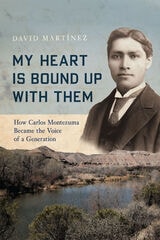
My Heart Is Bound Up with Them
How Carlos Montezuma Became the Voice of a GenerationDavid Martínez
University of Arizona Press, 2023
Carlos Montezuma is well known as an influential Indigenous figure of the turn of the twentieth century. While some believe he was largely interested only in enabling Indians to assimilate into mainstream white society, Montezuma’s image as a staunch assimilationist changes dramatically when viewed through the lens of his Yavapai relatives at Fort McDowell in Arizona.
Through his diligent research and transcription of the letters archived in the Carlos Montezuma Collection at Arizona State University Libraries, David Martínez offers a critical new perspective on Montezuma’s biography and legacy. During an attempt to force the Fort McDowell Yavapai community off of their traditional homelands north of Phoenix, the Yavapai community members and leaders wrote to Montezuma pleading for help. It was these letters and personal correspondence from his Yavapai cousins George and Charles Dickens, as well as Mike Burns that sparked Montezuma’s desperate but principled desire to liberate his Yavapai family and community—and all Indigenous people—from the clutches of an oppressive Indian Bureau.
Centering historically neglected Indigenous voices as his primary source material, Martínez elevates Montezuma’s correspondence and interactions with his family and their community and shows how it influenced his advocacy. Martínez argues that Montezuma’s work in Arizona directly contributed to his national projects. For his Yavapai community, Montezuma set an example as a resistance fighter and advocate on behalf of his people and other Indigenous groups. Martínez offers a critical exploration of history, memory, the formation of archival collections, and the art of writing biography.
[more]