Results by title
388 books match the query 'War' and 12 start with m

Macau in an Age of War and Revolution
Geoffrey C. Gunn
National University of Singapore Press, 2027
A new interpretation of the modern history of Macau that investigates the territory's political economy, Indigenous capitalism, and regional networks.
How did Macau, a small Portuguese-administered territory in the Pearl River delta, navigate the tumultuous waves of the twentieth century? Chinese comprador and "red capitalist" elites are at the heart of its transformation, evolving from intermediaries to influential architects of Macau's economic landscape. Their ventures in gambling, opium, banking, and shipping forged powerful networks that linked Macau closely with South China and Hong Kong.
Amidst global upheavals—from revolutions and invasions to civil wars and the Cold War—Macau's resilience lay in its ability to adapt to shifting political and economic realities. Macau in an Age of War and Revolution highlights the pivotal roles of refugees, Macanese intermediaries, and local governance in shaping Macau's unique path. By spotlighting the rise of local capital and agency, this book offers a compelling explanation for Macau's distinct trajectory under China's "one country, two systems" framework, setting it apart from its neighbor Hong Kong.
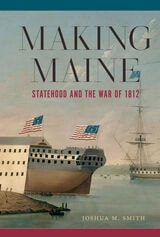
Making Maine
Statehood and the War of 1812Joshua M. Smith
University of Massachusetts Press, 2022
Honorable mention for U.S. Maritime History, John Lyman Book Awards
After the Revolutionary War ended, the new American nation grappled with a question about its identity: Were the states sovereign entities or subordinates to a powerful federal government? The War of 1812 brought this vexing issue into sharp relief, as a national government intent on waging an unpopular war confronted a populace in Massachusetts that was vigorously opposed to it. Maine, which at the time was part of Massachusetts, served as the battleground in this political struggle.
Joshua M. Smith recounts an innovative history of the war, focusing on how it specifically affected what was then called the District of Maine. Drawing on archival materials from the United States, Britain, and Canada, Smith exposes the bitter experience of Maine’s citizens during that conflict as they endured multiple hardships, including starvation, burdensome taxation, smuggling, treason, and enemy occupation. War’s inherent miseries, along with a changing relationship between regional and national identities, gave rise to a statehood movement that rejected a Boston-centric worldview in favor of a broadly American identity.
Manassas
A Novel of the WarUpton Sinclair
University of Alabama Press, 2000
Centers on the moral dimension of the conflict as it traces a young Mississippi boy’s conversion from pro-slavery Southerner to abolitionist Union soldier
Allan Montague, born on a Mississippi plantation about twenty years before the Civil War, has grown up with slavery and considers it natural. When his father moves to Boston for business and takes the boy with him, young Allan carries a knife given to him by his cousin to use in killing abolitionists.
The first abolitionist young Allan meets in Boston is Levi Coffin, the reputed founder of the Underground Railroad. In this first of many meetings with historical figures, Allan forms a friendship with Coffin, who eventually takes him to hear a speech by former slave Frederick Douglass. Douglass's powerful words cement Allan's transformation into an abolitionist—a transformation that will lead him back to his Deep South home with the hope of freeing slaves and eventually back to the North and the fateful Battle of Manassas.
Kent Gramm, author of the introduction for this new edition of Manassas, calls the novel “a modern version of the morality play,” with the United States as the central character. “The real story, he writes, is the moral phenomenon of the Civil War.” It is a powerful book that deserves to be revived, read, and studied.
Maraña
War and Disease in the Jungles of ColombiaLina Pinto-García
University of Chicago Press, 2025
Cutaneous leishmaniasis, transmitted by female sandflies, produces skin lesions of varying size and shape. In Colombia, the insect vector of the disease is native to the same forested environments that have served as the main stage for one of the longest and most violent wars in Latin American history. As a result, the populations most affected by leishmaniasis in Colombia are members of the state army and nonstate armed groups.
Lina Pinto-García explores how leishmaniasis and the armed conflict are inextricably connected and mutually reinforcing. Maraña means “tangle” in Spanish but is also commonly used in Colombia to name the entangled greenery, braided lianas, and dense foliage that characterize the tropical forests where leishmaniasis transmission typically occurs. Pinto-García argues that leishmaniasis and the war are not merely linked but enmarañadas to each other through narratives, technologies, and practices produced by the state, medicine, biomedical research, and the armed conflict itself. All told, Maraña is a passionate study of how war has shaped the production of scientific knowledge about leishmaniasis and access to its treatments in Colombia.
Massacre on the Gila
An Account of the Last Major Battle Between American Indians, with Reflections on the Origin of WarClifton B. Kroeber
University of Arizona Press, 1986
"Rarely do the skills of historians and anthropologists mesh so admirably." —Western Historical Quarterly
"Kroeber and Fontana are meticulous professionals. Their study of this neglected slice of Southwestern history deserves applause." —Evan S. Connell, Los Angeles Times Book Review
"A rich feast for the curious and theorist alike." —Pacific Historical Review
"Kroeber and Fontana describe a little-known event, provide an effective analysis of the cultures of Indian groups in southwestern Arizona, and attempt to understand the broader causes of warfare. The result is an interesting and provocative study." —Journal of American History
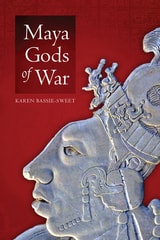
Maya Gods of War
Karen Bassie-Sweet
University Press of Colorado, 2021
Author Karen Bassie-Sweet traces the semantic markers used to distinguish flint from other types of stone, surveys various types of Chahk thunderbolt deities and their relationship to flint weapons, and explores the connection between lightning and the ruling elite. Additional chapters review these fire and solar deities and their roles in Maya warfare and examine the nature and manifestations of the Central Mexican thunderbolt god Tlaloc, his incorporation into the Maya pantheon, and his identification with meteors and obsidian weapons. Finally, Bassie-Sweet addresses the characteristics of the deity God L, his role as an obsidian merchant god, and his close association with the ancient land route between the highland Guatemalan obsidian sources and the lowlands.
Through analysis of the nature of the Teotihuacán deities and exploration of the ways in which these gods were introduced into the Maya region and incorporated into the Maya worldview, Maya Gods of War offers new insights into the relationship between warfare and religious beliefs in Mesoamerica. This significant work will be of interest to scholars of Maya religion and iconography.
Measuring the Correlates of War
J. David Singer and Paul F. Diehl, Editors
University of Michigan Press, 1991

Men, War and Film
The Calling Blighty Films of World War IISteve Hawley
Intellect Books, 2025
The Calling Blighty series of films produced by the Combined Kinematograph Service around the end of World War II were one-reel films in which soldiers of the “Forgotten Army” gave short spoken messages to the camera as a means of connecting the front line and the home front. Shown in local cinemas, these were the first films in which men spoke openly in their regional accents, and they hold profound meaning for remembrance, documentary representation, and the ecology of film in wartime. Of the four hundred films made on the Far Eastern Front, only sixty-four survive. Until now, however, these films have barely been researched, despite being a valuable source of social history. This book expands the history of Calling Blighty, placing it in a broader context for contemporary audiences.
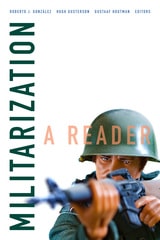
Militarization
A ReaderRoberto J. González, Hugh Gusterson, and Gustaaf Houtman, editors
Duke University Press, 2019
In collaboration with Catherine Besteman, Andrew Bickford, Catherine Lutz, Katherine T. McCaffrey, Austin Miller, David H. Price, David Vine

Mr. Dooley in Peace and in War
Finley Peter Dunne
University of Illinois Press, 1988
As Charlie McCarthy is to Edgar Bergen, so is Martin T. Dooley to newspaper humorist Finley Peter Dunne. Mr. Dooley in Peace and in War, originally published in 1898, collects brief, humorous pieces Dunne wrote for the Chicago Evening Post and the Chicago Journal. In an Irish-American dialect as thick as the foam on a pint of stout, Mr. Dooley and his friends discuss the military "sthrateejy" for American action in Cuba, "iliction" day shenanigans, Queen Victoria's jubilee, the "new woman," and the strange American sport of football, in which a player puts "a pair iv matthresses on his legs, a pillow behind, [and] a mask over his nose" and tries to kill his fellow men. Through his tall tales and speculations, Mr. Dooley reveals the pleasure and pain of being Irish in Chicago at the turn of the twentieth century.
Clothed in the charming hyperbole and mislocution of the unflappable Mr. Dooley, Dunne's incisive social criticism flies unerringly to the target, exposing prejudice, hypocrisy, insensitivity, and plain old-fashioned humbug.
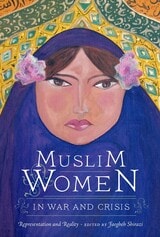
Muslim Women in War and Crisis
Representation and RealityEdited by Faegheh Shirazi
University of Texas Press, 2010
Representing diverse cultural viewpoints, Muslim Women in War and Crisis collects an array of original essays that highlight the experiences and perspectives of Muslim women—their dreams and nightmares and their daily struggles—in times of tremendous social upheaval. Analyzing both how Muslim women have been represented and how they represent themselves, the authors draw on primary sources ranging from poetry and diaries to news reports and visual media. Topics include:
- Peacebrokers in Indonesia
- Exploitation in the Islamic Republic of Iran
- Chechen women rebels
- Fundamentalism in Afghanistan, from refugee camps to Kabul
- Memoirs of Bengali Muslim women
- The 7/7 London bombings, British Muslim women, and the media
Also exploring such images in the United States, Spain, the former Yugoslavia, Tunisia, Algeria, Lebanon, and Iraq, this collection offers a chorus of multidimensional voices that counter Islamophobia and destructive clichés. Encompassing the symbolic national and religious identities of Muslim women, this study goes beyond those facets to examine the realities of day-to-day existence in societies that seek scapegoats and do little to defend the victims of hate crimes. Enhancing their scholarly perspectives, many of the contributors (including the editor) have lived through the strife they analyze. This project taps into their firsthand experiences of war and deadly political oppression.
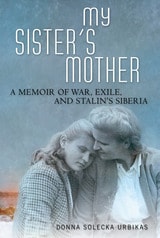
My Sister's Mother
A Memoir of War, Exile, and Stalin’s SiberiaDonna Solecka Urbikas
University of Wisconsin Press, 2019
In 1940, Janina Ślarzynska and her five-year-old daughter Mira were taken by Soviet secret police (NKVD) from their small family farm in eastern Poland and sent to Siberia with hundreds of thousands of others. So began their odyssey of hunger, disease, cunning survival, desperate escape across a continent, and new love amidst terrible circumstances.
But in the 1950s, baby boomer Donna yearns for a “normal” American family while Janina and Mira are haunted by the past. In this unforgettable memoir, Donna recounts her family history and her own survivor’s story, finally understanding the damaged mother who had saved her sister.
Finalist, Best Traditional Non-Fiction Book, Chicago Writers Association