Results by title
77 books match the query 'Wars' and 6 start with m
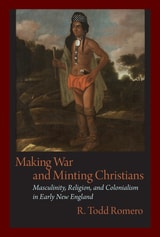
Making War and Minting Christians
Masculinity, Religion, and Colonialism in Early New EnglandR. Todd Romero
University of Massachusetts Press, 2011
In this book, R. Todd Romero traces the interaction of notions of gender, the practice of religion, and the conduct of warfare in colonial America. He shows how Native and Anglo-American ideas of manhood developed in counterpoint, in the context of Christian evangelization, colonial expansion, and recurrent armed conflict.
For the English, the cultivation of manliness became an important aspect of missionary efforts. Conversion demanded that the English “make men” of the Indians before they could “make them Christians,” a process that involved reshaping Native masculinity according to English patriarchal ideals that the colonists themselves rarely matched. For their part, Native Americans held on to older ways of understanding the divine and defining gender even as they entered English “praying towns” and negotiated the steep demands of the missionaries.
Evolving ideas of masculinity resonated with religious significance and shaped the meaning of warfare for Natives and colonists alike. Just as the English believed that their territorial expansion was divinely sanctioned, Indians attributed a string of victories in King Philip's War to “the Great God” and the perception that their enemies “were like women.” Trusting that war and manliness were necessarily linked, both groups engaged in ritual preparations for battle, believed deeply in the efficacy of the supernatural to affect the outcome of combat, and comprehended the meaning of war in distinctly religious ways.
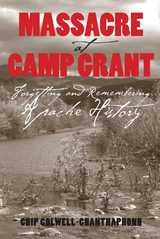
Massacre at Camp Grant
Forgetting and Remembering Apache HistoryChip Colwell-Chanthaphonh
University of Arizona Press, 2007
On April 30, 1871, an unlikely group of Anglo-Americans, Mexican Americans, and Tohono O’odham Indians massacred more than a hundred Apache men, women, and children who had surrendered to the U.S. Army at Camp Grant, near Tucson, Arizona. Thirty or more Apache children were stolen and either kept in Tucson homes or sold into slavery in Mexico. Planned and perpetrated by some of the most prominent men in Arizona’s territorial era, this organized slaughter has become a kind of “phantom history” lurking beneath the Southwest’s official history, strangely present and absent at the same time.
Seeking to uncover the mislaid past, this powerful book begins by listening to those voices in the historical record that have long been silenced and disregarded. Massacre at Camp Grant fashions a multivocal narrative, interweaving the documentary record, Apache narratives, historical texts, and ethnographic research to provide new insights into the atrocity. Thus drawing from a range of sources, it demonstrates the ways in which painful histories continue to live on in the collective memories of the communities in which they occurred.
Chip Colwell-Chanthaphonh begins with the premise that every account of the past is suffused with cultural, historical, and political characteristics. By paying attention to all of these aspects of a contested event, he provides a nuanced interpretation of the cultural forces behind the massacre, illuminates how history becomes an instrument of politics, and contemplates why we must study events we might prefer to forget.
Massacre on the Gila
An Account of the Last Major Battle Between American Indians, with Reflections on the Origin of WarClifton B. Kroeber
University of Arizona Press, 1986
"Rarely do the skills of historians and anthropologists mesh so admirably." —Western Historical Quarterly
"Kroeber and Fontana are meticulous professionals. Their study of this neglected slice of Southwestern history deserves applause." —Evan S. Connell, Los Angeles Times Book Review
"A rich feast for the curious and theorist alike." —Pacific Historical Review
"Kroeber and Fontana describe a little-known event, provide an effective analysis of the cultures of Indian groups in southwestern Arizona, and attempt to understand the broader causes of warfare. The result is an interesting and provocative study." —Journal of American History
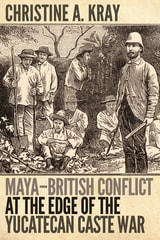
Maya-British Conflict at the Edge of the Yucatecan Caste War
Christine A. Kray
University Press of Colorado, 2023
Official British declarations of neutrality in the Caste War were confounded by a variety of political and economic factors, including competing land claims befuddled by a tangled set of treaties, mahogany extraction by British companies in contested territories, Maya rent demands, British trade in munitions to different groups of Maya combatants, and a labor system reliant on debt servitude. All these factors contributed to uneasy alliances and opportunistic crossings of imagined geopolitical borders in both directions, ultimately leading to a new military conflict in the western and northern regions of the territory claimed by Britain. What frequently began as hyper-local disputes spun out into international affairs as actors called upon more powerful groups for assistance. Evading reductionism, this work traces the decisions and actions of key figures as they maneuvered through the miasma of violence, abuse, deception, fear, flight, and glimpses of freedom.
Positioning the historiographic and ethnographic gaze on the English side without adopting the colonialist narratives and objectives found in English repositories, Maya-British Conflict at the Edge of the Yucatecan Caste War is an important and original contribution to a neglected area of study. It will appeal to students, scholars, and general readers interested in anthropology, Latin American cultures and history, Central American history, British imperialism, Indigenous rights, political anthropology, and colonialism and culture.
Mesoamerican Ritual Economy
Archaeological and Ethnological PerspectivesE. Christian Wells
University Press of Colorado, 2007
Exploring the intersection of spirituality and materiality, Mesoamerican Ritual Economy will be of interest to all scholars studying how worldview and belief motivate economic behavior. The authors consider a diverse set of Mesoamerican cultural patterns in order to investigate the ways in which ritual and economic practices influenced each other in the operation of communities, small-scale societies, and state-level polities. Contributors include: Sarah B. Barber, Frances F. Berdan, Karla L. Davis-Salazar, Barbara W. Fash, William L. Fash, Antonia E. Foias, Arthur A. Joyce, Brigitte Kovacevich, Ben A. Nelson, Enrique Rodríguez-Alegría, Katherine A. Spielmann, John M. Watanabe, E. Christian Wells.
Mountain River
Vietnamese Poetry from the Wars, 1948-1993Kevin Bowen
University of Massachusetts Press, 1998
This landmark bilingual collection presents a comprehensive selection of Vietnamese poetry spanning nearly fifty years of warfare and its aftermath, from the Indochinese War (1946-1954) through the Vietnam War (1961-1975) and into the post-war period. Edited and translated by renowned Vietnam War scholars and poets Kevin Bowen and Bruce Weigl, in collaboration with Vietnamese poet and editor Nguyen Ba Chung, this volume captures the voices of Vietnamese writers who experienced, witnessed, or processed the transformative conflicts that shaped modern Vietnam.
Encompassing poetry from multiple generations, these poems reflect on the diverse responses to conflict: some express patriotic commitment, others grapple with loss and trauma, while many explore the intimate human experiences of war. Mountain River demonstrates how Vietnamese poets drew upon a rich literary tradition while creating new forms of expression to address the unprecedented scale of modern warfare. The result is a collaborative effort that represents a significant achievement in postwar Vietnamese-American literary relations and cross-cultural translation.