Results by title
644 books match the query 'Wars & Conflicts' and 26 start with m

MacArthur's Japanese Constitution
Kyoko Inoue
University of Chicago Press, 1991
"This is an important book. . . . This is the most significant work on postwar Japanese constitutional history to appear in the West. It is highly instructive about the century-long process of cultural conflict in the evolution of government and society in modern Japan."—Thomas W. Burkman, Monumenta Nipponica
Maharajah of Bikaner
IndiaHugh Purcell
Haus Publishing, 2010
Making Endless War
The Vietnam and Arab-Israeli Conflicts in the History of International LawBrian Cuddy and Victor Kattan, Editors
University of Michigan Press, 2023
Making Endless War is built on the premise that any attempt to understand how the content and function of the laws of war changed in the second half of the twentieth century should consider two major armed conflicts, fought on opposite edges of Asia, and the legal pathways that link them together across time and space. The Vietnam and Arab-Israeli conflicts have been particularly significant in the shaping and attempted remaking of international law from 1945 right through to the present day. This carefully curated collection of essays by lawyers, historians, philosophers, sociologists, and political geographers of war explores the significance of these two conflicts, including their impact on the politics and culture of the world’s most powerful nation, the United States of America. The volume foregrounds attempts to develop legal rationales for the continued waging of war after 1945 by moving beyond explaining the end of war as a legal institution, and toward understanding the attempted institutionalization of endless war.

Making Jet Engines in World War II
Britain, Germany, and the United StatesHermione Giffard
University of Chicago Press, 2016
Giffard compares the approaches of Britain, Germany, and the United States. Each approached jet engines in different ways because of its own war aims and industrial expertise. Germany, which produced more jet engines than the others, did so largely as replacements for more expensive piston engines. Britain, on the other hand, produced relatively few engines—but, by shifting emphasis to design rather than production, found itself at war's end holding an unrivaled range of designs. The US emphasis on development, meanwhile, built an institutional basis for postwar production. Taken together, Giffard's work makes a powerful case for a more nuanced understanding of technological innovation, one that takes into account the influence of the many organizational factors that play a part in the journey from idea to finished product.
Making Maine
Statehood and the War of 1812Joshua M. Smith
University of Massachusetts Press, 2022
Honorable mention for U.S. Maritime History, John Lyman Book Awards
After the Revolutionary War ended, the new American nation grappled with a question about its identity: Were the states sovereign entities or subordinates to a powerful federal government? The War of 1812 brought this vexing issue into sharp relief, as a national government intent on waging an unpopular war confronted a populace in Massachusetts that was vigorously opposed to it. Maine, which at the time was part of Massachusetts, served as the battleground in this political struggle.
Joshua M. Smith recounts an innovative history of the war, focusing on how it specifically affected what was then called the District of Maine. Drawing on archival materials from the United States, Britain, and Canada, Smith exposes the bitter experience of Maine’s citizens during that conflict as they endured multiple hardships, including starvation, burdensome taxation, smuggling, treason, and enemy occupation. War’s inherent miseries, along with a changing relationship between regional and national identities, gave rise to a statehood movement that rejected a Boston-centric worldview in favor of a broadly American identity.
Making War in Côte d'Ivoire
Mike McGovern
University of Chicago Press, 2011
After a brief period of active combat in 2002, the conflict in Côte d’Ivoire settled into a pattern of neither war nor peace until the 2010 elections led to a new phase of direct conflict. During these taut years, short bursts of intense violence alternated with long periods of standoff. When things were peaceful, the Ivorian political elite and the press produced inflammatory rhetoric while soldiers and militias used the state of emergency as an excuse to shake down civilians at roadblocks. What kept this perpetually tense, dismal, and destructive situation simmering? In this groundbreaking book, Mike McGovern suggests the answer lies in understanding war as a process, not a series of events, and that rather than focusing on the role of political institutions, we should be paying attention to the flawed and unpredictable people within them.
McGovern argues that only deep knowledge of a region—its history, languages, literature, and popular culture—can yield meaningful insights into political decision making. Putting this theory into action, he examines an array of issues from the micro to the macro, including land tenure disputes, youth boredom, organized crime, and the international cocoa trade. Drawn from McGovern’s academic research and experience working for a conflict resolution think tank and the political access that position gave him, Making War in Côte D’Ivoire will be the definitive work on the Ivorian conflict and an innovative example of how anthropology can address the complexities of politics.
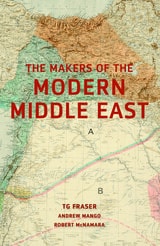
Making the Modern Middle East
Second EditionT.G. Fraser, Andrew Mango, and Robert McNamara
Gingko, 2015
This fully revised and updated second edition of The Makers of the Modern Middle East traces those changes and the ensuing history of the region through the rest of the twentieth century and on to the present. Focusing in particular on three leaders—Emir Feisal, Mustafa Kemal, and Chaim Weizmann—the book offers a clear, authoritative account of the region seen from a transnational perspective, one that enables readers to understand its complex history and the way it affects present-day events.

Making the World Safe for Capitalism
How Iraq Threatened the US Economic Empire and had to be DestroyedChristopher Doran
Pluto Press, 2012
The Iraq war defined the first decade of the twenty-first century – leading to mass protests and raising profound questions about domestic politics and the use of military force. Yet most explanations of the war have a narrow focus either on political personalities or oil.
Christopher Doran provides a unique perspective, arguing that the drive to war came from the threat Iraq might pose to American economic hegemony if the UN sanctions regime was ended. Doran argues that this hegemony is rooted in third world debt and corporate market access. It was protection of these arrangements that motivated US action, not Iraq’s alleged weapons of mass destruction or a simplistic desire to seize its oil.
This book will provide new insights on the war which still casts a shadow over global politics, and will have wide appeal to all those concerned about the Middle East, world peace and global development.
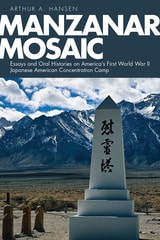
Manzanar Mosaic
Essays and Oral Histories on America's First World War II Japanese American Concentration CampArthur A. Hansen
University Press of Colorado, 2023
To begin, Hansen presents two essays, the first centering on his work with Ronald Larson in the mid-1970s on the history of Doho, a Japanese and English dual-language newspaper, and the second an article with David Hacker on revisionist ethnic perspectives of the Manzanar “riot.” A second section is composed of five oral history interviews of selected camp personalities—a female Nisei journalist, a male Nisei historical documentarian, a male Kibei Communist block manager, the Caucasian wife and comrade of the block manager, and the male Kibei who was the central figure in the Manzanar Riot/Revolt—that offer powerful insight into the controversial content of the two essays that precede them.
Manzanar can be understood only by being considered within the much wider context of Japanese American community formation and contestation before, during, and after World War II. A varied collection of scholarly articles and interviews, Manzanar Mosaic engages diverse voices and considers multiple perspectives to illuminate aspects of the Japanese American community, the ethnic press, the Manzanar concentration camp, and the movement for redress and reparations.
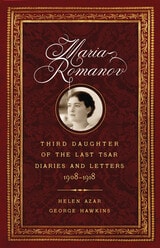
Maria Romanov
Third Daughter of the Last Tsar, Diaries and Letters, 1908–1918Helen Azar
Westholme Publishing, 2019
In the twilight of the nineteenth century, a third daughter was born to Tsar Nicholas II and his wife Alexandra. Grand Duchess Maria Nikolaevna—known to her family and friends simply as “Mashka”—grew into an empathetic, down-to-earth girl, unaffected by her imperial status. Often overshadowed by her two older sisters, Olga and Tatiana, and later, her brother Alexei and younger sister Anastasia, Maria ultimately proved to have a uniquely strong and solid personality.
In Maria Romanov: Third Daughter of the Last Tsar, Diaries and Letters, 1908–1918, by translator and researcher Helen Azar with George Hawkins, Mashka’s voice is heard again through her intimate writings, presented for the first time in English. The Grand Duchess was much more than a pretty princess wearing white dresses in hundreds of faded sepia photographs; Maria’s surviving diaries and letters offer a fascinating insight into the private life of a loving family—from festivals and faith, to Rasputin and the coming Revolution; it is clear why this middle child ultimately became a pillar of strength and hope for them all. Maria’s gentle character belied her incredible courage, which emerged in the darkest hours of her brief life. “The incarnation of modesty elevated by suffering,” as Maria was described during the last weeks of her life, she was able to maintain her kindness and optimism, even in the midst of violence and degradation.
On a stuffy summer night in 1918, only a few weeks after her nineteenth birthday, Maria was murdered along with the rest of her family in a cellar of a house chosen for this “special purpose.” Two sets of charred remains, confirmed to be Maria’s and her brother Alexei’s, were not discovered until almost ninety years later, separately from those of the other victims of the massacre. As the authors relate, it is still unknown if these remains will ever be allowed to be laid to rest.
Mariupol 2013-2022
Stories of Mobilization and ResistanceHana Josticova
Central European University Press, 2024
The chapters in this book represent successive phases of one story – that of Mariupol, formerly Ukraine’s tenth largest city, and the second largest in the Donbas region. The author, a young Slovak academic, conducted her ethnographic fieldwork in this coastal town between November 2018 and August 2021. She was one of the last academics to do research in Mariupol before its invasion and eventual occupation by Russia.
During these years, Hana Jošticová was overwhelmed by acts of mobilization and resistance that went in opposite directions: support for a Western direction of Ukraine’s future, and support for the status quo that the victory of the Euromaidan seemed to threaten.
She noted the sequence of events presented in the media and through the lens of individual frames and narratives. Her book is a collection and interpretation of memories and testimonies from both sides: those who actively resisted Russian influence; and those who sparked their own revolution, the ‘Russian Spring.’ Her focus is on self-mobilized individuals who resorted to action outside of established organizational structures spontaneously, autonomously, without resources and guarantees of safety. Her evidence indicates that popular support for the Russian Spring had less to do with Russia than with the social, economic, or cultural characteristics of the Donetsk region.
Years of immersive research convinced the author that individuals are as important as masses, ideas are as powerful as material resources, and beliefs and emotions are as critical as weapons.
Martin Monath
A Jewish Resistance Fighter Amongst Nazi SoldiersNathaniel Flakin
Pluto Press, 2019

Masters of Their Own Destiny
Asians in the First World WarEdited by Claire Thi Liên Tran
National University of Singapore Press, 2026
An intervention in World War I historiography that foregrounds personal accounts of the conflict from its non-European participants and witnesses.
Accounts of World War I tend to focus on Europe, the epicenter of this conflict, and find in its battlefields the later death of empires, spreading revolution, and eventual decolonization. However, the war was also global, drawing in people from all over the world while rapidly circulating ideas and innovations far beyond Europe.
Almost two million non-Europeans participated in the war as soldiers, workers, and professionals, including Asians in particular. They could be found in the battlefields of France, behind the lines in munitions factories and military hospitals, in the frozen construction sites of the Murmansk Railway, and in Mesopotamia’s burning deserts. The voices of these volunteers and conscripts are rarely heard; the war’s narratives are mainly European. And yet, here and there, lone voices pierce the silence.
In a compelling intervention in World War I historiography, Masters of Their Own Destiny offers a history from below, demonstrating how rare personal accounts may illuminate broader historical forces. Alongside the story of Nguyen Xuan Mai, a Vietnamese military doctor whose pursuit of professional recognition ended in disillusionment with colonial promises, this study draws on a wealth of material like Indian soldiers’ letters, Vietnamese workers’ censored correspondence, and records of Chinese laborers who witnessed revolution in Russia. It gives voice to hitherto ignored wartime experiences that later transformed the expectations of millions of colonial subjects and seeded the anticolonial movements that followed.
Mekong Diaries
Viet Cong Drawings and Stories, 1964-1975Sherry Buchanan
University of Chicago Press, 2008
These guerrilla artists—some military officers and some civilians—lived clandestinely with the fighters, moving camp alongside them, going on reconnaissance missions, and carrying their sketchbooks, ink, and watercolors into combat. Trained by professors from the Hanoi Institute of Fine Arts who journeyed down the perilous Ho Chi Minh Trail to ensure a pictorial history of the war, they recorded battles and events from Operation Junction City to Khe Sanh to the Tet Offensive. They also sketched as the spirit moved them, rendering breathtaking landscapes, hut and bunker interiors, activities at base camps, troops on the move, portraits for the families of fallen soldiers, and the unimaginable devastation that the conflict left in its wake.
Their collective record—which Sherry Buchanan skillfully compiles here—is an extraordinary historical and artistic document of people at war. As such, it serves as a powerful response to the self-centeredness of American accounts of Vietnam, filling a profound gap in our national memory by taking us into the misunderstood worlds of those whom we once counted among our worst enemies.
Memoir of Hungary
1944-1948Sándor Márai
Central European University Press, 1996
This scathing, at times humorous, and always insightful memoir by exiled Hungarian novelist Sándor Márai, provides one of the most poignant and human portraits of life in Hungary between the German occupation in 1944 and the solidification of communist power in 1948. Both a fervent anti-fascist and anti-communist, Márai draws a vivid portrait of the Hungarian peasantry and middle-class during this period, while delivering a telling indictment of the communist system from which he fled. Witty, aphoristic and psychologically clear-sighted, this memoir depicts the tragedy and pathos of a crucial period in the post-war history of a nation which has been 'central' to both the communists and the post-communist history of our times.

Men, War and Film
The Calling Blighty Films of World War IISteve Hawley
Intellect Books, 2025
The Calling Blighty series of films produced by the Combined Kinematograph Service around the end of World War II were one-reel films in which soldiers of the “Forgotten Army” gave short spoken messages to the camera as a means of connecting the front line and the home front. Shown in local cinemas, these were the first films in which men spoke openly in their regional accents, and they hold profound meaning for remembrance, documentary representation, and the ecology of film in wartime. Of the four hundred films made on the Far Eastern Front, only sixty-four survive. Until now, however, these films have barely been researched, despite being a valuable source of social history. This book expands the history of Calling Blighty, placing it in a broader context for contemporary audiences.
Meuse-Argonne Diary
A Division Commander in World War IWilliam M. Wright & Edited & Intro by Robert H. Ferrell
University of Missouri Press, 2004
September 13, 1918
Got no sleep at all last night.
About two o'clock in the morning Col. Heintzelman, chief of staff of the corps, came out and he was much pleased with what the division had accomplished and with the way they had gone through. It was the division's first battle and it played a very important and creditable part. Certain things fell down. . . . The truth of the matter is the troops got away from the wire and it was impossible to keep the wire up through the tangle of barbed wire and woods. We captured 3,000 prisoners on our front alone and have lost 521.
November 1, 1918 Considerable heavy artillery fire all night. The preparation fire went down promptly at 3:30, it was very heavy. . . . The barrage went down promptly at 5:30. Troops jumped off. At 7:30 thirty prisoners reported from Le Dhuy Fme., taken by the 353rd and 354th infantries. I don't understand what the 353rd Infantry is doing in there, as it is out of the sector. At 7:00 a.m. there was a distinct lull in the artillery fire. . . . I told Hanson at 8:05 to move his troops forward to parallel 86 immediately. He stated that he would get them going about 8:30, but actually did not get them started until about eleven o'clock. I sent for him on arrival and told him to hurry his men up. Before Lee left I had ordered the divisional reserve to move forward with its advance element on the first objective to maintain their echelonment in depth. Smyser came in at one o'clock and I ordered the divisional machine guns to the front to take position about one-half kilometer east of Dhuy Fme. At the time the reserves were ordered forward. I ordered Hanson to take his P.C. to Dhuy Fme. . . . Hanson has just arrived. I do not understand why he is always so slow. He seems to be inordinately stupid.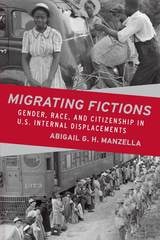
Migrating Fictions
Gender, Race, and Citizenship in U.S. Internal DisplacementsAbigail G. H. Manzella
The Ohio State University Press, 2018
Winner, 2021 CCCC Outstanding Book Award
Migrating Fictions analyzes the role of race, gender, and citizenship in the major internal displacements of the 20th century in history and in narrative. Surveying the particular tactics employed by the United States during the Great Migration, the Dust Bowl, the Japanese American incarceration, and the migrant labor of the Southwest, Abigail G. H. Manzella reveals how the country’s past is imbued with governmentally (en)forced movements that diminished access to full citizenship rights for the laboring class, people of color, and women.
This work is the first book-length study to examine all of these movements together along with their literature, including Zora Neale Hurston’s Their Eyes Were Watching God, Sanora Babb’s Whose Names Are Unknown, Julie Otsuka’s When the Emperor Was Divine, Helena María Viramontes’s Under the Feet of Jesus, and Jesmyn Ward’s Salvage the Bones. Manzella shows how the United States’ history of spatial colonization within its own borders extends beyond isolated incidents into a pattern based on ideology about nation-building, citizenship, and labor. This book seeks to theorize a Thirdspace, an alternate location for social justice that acknowledges the precarity of the internally displaced person.
Minor Salvage
The Korean War and Korean American Life WritingsStephen Hong Sohn
University of Michigan Press, 2022
Mobilizing Minerva
American Women in the First World WarKimberly Jensen
University of Illinois Press, 2007
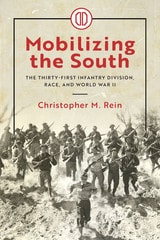
Mobilizing the South
The Thirty-First Infantry Division, Race, and World War IIChristopher M. Rein
University of Alabama Press, 2022
A richly researched account of the social, racial, and political history of a major Deep South infantry division at home and in the Pacific
Chris Rein’s study of the Thirty-First Infantry Division, known officially as the “Dixie Division,” illuminates the complexities in mobilizing American reserve units to meet the global emergency during World War II. Citizen soldiers from Alabama, Florida, Louisiana, and Mississippi formed the core of one of the ninety infantry divisions the Army successfully activated, trained, equipped, and deployed to defeat fascism in Europe and race-based imperialism in the Pacific. But the Army mobilized ideas along with manpower, and soldiers from across the Jim Crow South brought their racial ideas and views with them into the ranks and then exported these across the South Pacific. If the American victory in World War II represents a “double victory” over racism abroad and at home, the division’s service is a cogent reminder that the same powerful force could pull in opposite directions.
While focused on the division’s operational service during the war years, Mobilizing the South: The Thirty-First Infantry Division, Race, and World War II spans the division’s entire service from 1917 to 1967, from an interwar period highlighted by responses to natural disasters and facing down lynch mobs through a postwar service that included protecting activists in the most important struggles of the civil rights era. But the division’s extended service as a training establishment highlights lingering resentments and tensions within the American military system between the active and reserve components. Despite this, the division performed well in General Douglas MacArthur’s island-hopping campaign across the South Pacific. Using official records as well as details drawn from correspondence and oral histories, Rein captures how individual soldiers framed their exposure to a larger world, and how service alongside African American, New Guinean, and Filipino units both reinforced and modified views on race and postwar American society.
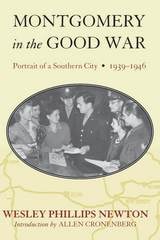
Montgomery in the Good War
Portrait of a Southern City, 1939-1946Wesley Phillips Newton
University of Alabama Press, 2000
One city. One war. A story of transformation at home and abroad.
Using newspaper accounts, interviews, letters, journals, and his own memory of the time, Wesley Newton reconstructs wartime-era Montgomery, Alabama--a sleepy southern capital that was transformed irreversibly during World War II.
The war affected every segment of Montgomery society: black and white, rich and poor, male and female, those who fought in Europe and the Pacific and those who stayed on the home front. Newton follows Montgomerians chronologically through the war from Pearl Harbor to Hiroshima as they experience patriotism, draft and enlistment, rationing, scarcity drives, and the deaths of loved ones. His use of small vignettes based on personal recollections adds drama and poignancy to the story.
Montgomery in the Good War is an important reminder that wars are waged at home as well as abroad and that their impact reverberates well beyond those who fight on the front lines. Those who came of age during the war will recognize themselves in this moving volume. It will also be enlightening to those who have lived in times of relative peace.
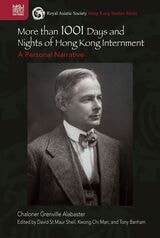
More than 1001 Days and Nights of Hong Kong Internment
A Personal NarrativeChaloner Grenville Alabaster
Hong Kong University Press, 2022
More Than 1001 Days and Nights of Hong Kong Internment is the wartime journal of Sir Chaloner Grenville Alabaster, former attorney-general of Hong Kong and one of the three highest-ranking British officials during the Japanese occupation. He was imprisoned by the Japanese at the Stanley Internment Camp from 1941 to 1945. During his internment, he kept a diary of his life in the camp in small notebooks, hiding them until his release in 1945. He wrote his wartime journal on the basis of these notes. The journal records his day-to-day experiences of the fall of Hong Kong, his time at Stanley, and his eventual release. The book is an important primary source for understanding the daily operation of the Stanley Internment Camp and the period immediately after the fall of Hong Kong.
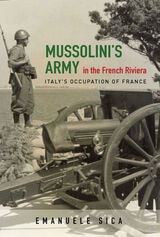
Mussolini's Army in the French Riviera
Italy's Occupation of FranceEmanuele Sica
University of Illinois Press, 2016
Employing a multi-tiered approach, Emanuele Sica examines the simultaneously conflicting and symbiotic relationship between the French population and Italian soldiers. At the grassroots level, Sica asserts that the cultural proximity between the soldiers and the local population, one-quarter of which was Italian, smoothed the sharp angles of miscommunication and cultural faux-pas at a time of great uncertainty. At the same time, it encouraged a laxness in discipline that manifested as fraternization and black marketeering. Sica's examination of political tensions highlights how French prefects and mayors fought to keep the tatters of sovereignty in the face of military occupation. In addition, he reveals the tense relationship between Fascist civilian authorities eager to fulfil imperial dreams of annexation and army leaders desperate to prevent any action that might provoke French insurrection. Finally, he completes the tableau with detailed accounts of how food shortages and French Resistance attacks brought sterner Italian methods, why the Fascists' attempted "Italianization" of the French border city of Menton failed, and the ways the occupation zone became an unlikely haven for Jews.
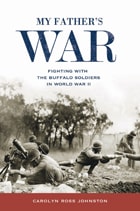
My Father's War
Fighting with the Buffalo Soldiers in World War IICarolyn Ross Johnston
University of Alabama Press, 2012
A compelling story of a unit of Buffalo Soldiers and their white commander fighting on the Italian front during World War II.
The 92nd Division of the Fifth Army was the only African American infantry division to see combat in Europe during 1944 and 1945, suffering more than 3,200 casualties. Members of this unit, known as Buffalo Soldiers, endured racial violence on the home front and experienced racism abroad. Engaged in combat for nine months, they were under the command of southern white infantry officers like their captain, Eugene E. Johnston.
Carolyn Ross Johnston draws on her father’s account of the war and her extensive interviews with other veterans of the 92nd Division to describe the experiences of a naïve southern white officer and his segregated unit on an intimate level. During the war, the protocol that required the assignment of southern white officers to command black units, both in Europe and in the Pacific theater, was often problematic, but Johnston seemed more successful than most, earning the trust and respect of his men at the same time that he learned to trust and respect them. Gene Johnston and the African American soldiers were transformed by the war and upon their return helped transform the nation.
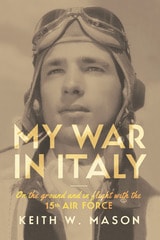
My War in Italy
On the Ground and in Flight with the 15th Air ForceKeith W. Mason
University of Missouri Press, 2027
Six weeks before Pearl Harbor, Keith Mason received a $150 uniform allowance, a pair of silver wings, and his first assignment as a flight instructor: Randolph Field, Texas. Two years later, he was Squadron Officer in the 460th Bomb Group, 15th Air Force in Spinazzola, Italy - flying the harrowing combat missions he dreamed of as a boy in rural Iowa.
As a memoir of one man’s war years, Mason provides insight on the inner workings of serving as an airman during World War II: facing stultifying boredom, stupefying incompetence, paralyzing fear, and stunning success. Details of how crews were selected for combat missions, of the necessity to occasionally break up crews, and of select missions in which Mason was a participant are important additions to the history and literature of this often neglected theater.