Results by title
2285 books match the query 'Women' and 107 start with m
MAKING STORIES, MAKING SELVES
FEMINIST REFLECTIONS ON THE HOLOCAUSTR. Ruth Linden
The Ohio State University Press, 1995
Urged forward by these silences, Linden, a feminist and sociologist, began to interview Jewish Holocaust survivors in 1983. As Linden interprets survivors' accounts of the death camps and the resistance, she reveals complex ways in which selves are constructed through storytelling. The stories that unfold are continuously fashioned and refashioned—never stripped of context or frozen in time. What emerges is an unexpectedly elegant montage in which interviewee, interviewer, and author are intertwined.
Linden's meetings with survivors and her encounters with their stories transformed her as a feminist, a Jew, and a social scientist. Her analysis reveals the intimate connections between an ethnographer's lived experience and her interpretations of others'. Linden's reflections on the process of ethnography belie the rhetoric of positivism in the social sciences. They will inspire other scholars to break free of research and writing practices in their own disciplines that efface the ineluctable bond between knower and known. All readers will be challenged to reexamine the Holocaust in an intensely personal light and to reconsider the meanings of survival in our own time.
Cutting across the boundaries of ethnography and autobiography to create a new kind of text, Making Stories, Making Selves offers a significant contribution to interpretive social science and the literature of the Holocaust. Linden's original and courageous work is vital reading for Holocaust scholars, students of modern Jewish life, sociologists, feminist theorists, and all readers seeking to understand their own relationship to the Holocaust.

MOTHERS MOTHERHOOD
READINGS IN AMERICAN HISTORYEdited by Rima D. Apple and Janet Golden
The Ohio State University Press, 1997
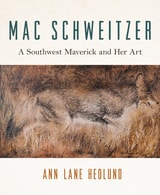
Mac Schweitzer
A Southwest Maverick and Her ArtAnn Lane Hedlund
University of Arizona Press, 2025
Southwest Books of the Year Top Pick
In Tucson during the 1950s, nearly everyone knew, or wanted to know, the southwestern artist Mac Schweitzer. Born Mary Alice Cox in Cleveland, Ohio, in 1921, she grew up a tomboy who adored horses, cowboys, and art. After training at the Cleveland School of Art and marrying, she adopted her maiden initials (M. A. C.) as her artistic name and settled in Tucson in 1946. With a circle of influential friends that included anthropologists, designer-craftsmen, and Native American artists, she joined Tucson’s “Early Moderns,” receiving exhibits, commissions, and awards for her artwork. When she died in 1962, Mac’s artistic legacy faded from public view, but her prize-winning works attest to a thriving career.
Author Ann Lane Hedlund draws from the artist’s letters, photo albums, and published reviews to tell the story of Mac’s creative and adventuresome life. Her watercolors, oil paintings, prints, and sculptures—a diverse body of work never before seen in public—range from naturalistic studies of Sonoran Desert animals to impressionistic landscapes to moody abstractions. A sharp observer of Indigenous life, she sketched and painted scenes of Navajo (Diné), Hopi, O’odham, and Yaqui people and events. These unique portrayals of the Southwest illustrate this saga of a maverick artist rediscovered.
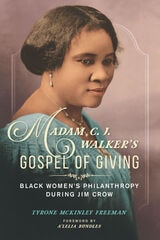
Madam C. J. Walker's Gospel of Giving
Black Women's Philanthropy during Jim CrowTyrone McKinley Freeman
University of Illinois Press, 2020
- AFP/Skystone Partners Prize for Research on Fundraising and Philanthropy, Association of Fundraising Professionals, 2021
- Terry McAdam Book Award, given by the Alliance for Nonprofit Management
- 2023 Peter Dobkin Hall History of Philanthropy Prize from the Association for Research on Nonprofit and Voluntary Action (ARNOVA).
Founder of a beauty empire, Madam C. J. Walker was celebrated as America's first self-made female millionaire in the early 1900s. Known as a leading African American entrepreneur, Walker was also devoted to an activist philanthropy aimed at empowering African Americans and challenging the injustices inflicted by Jim Crow.
Tyrone McKinley Freeman's biography highlights how giving shaped Walker's life before and after she became wealthy. Poor and widowed when she arrived in St. Louis in her twenties, Walker found mentorship among black churchgoers and working black women. Her adoption of faith, racial uplift, education, and self-help soon informed her dedication to assisting black women's entrepreneurship, financial independence, and activism. Walker embedded her philanthropy in how she grew her business, forged alliances with groups like the National Association of Colored Women, funded schools and social service agencies led by African American women, and enlisted her company's sales agents in local charity and advocacy work.
Illuminating and dramatic, Madam C. J. Walker’s Gospel of Giving broadens our understanding of black women’s charitable giving and establishes Walker as a foremother of African American philanthropy.
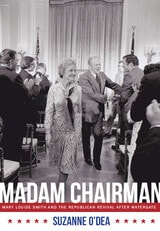
Madam Chairman
Mary Louise Smith and the Republican Revival after WatergateSuzanne O'Dea
University of Missouri Press, 2012
Made in China
Women Factory Workers in a Global WorkplacePun Ngai
Duke University Press, 2005
Pun Ngai conducted ethnographic work at an electronics factory in southern China’s Guangdong province, in the Shenzhen special economic zone where foreign-owned factories are proliferating. For eight months she slept in the employee dormitories and worked on the shop floor alongside the women whose lives she chronicles. Pun illuminates the workers’ perspectives and experiences, describing the lure of consumer desire and especially the minutiae of factory life. She looks at acts of resistance and transgression in the workplace, positing that the chronic pains—such as backaches and headaches—that many of the women experience are as indicative of resistance to oppressive working conditions as they are of defeat. Pun suggests that a silent social revolution is underway in China and that these young migrant workers are its agents.
Major Women Writers of Seventeenth-Century England
James Fitzmaurice, Josephine A. Roberts, Carol L. Barash, Eugene R. Cunnar, and Nancy A. Gutierrez, Editors
University of Michigan Press, 1997
Making Choices, Making Do
Survival Strategies of Black and White Working-Class Women during the Great DepressionLois Rita Helmbold
Rutgers University Press, 2023
Making Modern Girls
A History of Girlhood, Labor, and Social Development in Colonial LagosAbosede A. George
Ohio University Press, 2014
Winner of the 2015 Aidoo-Snyder Book Prize for outstanding book on African women's experiences. (African Studies Association)
Honorable Mention, New York African Studies Association Book Prize
In Making Modern Girls, Abosede A. George examines the influence of African social reformers and the developmentalist colonial state on the practice and ideology of girlhood as well as its intersection with child labor in Lagos, Nigeria. It draws from gender studies, generational studies, labor history, and urban history to shed new light on the complex workings of African cities from the turn of the twentieth century through the nationalist era of the 1950s.
The two major schemes at the center of this study were the modernization project of elite Lagosian women and the salvationist project of British social workers. By approaching children and youth, specifically girl hawkers, as social actors and examining the ways in which local and colonial reformers worked upon young people, the book offers a critical new perspective on the uses of African children for the production and legitimization of national and international social development initiatives.
Making Modern Girls demonstrates how oral sources can be used to uncover the social history of informal or undocumented urban workers and to track transformations in practices of childhood over the course of decades. George revises conventional accounts of the history of development work in Africa by drawing close attention to the social welfare initiatives of late colonialism and by highlighting the roles that African women reformers played in promoting sociocultural changes within their own societies.
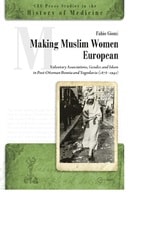
Making Muslim Women European
Voluntary Associations, Gender, and Islam in Post-Ottoman Bosnia and Yugoslavia (1878-1941)Fabio Giomi
Central European University Press, 2021
This social, cultural, and political history of Slavic Muslim women of the Yugoslav region in the first decades of the post-Ottoman era is the first to provide a comprehensive overview of the issues confronting these women. It is based on a study of voluntary associations (philanthropic, cultural, Islamic-traditionalist, and feminist) of the period.
It is broadly held that Muslim women were silent and relegated to a purely private space until 1945, when the communist state “unveiled” and “liberated” them from the top down. After systematic archival research in Bosnia, Croatia, Serbia, and Austria, Fabio Giomi challenges this view by showing: • How different sectors of the Yugoslav elite through association publications, imagined the role of Muslim women in post-Ottoman times, and how Muslim women took part in the construction or the contestation of these narratives. • How associations employed different means in order to forge a generation of “New Muslim Women” able to cope with the post-Ottoman political and social circumstances. • And how Muslim women used the tools provided by the associations in order to pursue their own projects, aims and agendas. The insights are relevant for today’s challenges facing Muslim women in Europe. The text is illustrated with exceptional photographs.T
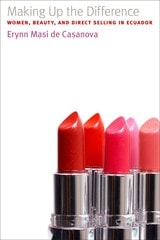
Making Up the Difference
Women, Beauty, and Direct Selling in EcuadorBy Erynn Masi de Casanova
University of Texas Press, 2011
Globalization and economic restructuring have decimated formal jobs in developing countries, pushing many women into informal employment such as direct selling of cosmetics, perfume, and other personal care products as a way to "make up the difference" between household income and expenses. In Ecuador, with its persistent economic crisis and few opportunities for financially and personally rewarding work, women increasingly choose direct selling as a way to earn income by activating their social networks. While few women earn the cars and trips that are iconic prizes in the direct selling organization, many use direct selling as part of a set of household survival strategies.
In this first in-depth study of a cosmetics direct selling organization in Latin America, Erynn Masi de Casanova explores women's identities as workers, including their juggling of paid work and domestic responsibilities, their ideas about professional appearance, and their strategies for collecting money from customers. Focusing on women who work for the country's leading direct selling organization, she offers fascinating portraits of the everyday lives of women selling personal care products in Ecuador's largest city, Guayaquil. Addressing gender relations (including a look at men's direct and indirect involvement), the importance of image, and the social and economic context of direct selling, Casanova challenges assumptions that this kind of flexible employment resolves women's work/home conflicts and offers an important new perspective on women's work in developing countries.
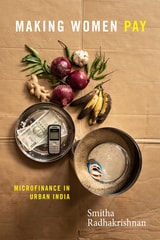
Making Women Pay
Microfinance in Urban IndiaSmitha Radhakrishnan
Duke University Press, 2022
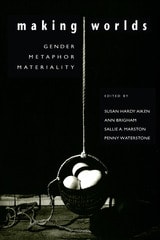
Making Worlds
Gender, Metaphor, MaterialityEdited by Susan Hardy Aiken, Ann Brigham, Sallie A. Marston, and Penny Waterstone
University of Arizona Press, 1997
In recent years these questions have occasioned intensifying debates, but they have seldom extended beyond the boundaries of individual academic disciplines or crossed the divide that has traditionally separated the academy from the "outside" world. Making Worlds both questions and traverses those divisions by combining personal essays, activist political rhetoric, oral history, poetry, iconography, and performance art with interdisciplinary academic discourses.
Representing a wide range of perspectives, Making Worlds develops a provocative conversation about gender and spatiality in the interwoven symbolic and material environments we create. The contributors engage such issues as the body as site of symbolic action, fabrication, and desire; the place and play of sexualities; the cultural implications of everyday life—home, travel, work, childbirth, food, disease, and death; technology and mass media; surveillance, confinement, and the law; the dynamics of race and ethnicity; imperialism, oppression, and resistance; the politics of urban spaces; landscape and cultural memory; the experience of time; and the nature of "Nature." For students and scholars in cultural studies, geography, literary criticism, anthropology, history, and women's studies, it offers new ways of thinking about space, place, and the spatial contexts of social thought and action.
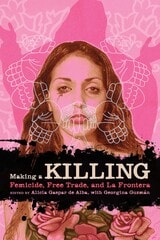
Making a Killing
Femicide, Free Trade, and La FronteraEdited by Alicia Gaspar de Alba, with Georgina Guzmán
University of Texas Press, 2010
Since 1993, more than five hundred women and girls have been murdered in Ciudad Juárez across the border from El Paso, Texas. At least a third have been sexually violated and mutilated as well. Thousands more have been reported missing and remain unaccounted for. The crimes have been poorly investigated and have gone unpunished and unresolved by Mexican authorities, thus creating an epidemic of misogynist violence on an increasingly globalized U.S.-Mexico border.
This book, the first anthology to focus exclusively on the Juárez femicides, as the crimes have come to be known, compiles several different scholarly "interventions" from diverse perspectives, including feminism, Marxism, critical race theory, semiotics, and textual analysis. Editor Alicia Gaspar de Alba shapes a multidisciplinary analytical framework for considering the interconnections between gender, violence, and the U.S.-Mexico border. The essays examine the social and cultural conditions that have led to the heinous victimization of women on the border—from globalization, free trade agreements, exploitative maquiladora working conditions, and border politics, to the sexist attitudes that pervade the social discourse about the victims. The book also explores the evolving social movement that has been created by NGOs, mothers' organizing efforts, and other grassroots forms of activism related to the crimes. Contributors include U.S. and Mexican scholars and activists, as well as personal testimonies of two mothers of femicide victims.
Malawi's Sisters
Melanie S. Hatter
Four Way Books, 2019
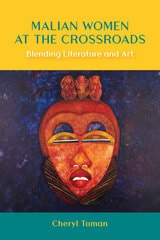
Malian Women at the Crossroads
Blending Literature and ArtCheryl Toman
Michigan State University Press, 2027
Mali’s history is defined by crossroads—geographic, cultural, and intellectual—linking to the Sahara and to long-standing trade routes. Francophone Malian women’s writing reflects this convergence, positioning literature as a site where diverse artistic and cultural traditions meet and evolve. In Malian Women at the Crossroads: Blending Literature and Art, writers such as Aoua Kéita, Aïcha Fofana, Adame Ba Konaré, Fatoumata Sidibé, Zakiyatou oualett Halatine, and Fadimata walett Oumar blur the boundaries between text and artistic practice, incorporating storytelling, visual arts, music, textile design, and other creative forms into their work. These interdisciplinary expressions both honor and reinterpret tradition, illuminating Mali’s cultural diversity while challenging divisions rooted in gender and ethnicity.
The voices of these writers denounce the conflict that has plagued Mali for over a decade and opt instead for showcasing creativity that preserves the memory of more promising times.
Man-Made Medicine
Women’s Health, Public Policy, and ReformKary L. Moss, ed.
Duke University Press, 1996
These essays by physicians, lawyers, activists, and scholars present a rare interdisciplinary approach to a complex set of issues. Gender stereotyping and bias in the collection, analysis, and reporting of scientific data and in the ways health-related news is covered by the media are examined. The exclusion of women from the health care policy-making process and the effect such exclusion has on the determination of priorities among potential areas of research are also explored. With discussions of the plight of specific populations of women whose health care needs are not being sufficiently met—for example, immigrants, prisoners, the mentally ill, or women with HIV/AIDS, disabilities, or reproductive health problems—this book considers matters of race and class within the parameters of gender as it builds a fundamental challenge to the existing health care system. A range of current reform proposals are also evaluated in terms of their potential impact on women.
Suggesting no less than a radical rethinking of women’s medicine, Man-Made Medicine gives essential direction to the discussions that will shape the future of health care in this country. It will be of great interest to a wide audience, including health care advocates, policymakers, scholars, and readers generally concerned with women’s health issues.
Contributors. Ellen Barry, Laurie Beck, Joan Bertin, Janet Calvo, Wendy Chavkin, Kay Dickersin, Abigail English, Elizabeth Fee, Carol Gill, Nancy Krieger, Joyce McConnell, Judy Norsigian, Ann Scales, Susan Stefan, Lauren Schnaper, Catherine Teare
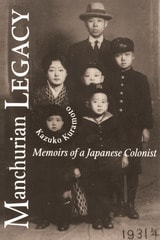
Manchurian Legacy
Memoirs of a Japanese ColonistKazuko Kuramoto
Michigan State University Press, 1999
Kazuko Kuramoto was born and raised in Dairen, Manchuria, in 1927, at the peak of Japanese expansionism in Asia. Dairen and the neighboring Port Arthur were important colonial outposts on the Liaotung Peninsula; the train lines established by Russia and taken over by the Japanese, ended there. When Kuramoto's grandfather arrived in Dairen as a member of the Japanese police force shortly after the end of the Russo-Japanese War in 1905, the family's belief in Japanese supremacy and its "divine" mission to "save" Asia from Western imperialists was firmly in place. As a third-generation colonist, the seventeen-year-old Kuramoto readily joined the Red Cross Nurse Corps in 1944 to aid in the war effort and in her country's sacred cause. A year later, her family listened to the emperor's radio broadcast ". . . we shall have to endure the unendurable, to suffer the insufferable." Japan surrendered unconditionally.
Manchurian Legacy is the story of the family's life in Dairen, their survival as a forgotten people during the battle to reclaim Manchuria waged by Russia, Nationalist China, and Communist China, and their subsequent repatriation to a devastated Japan. Kuramoto describes a culture based on the unthinking oppression of the colonized by the colonizer. And, because Manchuria was, in essence, a Japanese frontier, her family lived a freer and more luxurious life than they would have in Japan—one relatively unscathed by the war until after the surrender.
As a commentator Kuramoto explores her culture both from the inside, subjectively, and from the outside, objectively. Her memoirs describe her coming of age in a colonial society, her family's experiences in war-torn Manchuria, and her "homecoming" to Japan—where she had never been—just as Japan is engaged in its own cultural upheaval.
Marching Together
Women of the Brotherhood of Sleeping Car PortersMelinda Chateauvert
University of Illinois Press, 1998
The Brotherhood of Sleeping Car Porters (BSCP) was the first national trade union for African Americans. Standard BSCP histories focus on the men who built the union. Yet the union's Ladies' Auxiliary played an essential role in shaping public debates over black manhood and unionization, setting political agendas for the black community, and crafting effective strategies to win racial and economic justice.
Melinda Chateauvert explores the history of the Ladies' Auxiliary and the wives, daughters, and sisters of Pullman porters who made up its membership and used the union to claim respectability and citizenship. As she shows, the Auxiliary actively educated other women and children about the labor movement, staged consumer protests, and organized local and national civil rights campaigns ranging from the 1941 March on Washington to school integration to the Montgomery Bus Boycott. Chateauvert also sheds light on the plight of Pullman maids, who—relegated to the Auxiliary—found their problems as working women neglected in favor of the rhetoric of racial solidarity.
Margaret Fuller
Transatlantic Crossings in a Revolutionary AgeEdited by Charles Capper and Cristina Giorcelli
University of Wisconsin Press, 2007
This volume is a collaboration of international scholars who, from varied fields and approaches, assess Fuller’s genius and character. Treating the last several years of Margaret Fuller’s short life, these essays offer a truly international discussion of Fuller’s unique cultural, political, and personal achievements. From the origins and articulations of Fuller’s cosmopolitanism to her examination of “the woman question,” and from her fascination with the European “other” to her candid perception of imperial America from abroad, they ponder what such an extraordinary woman meant to America, and also to Italy and Europe, during her lifetime and continuing to the present.

Margaret Mead and Ruth Benedict
The Kinship of WomenHilary Lapsley
University of Massachusetts Press, 2001
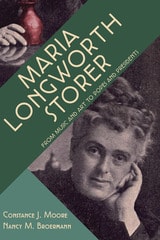
Maria Longworth Storer
From Music and Art to Popes and PresidentsConstance J. Moore; Nancy M. Broermann
Ohio University Press, 2019
Published by the University of Cincinnati Press
While the adage may go, “Behind every great man is a great woman,” the story of Maria Longworth Storer necessitates a new adage—at the front of every great city is a great woman. After being shunted into the biographies and history books of other people, Longworth Storer is now finally given center stage on the one hundred and seventieth anniversary of her birth.
Maria Longworth Storer: From Music and Art to Popes and Presidents is the most comprehensive biography of this one of a kind Cincinnatian. Known as the founder of the first female-run manufacturing company in the United States, Rookwood Pottery, Longworth Storer was passionate about women’s rights, her city, and issues of poverty and the arts. She owned Rookwood pottery for nine years, and then transferred ownership after earning recognition at the Exhibition of American Art Industry in Philadelphia and receiving a gold medal at the Exposition Universelle in Paris. Aside from her success with Rookwood, Longworth Storer was central to making the Queen City the major cultural landmark it is today. Although the rest of her life was no less remarkable as the wife of notorious diplomat Bellamy Storer, later embroiled in the famous Roosevelt-Storer scandal, little has been written about her contributions and exploits in diplomatic relations and her powerful influence on turn-of-the-twentieth-century political leaders.
Featuring new archival research, and never before seen photos of the Storer family, authors Constance J. Moore and Nancy M. Broermann have compiled a portrait of Maria Longworth Storer that is rich in detail, fitting to both the wide, often eclectic, breadth of Longworth Storer’s projects, and to the depth of her impact on leaders from Washington D.C. to Europe.
Moving through major moments in both American and Cincinnati history, and intersecting with significant historical figures including Teddy Roosevelt and William Howard Taft, Moore and Broermann expose the broader historical narrative of Longworth Storer’s life without letting her unique spirit and individual accomplishments become overshadowed by them.
Through thoughtful, balanced narrative, readers get to know a remarkable woman whose fascinating and dramatic life as a political figure, women’s rights advocate, and patron of the arts has had a long lasting legacy on the Queen City and the Shaping of our nation’s diplomatic policies.
Marie Equi
Radical Politics and Outlaw PassionsMichael Helquist
Oregon State University Press, 2015
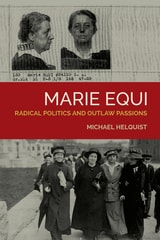
Equi self-studied her way into a San Francisco medical school and then obtained her license in Portland to become one of the first practicing woman physicians in the Pacific Northwest. From Pendleton, Portland, Seattle and beyond to Boston and San Francisco, she leveraged her professional status to fight for woman suffrage, labor rights, and reproductive freedom. She mounted soapboxes, fought with police, and spent a night in jail with birth control advocate Margaret Sanger. Equi marched so often with unemployed men that the media referred to them as her army. She battled for economic justice at every turn and protested the U.S. entry into World War I, leading to a conviction for sedition and a three-year sentence in San Quentin. Breaking boundaries in all facets of life, she became the first well-known lesbian in Oregon, and her same-sex affairs figured prominently in two U.S. Supreme Court cases.
Marie Equi is a finely written, rigorously researched account of a woman of consequence, who one fellow-activist considered “the most interesting woman that ever lived in this state, certainly the most fascinating, colorful, and flamboyant.” This much anticipated biography will engage anyone interested in Pacific Northwest history, women’s studies, the history of lesbian and gay rights, and the personal demands of political activism. It is the inspiring story of a singular woman who was not afraid to take risks, who refused to compromise her principles in the face of enormous opposition and adversity, and who paid a steep personal price for living by her convictions.
Marie Syrkin
Values Beyond the SelfCarole S. Kessner
Brandeis University Press, 2008
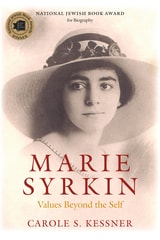
Marie Syrkin’s life spanned ninety years of the twentieth century, 1899–1989. As a polemical journalist, socialist Zionist, poet, educator, literary critic, translator, and idiosyncratic feminist, she was an eyewitness to and reporter on most of the major events in America, Israel, and Europe. Beautiful as well as brilliant, she had a rich personal life as a lover, wife, mother, and friend. During her lifetime Syrkin’s name was widely recognized in the world of Jewish life and letters. Yet, since Syrkin’s death, recognition of her name is no longer quite so immediate. Carole S. Kessner’s biography restores Syrkin’s fascinating life and legacy for a new generation.
Marriage to the Sea
Linked NovellasSarah Stone
Four Way Books, 2026
Marta
A NovelEliza Orzeszkowa
Ohio University Press, 2018
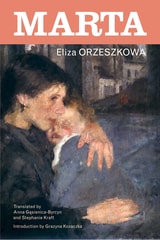
Eliza Orzeszkowa was a trailblazing Polish novelist who, alongside Leo Tolstoy and Henryk Sienkiewicz, was a finalist for the 1905 Nobel Prize in Literature. Of her many works of social realism, Marta (1873) is among the best known, but until now it has not been available in English. Easily a peer of The Awakening and A Doll’s House, the novel was well ahead of the English literature of its time in attacking the ways the labor market failed women.
Suddenly widowed, the previously middle-class Marta Świcka is left penniless and launched into a grim battle for her survival and that of her small daughter. As she applies for job after job in Warsaw—portrayed here as an every-city, an unforgiving commercial landscape that could be any European metropolis of the time—she is told time after time that only men will be hired, that men need jobs because they are fathers and heads of families.
Marta burns with Orzeszkowa’s feminist conviction that sexism was not just an annoyance but a threat to the survival of women and children. It anticipated the need for social safety nets whose existence we take for granted today, and could easily read as an indictment of current efforts to dismantle those very programs. Tightly plotted and exquisitely translated by Anna Gąsienica-Byrcyn and Stephanie Kraft, Marta resonates beyond its Polish setting to find its place in women’s studies, labor history, and among other works of nineteenth-century literature and literature of social change.
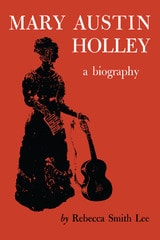
Mary Austin Holley
A BiographyBy Rebecca Smith Lee
University of Texas Press, 1962
Mary Austin Holley found life challenging and made it interesting for others. As wife and widow of Horace Holley, eminent orator, clergyman, and educator, and as cousin and friend of Stephen F. Austin, founder of the first Texas colony, she formed friendships among important people. From New Haven to New Orleans and Brazoria, Texas, she was beloved.
The panorama of her life, described in vivid detail by a former head of the English Department at Texas Christian University, transports the reader to the tempestuous early years of the American Republic and, finally, to Texas during its colonization and early Republic years. Throughout this charming book Mrs. Holley's "intuition for important people" brings the reader into the company of many of America's great and accomplished: Noah Webster, John Quincy Adams, President and Mrs. Monroe, Andrew Jackson, Sam Houston, and many others.
Mary Austin
Song of a MaverickEsther F. Lanigan
University of Arizona Press, 1997
"[Lanigan] provides illuminating sociological background and lucidly marshals the existing biolgraphical data." —Choice
"Mary Hunter Austin was a well-known and respected author and activitst in her lifetime but is little known in ours. In this excellent biography...[Lanigan] chose to focus on a few central relationships in Austin's life, to explore in some depth a few central texts, and to understand the interior life of her subject. She has done a splendid job." —Ann J. Lane in the Journal of American History
Mary Chesnut's Civil War Epic
Julia A. Stern
University of Chicago Press, 2009
A genteel southern intellectual, saloniste, and wife to a prominent colonel in Jefferson Davis’s inner circle, Mary Chesnut today is remembered best for her penetrating Civil War diary. Composed between 1861 and 1865 and revised thoroughly from the late 1870s until Chesnut’s death in 1886, the diary was published first in 1905, again in 1949, and later, to great acclaim, in 1981. This complicated literary history and the questions that attend it—which edition represents the real Chesnut? To what genre does this text belong?—may explain why the document largely has, until now, been overlooked in literary studies.
Julia A. Stern’s critical analysis returns Chesnut to her rightful place among American writers. In Mary Chesnut’s Civil War Epic, Stern argues that the revised diary offers the most trenchant literary account of race and slavery until the work of Faulkner and that, along with his Yoknapatawpha novels, it constitutes one of the two great Civil War epics of the American canon. By restoring Chesnut’s 1880s revision to its complex, multidecade cultural context, Stern argues both for Chesnut’s reinsertion into the pantheon of nineteenth-century American letters and for her centrality to the literary history of women’s writing as it evolved from sentimental to tragic to realist forms.
Mary Lincoln Demystified
Frequently Asked Questions about Abraham’s WifeDonna D. McCreary
Southern Illinois University Press, 2022
Answering the most enigmatic questions about Mary Lincoln’s life
After portraying Mary Lincoln in hundreds of performances and giving lectures over a more than thirty-year career, Donna D. McCreary has fielded every imaginable inquiry about the First Lady. Gathered here, readers will find answers to the most frequently asked questions to come from live audiences. This first question-and-answer book arises directly from a public’s enduring curiosity with one the country’s most important historical figures. Decades of conversations with audiences, scholars, and relatives of the Todd family frame McCreary’s intimate and devoted research to offer a new and unique portrait of the most tragic First Lady.
Though Mary has been portrayed in books and film, McCreary’s book contains information not found elsewhere—details others have overlooked and those that would not fit well into a narrative history—such as lists of Mary’s beaus, servants, and the people the Todd family enslaved; appendixes that present mini-biographies of families and friends; and a uniquely thorough timeline. Mary Lincoln Demystified covers areas in which McCreary’s audiences have expressed the most interest: Mary’s sanity, her family relationships, her views on slavery and African Americans, her personality and habits, and what happened to her possessions and children after she died.
While sympathetic to the woman she portrayed for two decades, McCreary examines both sides of controversial issues and presents the facts with her trademark style and flair. More than a good read, McCreary’s Q&A factbook, based as it is on decades of extensive research in primary and secondary sources, will be the definitive resource for answers about Mary for years to come.
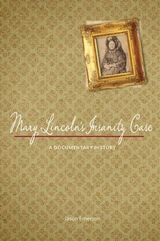
Mary Lincoln's Insanity Case
A Documentary HistoryJason Emerson
University of Illinois Press, 2012
In 1875 Mary Lincoln, the widow of a revered president, was committed to an insane asylum by her son, Robert. The trial that preceded her internment was a subject of keen national interest. The focus of public attention since Abraham Lincoln's election in 1860, Mary Lincoln had attracted plentiful criticism and visible scorn from much of the public, who perceived her as spoiled, a spendthrift, and even too much of a Southern sympathizer. Widespread scrutiny only increased following her husband's assassination in 1865 and her son Tad's death six years later, after which her overwhelming grief led to the increasingly erratic behavior that led to her being committed to a sanitarium. A second trial a year later resulted in her release, but the stigma of insanity stuck. In the years since, questions emerged with new force, as the populace and historians debated whether she had been truly insane and subsequently cured, or if she was the victim of family maneuvering.
In this volume, noted Lincoln scholar Jason Emerson provides a documentary history of Mary Lincoln's mental illness and insanity case, evenhandedly presenting every possible primary source on the subject to enable a clearer view of the facts. Beginning with documents from the immediate aftermath of her husband's assassination and ending with reminiscences by friends and family in the mid-twentieth century, Mary Lincoln's Insanity Case: A Documentary History compiles more than one hundred letters, dozens of newspaper articles, editorials, and legal documents, and the daily patient progress reports from Bellevue Place Sanitarium during Mary Lincoln's incarceration. Including many materials that have never been previously published, Emerson also collects multiple reminiscences, interviews, and diaries of people who knew Mary Lincoln or were involved in the case, including the first-hand recollection of one of the jurors in the 1875 insanity trial.
Suggesting neither accusation nor exoneration of the embattled First Lady, Mary Lincoln's Insanity Case: A Documentary History gives scholars and history enthusiasts incomparable access to the documents and information crucial to understanding this vexing chapter in American history.
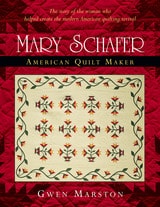
Mary Schafer, American Quilt Maker
Gwen Marston
University of Michigan Press, 2004
Extensively illustrated, with over 100 drawings and 11 unique Mary Schafer patterns, Mary Schafer, American Quilt Maker is a must-have book for anyone passionate about American quilting.
While we take that passion for granted today, author Gwen Marston shows that it wasn't always so; indeed, one woman, Mary Schafer, was largely responsible for the restoration of interest in one of our greatest folk arts -- long before the American bicentennial turned quilting into what seemed like an overnight sensation.
Marston presents Schafer as an unassuming scholar: the anonymous quilter, remaining humble and somewhat retiring. Behind the modest façade, however, Schafer displayed a remarkable devotion to research, historical accuracy, and community through her efforts to make quilting available to as many people as possible.
Nonquilters will find Mary Schafer, American Quilt Maker a welcome addition to their collection of the work of masters of American folk art, while quilting aficionados will appreciate it not only for the story it tells, but for the generous selection of patterns and illustrations it offers.
Gwen Marston is a nationally known quilt maker, teacher, and author. She is the author of over fifteen books on quilting, including Liberated String Quilts, 70 Classic Quilting Patterns, and Amish Quilting Patterns.
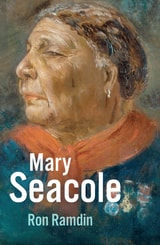
Mary Seacole
Ron Ramdin
Haus Publishing, 2020
Mary Seacole’s remarkable life began in Jamaica, where she was born a free person, the daughter of a black mother and white Scottish army officer. Ron Ramdin—who, like Seacole, was born in the Caribbean and emigrated to the United Kingdom—tells the remarkable story of this woman, celebrated today as a pioneering nurse.
Refused permission to serve as an army nurse, Seacole took the remarkable step of funding her own journey to the Crimean battlefront, and there, in the face of sometimes harsh opposition, she established a hotel for wounded British soldiers. Unlike Florence Nightingale—whose exploits saw her venerated as the “lady with the lamp” for generations afterward—Seacole cared for soldiers perilously close to the fighting. As Ramdin shows in this biography, Seacole’s time in Crimea, for which she is best known, was only the pinnacle of a life of adventure and travel.
Mary Wroth
The Countess of Montgomery's Urania (Abridged)Edited by Mary Ellen Lamb
Arizona Center for Medieval and Renaissance Studies, 2000
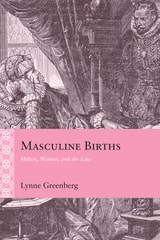
Masculine Births
Milton, Women, and the LawLynne Greenberg
Northwestern University Press, 2026
Examining the legal lives of early modern women through Milton’s literary works
In his History of Britain, John Milton writes, “Laws are Masculin Births . . . nothing [is] more awry from the Law of God and Nature, then that a Woman should give Laws to Men.” In this interdisciplinary study, Lynne Greenberg explores the normative and nonnormative legal lives of early modern women as depicted in Milton’s works—unmarried and married women, mothers, heiresses, widows, and queens—providing cogent overviews of the laws of multiple jurisdictions to offer critical context for each case study. Greenberg explores a wide range of legal-juridical materials and previously unexplored archival and private family documents. As she demonstrates, while Milton’s narratives are at times enmeshed in existing jural paradigms, they also offer resistant responses to marital, custodial, property, inheritance, and criminal laws and even imagine alternative jural paradigms for women. Through Masculine Births: Milton, Women and the Law, Greenberg deftly reveals that Milton both reproduces seventeenth-century legal constructs and gives birth to laws that move us toward greater equality for women.
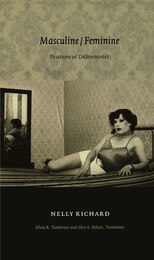
Masculine/Feminine
Practices of Difference(s)Nelly Richard
Duke University Press, 2004
Richard helped to organize the 1987 International Conference on Latin American Women’s Literature in Santiago, one of the most significant literary events to take place under the Pinochet dictatorship. Published in Chile in 1993, Masculine/Feminine develops some of the key issues brought to the fore during that landmark meeting. Richard theorizes why the feminist movement has been crucial not only to the liberation of women but also to understanding the ways in which power operated under the military regime in Chile. In one of her most widely praised essays, she explores the figure of the transvestite, artistic imagery of which exploded during the Chilean dictatorship. She examines the politics and the aesthetics of this phenomenon, particularly against the background of prostitution and shantytown poverty, and she argues that gay culture works to break down the social demarcations and rigid structures of city life. Masculine/Feminine makes available, for the first time in English, one of Latin America’s most significant works of feminist theory.
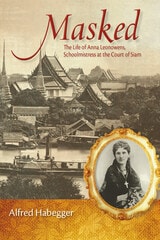
Masked
The Life of Anna Leonowens, Schoolmistress at the Court of SiamAlfred Habegger
University of Wisconsin Press, 2014
But who was Leonowens and why did her story take hold? Although it has been known for some time that she was of Anglo-Indian parentage and that her tales about the Siamese court are unreliable, not until now, with the publication of Masked, has there been a deeply researched account of her extraordinary life. Alfred Habegger, an award-winning biographer, draws on the archives of five continents and recent Thai-language scholarship to disclose the complex person behind the mask and the troubling facts behind the myth. He also ponders the curious fit between Leonowens’s compelling fabrications and the New World’s innocent dreams—in particular the dream that democracy can be spread through quick and easy interventions.
Exploring the full historic complexity of what it once meant to pass as white, Masked pays close attention to Leonowens’s midlevel origins in British India, her education at a Bombay charity school for Eurasian children, her material and social milieu in Australia and Singapore, the stresses she endured in Bangkok as a working widow, the latent melancholy that often afflicted her, the problematic aspects of her self-invention, and the welcome she found in America, where a circle of elite New England abolitionists who knew nothing about Southeast Asia gave her their uncritical support. Her embellished story would again capture America’s imagination as World War II ended and a newly interventionist United States looked toward Asia.
Best Books for General Audiences, selected by the American Association of School Librarians
Best Regional Special Interest Boosk, selected by the Public Library Reviewers
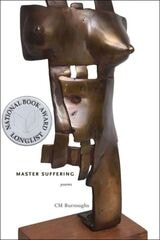
Master Suffering
CM Burroughs
Tupelo Press, 2021
Mayaya Rising
Black Female Icons in Latin American and Caribbean Literature and CultureDawn Duke
Bucknell University Press, 2023
Meaningful Work
StoriesJoAnna Novak
University of Alabama Press, 2021
WINNER OF FC2's RONALD SUKENICK INNOVATIVE FICTION PRIZE
A stunning look at the labor of obsession and the industry of self-destruction
In her lush, lyrical, and unflinching short fiction debut, JoAnna Novak examines the restless throb of desire amid the rote work of jobs and obligations, from the walk-ins of a New York banquet kitchen to the pier of Venice Beach. Fueled by jellyfish pad Thai and Necco wafers, Mountain Dew and Xiaolongbao, the characters in these stories defy boundaries and mores: In “MEMO 19,” a former anorectic, bored of recovery and her clerical job, invites an unparalleled act of sexual defilement and in “Rio Grande, Wisconsin,” a fleshly preteen fantasizes about Bill Murray on a family vacation to Wisconsin. Celebrating the grueling beauty of the shift and the ticking virtues of self-restraint, Meaningful Work is a pageant of formal experimentation, in fearless, glittering prose.
Medea’s Daughters
Forming and Performing the Woman Who KillsJennifer Jones
The Ohio State University Press, 2003
In Medea's Daughters, Jennifer Jones explores the legal, cultural, and dramatic representations of six accused murderesses to look at how English-speaking society responded to and controlled anxiety over female transgressions. The woman who kills—in particular, the woman who kills a member of her own family—has not only broken the law, she has also violated gender expectations. Jones argues that dramatic representations of criminal women, especially women who kill, proliferate during times of heightened feminist activity and that theatrical narratives, as evidenced in plays, television, and film, serve to contain women and deflect attention away from issues of women’s systematic repression.
Medea’s Daughters focuses on six women (of whom Lizzie Borden, Susan Smith, and Louise Woodward are the best known) whose murder trials caught the attention of their respective cultures. This broad spectrum allows an examination of how women’s legal status has evolved over five centuries.
Medieval Misogyny and the Invention of Western Romantic Love
R. Howard Bloch
University of Chicago Press, 1991
Through analyses of a broad range of patristic and medieval texts, Bloch explores the Christian construction of gender in which the flesh is feminized, the feminine is aestheticized, and aesthetics are condemned in theological terms. Tracing the underlying theme of virginity from the Church Fathers to the courtly poets, Bloch establishes the continuity between early Christian antifeminism and the idealization of woman that emerged in the twelfth and thirteenth centuries. In conclusion he explains the likely social, economic, and legal causes for the seeming inversion of the terms of misogyny into those of an idealizing tradition of love that exists alongside its earlier avatar until the current era.
This startling study will be of great value to students of medieval literature as well as to historians of culture and gender.
Medieval Women and Their Objects
Jenny Adams and Nancy Mason Bradbury, editors
University of Michigan Press, 2016
The opening section looks at how medieval authors imagined fictional and legendary women using particular objects in ways that reinforce or challenge gender roles. These women bring objects into the orbit of gender identity, employing and relating to them in a literal sense, while also taking advantage of their symbolic meanings. The second section focuses on the use of texts both as objects in their own right and as mechanisms by which other objects are defined. The possessors of objects in these essays lived in the world, their lives documented by historical records, yet like their fictional and legendary counterparts, they too used objects for instrumental ends and with symbolic resonances. The final section considers the objectification of medieval women’s bodies as well as its limits. While this at times seems to allow for a trade in women, authorial attempts to give definitive shapes and boundaries to women’s bodies either complicate the gender boundaries they try to contain or reduce gender to an ideological abstraction. This volume contributes to the ongoing effort to calibrate female agency in the late Middle Ages, honoring the groundbreaking work of Carolyn P. Collette.
Memoirs (1630-1680)
Sophia of Hanover
Iter Press, 2013
Memoirs of Elleanor Eldridge
Joycelyn K. Moody
University of Delaware Press, 0
Elleanor Eldridge, born of African and US indigenous descent in 1794, operated a lucrative domestic services business in nineteenth century Providence, Rhode Island. In defiance of her gender and racial background, she purchased land and built rental property from the wealth she gained as a business owner. In the 1830s, Eldridge was defrauded of her property by a white lender. In a series of common court cases as defendant and plaintiff, she managed to recover it through the Rhode Island judicial system. In order to raise funds to carry out this litigation, her memoir, which includes statements from employers endorsing her respectable character, was published in 1838. Frances Harriet Whipple, an aspiring white writer in Rhode Island, narrated and co-authored Eldridge’s story, expressing a proto-feminist outrage at the male “extortioners” who caused Eldridge’s loss and distress.
With the rarity of Eldridge’s material achievements aside, Memoirs of Elleanor Eldridge forms an exceptional antebellum biography, chronicling Eldridge’s life from her birth. Because of Eldridge’s exceptional life as a freeborn woman of color entrepreneur, it constitutes a counter-narrative to slave narratives of early nineteenth-century New England, changing the literary landscape of conventional American Renaissance studies and interpretations of American Transcendentalism.
With an introduction by Joycelyn K. Moody, this new edition contextualizes the extraordinary life of Elleanor Eldridge—from her acquisition of wealth and property to the publication of her biography and her legal struggles to regain stolen property. Because of her mixed-race identity, relative wealth, local and regional renown, and efficacy in establishing a collective of white women patrons, this biography challenges typical African and Indigenous women’s literary production of the early national period and resituates Elleanor Eldridge as an important cultural and historical figure of the nineteenth century.

Memoirs of an Indo Woman
Twentieth Century Life in the East Indies and AbroadMarguérite Schenkhuizen
Ohio University Press, 1993
The memoirs of Marguérite Schenkhuizen provide an overview of practically the whole of the twentieth century as experienced by persons of mixed Dutch and Indonesian ancestry who lived in the former Dutch East Indies. The memoirs provide vignettes of Indonesian life, both rural and urban, as seen through the eyes of the author first as a girl, then as a wife separated from her husband during the Japanese occupation, finally as an immigrant to the United States after World War II.
This self-portrait gives glimpses of the life of Indos from inside their society, glimpses that are valuable for their descendents as well as for outsiders. Written with humor and a positive town, Schenkhuizen’s story sets aside the myth that Indos were denied access to the upper layers of Dutch colonial society or were otherwise disadvantaged. Instead, her life story provides an authentic view of a vital Indo culture and experience that has been unavailable to the general reader of English.
Memoirs of the Life, Religious Experience, Ministerial Travels, and Labours of Mrs. Elaw
Kimberly D. Blockett
University of Delaware Press, 0
Elaw preached from Maine to Virginia, attracting multiracial and multidenominational audiences that included powerful men, wealthy White women, poor families, and enslaved communities. She moved from Bristol to Burlington, New Jersey, then to Nantucket, Massachusetts, and finally, in 1840, to London’s East End. In England, Elaw’s celebrity expanded, and at least twice she drew crowds so large they caused human stampedes and multiple injuries.
Kimberly D. Blockett’s introduction and extensive annotations draw on newly unearthed information about the entirety of Elaw’s evangelism to provide context for this remarkable story of an antebellum Black woman’s personal and professional mobility.
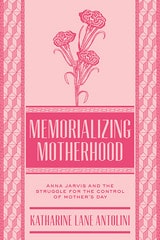
Memorializing Motherhood
Anna Jarvis and the Struggle for Control of Mother's DayKatharine Lane Antolini
West Virginia University Press, 2017
Few know the name Anna Jarvis, yet on the second Sunday in May, we mail the card, buy the flowers, place the phone call, or make the brunch reservation to honor our mothers, all because of her.
Anna Jarvis organized the first official Mother’s Day celebration in Grafton, West Virginia in 1908 and then spent decades promoting the holiday and defending it from commercialization. She designed her Mother’s Day celebration around a sentimental view of motherhood and domesticity, envisioning a day venerating the daily services and sacrifices of mothers within the home.
After Mother’s Day became a national holiday in 1914, many organizations sought to align the holiday’s meaning with changing perceptions of modern motherhood in the twentieth century. Instead of restricting a mother’s service and influence solely to the domestic sphere, they emphasized the power of mothers both within their homes and throughout their communities.
Jarvis refused to accept this changing interpretation, claiming both intellectual and legal ownership of Mother’s Day. Her obsession with protecting the purity of her vision sustained a war of verbal and legal assaults against rival holiday promoters, patriotic women’s organizations, charitable foundations, public health reformers, and the Franklin D. Roosevelt administration. The struggle for control of Mother’s Day ultimately threatened her livelihood, physical health, and emotional stability.
Memorializing Motherhood explores the complicated history of Anna Jarvis’s movement to establish and control Mother’s Day, as well as the powerful conceptualization of this day as both a holiday and a cultural representation of motherhood.
Memory, Meaning, and Resistance
Reflecting on Oral History and Women at the MarginsFran Leeper Buss
University of Michigan Press, 2017
Memphis Tennessee Garrison
The Remarkable Story of a Black Appalachian WomanAncella R. Bickley
Ohio University Press, 2001
As a black Appalachian woman, Memphis Tennessee Garrison belonged to a demographic category triply ignored by historians.
The daughter of former slaves, she moved to McDowell County, West Virginia, at an early age and died at ninety-eight in Huntington. The coalfields of McDowell County were among the richest seams in the nation. As Garrison makes clear, the backbone of the early mining work force—those who laid the railroad tracks, manned the coke ovens, and dug the coal—were black miners. These miners and their families created communities that became the centers of the struggle for unions, better education, and expanded civil rights. Memphis Tennessee Garrison, an innovative teacher, administrative worker at U.S. Steel, and vice president of the National Board of the NAACP at the height of the civil rights struggle (1963-66), was involved with all of these struggles.
In many ways, this oral history, based on interview transcripts, is the untold and multidimensional story of African American life in West Virginia, as seen through the eyes of a remarkable woman. She portrays a courageous people who organize to improve their working conditions, send their children to school and then to college, own land, and support a wide range of cultural and political activities.