Results by title
211 books match the query 'Working class' and 8 start with m
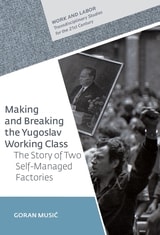
Making and Breaking the Yugoslav Working Class
The Story of Two Self-Managed FactoriesGoran Music
Central European University Press, 2021
Workers' self-management was one of the unique features of communist Yugoslavia. Goran Musić has investigated the changing ways in which blue-collar workers perceived the recurring crises of the regime. Two self-managed metal enterprises, one in Serbia another in Slovenia, provide the frame of the analysis in the time span between 1945 and 1989. These two factories became famous for strikes in 1988 that evoked echoes in popular discourses in former Yugoslavia. Drawing on interviews, factory publications and other media, local archives, and secondary literature, Musić analyzes the two cases, going beyond the clichés of political manipulation from the top and workers' intrinsic attraction to nationalism.
The author explains how, in the later phase of communist Yugoslavia, growing social inequalities among the workers and undemocratic practices inside the self-managed enterprises facilitated the spread of a nationalist and pro-market ideology on the shop floors. Yet rather than being a mass taken advantage of by populist leaders, the working class Musić presents is one with agency and voice, a force that played an important role in shaping the fate of the country. The book thus seeks to open a debate on the social processes leading up to the dissolution of Yugoslavia.

Manhood on the Line
Working-Class Masculinities in the American HeartlandStephen Meyer
University of Illinois Press, 2016
Manufacturing Suburbs
Building Work And Homeedited by Robert Lewis
Temple University Press, 2004
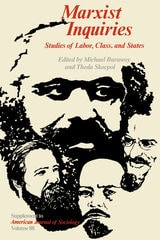
Marxist Inquiries
Studies of Labor, Class, and StatesEdited by Michael Burawoy and Theda Skocpol
University of Chicago Press, 1983
– the economic bases of state policies and their determination by social and political struggles;
– the politcal reshaping of international economic order;
– industrial work in relation to other institutions (such as education, patriarchy, and citizenship);
– the transformation of class structures in capitalist and state-socialist societies.
Published as a supplement to American Journal of Sociology, these studies constitute essential reading both for those sociologists who see Marxism as a powerful framework for understanding capitalist societies and for those who may not be committed to working within the Marxist tradition but nevertheless want to see Marxist hypotheses fully researched and debated.
Men at Work
Rediscovering Depression-era Stories from the Federal Writers’ ProjectMatthew Basso
University of Utah Press, 2012
As part of Roosevelt’s New Deal program of the 1930s, the Works Progress Administration (WPA) provided relief jobs to millions of Americans. One facet of the WPA was the hiring of men and women to document the history and folklore of America so as to capture the “soul” of the nation. While researching at the Montana Historical Society Research Center more than a decade ago, historian Matthew Basso stumbled upon copies of six stories that had been submitted for inclusion in a volume titled Men at Work.They arrived too late to be considered. Federal Writers’ Project (FWP) staff had already chosen thirty-four stories from submissions across the country and the volume was nearing publication. In the end, however, that publication was waylaid by the eruption of World War II and the manuscript was forgotten. Now, Basso is bringing these rediscovered stories to their intended audience—the American people.
Works of fiction that have a creative nonfiction feel, these narratives stem from direct observation of or participation in the work described and offer portraits of Americans from diverse ethnic backgrounds who labored in jobs as varied as logging, mining, fruit packing, and rodeo riding. The writers, directed by editor Harold Rosenberg, also represent a variety of backgrounds and experience. Some, like Jack Conroy, Jim Thompson, and Chester Himes, became strong voices in the literary world. The vivid accounts in Men at Work illuminate the meaning of work during a time when jobs were scarce and manual labor highly valued. With our country once again in financial crisis and workers facing an anemic job market, today’s readers will find these stories especially poignant.
Men, Women, and Work
Class, Gender, and Protest in the New England Shoe Industry, 1780-1910Mary H. Blewett
University of Illinois Press, 1988
Modernization and the Working Class
The Politics of LegitimacyBy Carlos H. Waisman
University of Texas Press, 1982
This is a fascinating inquiry into the factors that determine the acceptance or rejection of capitalism by the industrial working class. Combining classical social theory, historical evidence, and survey data, Waisman explores the relationship between the degree of modernization and the legitimacy of the capitalist social order.
Propositions about the interaction between established elites and emerging working classes are illustrated with three typical cases: Disraelian Britain, Bismarckian Germany, and Peronist Argentina. From the contrasting theories of Marx and Bakunin, the author derives hypotheses concerning the position of the working class in the economy and the consequences this has for legitimacy. He finds that countries at middle levels of industrial development—mostly latecomers to industrialization in Southern Europe and advanced areas of Latin America—have the greatest difficulty in establishing capitalism as a legitimate social order. They are advanced enough to have a large working class, yet underdeveloped enough to have a dissatisfied one.
My Blue Heaven
Life and Politics in the Working-Class Suburbs of Los Angeles, 1920-1965Becky M. Nicolaides
University of Chicago Press, 2002
As Becky M. Nicolaides shows in My Blue Heaven, this ethic of self-reliance and homeownership formed the core of South Gate's identity. With post-World War II economic prosperity, the community's emphasis shifted from building homes to protecting them as residents tried to maintain their standard of living against outside threats—including the growing civil rights movement—through grassroots conservative politics based on an ideal of white homeowner rights. As the citizens of South Gate struggled to defend their segregated American Dream of suburban community, they fanned the flames of racial inequality that erupted in the 1965 Watts riots.