Results by title
857 books match the query 'Architecture' and 58 start with m
Mound Excavations at Moundville
Architecture, Elites and Social OrderVernon James Knight, Jr.
University of Alabama Press, 2010
How social and political power was wielded in order to build Moundville
Movable Londons
Performance and the Modern CityJulia H Fawcett
University of Michigan Press, 2025

Movie Censorship and American Culture
Francis G. Couvares
University of Massachusetts Press, 2006
From the earliest days of public outrage over “indecent” nickelodeon shows, Americans have worried about the power of the movies. The eleven essays in this book examine nearly a century of struggle over cinematic representations of sex, crime, violence, religion, race, and ethnicity, revealing that the effort to regulate the screen has reflected deep social and cultural schisms.
In addition to the editor, contributors include Daniel Czitrom, Marybeth Hamilton, Garth Jowett, Charles Lyons, Richard Maltby, Charles Musser, Alison M. Parker, Charlene Regester, Ruth Vasey, and Stephen Vaughn. Together they make it clear that censoring the movies is more than just a reflex against "indecency," however defined. Whether censorship protects the vulnerable or suppresses the creative, it is part of a broader culture war that breaks out recurrently as Americans try to come to terms with the market, the state, and the plural society in which they live.
Moving Boarders
Skateboarding and the Changing Landscape of Urban Youth SportsMatthew Atencio
University of Arkansas Press, 2018
This excellent treatise on the contemporary youth sports scene examines how modern families embrace skateboarding and the role commerce plays in this unexpected new parent culture, and highlights how private corporations, community leaders, parks and recreation departments, and nonprofits like the Tony Hawk Foundation have united to energize skate parks—like soccer fields before them—as platforms for community engagement and the creation of social and economic capital.
Multiplicity
On Constraint and Agency in Contemporary ArchitectureEdited by Pari Riahi, Laure Katsaros, and Michael T. Davis
University of Massachusetts Press, 2024
Today, the field of architecture faces a reckoning. While there is no longer consensus on what defines an architectural work, theorists, historians, and practitioners are grappling with urgent issues—among them the impact of climate change, the dynamics of power and race in relation with the built environment, and the technological, practical, and ethical dimensions of architecture. As established practices, academic objectives, and professional expectations come under scrutiny, architecture is in search of new definitions, identities, and voices.
Inspired by Italo Calvino’s memos about literature in the twenty-first century, this volume—the second in a series— situates architecture within a broad framework, exploring its complex interactions with environmental, cultural, political, social, artistic, and technological forces. The editors’ objective is to spur conversation across the boundaries that divide architecture’s theorists and historians from practitioners. In addition to the editors, the contributors include Sanford Kwinter, Aleksandra Jaeschke, Jennifer Mack, Rahul Mehrotra, Charles Waldheim, Kristi Cheramie, Jesse Reiser, Julian Harake, Jenny E. Sabin, Charles Davis, Esra Akcan, and David Karmon.
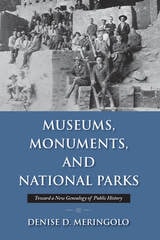
Museums, Monuments, and National Parks
Toward a New Genealogy of Public HistoryDenise D. Meringolo
University of Massachusetts Press, 2012
All of these developments included interpretive activities that shaped public understanding of the past. Yet it was not until the emergence of the education-oriented National Park Service history program in the 1920s and 1930s that public history found an institutional home that grounded professional practice simultaneously in the values of the emerging discipline and in government service. Even thereafter, tensions between administrators in Washington and practitioners on the ground at National Parks, monuments, and museums continued to define and redefine the scope and substance of the field. The process of definition persists to this day, according to Meringolo, as public historians establish a growing presence in major universities throughout the United States and abroad.
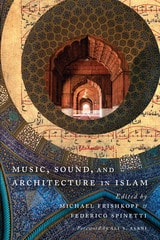
Music, Sound, and Architecture in Islam
Edited by Michael Frishkopf and Federico Spinetti
University of Texas Press, 2018
Tracing the connections between music making and built space in both historical and contemporary times, Music, Sound, and Architecture in Islam brings together domains of intellectual reflection that have rarely been in dialogue to promote a greater understanding of the centrality of sound production in constructed environments in Muslim religious and cultural expression.
Representing the fields of ethnomusicology, anthropology, art history, architecture, history of architecture, religious studies, and Islamic studies, the volume’s contributors consider sonic performances ranging from poetry recitation to art, folk, popular, and ritual musics—as well as religious expressions that are not usually labeled as “music” from an Islamic perspective—in relation to monumental, vernacular, ephemeral, and landscape architectures; interior design; decoration and furniture; urban planning; and geography. Underscoring the intimate relationship between traditional Muslim sonic performances, such as the recitation of the Qur’an or devotional songs, and conventional Muslim architectural spaces, from mosques and Sufi shrines to historic aristocratic villas, gardens, and gymnasiums, the book reveals Islam as an ideal site for investigating the relationship between sound and architecture, which in turn proves to be an innovative and significant angle from which to explore Muslim cultures.
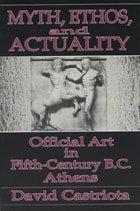
Myth, Ethos, and Actuality
Official Art in Fifth Century B.C. AthensDavid Castriota
University of Wisconsin Press, 1992
Using material remains, as well as the evidence of contemporary Greek history, rhetoric, and poetry, David Castriota interprets the Athenian monuments as vehicles of an official ideology intended to celebrate and justify the present in terms of the past.
Castriota focuses on the strategy of ethical antithesis that asserted Greek moral superiority over the “barbaric” Persians, whose invasion had been repelled a generation earlier. He examines how, in major public programs of painting and sculpture, the leading artists of the period recast the Persians in the guise of wild and impious mythic antagonists to associate them with the ethical flaws or weaknesses commonly ascribed to women, animals, and foreigners. The Athenians, in contrast, were compared to mythic protagonists representing the excellence and triumph of Hellenic culture.
Castriota’s study is innovative in emphasizing the ethical implication of mythic precedents, which required substantial alterations to render them more effective as archetypes for the defense of Greek culture against a foreign, morally inferior enemy. The book looks in new ways at how the patrons and planners sought to manipulate viewer response through the selective presentation or repackaging of mythic traditions.