1566 books match the query 'Christianity' and 70 start with m
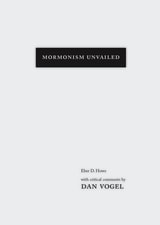
cover of Mormonism Unvailed: Eber D. Howe, with critical comments by Dan Vogel

Mormonism Unvailed

Eber D. Howe, with critical comments by Dan Vogel

Eber Dudley Howe

Signature Books, 2015

 Any Latter-day Saint who has ever defended his or her beliefs has likely addressed issues first raised by Eber D. Howe in 1834. Howe’s famous exposé was the first of its kind, with information woven together from previous news articles and some thirty affidavits he and others collected. He lived and worked in Painesville, Ohio, where, in 1829, he had published about Joseph Smith’s discovery of a “golden bible.” Smith’s decision to relocate in nearby Kirtland sparked Howe’s attention. Of even more concern was that Howe’s wife and other family members had joined the Mormon faith. Howe immediately began investigating the new Church and formed a coalition of like-minded reporters and detractors. By 1834, Howe had collected a large body of investigative material, including affidavits from Smith’s former neighbors in New York and from Smith’s father-inlaw in Pennsylvania. Howe learned about Smith’s early interest in pirate gold and use of a seer stone in treasure seeking and heard theories from Smith’s friends, followers, and family members about the Book of Mormon’s origin. Indulging in literary criticism, Howe joked that Smith, “evidently a man of learning,” was a student of “barrenness of style and expression.” Despite its critical tone, Howe’s exposé is valued by historians for its primary source material and account of the growth of Mormonism in northeastern Ohio.
[more]
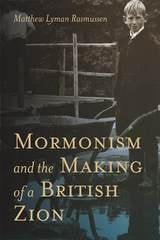
cover of Mormonism and the Making of a British Zion

Mormonism and the Making of a British Zion

Matthew L. Rasmussen

University of Utah Press, 2016

Mormonism in Britain began in the late 1830s with the arrival of American missionaries from the Church of Jesus Christ of Latter-day Saints. Not long afterward, thousands of British converts emigrated to Utah and became a kind of lifeblood for the early Mormon Church. The English North West, where Mormonism had its strongest presence, has since become a place of profound significance to the church, both institutionally and internationally. Despite its importance to Mormonism, this history has never been fully explored. Matthew Rasmussen provides the first detailed account and examines how Mormonism has changed and endured in Britain.

After many British believers left for America, church membership in England fell so sharply that the movement in Britain seemed to be on the brink of collapse. Yet British Mormonism gradually resurged and continues today. How did this religious minority flourish when so many nineteenth-century revivalist movements did not? Rasmussen explains Mormonism’s inception, perpetuation, and maturation in Britain in a compelling case study of a “new religious movement” with staying power. From its establishment in 1837 to its maturation in 1998, the Mormon perspective of Britain shifted dramatically. This book chronicles that shift, and illustrates how doctrinal adaptation has enabled Mormonism in Britain to persist. 
[more]
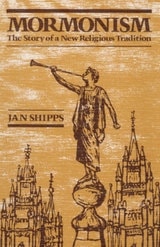
cover of Mormonism: THE STORY OF A NEW RELIGIOUS TRADITION

Mormonism

THE STORY OF A NEW RELIGIOUS TRADITION

Jan Shipps

University of Illinois Press, 1985
"Without fully and consciously realizing that they were doing so, the followers of Jesus established a new religious tradition. This book tells the story of yet another assembly of saints whose history, I believe, is in many respects analogous to the history of those early Christians who thought at first that they had found the only proper way to be Jews. Mormonism started to grow away from traditional Christianity almost immediately upon coming into existence. It began as a movement that understood itself as Christian, but. . . these nineteenth-century Latter-day Saints (as they came to be called) embarked on a path that led to developments that now distinguish their tradition from the Christian tradition as surely as early Christianity was distinguished from its Hebraic context."--From the preface
 
[more]
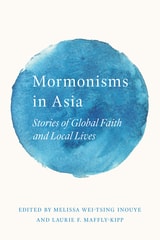
cover of Mormonisms in Asia: Stories of Global Faith and Local Lives

Mormonisms in Asia

Stories of Global Faith and Local Lives

Edited by Melissa Wei-Tsing Inouye and Laurie F. Maffly-Kipp

University of Illinois Press, 2026

Mormonism is often described as the quintessentially American religion, one that is highly centralized around its leadership and demographic presence in Utah. But given a dramatic increase in non-U.S. membership since 1960 in both the Church of Jesus Christ of Latter-day Saints and the Community of Christ, new questions about these movements come to the fore: How are these Restoration traditions lived and experienced in other parts of the world? How do church members outside the United States understand their relationship to a sacralized American past and an administrative hierarchy in Salt Lake City? And how has the relatively recent explosion of membership outside of the United States begun to shift the faith’s institutional, political, and cultural dynamics within those traditions? Most importantly, how do church members from different localities and cultures relate to each other, forming a global community? Or do they?

This volume focuses on Asia, a region that includes more than half the world's population, but where Restoration traditions specifically and Christianity broadly are minority faiths. It uses a combination of focused case studies and theoretical analysis to highlight broader trends and themes that those studies suggest about the meaning of a globalized faith in the twenty-first century. The first section of this book lays out ways of thinking about Mormonism’s global presence in terms of the nation-state, and the essays explore where and how Restoration traditions as institutional actors have made their way into new political and social contexts. The second section studies the tensions created by the encounters of LDS norms with preexisting cultural and political values in local settings. These essays burrow more deeply into political and religious realities and explore the variations in Mormon cultural assumptions about politics and society, as well as the relationship between local congregants and the Mormon administrative center. The final section presents fine-grained
studies that focus attention on one of the central features of LDS lived religion: the role of gender and the family in the religious community. In each case, divine dictates necessarily bump up against traditional societal norms that converts must navigate.

Contributors: John-Charles Duffy, Stacilee Ford, Taunalyn Ford, Conan Grames, David J. Howlett, Melissa Wei-Tsing Inouye, Keisha Lai, Laurie Maffly-Kipp, Matthew Martinich, Meagan Rainock, Shinji Takagi, Pierre Vendassi
[more]
cover of Mormons and Mormonism: An Introduction to an American World Religion

Mormons and Mormonism

An Introduction to an American World Religion

Edited by Eric A. Eliason

University of Illinois Press, 2001

Mormons and Mormonism gathers key essays by leading scholars on the history, foundational ideas and practices, and worldwide expansion of the Church of Jesus Christ of Latter-day Saints. The ideal introduction to Mormonism, this choice sampler provides a selective overview of what many historians consider the most innovative and successful religion to emerge during the spiritual ferment of antebellum America.
 
This volume explains how the earliest Mormons viewed their religion and suggests that the Book of Mormon appeared to them as an exciting document of social protest. Contributors consider the history of persecution of the Mormons, the church's relationship with the state of Utah and with other divisions of Christianity, and culture clashes in the church's missionary efforts. Mormons and Mormonism also places beliefs such as vicarious baptism for the dead in a larger context of community and religious ideals.
 
The founding of Mormonism and its rapid emergence as a new world religion are among the most intriguing aspects of American religious history and among the most neglected in the religion classroom. This much-needed volume lays the groundwork for a better understanding of the LDS Church and its historical and potential impact on the United States and the world.
 
[more]
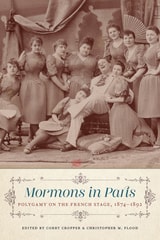
cover of Mormons in Paris: Polygamy on the French Stage, 1874-1892

Mormons in Paris

Polygamy on the French Stage, 1874-1892

Corry Cropper

Bucknell University Press, 2021

Winner of the 2021 Best International Book Award from the Mormon History Association

In the late nineteenth century, numerous French plays, novels, cartoons, and works of art focused on Mormons. Unlike American authors who portrayed Mormons as malevolent “others,” however, French dramatists used Mormonism to point out hypocrisy in their own culture. Aren't Mormon women, because of their numbers in a household, more liberated than French women who can't divorce? What is polygamy but another name for multiple mistresses? This new critical edition presents translations of four musical comedies staged or published in France in the late 1800s: Mormons in Paris (1874), Berthelier Meets the Mormons (1875), Japheth’s Twelve Wives (1890), and Stephana’s Jewel (1892). Each is accompanied by a short contextualizing introduction with details about the music, playwrights, and staging. Humorous and largely unknown, these plays use Mormonism to explore and mock changing French mentalities during the Third Republic, lampooning shifting attitudes and evolving laws about marriage, divorce, and gender roles.

Published by Bucknell University Press. Distributed worldwide by Rutgers University Press.
[more]
cover of Mormons, Musical Theater, and Belonging in America

Mormons, Musical Theater, and Belonging in America

Jake Johnson

University of Illinois Press, 2019
The Church of Jesus Christ of Latter-day Saints adopted the vocal and theatrical traditions of American musical theater as important theological tenets. As Church membership grew, leaders saw how the genre could help define the faith and wove musical theater into many aspects of Mormon life. Jake Johnson merges the study of belonging in America with scholarship on voice and popular music to explore the surprising yet profound link between two quintessentially American institutions. Throughout the twentieth and twenty-first centuries, Mormons gravitated toward musicals as a common platform for transmitting political and theological ideas. Johnson sees Mormons using musical theater as a medium for theology of voice--a religious practice that suggests how vicariously voicing another person can bring one closer to godliness. This sounding, Johnson suggests, created new opportunities for living. Voice and the musical theater tradition provided a site for Mormons to negotiate their way into middle-class respectability. At the same time, musical theater became a unique expressive tool of Mormon culture.
[more]
cover of Moses Mendelssohn: Writings on Judaism, Christianity, and the Bible

Moses Mendelssohn

Writings on Judaism, Christianity, and the Bible

Edited by Michah Gottlieb

Brandeis University Press, 2011
German Jewish philosopher Moses Mendelssohn (1729–1786) is best known in the English-speaking world for his Jerusalem (1783), the first attempt to present Judaism as a religion compatible with the ideas of the Enlightenment. While incorporating much of Jerusalem, Michah Gottlieb’s volume seeks to expand knowledge of Mendelssohn’s thought by presenting translations of many of his other seminal writings from the German or Hebrew originals. These writings include essays, commentaries, unpublished reflections, and personal letters. Part One includes selections from the three major controversies of Mendelssohn’s life, all of which involved polemical encounters with Christian thinkers. Part Two presents selections from Mendelssohn’s writings on the Bible. Part Three offers texts that illuminate Mendelssohn’s thoughts on a diverse range of religious topics, including God’s existence, the immortality of the soul, and miracles. Designed for class adoption, the volume contains annotations and an introduction by the editor.
[more]
cover of Moth and Rust: Mormon Encounters with Death

Moth and Rust

Mormon Encounters with Death

Steven Carter

Signature Books, 2017

In Mormonism we are sometimes seemingly casual
about death: it’s a veil or a mission call to the spirit
world. But our actual encounters with the reality of
death inevitably change us in ways that are difficult
to articulate.
In this collection, Mormon writers wrestle with
mortality and its aftermath. A family sings a hesitant
rendition of Happy Birthday to a grief-stricken
mother who buried her toddler just a few hours earlier;
an agnostic son decides he’s Mormon enough to
arrange a funeral for his believing father.
Some essays use death as a means to understand
faith. One author imagines a world where Heavenly
Mother visits her children in the form of their
female ancestors, appearing to her descendants in
times of grief or pain.
Others address practicalities: how do you protect
your children from death while still allowing them
to experience the world; how do you get through
one more nausea-ridden day of cancer treatment?
Still others delve into death’s questions: does the
overwhelming suffering that occurs in the animal
kingdom have a function in the “plan of happiness”?
Sometimes humorous, sometimes heartbreaking,
always thought-provoking, these personal essays,
poems, and stories may never be heard at a Mormon
funeral. But they probably should be.
[more]
cover of Mother Ann Lee: Morning Star of the Shakers

Mother Ann Lee

Morning Star of the Shakers

Nardi Reeder Campion

Brandeis University Press, 2026

The definitive biography of the founder of the Shaker movement, whose remarkable life is the subject of a new film, The Testament of Ann Lee.
 
This acclaimed, accessible, and thoroughly researched biography documents the life of Ann Lee, a controversial, religious leader and early feminist figure. Lee established the Shaker movement in 1770 in Manchester, England. The core principles of the Shakers were radical: in an era when wives were the possession of their husband, Lee proclaimed the equality of men and women. The Shakers were dedicated to beliefs in absolute pacifism, equality of the sexes, absolute celibacy, and the cleansing of sin through dancing and chanting to shake away the past.

The Shakers sought inner peace and harmony, but their unusual beliefs, including total abstinence from sex and their exhibitions of mystical ecstasy were considered suspect and led to the imprisonment of Lee and her followers. While jailed, Lee experienced a blinding, soul-splitting vision which reaffirmed her belief in celibacy and named her the second coming of Christ. Seeking religious freedom, she led her followers, known as the United Society of Believers in Christ’s Second Appearing, from England to settle in upstate New York, near Albany.

Mother Ann Lee died in 1784, but her movement continued to grow into the nineteenth century with at least eighteen utopian Shaker communities in Kentucky, Maine, Massachusetts, New Hampshire, New York, and Ohio. Today many of those Shaker settlements are museums. The last remaining Shaker community is at Sabbathday Lake Shaker Village near Poland, Maine. The Testament of Ann Lee, starring Amanda Seyfried, drew on this book among other sources to tell Lee’s story.
[more]
cover of Mother Figured: Marian Apparitions and the Making of a Filipino Universal

Mother Figured

Marian Apparitions and the Making of a Filipino Universal

Deirdre de la Cruz

University of Chicago Press, 2015

There is no female religious figure so widely known and revered as the Virgin Mary. Mary has inspired in cultures around the world a deep devotion, a desire to emulate her virtue, and a strong belief in her power. Perhaps no population has been so deeply affected by this maternal figure as Filipino Catholics, whose apparitions of Mary have increased in response to recent events, drawing from a broad repertoire of the Catholic supernatural and pulling attention to new articulations of Christianity in the Global South.
 
In Mother Figured, historical anthropologist Deirdre de la Cruz offers a detailed examination of several appearances and miracles of the Virgin Mary in the Philippines from materials and sites ranging from the mid-nineteenth century to the present. By analyzing the effects of the mass media on the perception and proliferation of apparition phenomena, de la Cruz charts the intriguing emergence of new voices in the Philippines that are broadcasting Marian discourse globally. Based on two years of ethnographic fieldwork and hitherto unexplored archives in the Philippines, the United States, and Spain, Mother Figured documents the conditions of Marian devotion’s modern development and tracks how it has transformed Filipinos’ social and political role within the greater Catholic world.
[more]
cover of Mother Juana de la Cruz, 1481–1534: Visionary Sermons

Mother Juana de la Cruz, 1481–1534

Visionary Sermons

Juana de la Cruz

Iter Press, 2016

Juana de la Cruz (1481–1534) is a unique figure in the history of the Catholic Church, thanks to her public visionary experiences during which she lost consciousness, while a deep voice, identifying itself as Christ, issued from her, narrating the feasts and pageants taking place in heaven. Juana’s so called “sermons,” collected in a manuscript called Libro del Conorte, form a fascinating window into Castilian religiosity in the early sixteenth century. There is much to reap from these sermons concerning Spanish Renaissance culture, theology, mysticism, gender roles, and interreligious interactions.
[more]
cover of Mother Teresa's General Letters to Her Sisters

Mother Teresa's General Letters to Her Sisters

Brian Kolodiejchuk

Catholic University of America Press, 2024
Mother Teresa’s General Letters to Her Sisters is a collection of Mother Teresa’s circular letters to the members of her religious congregation, the Missionaries of Charity Sisters. Not intended for those outside her community, they were written informally and spontaneously, often with little editing. It was for Mother Teresa a way of “being present” to the members of her rapidly expanding religious order. Seemingly of little interest except for those to whom they were addressed, the letters reveal the spiritual depth and pragmatic leadership of one of the most popular modern saints, as well as the inner dynamics underlying one of the most flourishing religious congregations of the last century. At the same time, and perhaps surprisingly, these letters may also prove to be worthwhile reading for a wider audience. Something of God’s wisdom and love seems to shine through Mother Teresa’s guidance and counsels, giving the reader light and help even though he or she is not living the same religious life as one of the Sisters. Mother Teresa’s unpolished statements are at times humble and at times humbling. They inspire confidence and encourage generosity. Many a time they are humorous but more often challenging. They are sprinkled with serene joy but also permeated with deep pain. She delighted in her Sisters’ accomplishments yet did not shy away from correcting even the smallest flaw, which didn’t escape her very observant eye. Sometimes she sounded just like a mother, full of tender loving care, and at other times more like a commander in chief, exhibiting an iron will and uncompromising determination. In either case, her followers seemed to have been drawn into the mystery of her charism, endeavoring to keep pace with her. Was it the attraction of what could be termed as her “leadership style” in the unremitting service of the poorest of the poor, or the perceived love of a mother’s heart that made her so unanimously loved and admired by the members of her congregation? Or was it both? The letters will reveal the answer! Inspiring in their simplicity, the letters may well serve as a treasure trove where anyone from a reflective scholar to a caring mother of a family may find satisfaction for their spiritual palate. The attractiveness of perennial truth often makes Mother Teresa’s presentation of traditional spiritual themes likewise relevant for contemporary needs. In the context of Mother Teresa’s statement that “we are created for greater things, to love and to be loved’,” these letters will help the reader discover and experience God’s presence through the little miracles of His love in one’s daily life. They will inspire us “to put our love into living action,” sharing His love with all those we meet, and so make our lives “something beautiful for God.”
[more]
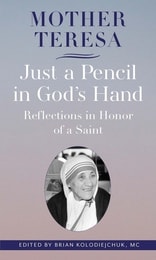
cover of Mother Teresa: Just a Pencil In God's Hand: Reflections in Honor of a Saint

Mother Teresa

Just a Pencil In God's Hand: Reflections in Honor of a Saint

Brian Kolodiejchuk

Catholic University of America Press, 2024
This anthology contains a collection of intellectual explorations honoring the enduring legacy of Mother Teresa. The symposium, held on 10 September 2022 at the Catholic University of America (CUA), brought together leading scholars to speak of Mother Teresa's legacy to produce the following papers, each shedding light on a life characterized by compassion, selflessness, and devoted service to the poorest of the poor, the forgotten, and the outcast of society. The keynote address by George Weigel, “Mother Teresa and John Paul II: Lessons for Our Troubled Times,” uncovers the lessons from the partnership of two great saints and their efforts to make way for Love in a dark world. "Mother Teresa: Holiness, Process of Canonization, and Miracle;" by the postulator of her cause, Fr. Brian Kolodiejchuk, MC, explores the nature of holiness, several characteristics of Mother Teresa’s holiness and the process that led to her canonization in 2016. In “Praxiological Approach to the Poor: Mother Teresa’s authentic retrieval of Christian praxis through faith, hope, and charity,” presented by Fr Darren Dentino, MC, we delve into Mother Teresa’s profound relationship with the underprivileged, showcasing a service approach that transcends simple social work and touches and heals the physical and inner wounds of many. Janice Breidenbach, a professor at Ave Maria University, sheds light on her own experience as a mother and explains Mother Teresa’s deep understanding of motherhood in her paper “Mother Teresa’s Philosophy of Motherhood.” "Mother Teresa: A Carmelite Perspective" by CUA professor, Fr Stephen Payne, OCD, explores the connections between Mother Teresa and the Carmelite tradition, highlighting the influence of Carmelite spirituality on her life and journey. Jim Towey's paper delves into Mother Teresa's motherhood and her humanity, emphasizing how her ordinary yet profound acts of love and compassion were reflective of her saintly character. In the annual conference held the following year, Catholic University of America professor Bradley Gregory, examines the phrase “you did it to me” from the judgment scene in the gospel of Matthew (25:40) which Mother Teresa would refer to as “the gospel on five fingers.” Drawing on the rich theological resources of Scripture and the Church’s tradition, Professor Bradley expounds on how this passage relates to the gospel of grace, which calls us into God’s work of redeeming and healing the world. Each paper testifies to Mother Teresa’s enduring legacy as a reflection of God’s love in the world, providing readers an opportunity to contemplate her steadfast dedication and honor the legacy of one of the 20th century's most profound figures.
[more]
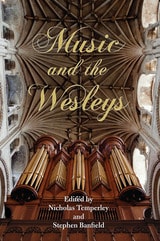
cover of Music and the Wesleys

Music and the Wesleys

Edited by Nicholas Temperley and Stephen Banfield

University of Illinois Press, 2010
Providing new insight into the Wesley family, the fundamental importance of music in the development of Methodism, and the history of art music in Britain, Music and the Wesleys examines more than 150 years of a rich music-making tradition in England. John Wesley and his brother Charles, founders of the Methodist movement, considered music to be a vital part of religion, while Charles's sons Charles and Samuel and grandson Samuel Sebastian were among the most important English composers of their time.
 
This book explores the conflicts faced by the Wesleys but also celebrates their triumphs: John's determination to elevate the singing of his flock; the poetry of Charles's hymns and their musical treatment in both Britain and America; the controversial family concerts by which Charles launched his sons on their careers; the prolific output of Charles the younger; Samuel's range and rugged individuality as a composer; the oracular boldness of Sebastian's religious music and its reception around the English-speaking world. Exploring British concert life, sacred music forms, and hymnology, the contributors analyze the political, cultural, and social history of the Wesleys' enormous influence on English culture and religious practices.
 
Contributors are Stephen Banfield, Jonathan Barry, Martin V. Clarke, Sally Drage, Peter S. Forsaith, Peter Holman, Peter Horton, Robin A. Leaver, Alyson McLamore, Geoffrey C. Moore, John Nightingale, Philip Olleson, Nicholas Temperley, J. R. Watson, Anne Bagnall Yardley, and Carlton R. Young.
[more]
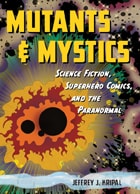
cover of Mutants and Mystics: Science Fiction, Superhero Comics, and the Paranormal

Mutants and Mystics

Science Fiction, Superhero Comics, and the Paranormal

Jeffrey J. Kripal

University of Chicago Press, 2011

In many ways, twentieth-century America was the land of superheroes and science fiction. From Superman and Batman to the Fantastic Four and the X-Men, these pop-culture juggernauts, with their "powers and abilities far beyond those of mortal men," thrilled readers and audiences—and simultaneously embodied a host of our dreams and fears about modern life and the onrushing future.

But that's just scratching the surface, says Jeffrey Kripal. In Mutants and Mystics, Kripal offers a brilliantly insightful account of how comic book heroes have helped their creators and fans alike explore and express a wealth of paranormal experiences ignored by mainstream science. Delving deeply into the work of major figures in the field—from Jack Kirby’s cosmic superhero sagas and Philip K. Dick’s futuristic head-trips to Alan Moore’s sex magic and Whitley Strieber’s communion with visitors—Kripal shows how creators turned to science fiction to convey the reality of the inexplicable and the paranormal they experienced in their lives. Expanded consciousness found its language in the metaphors of sci-fi—incredible powers, unprecedented mutations, time-loops and vast intergalactic intelligences—and the deeper influences of mythology and religion that these in turn drew from; the wildly creative work that followed caught the imaginations of millions. Moving deftly from Cold War science and Fredric Wertham's anticomics crusade to gnostic revelation and alien abduction, Kripal spins out a hidden history of American culture, rich with mythical themes and shot through with an awareness that there are other realities far beyond our everyday understanding.

A bravura performance, beautifully illustrated in full color throughout and brimming over with incredible personal stories, Mutants and Mystics is that rarest of things: a book that is guaranteed to broaden—and maybe even blow—your mind.
[more]
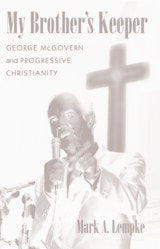
cover of My Brother's Keeper: George McGovern and Progressive Christianity

My Brother's Keeper

George McGovern and Progressive Christianity

Mark A. Lempke

University of Massachusetts Press, 2017

George McGovern is chiefly remembered for his landslide loss to Richard Nixon in 1972. Yet at the time, his candidacy raised eyebrows by invoking the prophetic tradition, an element of his legacy that is little studied. In My Brother's Keeper, Mark A. Lempke explores the influence of McGovern's evangelical childhood, Social Gospel worldview, and conscientious Methodism on a campaign that brought antiwar activism into the mainstream.

McGovern's candidacy signified a passing of the torch within Christian social justice. He initially allied with the ecumenical movement and the mainline Protestant churches during a time when these institutions worked easily with liberal statesmen. But the senator also galvanized a dynamic movement of evangelicals rooted in the New Left, who would dominate subsequent progressive religious activism as the mainline entered a period of decline. My Brother's Keeper argues for the influential, and often unwitting, role McGovern played in fomenting a “Religious Left” in 1970s America, a movement that continues to this day. It joins a growing body of scholarship that complicates the dominant narrative of that era's conservative Christianity.
[more]
cover of Mysteries of the Lord's Prayer: Wisdom from the Early Church

Mysteries of the Lord's Prayer

Wisdom from the Early Church

John Gavin

Catholic University of America Press, 2021
The Lord’s Prayer contains mysteries generally overlooked by most Christians. For the Fathers of the Church, such mysteries or “difficulties”—many of which continue to puzzle modern scholars—marked divinely inspired points for prayer and reflection. Saints Cyprian of Carthage, Augustine of Hippo, Peter Chrysologus, Maximus the Confessor and others grappled with the hidden meanings behind these questions and the fruits of their efforts can inspire contemporary readers. In this volume John Gavin, SJ explores eight mysteries of the Lord’s prayer in light of the early Church’s wisdom: How can human beings call God “Father”? Where is God the Father? How can God grow in holiness? Was there ever a time when God did not rule? Are there limitations to God’s will? Why should we seek bread? Can we make a deal with God? Does God tempt us? Without ignoring the insights of contemporary exegesis, this volume demonstrates that the responses of the Fathers to these questions have continuing relevance. Not only did they understand the issues surrounding linguistic, textual, and theological difficulties, but they also grasped the nuances of Christ’s words as illuminated by the scriptures as a whole. They provide an interpretation that challenges the mind and transforms the heart. Mysteries of the Lord's Prayer offers the general reader, as well as scholars, a chance to rediscover a prayer that unites Christians throughout the world. It also includes appendices to aid those who wish to explore the Fathers’ writings on their own for a deeper encounter with the wisdom of the early Church.
[more]
cover of Mystery of the Church, People of God

Mystery of the Church, People of God

Rose Beal

Catholic University of America Press, 2014
Congar coined the term "total ecclesiology" in his ground-breaking outline for a theology of the laity, A Way towards a Theology of the Laity. In Mystery of the Church, People of God, Rose M. Beal argues that "total ecclesiology" is the necessary and appropriate lens for a comprehensive interpretation of Congar's ecclesiological project prior to the Second Vatican Council (1962-1965). Beal works from Congar's published works from 1931 to 1954, as well as from unpublished texts from the same time period, to integrate and propose a comprehensive interpretation of his ecclesiological purposes and methods.
[more]
cover of Myths America Lives By: White Supremacy and the Stories That Give Us Meaning

Myths America Lives By

White Supremacy and the Stories That Give Us Meaning

Richard T. Hughes

University of Illinois Press, 2018

Six myths lie at the heart of the American experience. Taken as aspirational, four of those myths remind us of our noblest ideals, challenging us to realize our nation's promise while galvanizing the sense of hope and unity we need to reach our goals. Misused, these myths allow for illusions of innocence that fly in the face of white supremacy, the primal American myth that stands at the heart of all the others.
[more]