Results by title
2018 books match the query 'Political aspects' and 91 start with m

Michael Osborn on Metaphor and Style
Michael Osborn
Michigan State University Press, 2018
Migration Stories
Connecting Activism, Policy, and ScholarshipEdited by Benjamin Gatling
University of Illinois Press, 2025
Ranging from oral history projects to the asylum process to calls for decolonial justice, the contributors’ analyses illuminate how migrants’ and refugees’ personal narratives influence both perceptions and policies. Their merger of perspectives provides a nuanced understanding of migration and emphasizes the importance of how storytelling can foster empathy, challenge stereotypes, and drive social change. At the same time, the essays center migrants’ and refugees’ voices within public debates and in work done to humanize the reality they face.
Original and multifaceted, Migration Stories provides a vital addition to how we study and frame immigration.
Millennial Makeover
MySpace, YouTube, and the Future of American PoliticsWinograd, Morley
Rutgers University Press, 2008
A 2008 New York Times Notable Book of the Year
It happens in America every four decades and it is about to happen again. America’s demand for change in the 2008 election will cause another of our country’s periodic political makeovers. This realignment, like all others before it, will result from the coming of age of a new generation of young Americans—the Millennial Generation—and the full emergence of the Internet-based communications technology that this generation uses so well. Beginning in 2008, almost everything about American politics and government will transform—voting patterns, the fortunes of the two political parties, the issues that engage the nation, and our government and its public policy.
Building on the seminal work of previous generational theorists,Morley Winograd and Michael D. Hais demonstrate and describe, for the first time, the two types of realignments—“idealist” and “civic”—that have alternated with one another throughout the nation’s history. Based on these patterns, Winograd and Hais predict that the next realignment will be very different from the last one that occurred in 1968. “Idealist” realignments, like the one put into motion forty years ago by the Baby Boomer Generation, produce, among other things, a political emphasis on divisive social issues and governmental gridlock. “Civic” realignments, like the one that is coming, and the one produced by the famous GI or “Greatest” Generation in the 1930s, by contrast, tend to produce societal unity, increased attention to and successful resolution of basic economic and foreign policy issues, and institution-building.
The authors detail the contours and causes of the country’s five previous political makeovers, before delving deeply into the generational and technological trends that will shape the next. The book’s final section forecasts the impact of the Millennial Makeover on the elections, issues, and public policies that will characterize America’s politics in the decades ahead.
For additional information go to:
Millennial Makeover website.
Minorities and Law in Czechoslovakia
Jan Kuklík and René Petráš
Karolinum Press, 2017
Minority Rules
The Miao and the Feminine in China's Cultural PoliticsLouisa Schein
Duke University Press, 2000
Posing questions about gender, cultural politics, and identity, Schein examines how non-Miao people help to create Miao ethnicity by depicting them as both feminized keepers of Chinese tradition and as exotic others against which dominant groups can assert their own modernity. In representing and consuming aspects of their own culture, Miao distance themselves from the idea that they are less than modern. Thus, Schein explains, everyday practices, village rituals, journalistic encounters, and tourism events are not just moments of cultural production but also performances of modernity through which others are made primitive. Schein finds that these moments frequently highlight internal differences among the Miao and demonstrates how not only minorities but more generally peasants and women offer a valuable key to understanding China as it renegotiates its place in the global order.
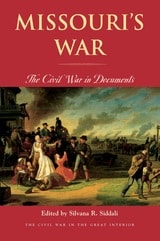
Missouri’s War
The Civil War in DocumentsSilvana R. Siddali
Ohio University Press, 2009
Winner of a 2011 “Distinguished Achievement in Literature” award, Missouri Humanities Council
Civil War Missouri stood at the crossroads of America. As the most Southern-leaning state in the Middle West, Missouri faced a unique dilemma. The state formed the gateway between east and west, as well as one of the borders between the two contending armies. Moreover, because Missouri was the only slave state in the Great Interior, the conflicts that were tearing the nation apart were also starkly evident within the state. Deep divisions between Southern and Union supporters, as well as guerrilla violence on the western border, created a terrible situation for civilians who lived through the attacks of bushwhackers and Jayhawkers.
The documents collected in Missouri's War reveal what factors motivated Missourians to remain loyal to the Union or to fight for the Confederacy, how they coped with their internal divisions and conflicts, and how they experienced the end of slavery in the state. Private letters, diary entries, song lyrics, official Union and Confederate army reports, newspaper editorials, and sermons illuminate the war within and across Missouri's borders.
Missouri's War also highlights the experience of free and enslaved African Americans before the war, as enlisted Union soldiers, and in their effort to gain rights after the end of the war. Although the collection focuses primarily on the war years, several documents highlight both the national sectional conflict that led to the outbreak of violence and the effort to reunite the conflicting forces in Missouri after the war.
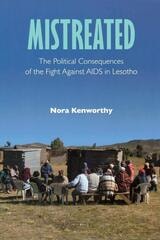
Mistreated
The Political Consequences of the Fight against AIDS in LesothoNora Kenworthy
Vanderbilt University Press, 2017
In Lesotho, which has the world's second highest HIV prevalence, HIV treatment has had unintentional but pervasive political costs, distancing citizens from the government, fostering distrust of health programs, and disrupting the social contract. Based on ethnographic observation between 2008 and 2014, this book chillingly anticipates the political violence and instability that swept through Lesotho in 2014.
This book is a recipient of the Norman L. and Roselea J. Goldberg Prize from Vanderbilt University Press for the best book in the area of medicine.
Mixed Emotions
Beyond Fear and Hatred in International ConflictAndrew A. G. Ross
University of Chicago Press, 2013
From passionate protests to poignant speeches, Andrew A. G. Ross analyzes high-emotion events with an eye to how they shape public sentiment and finds that there is no single answer. The politically powerful play to the public’s emotions to advance their political aims, and such appeals to emotion also often serve to sustain existing values and institutions. But the affective dimension can produce profound change, particularly when a struggle in the present can be shown to line up with emotionally resonant events from the past. Extending his findings to well-studied conflicts, including the War on Terror and the violence in Rwanda and the Balkans, Ross identifies important sites of emotional impact missed by earlier research focused on identities and interests.
Model Immigrants and Undesirable Aliens
The Cost of Immigration Reform in the 1990sChristina Gerken
University of Minnesota Press, 2013
During 1995 and 1996, President Bill Clinton signed into law three bills that altered the rights and responsibilities of immigrants: the Antiterrorism and Effective Death Penalty Act, the Personal Responsibility Act, and the Illegal Immigration Reform and Immigrant Responsibility Act. Model Immigrants and Undesirable Aliens examines the changing debates around immigration that preceded and followed the passage of landmark legislation by the U.S. Congress in the mid-1990s, arguing that it represented a new, neoliberal way of thinking and talking about immigration.
Christina Gerken explores the content and the social implications of the deliberations that surrounded the development and passage of immigration reform, analyzing a wide array of writings from congressional debates and committee reports to articles and human-interest stories in mainstream newspapers. The process, she shows, disguised its underlying racism by creating discursive strategies that shaped and upheld an image of “desirable” immigrants—those who could demonstrate “personal responsibility” and an ability to contribute to the U.S. economy. Gerken finds that politicians linked immigration to complex issues: poverty, welfare reform, so-called family values, measures designed to combat terrorism, and the spiraling costs of social welfare programs.
Although immigrants were often at the center of congressional debates, politicians constructed an elaborate, abstract terminology that appeared to be unrelated to race or gender. Instead, politicians promoted neoliberal policies as the avenue to a postracist, postsexist world of opportunity for every rational consumer with an entrepreneurial spirit. Still, Gerken concludes that the passage of pathbreaking legislation was characterized by a useful tension between neoliberal assumptions and hidden anxieties about race, class, gender, and sexuality.
Modernism’s Magic Hat
Architecture and the Illusion of Development without CapitalIjlal Muzaffar
University of Texas Press, 2024
Examines the role of architecture in the history of global development and decolonization.
In Modernism’s Magic Hat, Ijlal Muzaffar examines how modern architects and planners help resolve one of the central dilemmas of the mid-twentieth-century world order: how to make decolonization plausible without accounting for centuries of capital drain under colonial rule. In the years after World War II, architects and planners found extensive opportunities in new international institutions—such as the World Bank, the UN, and the Ford Foundation—and helped shape new models of global intervention that displaced the burden of change onto the inhabitants. Muzaffar argues that architecture in this domain didn’t just symbolically represent power, but formed the material domain through which new modes of power acquired sense. Looking at a series of architectural projects across the world, from housing in Ghana to village planning in Nigeria and urban planning in Venezuela and Pakistan, Muzaffar explores how architects and planners shaped new ideas of time, land, climate, and the decolonizing body, making them appear as sources of untapped value. What resulted, Muzaffar argues, is a widespread belief in spontaneous Third World “development” without capital, which continues to foreclose any global discussion of colonial theft.
Modernist Art in Ethiopia
Elizabeth W. Giorgis
Ohio University Press, 2019
Short-listed for the Fage & Oliver Prize for outstanding scholarly work published on Africa.
Finalist, African Studies Association Book Prize.
Finalist, ASA Bethwell A. Ogot Prize for best book in east African studies.
If modernism initially came to Africa through colonial contact, what does Ethiopia’s inimitable historical condition—its independence save for five years under Italian occupation—mean for its own modernist tradition? In Modernist Art in Ethiopia—the first book-length study of the topic—Elizabeth W. Giorgis recognizes that her home country’s supposed singularity, particularly as it pertains to its history from 1900 to the present, cannot be conceived outside the broader colonial legacy. She uses the evolution of modernist art in Ethiopia to open up the intellectual, cultural, and political histories of it in a pan-African context.
Giorgis explores the varied precedents of the country’s political and intellectual history to understand the ways in which the import and range of visual narratives were mediated across different moments, and to reveal the conditions that account for the extraordinary dynamism of the visual arts in Ethiopia. In locating its arguments at the intersection of visual culture and literary and performance studies, Modernist Art in Ethiopia details how innovations in visual art intersected with shifts in philosophical and ideological narratives of modernity. The result is profoundly innovative work—a bold intellectual, cultural, and political history of Ethiopia, with art as its centerpiece.
Modernity for the Masses
Antonio Bonet's Dreams for Buenos AiresBy Ana María León
University of Texas Press, 2021
2022 PROSE Award Finalist in Architecture and Urban Planning
2022 Association for Latin American Art Arvey Foundation Book Award, Honorable Mention
Throughout the early twentieth century, waves of migration brought working-class people to the outskirts of Buenos Aires. This prompted a dilemma: Where should these restive populations be situated relative to the city’s spatial politics? Might housing serve as a tool to discipline their behavior?
Enter Antonio Bonet, a Catalan architect inspired by the transatlantic modernist and surrealist movements. Ana María León follows Bonet's decades-long, state-backed quest to house Buenos Aires's diverse and fractious population. Working with totalitarian and populist regimes, Bonet developed three large-scale housing plans, each scuttled as a new government took over. Yet these incomplete plans—Bonet's dreams—teach us much about the relationship between modernism and state power.
Modernity for the Masses finds in Bonet's projects the disconnect between modern architecture’s discourse of emancipation and the reality of its rationalizing control. Although he and his patrons constantly glorified the people and depicted them in housing plans, Bonet never consulted them. Instead he succumbed to official and elite fears of the people's latent political power. In careful readings of Bonet's work, León discovers the progressive erasure of surrealism's psychological sensitivity, replaced with an impulse, realized in modernist design, to contain the increasingly empowered population.
Modernizing Repression
Police Training and Nation-Building in the American CenturyJeremy Kuzmarov
University of Massachusetts Press, 2012
As American troops became bogged down first in Iraq and then Afghanistan, a key component of U.S. strategy was to build up local police and security forces in an attempt to establish law and order. This approach, Jeremy Kuzmarov shows, is consistent with practices honed over more than a century in developing nations within the expanding orbit of the American empire. From the conquest of the Philippines and Haiti at the turn of the twentieth century through Cold War interventions and the War on Terror, police training has been valued as a cost-effective means of suppressing radical and nationalist movements, precluding the need for direct U.S. military intervention and thereby avoiding the public opposition it often arouses.
Unlike the spectacular but ephemeral pyrotechnics of the battlefield, police training programs have had lasting consequences for countries under the American imperial umbrella, fostering new elites, creating powerful tools of social control, and stifling political reform. These programs have also backfired, breeding widespread resistance, violence, and instability—telltale signs of “blowback” that has done more to undermine than advance U.S. strategic interests abroad.
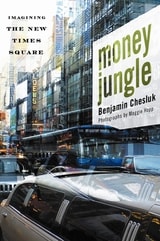
Money Jungle
Imagining the New Times SquareChesluk, Benjamin
Rutgers University Press, 2008
For more than a century, Times Square has mesmerized the world with the spectacle of its dazzling supersigns, its theaters, and its often-seedy nightlife. New York City’s iconic crossroads has drawn crowds of revelers, thrill-seekers, and other urban denizens, not to mention lavish outpourings of advertising and development money.
Many have hotly debated the recent transformation of this legendary intersection, with voices typically falling into two opposing camps. Some applaud a blighted red-light district becoming a big-budget, mainstream destination. Others lament an urban zone of lawless possibility being replaced by a Disneyfied, theme-park version of New York. In Money Jungle, Benjamin Chesluk shows that what is really at stake in Times Square are fundamental questions about city life—questions of power, pleasure, and what it means to be a citizen in contemporary urban space.
Chesluk weaves together surprising stories of everyday life in and around the Times Square redevelopment, tracing the connections between people from every level of this grand project in social and spatial engineering: the developers, architects, and designers responsible for reshaping the urban public spaces of Times Square and Forty-second Street; the experimental Midtown Community Court and its Times Square Ink. job-training program for misdemeanor criminals; encounters between NYPD officers and residents of Hell’s Kitchen; and angry confrontations between city planners and neighborhood activists over the future of the area.
With an eye for offbeat, telling details and a perspective that is at once sympathetic and critical, Chesluk documents how the redevelopment has tried, sometimes successfully and sometimes not, to reshape the people and places of Times Square. The result is a colorful and engaging portrait, illustrated by stunning photographs by long-time local photographer Maggie Hopp, of the street life, politics, economics, and cultural forces that mold America’s urban centers.
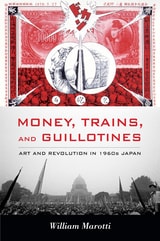
Money, Trains, and Guillotines
Art and Revolution in 1960s JapanWilliam Marotti
Duke University Press, 2013
Monotheistic Kingship
The Medieval VariantsAziz Al-Azmeh
Central European University Press, 2004
This volume of essays intends to present diverse aspects of monotheistic kingship during the Middle Ages in two general-theoretical articles and a series of “case studies” on the relationship of religion and rulership. The authors discuss examples of the role of religion—based on both textual and iconic evidence—in Carolingian, Ottonian and late medieval western Europe; in Byzantium and Armenia; Georgia; Hungary; the Khazar Khanate; Poland, and Rus’. Two studies explore the issue in medieval Jewish and Islamic political thought. The editors hope that these special inquiries will engender more comparative studies on the subject.
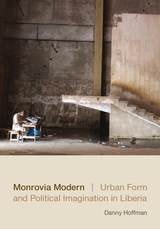
Monrovia Modern
Urban Form and Political Imagination in LiberiaDanny Hoffman
Duke University Press, 2017
Moral Issues
How Public Opinion on Abortion and Gay Rights Affects American Religion and PoliticsPaul Goren and Christopher Chapp
University of Chicago Press, 2024
A new perspective on how beliefs about abortion and gay rights reshaped American politics.
Many believe that religious and partisan identities undergird American public opinion. However, when it comes to abortion and gay rights, the reverse may be closer to the truth.
Drawing on wide-ranging evidence, Paul Goren and Christopher Chapp show that views on abortion and gay rights are just as durable and politically impactful—and often more so—than political and religious identities. Goren and Chapp locate the lasting strength of stances on abortion and gay rights in the automatic, visceral emotions that the media has primed since the late 1980s. Moral Issues examines how attitudes toward these moralized issues affect, and can sometimes even disrupt, religious and partisan identities. Indeed, over the last thirty years, these attitudes have accelerated the rise of the religious “nones,” who have no religious affiliation, and promoted moral sorting into the Democratic and Republican parties.
More City than Water
A Houston Flood AtlasEdited by Lacy M. Johnson and Cheryl Beckett
University of Texas Press, 2022
2022 Art in Service to the Environment Award, Sierra Club Lone Star Chapter
Honorable Mention, 2022 Nonfiction Prize, Writers' League of Texas
Writers explore a city’s relationship with chronic catastrophic flooding.
Shortly after Hurricane Harvey dumped a record 61 inches of rain on Houston in 2017, celebrated writer and Bayou City resident Lacy M. Johnson began collecting flood stories. Although these stories attested to the infinite variety of experience in America’s most diverse city, they also pointed to a consistent question: What does catastrophic flooding reveal about this city, and what does it obscure?
More City than Water brings together essays, conversations, and personal narratives from climate scientists, marine ecologists, housing activists, urban planners, artists, poets, and historians as they reflect on the human geography of a region increasingly defined by flooding. Both a literary and a cartographic anthology, More City than Water features striking maps of Houston’s floodplains, waterways, drainage systems, reservoirs, and inundated neighborhoods. Designed by University of Houston seniors from the Graphic Design program, each map, imaginative and precise, shifts our understanding of the flooding, the public’s relationship to it, and the fraught reality of rebuilding. Evocative and unique, this is an atlas that uncovers the changing nature of living where the waters rise.
Mothering through Precarity
Women's Work and Digital MediaJulie A. Wilson and Emily Chivers Yochim
Duke University Press, 2017
Motherless Tongues
The Insurgency of Language amid Wars of TranslationVicente L. Rafael
Duke University Press, 2016
Mothers, Daughters, and Political Socialization
Two Generations at an American Women's CollegeKrista Jenkins
Temple University Press, 2013
Using a unique data set comparing mothers and daughters who attended Douglass College—the women's college of Rutgers University—twenty-five years apart, Krista Jenkins perceptively observes the changes in how women acquire their attitudes toward gender roles and behaviors in the post-women's movement years.
Mothers, Daughters, and Political Socialization examines the role of intergenerational transmission—the maternal influences on younger women—while also looking at differences among women in attitudes and behaviors relative to gender roles that might be attributed to the nature of the times during their formative years. How do daughters coming of age in an era when the women's movement is far less visible deal with gendered expectations compared to their mothers? Do they accept the contemporary status quo their feminist mothers fought so hard to achieve? Or, do they press forward with new goals?
Jenkins shows how contemporary women are socialized to accept or reject traditional gender roles that serve to undermine their equality.
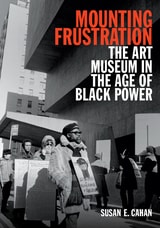
Mounting Frustration
The Art Museum in the Age of Black PowerSusan E. Cahan
Duke University Press, 2015
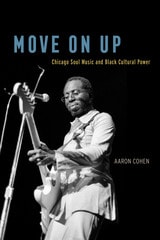
Move On Up
Chicago Soul Music and Black Cultural PowerAaron Cohen
University of Chicago Press, 2019
A Booklist Top 10 Arts Book of 2019
A No Depression Top Music Book of 2019
Curtis Mayfield. The Chi-Lites. Chaka Khan. Chicago’s place in the history of soul music is rock solid. But for Chicagoans, soul music in its heyday from the 1960s to the 1980s was more than just a series of hits: it was a marker and a source of black empowerment. In Move On Up, Aaron Cohen tells the remarkable story of the explosion of soul music in Chicago. Together, soul music and black-owned businesses thrived. Record producers and song-writers broadcast optimism for black America’s future through their sophisticated, jazz-inspired productions for the Dells and many others. Curtis Mayfield boldly sang of uplift with unmistakable grooves like “We’re a Winner” and “I Plan to Stay a Believer.” Musicians like Phil Cohran and the Pharaohs used their music to voice Afrocentric philosophies that challenged racism and segregation, while Maurice White of Earth, Wind, and Fire and Chaka Khan created music that inspired black consciousness. Soul music also accompanied the rise of African American advertisers and the campaign of Chicago’s first black mayor, Harold Washington, in 1983. This empowerment was set in stark relief by the social unrest roiling in Chicago and across the nation: as Chicago’s homegrown record labels produced rising stars singing songs of progress and freedom, Chicago’s black middle class faced limited economic opportunities and deep-seated segregation, all against a backdrop of nationwide deindustrialization.
Drawing on more than one hundred interviews and a music critic’s passion for the unmistakable Chicago soul sound, Cohen shows us how soul music became the voice of inspiration and change for a city in turmoil.
Movements in Times of Democratic Transition
Bert Klandermans
Temple University Press, 2015
The editors and contributors to Movements in Times of Democratic Transition examine in comparative detail how social movements act within the context of the democratic transitions they have been fighting for, and how they are affected by the changes they helped bring about. Offering insights into the nature of how social movements decline, radicalize, revitalize, or spark new cycles of activism, Movements in Times of Democratic Transition provides a comprehensive analysis of these key questions of mobilization research.
Contributors include: Paul Almeida, Christopher J. Colvin, Stephen Ellis, Grzegorz Ekiert, Grzegorz Forys, Krzysztof Gorlach, Camila Penna, Sebastián Pereyra, Steven Robbins, Ton Salman, Mate Szabo, Ineke van Kessel, Michal Wenzel, and the editors.
Moving Beyond Academic Discourse
Composition Studies and the Public SphereChristian R. Weisser. Foreword by Gary A. Olson
Southern Illinois University Press, 2002
Moving student writing beyond academic discourse and into larger public spheres is a difficult task, but Christian R. Weisser’s study challenges composition instructors to do just that. This highly accessible book does what no other study has attempted to do: place the most current, cutting-edge theories and pedagogies in rhetoric and composition in their intellectual and historical contexts, while at the same time offering a unique, practical theory and pedagogy of public writing for use both inside and outside of the classroom.
By positing a theory of the public for composition studies, one which envisions the public sphere as a highly contested, historically textured, multilayered, and sometimes contradictory site, Weisser offers a new approach to the roles that compositionists might assume in their attempts to initiate progressive political and social change.
After first providing a historical context that situates composition’s recent interest in public writing, Weisser next examines recent theories in composition studies that consider writing an act of social engagement before outlining a more complex theory of the public based on the work of Jürgen Habermas. The resulting re-envisioning of the public sphere expands current conversations in rhetoric and composition concerning the public.
Weisser concludes with a holistic vision that places greater political and social import on addressing public issues and conversations in the composition classroom and that elucidates the role of the public intellectual as it relates specifically to compositionists in postmodern society.
Moving Performances
Divas, Iconicity, and Remembering the Modern StageScheper, Jeanne
Rutgers University Press, 2017
Moving Politics
Emotion and ACT UP's Fight against AIDSDeborah B. Gould
University of Chicago Press, 2009
In the late 1980s, after a decade spent engaged in more routine interest-group politics, thousands of lesbians and gay men responded to the AIDS crisis by defiantly and dramatically taking to the streets. But by the early 1990s, the organization they founded, ACT UP, was no more—even as the AIDS epidemic raged on. Weaving together interviews with activists, extensive research, and reflections on the author’s time as a member of the organization, Moving Politics is the first book to chronicle the rise and fall of ACT UP, highlighting a key factor in its trajectory: emotion.
Surprisingly overlooked by many scholars of social movements, emotion, Gould argues, plays a fundamental role in political activism. From anger to hope, pride to shame, and solidarity to despair, feelings played a significant part in ACT UP’s provocative style of protest, which included raucous demonstrations, die-ins, and other kinds of street theater. Detailing the movement’s public triumphs and private setbacks, Moving Politics is the definitive account of ACT UP’s origin, development, and decline as well as a searching look at the role of emotion in contentious politics.

Murder in Their Hearts
The Fall Creek MassacreDavid Thomas Murphy
Indiana Historical Society Press, 2010

Murdoch's Politics
How One Man's Thirst For Wealth and Power Shapes our WorldDavid McKnight
Pluto Press, 2013
Rupert Murdoch's News Corporation is the most powerful media organisation in the world. Murdoch's commercial success is obvious, but less well understood is his successful pursuit of political goals, using News Corporation as his vehicle.
In Murdoch's Politics David McKnight tracks Murdoch's influence, from his support for Reagan and Thatcher, his deal with Tony Blair and attacks on Barack Obama. He examines the secretive corporate culture of News Corporation: its private political seminars for editors, its support for think tanks and its global campaigns on issues like Iraq and climate change.
Including analysis of the phone hacking crisis, possible bribery charges and Murdoch's appearance at the Leveson enquiry, this book is a highly topical study of one of the most influential and controversial figures of the modern age.
Museum Frictions
Public Cultures/Global TransformationsIvan Karp, Corinne A. Kratz, Lynn Szwaja, and Tomás Ybarra-Frausto With Gustavo Buntinx, Barbara Kirshenblatt-Gimblett, and Ciraj Rassool, eds.
Duke University Press, 2006
Whether contrasting the transformation of Africa’s oldest museum, the South Africa Museum, with one of its newest, the Lwandle Migrant Labor Museum; offering an interpretation of the audio guide at the Guggenheim Bilbao; reflecting on the relative paucity of art museums in Peru and Cambodia; considering representations of slavery in the United States and Ghana; or meditating on the ramifications of an exhibition of Australian aboriginal art at the Asia Society in New York City, the contributors highlight the frictions, contradictions, and collaborations emerging in museums and heritage sites around the world. The volume opens with an extensive introductory essay by Ivan Karp and Corinne A. Kratz, leading scholars in museum and heritage studies.
Contributors. Tony Bennett, David Bunn, Gustavo Buntinx, Cuauhtémoc Camarena, Andrea Fraser, Martin Hall, Ivan Karp, Barbara Kirshenblatt-Gimblett, Corinne A. Kratz, Christine Mullen Kreamer, Joseph Masco, Teresa Morales, Howard Morphy, Ingrid Muan, Fred Myers, Ciraj Rassool, Vicente Razo, Fath Davis Ruffins, Lynn Szwaja, Krista A. Thompson, Leslie Witz, Tomás Ybarra-Frausto
Museum Politics
Power Plays At The ExhibitionTimothy W. Luke
University of Minnesota Press, 2002
The first sustained critique of the ways museum exhibits shape cultural assumptions and political values
Each year the more than seven thousand museums in the United States attract more attendees than either movies or sports. Yet until recently, museums have escaped serious political analysis. The past decade, however, has witnessed a series of unusually acrimonious debates about the social, political, and moral implications of museum exhibitions as varied as the Enola Gay display at the Smithsonian’s Air and Space Museum and the Sensation exhibit at the Brooklyn Museum of Art.
In this important volume, Timothy W. Luke explores museums’s power to shape collective values and social understandings, and argues persuasively that museum exhibitions have a profound effect on the body politic. Through discussions of topics ranging from how the National Holocaust Museum and the Museum of Tolerance in Los Angeles have interpreted the Holocaust to the ways in which the American Museum of Natural History, the Missouri Botanical Gardens, and Tucson’s Arizona-Sonora Desert Museum have depicted the natural world, Luke exposes the processes through which museums challenge but more often affirm key cultural and social realities.
Music Is Power
Popular Songs, Social Justice, and the Will to ChangeBrad Schreiber
Rutgers University Press, 2024
Honorable Mention, Graphis 2021 Design Annual Competition
Popular music has long been a powerful force for social change. Protest songs have served as anthems regarding war, racism, sexism, ecological destruction, and so many other crucial issues.
Music Is Power takes us on a guided tour through the past one hundred years of politically conscious music, from Pete Seeger and Woody Guthrie to Green Day and NWA. Covering a wide variety of genres, including reggae, country, metal, psychedelia, rap, punk, folk, and soul, Brad Schreiber demonstrates how musicians can take a variety of approaches— angry rallying cries, mournful elegies to the victims of injustice, or even humorous mockeries of authority—to fight for a fairer world. While shining a spotlight on Phil Ochs, Gil Scott-Heron, the Dead Kennedys and other seminal, politicized artists, he also gives readers a new appreciation of classic acts such as Lesley Gore, James Brown, and Black Sabbath, who overcame limitations in their industry to create politically potent music
Music Is Power tells fascinating stories about the origins and the impact of dozens of world-changing songs, while revealing political context and the personal challenges of legendary artists from Bob Dylan to Bob Marley.
Supplemental material (Artist and Title List): https://d3tto5i5w9ogdd.cloudfront.net/wp-content/uploads/2020/07/24001955/Music_Is_Power_Supplementary_Artist_Title_List.doc
Music and the Making of Portugal and Spain
Nationalism and Identity Politics in the Iberian PeninsulaEdited by Matthew Machin-Autenrieth, Salwa el-Shawan Castelo-Branco, and Samuel Llano
University of Illinois Press, 2023
What does music in Portugal and Spain reveal about the relationship between national and regional identity building? How do various actors use music to advance nationalism? How have state and international heritage regimes contributed to nationalist and regionalist projects? In this collection, contributors explore these and other essential questions from a range of interdisciplinary vantage points. The essays pay particular attention to the role played by the state in deciding what music represents Portuguese or Spanish identity. Case studies examine many aspects of the issue, including local recording networks, so-called national style in popular music, and music’s role in both political protest and heritage regimes. Topics include the ways the Salazar and Franco regimes adapted music to align with their ideological agendas; the twenty-first-century impact of UNESCO’s Intangible Cultural Heritage program on some of Portugal and Spain's expressive practices; and the tensions that arise between institutions and community in creating and recreating meanings and identity around music.
Contributors: Ricardo Andrade, Vera Marques Alves, Salwa El-Shawan Castelo-Branco, Cristina Sánchez-Carretero, José Hugo Pires Castro, Paulo Ferreira de Castro, Fernán del Val, Héctor Fouce, Diego García-Peinazo, Leonor Losa, Josep Martí, Eva Moreda Rodríguez, Pedro Russo Moreira, Cristina Cruces Roldán, and Igor Contreras Zubillaga
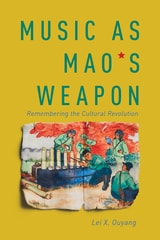
Music as Mao's Weapon
Remembering the Cultural RevolutionLei X. Ouyang
University of Illinois Press, 2022
China's Cultural Revolution (1966-1976) produced propaganda music that still stirs unease and, at times, evokes nostalgia. Lei X. Ouyang uses selections from revolutionary songbooks to untangle the complex interactions between memory, trauma, and generational imprinting among those who survived the period of extremes. Interviews combine with ethnographic fieldwork and surveys to explore both the Cultural Revolution's effect on those who lived through it as children and contemporary remembrance of the music created to serve the Maoist regime. As Ouyang shows, the weaponization of music served an ideological revolution but also revolutionized the senses. She examines essential questions raised by this phenomenon, including: What did the revolutionization look, sound, and feel like? What does it take for individuals and groups to engage with such music? And what is the impact of such an experience over time?
Perceptive and provocative, Music as Mao's Weapon is an insightful look at the exploitation and manipulation of the arts under authoritarianism.
My Brother's Keeper
George McGovern and Progressive ChristianityMark A. Lempke
University of Massachusetts Press, 2017
George McGovern is chiefly remembered for his landslide loss to Richard Nixon in 1972. Yet at the time, his candidacy raised eyebrows by invoking the prophetic tradition, an element of his legacy that is little studied. In My Brother's Keeper, Mark A. Lempke explores the influence of McGovern's evangelical childhood, Social Gospel worldview, and conscientious Methodism on a campaign that brought antiwar activism into the mainstream.
McGovern's candidacy signified a passing of the torch within Christian social justice. He initially allied with the ecumenical movement and the mainline Protestant churches during a time when these institutions worked easily with liberal statesmen. But the senator also galvanized a dynamic movement of evangelicals rooted in the New Left, who would dominate subsequent progressive religious activism as the mainline entered a period of decline. My Brother's Keeper argues for the influential, and often unwitting, role McGovern played in fomenting a “Religious Left” in 1970s America, a movement that continues to this day. It joins a growing body of scholarship that complicates the dominant narrative of that era's conservative Christianity.
My Voice Is My Weapon
Music, Nationalism, and the Poetics of Palestinian ResistanceDavid A. McDonald
Duke University Press, 2013
Myriad Intimacies
Lata Mani
Duke University Press, 2022
Mythical River
Chasing the Mirage of New Water in the American SouthwestMelissa L. Sevigny
University of Iowa Press, 2016
In contrast to this fantasy of abundance, Sevigny explores acts of restoration. From a dismantled dam in Arizona to an accidental wetland in Mexico, she examines how ecologists, engineers, politicians, and citizens have attempted to secure water for desert ecosystems. In a place scarred by conflict, she shows how recognizing the rights of rivers is a path toward water security. Ultimately, Sevigny writes a new map for the future of the American Southwest, a vision of a society that accepts the desert’s limits in exchange for an intimate relationship with the natural world.
Myths America Lives By
White Supremacy and the Stories That Give Us MeaningRichard T. Hughes
University of Illinois Press, 2018
meXicana Fashions
Politics, Self-Adornment, and Identity ConstructionEdited by Aída Hurtado and Norma E. Cantú
University of Texas Press, 2020
2020 Second Place, Best Nonfiction Multi Author, International Latino Book Awards
Collecting the perspectives of scholars who reflect on their own relationships to particular garments, analyze the politics of dress, and examine the role of consumerism and entrepreneurialism in the production of creating and selling a style, meXicana Fashions examines and searches for meaning in these visible, performative aspects of identity.
Focusing primarily on Chicanas but also considering trends connected to other Latin American communities, the authors highlight specific constituencies that are defined by region (“Tejana style,” “L.A. style”), age group (“homie,” “chola”), and social class (marked by haute couture labels such as Carolina Herrera and Oscar de la Renta). The essays acknowledge the complex layers of these styles, which are not mutually exclusive but instead reflect a range of intersections in occupation, origin, personality, sexuality, and fads. Other elements include urban indigenous fashion shows, the shifting quinceañera market, “walking altars” on the Days of the Dead, plus-size clothing, huipiles in the workplace, and dressing in drag. Together, these chapters illuminate the full array of messages woven into a vibrant social fabric.