1201 books match the query 'Race relations' and 59 start with m
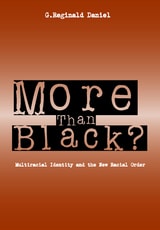
cover of More Than Black: Multiracial Identity & New Racial Order

More Than Black

Multiracial Identity & New Racial Order

G. Reginald Daniel

Temple University Press, 2001

In the United States, anyone with even a trace of African American ancestry has been considered black. Even as the twenty-first century opens, a racial hierarchy still prevents people of color, including individuals of mixed race, from enjoying the same privileges as Euro-Americans. In this book, G. Reginald Daniel argues that we are at a cross-roads, with members of a new multiracial movement pointing the way toward equality.

Tracing the centuries-long evolution of Eurocentrism, a concept geared to protecting white racial purity and social privilege, Daniel shows how race has been constructed and regulated in the United States. The so-called one-drop rule (i.e., hypodescent) obligated individuals to identify as black or white, in effect erasing mixed-race individuals from the social landscape. For most of our history, many mixed-race individuals of African American descent have attempted to acquire the socioeconomic benefits of being white by forming separate enclaves or "passing." By the 1990s, however, interracial marriages became increasingly common, and multiracial individuals became increasingly political, demanding institutional changes that would recognize the reality of multiple racial backgrounds and challenging white racial privilege.

More Than Black? regards the crumbling of the old racial order as an opportunity for substantially more than an improvement in U.S. race relations; it offers no less than a radical transformation of the nation's racial consciousness and the practice of democracy.
[more]
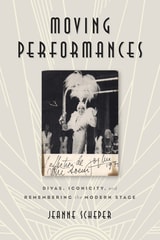
cover of Moving Performances: Divas, Iconicity, and Remembering the Modern Stage

Moving Performances

Divas, Iconicity, and Remembering the Modern Stage

Scheper, Jeanne

Rutgers University Press, 2017

Fabulous yet fierce, imperious yet impetuous, boss yet bitchy—divas are figures of paradox. Their place in culture is equally contradictory, as they are simultaneously venerated and marginalized, hailed as timeless but then frequently forgotten or exhumed as cult icons by future generations. 
 
Focusing on four early twentieth-century divas—Aida Overton Walker, Loïe Fuller, Libby Holman, and Josephine Baker—who were icons in their own time, Moving Performances considers what their past and current reception reveals about changing ideas of race and gender. Jeanne Scheper examines how iconicity can actually work to the diva’s detriment, reducing her to a fetish object, a grotesque, or a figure of nostalgia. Yet she also locates more productive modes of reception that reach to revive the diva’s moving performances, imbuing her with an affective afterlife.  
 
As it offers innovative theorizations of performance, reception, and affect, Moving Performances also introduces readers to four remarkable women who worked as both cultural producers and critics, deftly subverting the tropes of exoticism, orientalism, and primitivism commonly used to dismiss women of color. Rejecting iconic depictions of these divas as frozen in a past moment, Scheper vividly demonstrates how their performances continue to inspire ongoing movements. 
 
[more]
cover of Mu, 49 Marks of Abolition

Mu, 49 Marks of Abolition

Sora Y. Han

Duke University Press, 2024
In March 2020, Sora Y. Han learned her father was dying of cancer just as the COVID-19 pandemic arrived on California's shores. These two events led Han to introspection: “Who have I been writing to?” and “Who have I been writing for?” In her observance of the 49 days of mourning in Buddhist tradition, answers come in the form of mu – no thing, nothingness. Han’s poetic meditations on freedom struggle come alive in the empty spaces between words, letters, and pictograms spanning her many languages—English, Korean, Chinese, jazz, law, and poetry. Transliterating and dystranslating the writings of Fred Moten, Theresa Hak Kyung Cha, Jacques Lacan, Frantz Fanon, and others through the Korean alphabet, Han weaves the DMZ, Betty’s Case, the Thirteenth Amendment, Afro-pessimism, and psychoanalytic desire together into the open field of Bay Area radicalism. Mu is both a loving homage to and a playful subversion of political inheritances and the unsayable beyond law.
[more]
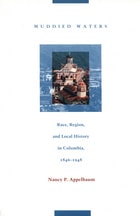
cover of Muddied Waters: Race, Region, and Local History in Colombia, 1846–1948

Muddied Waters

Race, Region, and Local History in Colombia, 1846–1948

Nancy P. Appelbaum

Duke University Press, 2003

Colombia’s western Coffee Region is renowned for the whiteness of its inhabitants, who are often described as respectable pioneer families who domesticated a wild frontier and planted coffee on the forested slopes of the Andes. Some local inhabitants, however, tell a different tale—of white migrants rapaciously usurping the lands of indigenous and black communities. Muddied Waters examines both of these legends, showing how local communities, settlers, speculators, and politicians struggled over jurisdictional boundaries and the privatization of communal lands in the creation of the Coffee Region. Viewing the emergence of this region from the perspective of Riosucio, a multiracial town within it, Nancy P. Appelbaum reveals the contingent and contested nature of Colombia’s racialized regional identities.

Nineteenth- and twentieth-century Colombian elite intellectuals, Appelbaum contends, mapped race onto their mountainous topography by defining regions in racial terms. They privileged certain places and inhabitants as white and modern and denigrated others as racially inferior and backward. Inhabitants of Riosucio, however, elaborated local narratives about their mestizo and indigenous identities that contested the white mystique of the Coffee Region. Ongoing violent conflicts over land and politics, Appelbaum finds, continue to shape local debates over history and identity. Drawing on archival and published sources complemented by oral history, Muddied Waters vividly illustrates the relationship of mythmaking and racial inequality to regionalism and frontier colonization in postcolonial Latin America.
[more]
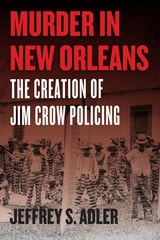
cover of Murder in New Orleans: The Creation of Jim Crow Policing

Murder in New Orleans

The Creation of Jim Crow Policing

Jeffrey S. Adler

University of Chicago Press, 2019

New Orleans in the 1920s and 1930s was a deadly place. In 1925, the city’s homicide rate was six times that of New York City and twelve times that of Boston. Jeffrey S. Adler has explored every homicide recorded in New Orleans between 1925 and 1940—over two thousand in all—scouring police and autopsy reports, old interviews, and crumbling newspapers. More than simply quantifying these cases, Adler places them in larger contexts—legal, political, cultural, and demographic—and emerges with a tale of racism, urban violence, and vicious policing that has startling relevance for today.

Murder in New Orleans shows that whites were convicted of homicide at far higher rates than blacks leading up to the mid-1920s. But by the end of the following decade, this pattern had reversed completely, despite an overall drop in municipal crime rates. The injustice of this sharp rise in arrests was compounded by increasingly brutal treatment of black subjects by the New Orleans police department. Adler explores other counterintuitive trends in violence, particularly how murder soared during the flush times of the Roaring Twenties, how it plummeted during the Great Depression, and how the vicious response to African American crime occurred even as such violence plunged in frequency—revealing that the city’s cycle of racial policing and punishment was connected less to actual patterns of wrongdoing than to the national enshrinement of Jim Crow. Rather than some hyperviolent outlier, this Louisiana city was a harbinger of the endemic racism at the center of today’s criminal justice state. Murder in New Orleans lays bare how decades-old crimes, and the racially motivated cruelty of the official response, have baleful resonance in the age of Black Lives Matter.

[more]
cover of Murder in Their Hearts: The Fall Creek Massacre

Murder in Their Hearts

The Fall Creek Massacre

David Thomas Murphy

Indiana Historical Society Press, 2010
In March 1824 a group of angry and intoxicated settlers brutally murdered nine Indians camped along a tributary of Fall Creek. The carnage was recounted in lurid detail in the contemporary press, and the events that followed sparked a national sensation. Murder in Their Hearts: The Fall Creek Massacre tells that, although violence between settlers and Native Americans was not unusual during the early nineteenth century, in this particular incident the white men responsible for the murders were singled out and hunted down, brought to trial, convicted by a jury of their neighbors, and, for the first time under American law, sentenced to death and executed for the murder of Native Americans.
[more]
cover of Murder on Shades Mountain: The Legal Lynching of Willie Peterson and the Struggle for Justice in Jim Crow Birmingham

Murder on Shades Mountain

The Legal Lynching of Willie Peterson and the Struggle for Justice in Jim Crow Birmingham

Melanie S. Morrison

Duke University Press, 2018

One August night in 1931, on a secluded mountain ridge overlooking Birmingham, Alabama, three young white women were brutally attacked. The sole survivor, Nell Williams, age eighteen, said a black man had held the women captive for four hours before shooting them and disappearing into the woods. That same night, a reign of terror was unleashed on Birmingham's black community: black businesses were set ablaze, posses of armed white men roamed the streets, and dozens of black men were arrested in the largest manhunt in Jefferson County history. Weeks later, Nell identified Willie Peterson as the attacker who killed her sister Augusta and their friend Jennie Wood. With the exception of being black, Peterson bore little resemblance to the description Nell gave the police. An all-white jury convicted Peterson of murder and sentenced him to death.

In Murder on Shades Mountain Melanie S. Morrison tells the gripping and tragic story of the attack and its aftermath—events that shook Birmingham to its core. Having first heard the story from her father—who dated Nell's youngest sister when he was a teenager—Morrison scoured the historical archives and documented the black-led campaigns that sought to overturn Peterson's unjust conviction, spearheaded by the NAACP and the Communist Party. The travesty of justice suffered by Peterson reveals how the judicial system could function as a lynch mob in the Jim Crow South. Murder on Shades Mountain also sheds new light on the struggle for justice in Depression-era Birmingham. This riveting narrative is a testament to the courageous predecessors of present-day movements that demand an end to racial profiling, police brutality, and the criminalization of black men.

[more]
cover of My Father Said Yes: A White Pastor in Little Rock School Integration

My Father Said Yes

A White Pastor in Little Rock School Integration

Dunbar H. Ogden

Vanderbilt University Press, 2008

On September 4, 1957, the group of African American high school students who became known as the Little Rock Nine walked up to the front of Central High to enroll in school. They were turned away by the National Guard, who had been called out by Arkansas Governor Orval Faubus. "Blood will run in the streets," said Faubus, "if Negro pupils should attempt to enter Central High School." A mob seethed out front. The man who led the Nine up to the lines of the National Guard on that fateful morning was the author's father, a white Presbyterian pastor.


My Father Said Yes is the untold story of the Reverend Dunbar Ogden, who became the pro-integration leader in Little Rock's white community. He responded to a call for support from Daisy Bates, co-owner of the town's black newspaper. Both faced fierce opposition from within as well as from outside. Reverend Ogden lost his church and Daisy Bates lost her newspaper.


This memoir is also a moving father-son story. In this frank account, the author discusses the depression his father battled for most of his life, as well as the family tragedy of his brother's suicide.

[more]
cover of Myth, Magic, and Farce: Four Multicultural Plays by Sterling Houston

Myth, Magic, and Farce

Four Multicultural Plays by Sterling Houston

Sterling Houston

University of North Texas Press, 2005

[more]