Results by title
1214 books match the query 'Subjects & Themes' and 59 start with m
Muscadine
A. H. Jerriod Avant
Four Way Books, 2023
Music in the Background
Bryce G. Boyer
Bridwell Press, 2026
I’ve been a professional journalist for over 50 years now, a prose writer whose favorite form is the essay. But there are emotions that poetry seems to capture better than prose. Not unique emotions because there are no such things as unique emotions, only the emotions shared by all of us, shared by the whole world. For me, prose seems much more observational, more a reflection of what our senses present and whatever meaning we attach to that reflection. Poetry is more an attempt to understand our feelings by digging down into ourselves like a spelunker explores a cave. The cave is ourselves, and we try to discover—or more probably uncover—what's down there that makes us human. In these few poems I've tried to throw a small flashlight beam on a few of those places down there.
My Life in Brutalist Architecture
John Gallaher
Four Way Books, 2024
My Oceans
Essays of Water, Whales, and WomenChristina Rivera
Northwestern University Press, 2025
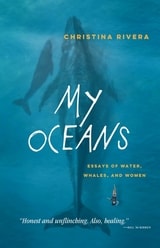
In a swell of sea-linked essays, Christina Rivera explores the kinship between marine animals, humans, and Earth’s blue womb. Rivera’s investigative questions begin with the toxic burden of her body and spiral out—to a grieving orca, a hunted manta ray, a pregnant sea turtle, a spawning salmon, an “endling” porpoise, and the “mother culture” of sperm whales—as she redefines what it means to mother and defend a collective future.
Braiding memoir with embodied climate science, Rivera challenges that it’s not anthropomorphism to feel deep connection to nonhuman species and proposes that gathering in collective grief is essential amid the sixth mass extinction. For ecofeminists, fans of Rachel Carson and Terry Tempest Williams—and for anyone who feels themself disintegrate in the presence of the sea—My Oceans offers a timely and wondrous descent into the deep waters of interconnection in which we swim.
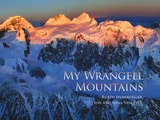
My Wrangell Mountains
Ruedi Homberger, Jon and Jona Van Zyle
University of Alaska Press, 2011
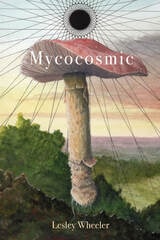
Mycocosmic
Lesley Wheeler
Tupelo Press, 2025
“Good things come to you through fire,” a Tarot reader told Lesley Wheeler as she was composing what became her sixth poetry collection, Mycocosmic. But how could that be true, while the planet was burning and life slamming her with one loss after another? Then she learned about pyrophilic fungi that lurk in soil until activated by fire. Enter mycelia and a teeming underground world that metabolizes death, changing what remains so that life can begin anew.
Mycocosmic offers intricately woven spell poems—prayers, hexes, charms, and invocations—that call for transformation. A parent’s death gives Wheeler the freedom to reveal difficult truths about family violence and her sexuality; a midlife mental health crisis transforms her sense of self. Incantatory language channeled through a wide variety of forms—including free verse, litany, sonnets, the bref double, the golden shovel, and the villanelle—empowers these shifts.
Beneath these poems runs a book-length essay in verse, “Underpoem [Fire Fungus],” sending tendrils across the footer of each page. This poetic mycelium nourishes metamorphosis and highlights its urgency. As Merlyn Sheldrake writes in Entangled Life, “Mycelium describes the most common of fungal habits, better thought of not as a thing but as a process: an exploratory, irregular tendency.” Poetry is rooted in real and imagined communities and conversations. Mycocosmic demonstrates how interdependence binds us together.
Mystical Poems of Rumi
Jalal al-Din Rumi
University of Chicago Press, 2009
Devour it the moment it is fresh, before the dust settles upon it.
Its place is the warm climate of the heart; in this world it dies of cold.
Like a fish it quivered for an instant on dry land, another moment and you see it is cold.
Even if you eat it imagining it is fresh, it is necessary to conjure up many images.
What you drink is really your own imagination; it is no old tale, my good man.
“Rumi is one of the world’s greatest lyrical poets in any language—as well as probably the most accessible and approachable representative of Islamic civilization for Western students.”—James W. Morris, Oberlin College
Mythography
The Study of Myths and RitualsWilliam G. Doty
University of Alabama Press, 2000
This new edition of William Doty's critically acclaimed study provides a comprehensive guidebook to the many schools of interpretation in this burgeoning field
William Doty's popular text has been hailed as the most comprehensive work of its kind. Extensively rewritten and completely restructured, the new edition provides further depth and perspective and is even more accessible to students of myth. It includes expanded coverage of postmodern and poststructuralist perspectives, the Gernet Center, mythic iconography, neo-Jungian approaches, and cultural studies, and it summarizes what is new in the study of Greek myth, iconography, French classical scholarship, and ritual studies. It also features a comprehensive index of names and topics, a glossary, an up-to-date annotated bibliography, and a guide to myth on the Internet.
Presenting all major myth theorists from antiquity to the present, Mythography is an encyclopedic work that offers a cross-disciplinary approach to the study of myth. By reflecting the dramatic increase in interest in myth among both scholars and general readers since publication of the first edition, it remains a key study of modern approaches to myth and
an essential guide to the wealth of mythographic research available today.
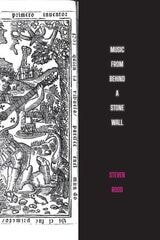
music from behind a stone wall
Steven Rood
Omnidawn, 2024
The poems in Steven Rood’s newest collection take on a musical sensibility as they flow from the poet’s sixty years as a classical guitarist who remains preoccupied with the tonalities of daily life. Each poem in music from behind a stone wall comes together to build a multi-layered symphony that reveals the delights and travails of family life and moments of intimate connection with animals and plants. At the core of the book are poems considering the overwhelming task of trying to communicate the essence of musical experience via the written word. This is a book of grief and joy sung with lyric acuity, vivid images, and formal variation.