Results by title
8642 books match the query '20th Century' and 493 start with m

Malcolm X's Michigan Worldview
An Exemplar for Contemporary Black StudiesRita Kiki Edozie
Michigan State University Press, 2024

Malicious Intent
Murder and the Perpetuation of Jim Crow Health CareDavid Barton Smith
Vanderbilt University Press, 2023
Race-related disparities in American death rates, exacerbated once again by the COVID-19 pandemic, have persisted since the birth of the modern US medical system a century ago. A unique but perpetually unequal history has prevented the United States from providing the kind of health care assurances that are taken for granted in other industrialized nations. The underlying story is one of political, medical, and bureaucratic machinations, all motivated by a deliberate Jim Crow systemic design. In Malicious Intent, David Barton Smith traces the Jean Cowsert story and the cold case of her death as a through line to explain the construction and fulfillment of an unequal health care system that would rather sacrifice many than provide for Black Americans.
Cowsert’s suspicious death came at a key moment in the struggle for universal health care in the wealthiest country on earth. Malicious Intent is a history of those failed efforts and a story of selective amnesia about one doctor’s death and the movement she fought for.

Malignant Growth
Creating the Modern Cancer Research Establishment, 1875–1915Alan I Marcus
University of Alabama Press, 2018
In Malignant Growth: Creating the Modern Cancer Research Establishment, 1875–1915, Alan I Marcus explores a relatively understudied period in the history of cancer by providing a careful investigation of the first public crusade to determine the cause of cancer. The search for cancer’s cause during the heady era of bacteriology was colored by the Germ Theory of Disease. Researchers had demonstrated in malady after malady that each disease was the result of a singular and specific pathogenic agent. That model led investigators to optimistically conclude that they would soon find the cause of what was termed the “emperor of all maladies,” cases of which were apparently increasing at a prodigious rate worldwide.
In this accessible history of science and medicine, Marcus exposes the complex story of the efforts made from 1875 through 1915 to first conquer and, failing that, to control cancer—a dual approach that remains in force to this day. He reveals the messiness of real-time scientific research, tracing the repeated lurches of promise, discoveries of hope, and the inevitable despair that always followed. Other barriers existed to the research, such as inconsistency in test standards and inter-laboratory competition and mistrust. Researchers approached cancer from such disparate specialties as clinical medicine, zoology, botany, chemistry, nutrition, bacteriology, pathology, and microbiology. Although they came from diverse fields, each steadfastly maintained that cancer operated in an analogous fashion to other bacteriological diseases.
Virtually every country and a slew of various clinicians and investigators waged this first war on cancer, operating in remarkably diverse scientific venues. Cancer laboratories and hospitals, as well as organizations like the American Cancer Society, were born out of this first offensive on cancer. Even as cancer continues to proliferate today, these institutions that initially formed to defeat cancer more than a hundred years ago persist and continue to expand.

Mama Might Be Better Off Dead
The Failure of Health Care in Urban AmericaLaurie Kaye Abraham
University of Chicago Press, 1994
Mama Might Be Better Off Dead immerses readers in the lives of four generations of a poor, African-American family in the neighborhood, who are beset with the devastating illnesses that are all too common in America’s inner-cities. Headed by Jackie Banes, who oversees the care of a diabetic grandmother, a husband on kidney dialysis, an ailing father, and three children, the Banes family contends with countless medical crises. From visits to emergency rooms and dialysis units, to trials with home care, to struggles for Medicaid eligibility, Laurie Kaye Abraham chronicles their access—or more often, lack thereof—to medical care. Told sympathetically but without sentimentality, their story reveals an inadequate health care system that is further undermined by the direct and indirect effects of poverty.
Both disturbing and illuminating, Mama Might Be Better Off Dead is an unsettling, profound look at the human face of health care in America. Published to great acclaim in 1993, the book in this new edition includes an incisive foreword by David Ansell, a physician who worked at Mt. Sinai Hospital, where much of the Banes family’s narrative unfolds.

Mammy
A Century of Race, Gender, and Southern MemoryKimberly Wallace-Sanders
University of Michigan Press, 2008
---Choice
"In this insightful analysis of representations of mammy, Wallace-Sanders skillfully illustrates how this core icon of Black womanhood has figured prominently in upholding hierarchies of race, gender, and class in the United States. Far from being a timeless, natural, benign image of domesticity, the idealized mammy figure was repeatedly reworked to accommodate varying configurations of racial rule. No one reading this book will be able to see Gone with the Wind in the same way ever again."
---Patricia Hill Collins, University of Maryland
"Kimberly Wallace-Sanders' interdisciplinary approach is first-rate. This expansive and engaging book should appeal to students and scholars in American studies, African American studies, and women's studies."
---Thadious Davis, The University of Pennsylvania
Her cheerful smile and bright eyes gaze out from the covers of old cookbooks, song sheets, syrup bottles, salt and pepper shakers, and cookie jars, and she has long been a prominent figure in fiction, film, television, and folk art. She is Mammy, a figure whose provocative hold on the American psyche has persisted since before the Civil War.
But who is Mammy, and where did she come from? Her large, dark body and her round smiling face tower over our imaginations to such an extent that more accurate representations of African American women wither in her shadow. Mammy's stereotypical attributes---a sonorous and soothing voice, raucous laugh, infinite patience, self-deprecating wit, and implicit acceptance of her own inferiority and her devotion to white children---all point to a long-lasting and troubled confluence of racism, sexism, and southern nostalgia.
This groundbreaking book traces the mammy figure and what it has symbolized at various historical moments that are linked to phases in America's racial consciousness. The author shows how representations of Mammy have loomed over the American literary and cultural imagination, an influence so pervasive that only a comprehensive and integrated approach of this kind can do it justice.
The book's many illustrations trace representations of the mammy figure from the nineteenth century to the present, as she has been depicted in advertising, book illustrations, kitchen figurines, and dolls. The author also surveys the rich and previously unmined history of the responses of African American artists to the black mammy stereotype, including contemporary reframings by artists Betye Saar, Michael Ray Charles, and Joyce Scott.
Kimberly Wallace-Sanders is Associate Professor of the Graduate Institute of Liberal Arts and Women's Studies at Emory University. She is editor of Skin Deep, Spirit Strong: The Black Female Body in American Culture.

Man in a Hurry
Murray MacLehose and Colonial Autonomy in Hong KongRay Yep
Hong Kong University Press, 2024
Man in a Hurry explores the latest available archival materials and re-examines MacLehose’s pivotal governorship in Hong Kong (1971–1982). MacLehose arrived in the challenging 1970s, when there were expectations for social reforms, uneasiness in the relationship between Hong Kong and London, and the 1997 factor looming large. The governor successfully carried out various social reforms and he also handled various major issues, including the anti-corruption campaign, the Vietnamese refugee crisis, and the granting of land lease of the New Territories beyond 1997. Yep unveils the tension and bargaining between the British government and explains how interest of the colony could be asserted, defended, and negotiated. This book is an important study of Hong Kong’s "golden years" when the city’s economy took off. It is a significant contribution to our understanding of how local autonomy was defined.
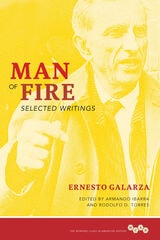
Man of Fire
Selected WritingsErnesto Galarza, Edited by Armando Ibarra and Rodolfo D. Torres
University of Illinois Press, 2013
Managed Migrations
Growers, Farmworkers, and Border Enforcement in the Twentieth CenturyBy Cristina Salinas
University of Texas Press, 2018
2020 National Association for Chicana and Chicano Studies (NACCS) Book Award Winner
Honorable Mention, Ramirez Family Award for Most Significant Scholarly Book, Texas Institute of Letters, 2019
Managed Migrations examines the concurrent development of a border agricultural industry and changing methods of border enforcement in the Rio Grande Valley of Texas during the past century.
Needed at one moment, scorned at others, Mexican agricultural workers have moved back and forth across the US–Mexico border for the past century. In South Texas, Anglo growers’ dreams of creating a modern agricultural empire depended on continuous access to Mexican workers. While this access was officially regulated by immigration laws and policy promulgated in Washington, DC, in practice the migration of Mexican labor involved daily, on-the-ground negotiations among growers, workers, and the US Border Patrol. In a very real sense, these groups set the parameters of border enforcement policy.
Managed Migrations examines the relationship between immigration laws and policy and the agricultural labor relations of growers and workers in South Texas and El Paso during the 1940s and 1950s. Cristina Salinas argues that immigration law was mainly enacted not in embassies or the halls of Congress but on the ground, as a result of daily decisions by the Border Patrol that growers and workers negotiated and contested. She describes how the INS devised techniques to facilitate high-volume yearly deportations and shows how the agency used these enforcement practices to manage the seasonal agricultural labor migration across the border. Her pioneering research reveals the great extent to which immigration policy was made at the local level, as well as the agency of Mexican farmworkers who managed to maintain their mobility and kinship networks despite the constraints of grower paternalism and enforcement actions by the Border Patrol.

Managing Energy Use in Modern Buildings
Case Studies in Conservation PracticeBernard Flaman
J. Paul Getty Trust, The, 2021
This collection of ten case studies addresses the issues surrounding the improvement of energy consumption and thermal comfort in modern buildings built between 1928 and 1969 and offers valuable lessons for other structures facing similar issues. These buildings, international in scope and diverse in type, style, and size, range from the Shulman House, a small residence in Los Angeles, to the TD Bank Tower, a skyscraper complex in Toronto, and from the Calouste Gulbenkian Foundation, a cultural venue in Lisbon, to the Van Nelle Factory in Rotterdam, now an office building. Showing ingenuity and sensitivity, the case studies consider improvements to such systems as heating, cooling, lighting, ventilation, and controls. They provide examples that demonstrate best practices in conservation and show ways to reduce carbon footprints, minimize impacts to historic materials and features, and introduce renewable energy sources, in compliance with energy codes and green-building rating systems.
The Conserving Modern Heritage series, launched in 2019, is written by architects, engineers, conservators, scholars, and allied professionals. The books in this series provide well-vetted case studies that address the challenges of conserving twentieth-century heritage.

Managing Legal Uncertainty
Elite Lawyers in the New DealRonen Shamir
Duke University Press, 1995
Applying the insights of Weber and Bourdieu to the sociology of the legal profession, Shamir shows that elite members of the bar had a keen self-interest in blocking the expansion of administrative law. He dismisses as oversimplified the view that elite lawyers were "hired guns" who argued that New Deal legislation was unconstitutional solely because of their duty to represent their capitalist clients. Instead, Shamir suggests, their alignment with the capitalist class was an incidental result of their attempt to articulate their vision of the law as scientific, apolitical, and judicially oriented—and thereby to defend their own position within the law profession. The academic legal realists on the other side of the constitutional debates criticized the rigidity of the traditional judicial process and insisted that flexibility of interpretation and the uncertainty of legal outcomes was at the heart of the legal system. The author argues that many legal realists, encouraged by the experimental nature of the New Deal, seized an opportunity to improve on their marginal status within the legal profession by moving their discussions from academic circles to the national policy agenda.
Managing Macroeconomic Policy
The Johnson PresidencyBy James E. Anderson and Jared E. Hazleton
University of Texas Press, 1986
Macroeconomic policy involves government action intended to influence the overall operation of the economy and to deal with such important public problems as economic growth, inflation, unemployment, and recession. In this first comprehensive treatment of presidential management of such policy for any presidency, authors James E. Anderson and Jared E. Hazleton focus on four tasks: developing and maintaining an information and decision-making system; coordination of policies in different macroeconomic areas; building support or consent for presidential policies; and administrative leadership. Drawing extensively upon presidential documents and interviews with Johnson administration officials, the authors pay particular attention to fiscal, monetary, wage-price, and international economic (especially balance of payments) policies during Johnson’s terms.
The authors use the concept of the subpresidency, as defined by Redford and Blisset in Organizing the Executive Branch: The Johnson Presidency (University of Chicago Press, 1981), to show how Johnson managed the macro-economic institutions of the council of Economic Advisors, the Bureau of the Budget (now the Office of Management and Budget), the Department of the Treasury, and the Federal Reserve Board in pursuit of his economic goals. What emerges is a vivid portrait of an activist president.
In evaluating management of macroeconomic policy in the Johnson administration, the authors focus on how presidential policies are developed and adopted rather than on the substance of the policies themselves. They conclude that the Johnson administration competently managed policy development during its presidential years.
This book is a volume in the Administrative History of the Johnson Presidency Series sponsored by the LBJ School of Public Affairs at the University of Texas at Austin, the first two volumes of which were published by the University of Chicago Press. Managing Macroeconomic Policy: The Johnson Presidency was funded in part by the National Endowment for the Humanities.
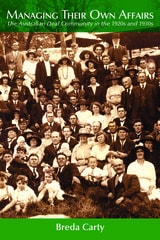
Managing Their Own Affairs
The Australian Deaf Community in the 1920s and 1930sBreda Carty
Gallaudet University Press, 2017
During this time, deaf Australians aspired to manage their own affairs. They enjoyed some success by establishing “breakaways” from the Deaf Societies, and they also established an independent national organization, which was contested and ultimately suppressed by the Deaf Societies. These developments were influenced by wider social movements in Australian society, such as the mobilization of minority groups in their push for autonomy and equal rights. Although most of the breakaway Deaf organizations did not survive beyond the 1930s, they significantly affected the power structures and relationships between deaf and hearing people in Australia. The Australian Deaf community’s attempts to organize independently during these years have been largely erased from collective memory, making Carty’s examination a particularly important and necessary addition to the historical literature.
Managing the Counterrevolution
The United States and Guatemala, 1954–1961Stephen M. Streeter
Ohio University Press, 2001
The Eisenhower administration’s intervention in Guatemala is one of the most closely studied covert operations in the history of the Cold War. Yet we know far more about the 1954 coup itself than its aftermath. This book uses the concept of “counterrevolution” to trace the Eisenhower administration’s efforts to restore U.S. hegemony in a nation whose reform governments had antagonized U.S. economic interests and the local elite.
Comparing the Guatemalan case to U.S.-sponsored counterrevolutions in Iran, the Dominican Republic, Brazil, and Chile reveals that Washington’s efforts to roll back “communism” in Latin America and elsewhere during the Cold War represented in reality a short-term strategy to protect core American interests from the rising tide of Third World nationalism.

Mandelstam, Blok, and the Boundaries of Mythopoetic Symbolism
Stuart Goldberg
The Ohio State University Press, 2011
“Mandelstam had no teacher,” marveled Anna Akhmatova, reflecting on his early maturity and singularity. But Mandelstam himself spoke of the need and even duty to study a poet’s literary roots. So how did this consummately complex, compelling, multi-resonant poet navigate and exploit the burden of the Russian Symbolist movement from which he emerged? How did this process change and augment his poetry?
Manhood in Hollywood from Bush to Bush
By David Greven
University of Texas Press, 2009
A struggle between narcissistic and masochistic modes of manhood defined Hollywood masculinity in the period between the presidencies of George H. W. Bush and George W. Bush. David Greven's contention is that a profound shift in representation occurred during the early 1990s when Hollywood was transformed by an explosion of films that foregrounded non-normative gendered identity and sexualities. In the years that have followed, popular cinema has either emulated or evaded the representational strategies of this era, especially in terms of gender and sexuality.
One major focus of this study is that, in a great deal of the criticism in both the fields of film theory and queer theory, masochism has been positively cast as a form of male sexuality that resists the structures of normative power, while narcissism has been negatively cast as either a regressive sexuality or the bastion of white male privilege. Greven argues that narcissism is a potentially radical mode of male sexuality that can defy normative codes and categories of gender, whereas masochism, far from being radical, has emerged as the default mode of a traditional normative masculinity. This study combines approaches from a variety of disciplines—psychoanalysis, queer theory, American studies, men's studies, and film theory—as it offers fresh readings of several important films of the past twenty years, including Casualties of War, The Silence of the Lambs, Fight Club, The Passion of the Christ, Auto Focus, and Brokeback Mountain.
Manhood
A Journey from Childhood into the Fierce Order of VirilityMichel Leiris
University of Chicago Press, 1992
"Leiris writes to appall, and thereby to receive from his readers the gift of a strong emotion—the emotion needed to defend himself against the indignation and disgust he expects to arouse in his readers."—Susan Sontag, New York Review of Books
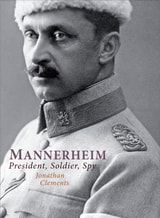
Mannerheim
President, Soldier, SpyJonathan Clements
Haus Publishing, 2012
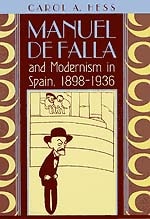
Manuel de Falla and Modernism in Spain, 1898-1936
Carol A. Hess
University of Chicago Press, 2001
Many Gods and Many Voices
The Role of the Prophet in English and American ModernismLouis L. Martz
University of Missouri Press, 1998
In Many Gods and Many Voices distinguished scholar Louis L. Martz addresses works by Ezra Pound, T. S. Eliot, William Carlos Williams, H. D., and D. H. Lawrence, with brief treatment of the relation of Pound's Cantos to Joyce's Ulysses. In a graceful, lucid style, Martz argues that a prophetic tradition is represented in the Cantos, The Waste Land, Paterson, and H. D.'s Trilogy and Helen in Egypt, along with Lawrence's Plumed Serpent and the second version of Lady Chatterley's Lover. Pound's often- cited view that an epic is a poem that "includes history" does not define epic alone, for the books of biblical prophecy also contain history: the history of Israel's misdeeds and continuous redemption.
On the other hand, Martz suggests that the term prophecy should not be limited to works that foretell the future, arguing that the biblical prophet is concerned primarily with the present. The prophet is a reformer, a denouncer of evil, as well as a seer of possible redemption. He hears "voices" and transmits the message of those voices to his people, in the hope of moving them away from wickedness and toward the ways of truth. According to Martz, such was the mission that inspired Walt Whitman and that Whitman passed on to Pound, Eliot, Williams, and Lawrence. (H. D. found her own sources of inspiration in Greek and Egyptian lore.)
Martz's premise is that biblical prophecy, with its mingling of poetry and prose, its abrupt shifts from violent denunciation to exalted poetry, provides a precedent for the texture of these modernist works that will help readers to appreciate the mingling of "voices" and the complex mixture of elements. Examining their interrelationships and their common themes, Many Gods and Many Voices offers fresh insights into these modern writers.
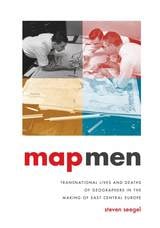
Map Men
Transnational Lives and Deaths of Geographers in the Making of East Central EuropeSteven Seegel
University of Chicago Press, 2018
Taking us deep into cartographical archives, Seegel re-creates the public and private worlds of these five mapmakers, who interacted with and influenced one another even as they played key roles in defining and redefining borders, territories, nations—and, ultimately, the interconnection of the world through two world wars. Throughout, he examines the transnational nature of these processes and addresses weighty questions about the causes and consequences of the world wars, the rise of Nazism and Stalinism, and the reasons East Central Europe became the fault line of these world-changing developments.
At a time when East Central Europe has surged back into geopolitical consciousness, Map Men offers a timely and important look at the historical origins of how the region was defined—and the key people who helped define it.
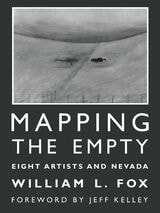
Mapping The Empty
Eight Artists And NevadaWilliam L. Fox
University of Nevada Press, 1999

Mapping Warsaw
The Spatial Poetics of a Postwar CityEwa Wampuszyc
Northwestern University Press, 2018
Juxtaposing close readings of photo books, socialist-era newsreels called the Polska Kronika Filmowa, the comedies of Leonard Buczkowski and Jan Fethke, the writing and films of Tadeusz Konwicki, and a case study on the Palace of Culture and Science—a "gift" from none other than Stalin—this study investigates the rhetorical and visual, rather than physical, reconstruction of Warsaw in various medias and genres.
Ewa Wampuszyc roots her analysis in the historical context of the postwar decade and shows how and why Poland's capital became an essential part of a propaganda program inspired by communist ideology and the needs of a newly established socialist People's Republic. Mapping Warsaw demonstrates how physical space manifests itself in culture, and how culture, history, and politics leave an indelible mark on places. It points out ways in which we take for granted our perception of space and the meanings we assign to it.
Mapping Wonderlands
Illustrated Cartography of Arizona, 1912–1962Dori Griffin
University of Arizona Press, 2013
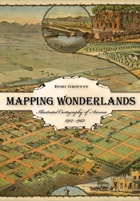
Mapping Wonderlands fills part of this gap in existing regional studies by looking at early popular pictorial maps of Arizona. These cartographic representations of the state utilize formal mapmaking conventions to create a place-based state history. They introduce illustrations, unique naming conventions, and written narratives to create carefully visualized landscapes that emphasize the touristic aspects of Arizona.
Analyzing the visual culture of tourism in illuminating detail, this book documents how Arizona came to be identified as an appealing tourism destination. Providing a historically situated analysis, Dori Griffin draws on samples from a comprehensive collection of materials generated to promote tourism during Arizona’s first half-century of statehood. She investigates the relationship between natural and constructed landscapes, visual culture, and narratives of place. Featuring sixty-six examples of these aesthetically appealing maps, the book details how such maps offered tourists and other users a cohesive and storied image of the state. Using historical documentation and rhetorical analysis, this book combines visual design and historical narrative to reveal how early-twentieth-century mapmakers and map users collaborated to imagine Arizona as a tourist’s paradise.
Marching Students
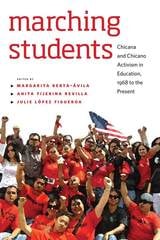
Chicana and Chicano Activism in Education, 1968 to the PresentMargarita Berta-Avila
University of Nevada Press, 2011
Contributors: Alejandro Covarrubias, Xico González, Eracleo Guevara, Adriana Katzew, Lilia R. De Katzew, Rita Kohli, Edward M. Olivos, Alejo Padilla, Carmen E. Quintana, Evelyn M. Rangel-Medina, Marianna Rivera, Daniel G. Solórzano, Carlos Tejeda
Marching West
The Los Angeles Civil Rights Movement in PhotographsKarin L. Stanford
J. Paul Getty Trust, The, 2026
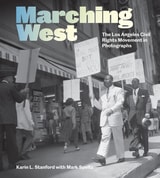
This volume presents the first visual history of the people and organizations that led the fight for change during the civil rights era in Los Angeles.
During a 1963 speech to a crowd of nearly forty thousand at Wrigley Field in Los Angeles, Dr. Martin Luther King Jr. addressed the question of how Angelenos could contribute to the civil rights movement: “The most important thing that you can do is to set Los Angeles free, because you have segregation and discrimination here, and police brutality.”
Marching West illuminates the dynamic history of civil rights activism in Los Angeles and explores how the medium of photography both witnessed and advanced the fight for Black equality. Over one hundred images, some of which have never been previously published, reveal connections between the local and national movements and document the actions of Western coalitions, religious leaders, Hollywood stars, and concerned citizens. Drawn from the Tom & Ethel Bradley Center at California State University, Northridge (CSUN), the Getty Research Institute, and other Southern California collections—including prints by Harry Adams, Howard Bingham, Charles Brittin, Joe Flowers, Vera Jackson, and Charles Williams—this unprecedented volume presents less familiar but essential stories about American progress toward social justice.

Margaret Atwood
Vision and FormsEdited by Kathryn Van Spanckeren and Jan Garden Castro. Foreword by Margaret Atwood
Southern Illinois University Press, 1988
A prolific writer and versatile social critic, Canadian novelist and poet Margaret Atwood has recently published Bluebeard’s Egg (short stories), Interlunar (poetry), and The Handmaid’s Tale a critically acclaimed best-selling novel.
This international collection of essays evaluates the complete body of her work—both the acclaimed fiction and the innovative poetry. The critics represented here—American, Australian, and Canadian—address Atwood’s handling of such themes as feminism, ecology, the gothic novel, and the political relationship between Canada and the United States.
The essays on Atwood’s novels introduce the general reader to her development as a writer, as she matures from a basically subjective, poetic vision, seen in Surfacing and The Edible Woman, to an increasingly engaged, political stance, exemplified by The Handmaid’s Tale. Other essays examine Atwood’s poetry, from her transformation of the Homeric model to her criticisms of the United States’ relationship with Canada. The last two critical essays offer a unique view of Atwood through an investigation of her use of the concept of shamanism and through a presentation of eight of her vivid watercolors.
The volume ends with Atwood presenting her own views in an interview with Jan Garden Castro and in a conversation between Atwood and students at the University of Tampa, Florida.
Margaret Atwood’s Textual Assassinations
Recent Poetry and FictionEdited by Sharon Rose Wilson
The Ohio State University Press, 2005
Marginal People in Deviant Places
Ethnography, Difference, and the Challenge to Scientific RacismJanice M. Irvine
University of Michigan Press, 2022
Place plays a crucial role in this work as Irvine examines its role in shaping ethnographies about outsiders and therefore understandings of social difference. Irvine has visited the sites of each of the ethnographies about which she writes, collecting photos, videos, and archival materials that will help readers understand the importance of place in the generation of particular ethnographic stories. The open-access online edition of this book is richly illustrated to help convey the deep sense of emplacement of the ethnographies discussed in this book and includes a series of interviews with sociologists about how they conduct their work and understand their forebears.
Marginalizing Colonialism
The Politics of Urban Growth in BolgatangaDomenico Cristofaro
Ohio University Press, 2026
Marginalizing Colonialism offers a social, political, and spatial history of Bolgatanga, a northern Ghanaian town whose colonial-era urban development has been largely overlooked in African historiography. Covering the late nineteenth century through the 1940s, the book traces how this settlement—long characterized as a remote hinterland of the British Empire—emerged as a commercial and political center in the region. Rather than depicting urbanization as an imperial project, it reveals how African actors actively shaped Bolgatanga’s growth and repeatedly marginalized, redirected, and evaded colonial authority.
The narrative follows Bolgatanga’s transformation from a dispersed settlement organized around kinship, ritual geographies, and earth shrines into a dynamic urban hub integrated into regional trade networks. Central to this shift were new land tenure systems, commercial expansion, and changing spatial practices. By the 1930s and 1940s, trade in kola, groundnuts, livestock, and other goods surged, stimulated by new roads and increased mobility. Population growth converted farmland into leased plots, permanent buildings replaced older compounds, and areas around the market became focal points of economic and social life.
These changes were driven not by the colonial state but rather by local negotiations and strategic adaptations. Chiefs, earth priests, merchants, and migrant traders mediated and reshaped colonial policies, while missionaries and settlers concluded land agreements beyond official oversight. Roads and marketplaces, planned through negotiations between colonial officials and local chiefs and built largely through African labor, became central infrastructures of local economic life. Even as colonial administrators sought to codify land tenure and regulate commerce, their influence remained largely nominal—a background presence in a story propelled by African initiative.
Drawing on archival documents, oral histories, and unpublished manuscripts by local intellectuals, Marginalizing Colonialism provides the first comprehensive urban history of Bolgatanga. It challenges dominant narratives in African colonial and urban historiography by exposing the silences of the colonial archive and highlighting the significance of medium-sized towns as arenas of negotiation and creativity. Ultimately, the book argues that Bolgatanga’s urbanization was a locally driven process that redefined power, space, and governance—leaving a legacy that continues to shape the city’s identity and regional role today.

Marguerite Duras
A LifeLaure Adler
University of Chicago Press, 2000
Adler, through her exploration of the events central to Duras's career, including her affair with and eventual denunciation of a Nazi collaborator and her childhood in Indochina, reveals Duras as the consummate pragmatist. She has combed through archives, unearthed letters, studied unpublished manuscripts, and interviewed scores of Duras's friends, lovers, enemies, and colleagues—as well as Duras herself—and she emerges with the richest portrait we have of Duras's life: her upbringing, her student days at the Sorbonne, her career as a novelist and filmmaker, and her involvement in French politics through the most complex decades of the twentieth century. "The masks and the truth" was the headline of a French review of Marguerite Duras, and Adler explores both, probing the line between fiction and selfhood and between political activities and personal responsibility.

Marguerite Yourcenar
Inventing a LifeJosyane Savigneau
University of Chicago Press, 1993
Here, in its intricate and often contradictory detail, is Marguerite Yourcenar's story, one in which loss and learning intertwined almost from the first and in which love assumed a strangely paradoxical place. Drawing on letters, diaries, and interviews with Yourcenar's friends, colleagues, and lovers, Josyane Savigneau's biography paints an intimate portrait of an artist who lived according to her own, occasionally contrary, terms: a Frenchwoman ardently in love with her native tongue, yet who lived half her life in New England; an avid seductress of women, who spent nearly forty years with one woman, yet fell in love early and late in her life with two young men; a powerful female writer whose most memorable protagonists were male, from Alexis of her first novel to the later historical characters Hadrian and Zeno. Savigneau weaves these and other contraries of Yourcenar's life into a vibrant and engrossing pattern.
Editor of "Le Monde des Livres," the literary pages of France's most influential newspaper, Savigneau first met Marguerite Yourcenar on assignment in 1984. What began as a professional relationship gradually turned into a friendship. Her personal insights into that life enrich this exhaustively documented text. Following the lead set by Yourcenar in her memoir Dear Departed, the biographer found herself "searching for a truth that is multiple, unstable, evasive, sometimes saddening, and at first glance scandalous but that one cannot approach without often feeling for human beings in all their frailty a certain measure of kinship and, always, a sense of pity." Yourcenar's profound intelligence and sympathy, her foibles and obsessions, her accomplishments and trials: all are revealed here in an uncompromising portrait of an incomparable artist.

Marianne Moore, Elizabeth Bishop, and May Swenson
The Feminist Poetics of Self-RestraintKirstin Hotelling Zona
University of Michigan Press, 2002
In recent years critical studies of Bishop and Moore have flourished, a large percentage of them devoted to explorations of sexuality and gender. A gap is growing, however, between feminist repossessions of Moore and Bishop and recent readings of their antiessentialist poetics. On the one hand, these poets are appearing more frequently in the feminist canon, but the price of this inclusion is usually the suppression of their strategies of self-restraint. While Zona questions the poetic privileging of self-expression, she establishes contiguity between feminist poetry and developments in American poetry at large. In doing so she asserts the centrality of feminist poetry within discussions of contemporary American poetry, thereby challenging the common perception of feminist poetry as an "alternative" (which often means auxiliary) genre.
Kirstin Hotelling Zona is Assistant Professor of Poetry and Poetics, Illinois State University.

Marina Tsvetaeva
The Double Beat of Heaven and HellLily Feiler
Duke University Press, 1994
Born to a family of Russian intelligentsia in 1892 and coming of age in the crucible of revolution and war, Tsvetaeva has been seen as a victim of her politicized time, her life and her work marked by exile, neglect, and persecution. This book is the first to show us the poet as she discovered her life through art, shaped as much by inner demons as by the political forces and harsh realities of her day. With remarkable psychological and literary subtlety, Lily Feiler traces these demons through the tragic drama of Tsvetaeva’s life and poetry. Hers is a story full of contradictions, resisting social and literary conventions but enmeshed in the politics and poetry of her time. Feiler depicts the poet in her complex relation to her contemporaries—Pasternak, Rilke, Mayakovsky, Mandelstam, and Akhmatova. She shows us a woman embodying the values of nineteenth-century romanticism, yet radical in her poetry, supremely independent in her art, but desperate for appreciation and love, simultaneously mother and child in her complicated sexual relationships with men and women.
From prerevolutionary Russia to Red Moscow, from pre-World War II Berlin, Prague, and Paris to the Soviet Union under Stalin, Feiler follows the tortuous drama of Tsvetaeva’s life and work to its last tragic act, exposing at each turn the passions that molded some of this century’s most powerful poetry.
Mario Giacomelli
Figure/GroundVirginia Heckert
J. Paul Getty Trust, The, 2021
Mario Giacomelli (1925–2000) was born into poverty and lived his entire life in Senigallia, a seaside town along the Adriatic coast in Italy’s Marche region. He purchased his first camera in 1953 and quickly gained recognition for the raw expressiveness of his images. His preference for grainy, high-contrast film and paper produced bold, geometric compositions with glowing whites and deep blacks. Giacomelli most frequently focused his camera on the people, landscapes, and seascapes of the Marche, and he often spent several years expanding and reinterpreting a single body of work or repurposing an image made for one series for inclusion in another. By applying titles derived from poetry and literature to his photographs, he transformed ordinary subjects into meditations on time, memory, and existence.
Spanning the photographer’s earliest pictures to those made in the final years of his life, this publication celebrates the J. Paul Getty Museum’s extensive Giacomelli holdings, formed in large part through a significant gift from Daniel Greenberg and Susan Steinhauser.
This volume is published to accompany an exhibition on view at the J. Paul Getty Museum at the Getty Center from June 29 to October 10, 2021.
Market Encounters
Consumer Cultures in Twentieth-Century GhanaBianca Murillo
Ohio University Press, 2017
In Market Encounters, Bianca Murillo explores the shifting social terrains that made the buying and selling of goods in modern Ghana possible. Fusing economic and business history with social and cultural history, she traces the evolution of consumerism in the colonial Gold Coast and independent Ghana from the late nineteenth century through to the political turmoil of the 1970s.
Murillo brings sales clerks, market women, and everyday consumers in Ghana to the center of a story that is all too often told in sweeping metanarratives about what happens when African businesses are incorporated into global markets. By emphasizing the centrality of human relationships to Ghana’s economic past, Murillo introduces a radical rethinking of consumption studies from an Africa-centered perspective. The result is a keen look at colonial capitalism in all of its intricacies, legacies, and contradictions, including its entanglement with gender and race.
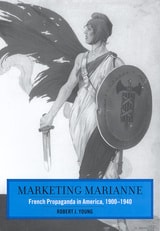
Marketing Marianne
French Propaganda in America, 1900-1940Robert J. Young
Rutgers University Press, 2003
Although historians have written extensively on propaganda during Napoleon III’s regime and Vichy, they have virtually ignored the Third Republic. Focusing on Third Republic policies, Marketing Marianne suggests that Americans’ long-lasting love affair with French culture is no accident. Robert J. Young argues that the French used subtle but effective means to influence U.S. policy in Europe. He examines French propaganda efforts and the methods of the French Foreign Ministry, always highlighting the wider cultural and social context of Franco-American relations. French propagandists believed that the steady promotion of their nation as the cultural capital of the world was the best way to foster goodwill among Americans. They slowly recognized the important role the United States played in maintaining the balance of power in Europe. Young argues that the French deliberately exploited America’s sense of cultural inferiority when faced with Europe’s rich heritage, and the rise of new technologies and modern forms of government in France encouraged the development of more sophisticated forms of propaganda.
Marketing Modernisms
Self-Promotion, Canonization, RereadingKevin J.H. Dettmar and Stephen Watt, Editors
University of Michigan Press, 1996
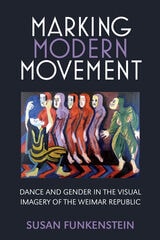
Marking Modern Movement
Dance and Gender in the Visual Imagery of the Weimar RepublicSusan Funkenstein
University of Michigan Press, 2020
Yet behind the razzle dazzle of these depictions and experiences was one far more complex involving issues of gender and the body during a tumultuous period in history, Germany’s first democracy (1918-1933). Rather than mere titillation, the images copiously illustrated and analyzed in Marking Modern Movement illuminate how visual artists and dancers befriended one another and collaborated together. In many ways because of these bonds, artists and dancers forged a new path in which images revealed artists’ deep understanding of dance, their dynamic engagement with popular culture, and out of that, a possibility of representing women dancers as cultural authorities to be respected. Through six case studies, Marking Modern Movement explores how and why these complex dynamics occurred in ways specific to their historical moment.
Extensively illustrated and with color plates, Marking Modern Movement is a clearly written book accessible to general readers and undergraduates. Coming at a time of a growing number of major art museums showcasing large-scale exhibitions on images of dance, the audience exists for a substantial general-public interest in this topic. Conversing across German studies, art history, dance studies, gender studies, and popular culture studies, Marking Modern Movement is intended to engage readers coming from a wide range of perspectives and interests.
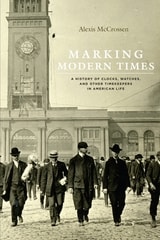
Marking Modern Times
A History of Clocks, Watches, and Other Timekeepers in American LifeAlexis McCrossen
University of Chicago Press, 2013
In Marking Modern Times, Alexis McCrossen relates how the American preoccupation with time led people from across social classes to acquire watches and clocks. While noting the difficulties in regulating and synchronizing so many timepieces, McCrossen expands our understanding of the development of modern time discipline, delving into the ways we have standardized time and describing how timekeepers have served as political, social, and cultural tools in a society that doesn’t merely value time but regards access to time as a natural-born right, a privilege of being an American.
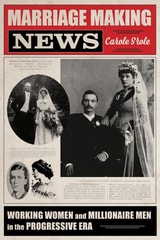
Marriage Making News
Working Women and Millionaire Men in the Progressive EraCarole Srole
University of Illinois Press, 2026
Women’s desire for autonomy, a rising divorce rate, the declining power of the upper class, new ideas of beauty and sexuality—newspaper tales of cross-class nuptials brought a host of anxieties about gender and class to the front page. Srole focuses particular attention on the economic changes faced by working-class women while also surveying newspaper attacks on their morality and womanhood, and their complicity in their own poverty. As she shows, working women and their advocates persevered by asserting an independence they pursued through union activism, professionalism, land ownership, and filling traditionally male jobs.
An engaging merger of media and women’s history, Marriage Making News looks at a rags-to-riches genre and illuminates the forces of change at work behind the stories.
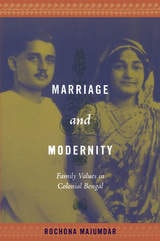
Marriage and Modernity
Family Values in Colonial BengalRochona Majumdar
Duke University Press, 2009
Majumdar examines three broad developments related to the modernity of arranged marriage: the growth of a marriage market, concomitant debates about consumption and vulgarity in the conduct of weddings, and the legal regulation of family property and marriages. Drawing on matrimonial advertisements, wedding invitations, poems, photographs, legal debates, and a vast periodical literature, she shows that the modernization of families does not necessarily imply a transition from extended kinship to nuclear family structures, or from matrimonial agreements negotiated between families to marriage contracts between individuals. Colonial Bengal tells a very different story.
Marshall Plan Modernism
Italian Postwar Abstraction and the Beginnings of AutonomiaJaleh Mansoor
Duke University Press, 2016

Martians And Misplaced Clues
Life Work Of Fredric BrownJack Seabrook
University of Wisconsin Press, 1993

Martin Faber
The Story of a Criminal with "Confessions of a Murder"William Gilmore Simms
University of Arkansas Press, 2006
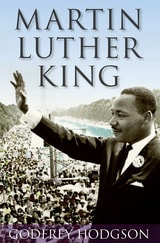
Martin Luther King
Godfrey Hodgson
University of Michigan Press, 2010
Dr. Martin Luther King Jr. is as relevant today as he was when he led civil rights campaigns in the 1950s and 1960s. He was an agent and a prophet of political change in this country, and the election of President Barack Obama is his direct legacy.
Now from one of Britain's most experienced political observers comes a new, accessible biography of the man and his works. The story of King is dramatic, and Godfrey Hodgson presents it with verve, clarity, and acute insight based in part on his own reporting on-scene at the time. He interviewed King half a dozen times or more; heard his speech at the March on Washington; was in Birmingham, Selma and Chicago; and met many of the characters in King's life story. Martin Luther King combines the best of his own reporting, plus the work of other biographers and researchers, to trace the iconic civil rights leader's career from his birth in Atlanta in 1929, through the campaigns that made possible the Civil Rights Act of 1964 and the Voting Rights Act of 1965, to his assassination in Memphis in 1968. Hodgson sheds light on every aspect of an extraordinary life: the Black Baptist culture in which King grew up, his theology and political philosophy, his physical and moral courage, his insistence on the injustice of inequality, his campaigning energy, his repeated sexual infidelities.
Hodgson describes the political minefield in which King operated; follows how he gradually persuaded President Kennedy that he could not stand by and allow the civil rights movement to be frustrated; and describes how, on the verge of success, his career was threatened by President Johnson's anger at King's principled decision to come out against the Vietnam War. He also puts King's career into the context of American history in the crisis of the 1960s. In his life, King was frustrated; but in death, he has been triumphant.
Martin Luther King allows the charisma and power of King's personality to shine through, showing in gripping narrative style exactly how one man helped America to progress toward its truest ideals. Hodgson's extensive research and detail help paint an accurate, complex portrait of one of America's most important leaders.
Godfrey Hodgson has worked in Britain and America as a newspaper and magazine journalist; as a television reporter, documentary maker and anchor; as a university teacher and lecturer; and as the author of a dozen well-received books about U.S. politics and recent history, including America in Our Time, a history of the United States in the 1960s; More Equal than Others, on politics and society in twentieth-century America; and most recently, a biography of Senator Daniel Patrick Moynihan, The Gentleman from New York. Hodgson met King on a number of occasions between 1956 and 1967. He recently retired as director of the Reuters Foundation Programme at Oxford University and is a visiting journalism professor at City University in London.
PRAISE FOR America in Our Time
"A critique so stimulating and compelling that I can only say read it."
---Richard Lingeman, The New York Times
"It simply gets right, without great fuss, the detail and proportion of things like the civil rights movement, student unrest, the stages of our Vietnam engagement."
---Garry Wills, The New York Review of Books
PRAISE FOR More Equal than Others
"The most thoughtful, thorough and sorrowful book imaginable on what has happened in these years."
---Bernard Crick, The Independent

Martin Mariner
Nico Braas
Amsterdam University Press, 2023
Martin Scorsese and the American Dream
Jim Cullen
Rutgers University Press, 2021
This book is the first study of Scorsese’s profound ambivalence toward the American Dream, the ways it drives some men and women to aspire to greatness, but leaves others seduced and abandoned. Showing that Scorsese understands the American dream in terms of a tension between provincialism and cosmopolitanism, Jim Cullen offers a new lens through which to view such seemingly atypical Scorsese films as The Age of Innocence, Hugo, and Kundun. Fast-paced, instructive, and resonant, Martin Scorsese and the American Dream illuminates an important dimension of our national life and how a great artist has brought it into focus.
Marvin Miller, Baseball Revolutionary
Robert F. Burk
University of Illinois Press, 2015
Educating and uniting the players as a workforce, Miller embarked on a long campaign to win the concessions that defined his legacy: decent workplace conditions, a pension system, outside mediation of player grievances and salary disputes, a system of profit sharing, and the long-sought dismantling of the reserve clause that opened the door to free agency. Through it all, allies and adversaries alike praised Miller's hardnosed attitude, work ethic, and honesty.
Comprehensive and illuminating, Marvin Miller, Baseball Revolutionary tells the inside story of a time of change in sports and labor relations, and of the contentious process that gave athletes in baseball and across the sporting world a powerful voice in their own games.
Marxism and the Interpretation of Culture
Edited by Cary Nelson and Lawrence Grossberg
University of Illinois Press, 1988
Mary Austin
Song of a MaverickEsther F. Lanigan
University of Arizona Press, 1997
"[Lanigan] provides illuminating sociological background and lucidly marshals the existing biolgraphical data." —Choice
"Mary Hunter Austin was a well-known and respected author and activitst in her lifetime but is little known in ours. In this excellent biography...[Lanigan] chose to focus on a few central relationships in Austin's life, to explore in some depth a few central texts, and to understand the interior life of her subject. She has done a splendid job." —Ann J. Lane in the Journal of American History