Results by title
1882 books match the query 'Criticism and interpretation' and 106 start with m
Mrs. Sigourney of Hartford
Poems and Prose on the Early American Deaf CommunityEdna Edith Sayers
Gallaudet University Press, 2013
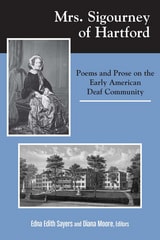
Lydia Huntley was born in 1791 in Norwich, CT, the only child of a poor Revolutionary war veteran. But her father’s employer, a wealthy widow, gave young Lydia the run of her library and later sent her for visits to Hartford, CT. After teaching at her own school for several years in Norwich, Lydia returned to Hartford to head a class of 15 girls from the best families. Among her students was Alice Cogswell, a deaf girl soon to be famous as a student of Thomas Hopkins Gallaudet and Laurent Clerc.
Lydia’s inspiration came from a deep commitment to the education of girls and also for African American, American Indian, and deaf children. She left teaching to marry Charles Sigourney, then turned to writing to support her family, publishing 56 books, 2,000 magazine articles, and popular poetry. Lydia Sigourney never abandoned her passion for deaf education, remaining a supporter of Gallaudet’s school for the deaf until her death. Yet, her contributions to deaf education and her writing have been forgotten until now.
All of Lydia Sigourney’s of Lydia Sigourney’s work on the nascent Deaf community is presented in this new volume. Her writing intertwines her mastery of the sentimentalism form popular in her day with her sharp insights on the best ways to educate deaf children. In the process, Mrs. Sigourney of Hartford reestablishes her rightful place in history.
Multi-Mediated Dostoevsky
Transposing Novels into Opera, Film, and DramaAlexander Burry
Northwestern University Press, 2011

Murder She Wrote
A Study of Agatha Christie's Detective FictionPatricia D. Maida
University of Wisconsin Press, 1982
This book explores the inter-relationships between Agatha Christie and her works to seek the wholeness in the Christie experience. The authors perceive an integration in personal experience and moral and aesthetic values between the woman and her art.
Music at Midnight
The Life and Poetry of George HerbertJohn Drury
University of Chicago Press, 2014
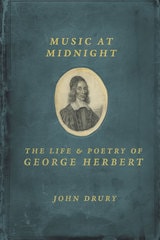
As Drury writes in his preface, Herbert lived “a quiet life with a crisis in the middle of it.” Drury follows Herbert from his academic success as a young man, seemingly destined for a career at court, through his abandonment of those hopes, his devotion to the restoration of a church in Huntingdonshire, and his final years as a country parson. Because Herbert’s work was only published posthumously, it has always been difficult to know when or in what context Herbert wrote his poems. But Drury skillfully places readings of the poems into his narrative at biographically credible moments, allowing us to appreciate not only Herbert’s frame of mind while writing, but also the society that produced it. A sensitive critic of Herbert’s poems as well as a theologian, Drury does full justice to the spiritual dimension of Herbert’s work. In addition, he reveals the occasions of sorrow, happiness, regret, and hope that Herbert captured in his poetry and that led T. S. Eliot to write, “What we can confidently believe is that every poem . . . is true to the poet’s experience.”
Painting a picture of a man torn between worldly ambition and spiritual life, Music at Midnight is an eloquent biography that breathes new life into some of the greatest English poems ever written.
My Business Is to Create
Blake's Infinite WritingEric G. Wilson
University of Iowa Press, 2011
p.MsoNormal, li.MsoNormal, div.MsoNormal { margin: 0in 0in 0.0001pt; font-size: 12pt; font-family: "Times New Roman"; }div.Section1 { page: Section1; }
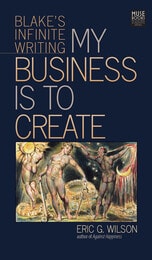
For William Blake, living is creating, conforming is death, and “the imagination . . . is the Human Existence itself.” But why are imagination and creation—so vital for Blake—essential for becoming human? And what is imagination? What is creation? How do we create? Blake had answers for these questions, both in word and in deed, answers that serve as potent teachings for aspiring writers and accomplished ones alike. Eric G. Wilson’s My Business Is to Create emulates Blake, presenting the great figure’s theory of creativity as well as the practices it implies.
In both his life and his art, Blake provided a powerful example of creativity at any cost—in the face of misunderstanding, neglect, loneliness, poverty, even accusations of insanity. Just as Los cries out in Jerusalem: The Emanation of the Giant Albion, “I must Create a System, or be enslav'd by another Man's; / I will not Reason and Compare: my business is to Create,” generations of writers and artists as diverse as John Ruskin, William Butler Yeats, Allen Ginsberg, Philip K. Dick, songwriter Patti Smith, the avant-garde filmmaker Jim Jarmusch, and the underground comic-book artist R. Crumb have taken Blake’s creed as inspiration.
Unwilling to cede his vision, Blake did more than simply produce iconoclastic poems and paintings; he also cleared a path toward spiritual and ethical enlightenment. To fashion powerful art is to realize the God within and thus to feel connected with enduring vitality and abundant generosity. This is Blake’s everlasting gospel, distilled here in an artist’s handbook of interest to scholars, writing teachers, and those who have made writing their way of life. My Business Is to Create is indispensable for all serious artists who want to transform their lives into art and make their art more alive.
Mysticism and Space
Space and Spatiality in the Works of Richard Rolle, The Cloud of Unknowing Author, and Julian of NorwichCarmel Bendon Davis
Catholic University of America Press, 2008