Results by title
1726 books match the query 'Film' and 107 start with m
Muscles in the Movies
Perfecting the Art of IllusionJohn D. Fair
University of Missouri Press, 2020

Music and Levels of Narration in Film
Steps across the BorderGuido Heldt
Intellect Books, 2013
A PDF version of this book is available for free in open access via the OAPEN Library platform, www.oapen.org It has been made available under a Creative Commons Attribution 4.0 International Public License and is part of Knowledge Unlatched.
Muslim Rap, Halal Soaps, and Revolutionary Theater
Artistic Developments in the Muslim WorldEdited by Karin van Nieuwkerk
University of Texas Press, 2011
From "green" pop and "clean" cinema to halal songs, Islamic soaps, Muslim rap, Islamist fantasy serials, and Suficized music, the performing arts have become popular and potent avenues for Islamic piety movements, politically engaged Islamists, Islamic states, and moderate believers to propagate their religio-ethical beliefs. Muslim Rap, Halal Soaps, and Revolutionary Theater is the first book that explores this vital intersection between artistic production and Islamic discourse in the Muslim world.
The contributors to this volume investigate the historical and structural conditions that impede or facilitate the emergence of a "post-Islamist" cultural sphere. They discuss the development of religious sensibilities among audiences, which increasingly include the well-to-do and the educated young, as well as the emergence of a local and global religious market. At the heart of these essays is an examination of the intersection between cultural politics, performing art, and religion, addressing such questions as where, how, and why pop culture and performing arts have been turned into a religious mission, and whether it is possible to develop a new Islamic aesthetic that is balanced with religious sensibilities. As we read about young Muslims and their quest for a "cool Islam" in music, their struggle to quell their stigmatized status, or the collision of morals and the marketplace in the arts, a vivid, varied new perspective on Muslim culture emerges.
Mute Dreams, Blind Owls, and Dispersed Knowledges
Persian Poesis in the Transnational CircuitryMichael M. J. Fischer
Duke University Press, 2004
Fischer reveals how the distinctive expressive idiom emerging in contemporary Iranian film reworks Persian imagery that has itself been in dialogue with other cultures since the time of Zoroaster and ancient Greece. He examines a range of narrative influences on this expressive idiom and imagery, including Zoroastrian ritual as it is practiced in Iran, North America, and India; the mythic stories, moral lessons, and historical figures written about in Iran’s national epic, the Shahnameh; the dreamlike allegorical world of Persian surrealism exemplified in Sadeq Hedayat’s 1939 novella The Blind Owl; and the politically charged films of the 1960s and 1970s. Fischer contends that by combining Persian traditions with cosmopolitan influences, contemporary Iranian filmmakers—many of whom studied in Europe and America—provide audiences around the world with new modes of accessing ethical and political experiences.
My Fair Ladies
Female Robots, Androids, and Other Artificial EvesWosk, Julie
Rutgers University Press, 2015
The fantasy of a male creator constructing his perfect woman dates back to the Greek myth of Pygmalion and Galatea. Yet as technology has advanced over the past century, the figure of the lifelike manmade woman has become nearly ubiquitous, popping up in everything from Bride of Frankenstein to Weird Science to The Stepford Wives. Now Julie Wosk takes us on a fascinating tour through this bevy of artificial women, revealing the array of cultural fantasies and fears they embody.
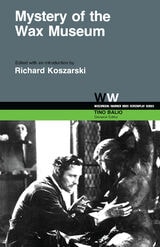
Mystery of the Wax Museum
Edited, with an introduction by Richard Koszarski; Tino T. Balio, Series Editor
University of Wisconsin Press, 1979
The Depression-era vogue for horror and the supernatural produced some of Hollywoood's most memorable chillers, among them Dr. Jekyll and Mr. Hyde (Paramount), Frankenstein, (Universal), and King Kong (RKO). At Warner Brothers, the main entry was Mystery of the Wax Museum, directed by Michael Curtiz, a grand thriller of 1933 in which Fay Wray (Who would appear opposite Kong later that same year) was threatened with waxy immortality by the maniacal Lionel Atwill.
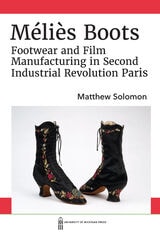
Méliès Boots
Footwear and Film Manufacturing in Second Industrial Revolution ParisMatthew Solomon
University of Michigan Press, 2022
Winner of the 2024 Society for Cinema and Media Studies Katherine Singer Kovacs Book Award
Before he became an influential cinematic innovator, Georges Méliès (1861–1938) was a maker of deluxe French footwear, an illusionist, and a caricaturist. Proceeding from these beginnings, Méliès Boots traces how the full trajectory of Georges Méliès’ career during the late-nineteenth and early-twentieth centuries, along with the larger cultural and historical contexts in which Méliès operated, shaped his cinematic oeuvre. Solomon examines Méliès’ unpublished drawings and published caricatures, the role of laughter in his magic theater productions, and the constituent elements of what Méliès called "the new profession of the cinéaste." The book also reveals Méliès' connections to the Incohérents, a group of ephemeral artists from the 1880s, demonstrating the group’s relevance for Méliès, early cinema, and modernity. By positioning Méliès in relation to the material culture of his time, Solomon demonstrates that Méliès’ work was expressive of a distinctly modern, and modernist, sensibility that appeared in France during the 1880s in the wake of the Second Industrial Revolution.