Results by title
2646 books match the query 'History & Criticism' and 181 start with m
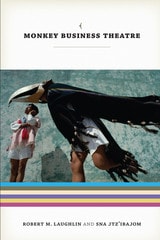
Monkey Business Theatre
By Robert M. Laughlin and Sna Jtz'ibajom
University of Texas Press, 2008
In 1983, a group of citizens in San Cristóbal de las Casas, Chiapas, formed Sna Jtz'ibajom, the Tzotzil-Tzeltal Maya writers' cooperative. In the two decades since, this group has evolved from writing and publishing bilingual booklets to writing and performing plays that have earned them national and international renown.
Anthropologist Robert M. Laughlin has been a part of the group since its beginnings, and he offers a unique perspective on its development as a Mayan cultural force. The Monkey Business Theatre, or Teatro Lo'il Maxil, as this branch of Sna Jtz'ibajom calls itself, has presented plays in virtually every corner of the state of Chiapas, as well as in Mexico City, Guatemala, Honduras, Canada, and in many museums and universities in the United States. It has presented to the world, for the first time in drama, a view of the culture of the Mayas of Chiapas.
In this work, Laughlin presents a translation of twelve of the plays created by Sna Jtz'ibajom, along with an introduction for each. Half of the plays are based on myths and half on the social, political, and economic problems that have confronted—and continue to confront—the Mayas of Chiapas.
Monsters vs. Patriarchy
Toxic Imagination in Global Horror CinemaPatricia Saldarriaga
Rutgers University Press, 2025
Monsters vs. Patriarchy examines female monstrosity as it appears in horror films from around the world and considers specific political, scientific, and historical contexts to better understand how we construct and reconstruct monstrosity, using an intersectional approach to examine the imposition of gender and racial hierarchies that support national power structures. The authors contend that monstrous female cinematic subjects, including ghosts, witches, cannibals, and posthuman beings, are becoming empowered, using the tools of their monstrification to smash the colonial, white supremacist, and misogynist structures that created them.
Monstrous Progeny
A History of the Frankenstein NarrativesFriedman, Lester D
Rutgers University Press, 2016
Monuments Askew
An Elliptical History of the Factory of the Eccentric ActorMaria Corrigan
Rutgers University Press, 2025
Moral Spectatorship
Technologies of Voice and Affect in Postwar Representations of the ChildLisa Cartwright
Duke University Press, 2008
For more than two decades, film theory has been dominated by a model of identification tacitly based on the idea of feeling what the other feels or of imagining oneself to be the other. Building on the theories of affect and identification developed by André Green, Melanie Klein, Donald W. Winnicott, and Silvan Tomkins, Cartwright develops a model of spectatorship that takes into account and provides a way of critically analyzing the dynamics of a different kind of identification, one that is empathetic and highly intersubjective.

More Art in the Public Eye
Micaela Martegani, Jeff Kaspar, and Emma Drew, editors
Duke University Press, 2019
Contributors. Rebecca Amato, Michael Birchall, Ofri Cnaani, Michelle Coffey, Jennifer Dalton, Emma Drew, Pablo Helguera, Mary Jane Jacob, Jessica Lynne, Jeff Kasper, Kimsooja, Micaela Martegani, Andrea Mastrovito, Tony Oursler, William Powhida, Ernesto Pujol, Michael Rakowitz, Kirk Savage, Dread Scott, Andres Serrano, Gregory Sholette, Xaviera Simmons, Krzysztof Wodiczko
More Important Than the Music
A History of Jazz DiscographyBruce D. Epperson
University of Chicago Press, 2013
Mormons in Paris
Polygamy on the French Stage, 1874-1892Corry Cropper
Bucknell University Press, 2021
In the late nineteenth century, numerous French plays, novels, cartoons, and works of art focused on Mormons. Unlike American authors who portrayed Mormons as malevolent “others,” however, French dramatists used Mormonism to point out hypocrisy in their own culture. Aren't Mormon women, because of their numbers in a household, more liberated than French women who can't divorce? What is polygamy but another name for multiple mistresses? This new critical edition presents translations of four musical comedies staged or published in France in the late 1800s: Mormons in Paris (1874), Berthelier Meets the Mormons (1875), Japheth’s Twelve Wives (1890), and Stephana’s Jewel (1892). Each is accompanied by a short contextualizing introduction with details about the music, playwrights, and staging. Humorous and largely unknown, these plays use Mormonism to explore and mock changing French mentalities during the Third Republic, lampooning shifting attitudes and evolving laws about marriage, divorce, and gender roles.
Published by Bucknell University Press. Distributed worldwide by Rutgers University Press.
Mother of the Blues
A Study of Ma RaineySandra R. Lieb
University of Massachusetts Press, 1981
Mother of the Blues is the first substantive biography of Gertrude "Ma" Rainey, the pioneering blues vocalist that dominated blues in the 1920s. Through a comprehensive study of Rainey's remarkable career, Sandra R. Lieb analyzes how Rainey combined African American folk traditions with emerging blues styles to help establish and popularize the blues as a national musical phenomenon in the early twentieth century. With close attention to Rainey's recordings, performances, and cultural significance as a Black female artist, Lieb explores the impact of Ma Rainey distinctive deep-throated voice, mesmerizing presence, and songs of love, desire, sexuality, and society in American music history and blues culture.
Mourning the Nation
Indian Cinema in the Wake of PartitionBhaskar Sarkar
Duke University Press, 2009
Sarkar tracks the initial reticence to engage with the trauma of 1947 and the subsequent emergence of a strong Partition discourse, revealing both the silence and the eventual “return of the repressed” as strands of one complex process. Connecting the relative silence of the early decades after Partition to a project of postcolonial nation-building and to trauma’s disjunctive temporal structure, Sarkar develops an allegorical reading of the silence as a form of mourning. He relates the proliferation of explicit Partition narratives in films made since the mid-1980s to disillusionment with post-independence achievements, and he discusses how current cinematic memorializations of 1947 are influenced by economic liberalization and the rise of a Hindu-chauvinist nationalism. Traversing Hindi and Bengali commercial cinema, art cinema, and television, Sarkar provides a history of Indian cinema that interrogates the national (a central category organizing cinema studies) and participates in a wider process of mourning the modernist promises of the nation form.
Mouse Morality
The Rhetoric of Disney Animated FilmBy Annalee R. Ward
University of Texas Press, 2002
2004 – Clifford G. Christians Ethics Research Award — The Carl Couch Center for Social and Internet Research
Kids around the world love Disney animated films, and many of their parents trust the Disney corporation to provide wholesome, moral entertainment for their children. Yet frequent protests and even boycotts of Disney products and practices reveal a widespread unease with the sometimes mixed and inconsistent moral values espoused in Disney films as the company attempts to appeal to the largest possible audience.
In this book, Annalee R. Ward uses a variety of analytical tools based in rhetorical criticism to examine the moral messages taught in five recent Disney animated films—The Lion King, Pocahontas, The Hunchback of Notre Dame, Hercules, and Mulan. Taking the films on their own terms, she uncovers the many mixed messages they purvey: for example, females can be leaders—but male leadership ought to be the norm; stereotyping is wrong—but black means evil; historical truth is valued—but only tell what one can sell, etc. Adding these messages together, Ward raises important questions about the moral ambiguity of Disney's overall worldview and demonstrates the need for parents to be discerning in letting their children learn moral values and life lessons from Disney films.
Movement, Action, Image, Montage
Sergei Eisenstein and the Cinema in CrisisLuka Arsenjuk
University of Minnesota Press, 2018
A major new study of Sergei Eisenstein delivers fresh, in-depth analyses of the iconic filmmaker’s body of work
What can we still learn from Sergei Eisenstein? Long valorized as the essential filmmaker of the Russian Revolution and celebrated for his indispensable contributions to cinematic technique, Eisenstein’s relevance to contemporary culture is far from exhausted. In Movement, Action, Image, Montage, Luka Arsenjuk considers the auteur as a filmmaker and a theorist, drawing on philosophers such as Georg Wilhelm Friedrich Hegel and Gilles Deleuze—as well as Eisenstein’s own untranslated texts—to reframe the way we think about the great director and his legacy.
Focusing on Eisenstein’s unique treatment of the foundational concepts of cinema—movement, action, image, and montage—Arsenjuk invests each aspect of the auteur’s art with new significance for the twenty-first century. Eisenstein’s work and thought, he argues, belong as much to the future as the past, and both can offer novel contributions to long-standing cinematic questions and debates.
Movement, Action, Image, Montage brings new elements of Eisenstein’s output into academic consideration, by means ranging from sustained and comprehensive theorization of Eisenstein’s practice as a graphic artist to purposeful engagement with his recently published, unfinished book Method, still unavailable in English translation. This tour de force offers new and significant insights on Eisenstein’s oeuvre—the films, the art, and the theory—and is a landmark work on an essential filmmaker.

Movie Censorship and American Culture
Francis G. Couvares
University of Massachusetts Press, 2006
From the earliest days of public outrage over “indecent” nickelodeon shows, Americans have worried about the power of the movies. The eleven essays in this book examine nearly a century of struggle over cinematic representations of sex, crime, violence, religion, race, and ethnicity, revealing that the effort to regulate the screen has reflected deep social and cultural schisms.
In addition to the editor, contributors include Daniel Czitrom, Marybeth Hamilton, Garth Jowett, Charles Lyons, Richard Maltby, Charles Musser, Alison M. Parker, Charlene Regester, Ruth Vasey, and Stephen Vaughn. Together they make it clear that censoring the movies is more than just a reflex against "indecency," however defined. Whether censorship protects the vulnerable or suppresses the creative, it is part of a broader culture war that breaks out recurrently as Americans try to come to terms with the market, the state, and the plural society in which they live.
Movie Comics
Page to Screen/Screen to PageDavis, Blair
Rutgers University Press, 2017
Movie Mavens
US Newspaper Women Take On the Movies, 1914-1923Edited by Richard Abel
University of Illinois Press, 2021
An invaluable collection of rare archival sources, Movie Mavens reveals women's essential contribution to the creation of American film culture.

Movie Migrations
Transnational Genre Flows and South Korean CinemaHye Seung Chung and David Scott Diffrient
Rutgers University Press, 2015
Movie Minorities
Transnational Rights Advocacy and South Korean CinemaHye Seung Chung and David Scott Diffrient
Rutgers University Press, 2021
Movie Workers
The Women Who Made British CinemaMelanie Bell
University of Illinois Press, 2021
After the advent of sound, women in the British film industry formed an essential corps of below-the-line workers, laboring in positions from animation artist to negative cutter to costume designer. Melanie Bell maps the work of these women decade-by-decade, examining their far-ranging economic and creative contributions against the backdrop of the discrimination that constrained their careers. Her use of oral histories and trade union records presents a vivid counter-narrative to film history, one that focuses not only on women in a male-dominated business, but on the innumerable types of physical and emotional labor required to make a motion picture. Bell's feminist analysis looks at women's jobs in film at important historical junctures while situating the work in the context of changing expectations around women and gender roles.
Illuminating and astute, Movie Workers is a first-of-its-kind examination of the unsung women whose invisible work brought British filmmaking to the screen.
Movie-Made Jews
An American TraditionHelene Meyers
Rutgers University Press, 2021
With incisive analysis, Movie-Made Jews challenges the assumption that American Jewish cinema is a cinema of impoverishment and assimilation. While it’s a truism that Jews make movies, this book brings into focus the diverse ways movies make Jews.
Movies & Mass Culture
Belton, John
Rutgers University Press, 1995
Movies That Mattered
More Reviews from a Transformative DecadeDave Kehr
University of Chicago Press, 2017
With When Movies Mattered, readers welcomed the first collection of Kehr’s criticism, written during his time at the Chicago Reader. Movies That Mattered is its sequel, with fifty more reviews and essays drawn from the archives of both the Chicago Reader and Chicago magazine from 1974 to 1986. As with When Movies Mattered, the majority of the reviews offer in-depth analyses of individual films that are among Kehr’s favorites, from a thoughtful discussion of the sobering Holocaust documentary Shoah to an irresistible celebration of the raucous comedy Used Cars. But fans of Kehr’s work will be just as taken by his dissections of critically acclaimed films he found disappointing, including The Shining, Apocalypse Now, and Raiders of the Lost Ark.
Whether you’re a long-time reader or just discovering Dave Kehr, the insights in Movies That Mattered will enhance your appreciation of the movies you already love—and may even make you think twice about one or two you hated.

Movies under the Influence
Jocelyn Szczepaniak-Gillece
University of Minnesota Press, 2024
A cultural history of the enduring relationship between film spectatorship and intoxicating substances
Movies under the Influence charts the entangled histories of moviegoing and mind-altering substances from early cinema through the psychedelic 1970s. Jocelyn Szczepaniak-Gillece examines how the parallel trajectories of these two enduring aspects of American culture, linked by their ability to influence individual and collective consciousness, resulted in them being treated and regulated in similar ways. Rather than looking at representations of drug use within film, she regards cinema and intoxicants as kindred experiences of immersion that have been subject to corresponding forces of ideology and power.
Exploring the effects of intoxicants such as caffeine, nicotine, alcohol, marijuana, and psychedelics on film spectatorship, Szczepaniak-Gillece demonstrates how American movie theaters sought to cultivate a dual identity, presenting themselves as both a place of wholesome entertainment and a shadowy zone of illicit behavior. Movies under the Influence highlights the various legislative, legal, and corporate powers that held sway over the darkened anonymity of theaters, locating the convergence of moviegoing and drug use as a site of mediation and social control in America.
As much as substances and cinema are points where power intervenes, they are also settings of potential transcendence, and Movies under the Influence maintains this paradox as a necessary component of American film history. Recontextualizing a wide range of films, from Hollywood to the avant-garde, this book examines the implicit relationship intoxicants suggest between mass media, spectatorship, and governmental regulation and provides a new angle from which to understand cinema’s lasting role in evolving American culture.
Moving Color
Early Film, Mass Culture, ModernismYumibe, Joshua
Rutgers University Press, 2012
Color was used in film well before The Wizard of Oz. Thomas Edison, for example, projected two-colored films at his first public screening in New York City on April 23, 1896. These first colors of early cinema were not photographic; they were applied manually through a variety of laborious processes—most commonly by the hand-coloring and stenciling of prints frame by frame, and the tinting and toning of films in vats of chemical dyes. The results were remarkably beautiful.
Moving Color is the first book-length study of the beginnings of color cinema. Looking backward, Joshua Yumibe traces the legacy of color history from the beginning of the nineteenth century to the cinema of the early twentieth century. Looking forward, he explores the implications of this genealogy on experimental and contemporary digital cinemas in which many colors have become, once again, vividly unhinged from photographic reality. Throughout this history, Moving Color revolves around questions pertaining to the sensuousness of color: how color moves us in the cinema—visually, emotionally, and physically.
Moving Consciously
Somatic Transformations through Dance, Yoga, and TouchEdited by Sondra Fraleigh
University of Illinois Press, 2015

Moving Image Theory
Ecological ConsiderationsEdited by Joseph D. Anderson and Barbara Fisher Anderson. Foreword by David Bordwell
Southern Illinois University Press, 2007
Moving Islands
Contemporary Performance and the Global PacificDiana Looser
University of Michigan Press, 2021
Moving Islands reveals the international and intercultural connections within contemporary performance from Oceania, focusing on theater, performance art, art installations, dance, film, and activist performance in sites throughout Oceania and in Australia, Asia, North America, and Europe. Diana Looser’s study moves beyond a predictable country-specific or island-specific focus to encompass an entire region defined by diversity and global exchange, showing how performance operates to frame social, artistic, and political relationships across widely dispersed locations. The study also demonstrates how Oceanian performance contributes to international debates about diaspora, indigeneity, urbanization, and environmental sustainability. The author considers the region’s unique cultural and geographic dynamics as she brings forth the paradigm of transpasifika to suggest a way of understanding these intercultural exchanges and connections, with the aim to “rework the cartographic and disciplinary priorities of transpacific studies to privilege the activities of Islander peoples.”
Moving Performances
Divas, Iconicity, and Remembering the Modern StageScheper, Jeanne
Rutgers University Press, 2017

Mozart and His World
Edited by Simon P. Keefe
University of Chicago Press, 2026
A collection of essays that reinvigorates our understanding of some of Mozart's best-loved works.
One of the world’s most revered composers, Wolfgang Amadeus Mozart (1756–1791) wrote works in almost every genre. His life and work continue to fascinate scholars, performers, and music lovers alike. Mozart and His World brings original perspectives to perennially popular topics in Mozart studies. Through wide-ranging essays that address interpretive, biographical, and contextual themes, the volume simultaneously widens and refines our view of Mozart’s oeuvre.
Mozart and His World moves from studies of instrumental music and musicians to the interpretation and reception of Mozart’s operas, and finally to primary sources from the decade or so after Mozart’s death. Across original chapters and several archival documents, Mozart and His World points new ways forward in key areas of Mozart scholarship, including the study of intellectual and stylistic ideas informing his works and of musicians and institutions within his orbit. While the volume reshapes our understanding of some of Mozart’s best-loved works, including The Magic Flute and his other operas, it also probes works that have received less attention, such as his early string quartets, an opera parody, and wind-music culture and arrangements.

Mozart and the Mediation of Childhood
Adeline Mueller
University of Chicago Press, 2021
The story of Wolfgang Amadeus Mozart’s precocity is so familiar as to be taken for granted. In scholarship and popular culture, Mozart the Wunderkind is often seen as belonging to a category of childhood all by himself. But treating the young composer as an anomaly risks minimizing his impact. In this book, Adeline Mueller examines how Mozart shaped the social and cultural reevaluation of childhood during the Austrian Enlightenment. Whether in a juvenile sonata printed with his age on the title page, a concerto for a father and daughter, a lullaby, a musical dice game, or a mass for the consecration of an orphanage church, Mozart’s music and persona transformed attitudes toward children’s agency, intellectual capacity, relationships with family and friends, political and economic value, work, school, and leisure time.
Thousands of children across the Habsburg Monarchy were affected by the Salzburg prodigy and the idea he embodied: that childhood itself could be packaged, consumed, deployed, “performed”—in short, mediated—through music. This book builds upon a new understanding of the history of childhood as dynamic and reciprocal, rather than a mere projection or fantasy—as something mediated not just through texts, images, and objects but also through actions. Drawing on a range of evidence, from children’s periodicals to Habsburg court edicts and spurious Mozart prints, Mueller shows that while we need the history of childhood to help us understand Mozart, we also need Mozart to help us understand the history of childhood.

Mozart the Performer
Variations on the Showman's ArtDorian Bandy
University of Chicago Press, 2023
We know Mozart as one of history’s greatest composers. But his contemporaries revered him as a multi-instrumentalist, a dazzling improviser, and the foremost keyboard virtuoso of his time. When he composed, it was often with a single aim in mind: to set the stage, quite literally, for compelling and captivating performances. He wrote piano concertos not with an eye to posterity but to give himself a repertoire with which to flaunt his keyboard wizardry before an awestruck public. The same was true of his sonatas, string quartets, symphonies, and operas, all of which were painstakingly crafted to produce specific effects on those who played or heard them, amusing, stirring, and ravishing colleagues and consumers alike.
Mozart the Performer brings to life this elusive side of Mozart’s musicianship. Dorian Bandy traces the influence of showmanship on Mozart’s style, showing through detailed analysis and imaginative historical investigation how he conceived his works as a series of dramatic scripts. Mozart the Performer is a book for anyone who wishes to engage more deeply with Mozart’s artistry and legacy and understand why, centuries later, his music still captivates us.
Multiculturalism and the Mouse
Race and Sex in Disney EntertainmentBy Douglas Brode
University of Texas Press, 2006
In his latest iconoclastic work, Douglas Brode—the only academic author/scholar who dares to defend Disney entertainment—argues that "Uncle Walt's" output of films, television shows, theme parks, and spin-off items promoted diversity decades before such a concept gained popular currency in the 1990s. Fully understood, It's a Small World—one of the most popular attractions at the Disney theme parks—encapsulates Disney's prophetic vision of an appealingly varied world, each race respecting the uniqueness of all the others while simultaneously celebrating a common human core. In this pioneering volume, Brode makes a compelling case that Disney's consistently positive presentation of "difference"—whether it be race, gender, sexual orientation, ideology, or spirituality—provided the key paradigm for an eventual emergence of multiculturalism in our society.
Using examples from dozens of films and TV programs, Brode demonstrates that Disney entertainment has consistently portrayed Native Americans, African Americans, women, gays, individual acceptance of one's sexual orientation, and alternatives to Judeo-Christian religious values in a highly positive light. Assuming a contrarian stance, Brode refutes the overwhelming body of "serious" criticism that dismisses Disney entertainment as racist and sexist. Instead, he reveals through close textual analysis how Disney introduced audiences to such politically correct principles as mainstream feminism. In so doing, Brode challenges the popular perception of Disney fare as a bland diet of programming that people around the world either uncritically deem acceptable for their children or angrily revile as reactionary pabulum for the masses.
Providing a long overdue and thoroughly detailed alternative, Brode makes a highly convincing argument that with an unwavering commitment to racial diversity and sexual difference, coupled with a vast global popularity, Disney entertainment enabled those successive generations of impressionable youth who experienced it to create today's aura of multiculturalism and our politically correct value system.
Multiple Voices in Feminist Film Criticism
Diane Carson
University of Minnesota Press, 1993
Murder Most Queer
The Homicidal Homosexual in the American TheaterJordan Schildcrout
University of Michigan Press, 2014

Murder Most Queer
The Homicidal Homosexual in the American TheaterJordan Schildcrout
University of Michigan Press, 2014

Murder by Accident
Medieval Theater, Modern Media, Critical IntentionsJody Enders
University of Chicago Press, 2009
Over fifty years ago, it became unfashionable—even forbidden—for students of literature to talk about an author’s intentions for a given work. In Murder by Accident, Jody Enders boldly resurrects the long-disgraced concept of intentionality, especially as it relates to the theater.
Drawing on four fascinating medieval events in which a theatrical performance precipitated deadly consequences, Enders contends that the marginalization of intention in critical discourse is a mirror for the marginalization—and misunderstanding—of theater. Murder by Accident revisits the legal, moral, ethical, and aesthetic limits of the living arts of the past, pairing them with examples from the present, whether they be reality television, snuff films, the “accidental” live broadcast of a suicide on a Los Angeles freeway, or an actor who jokingly fired a stage revolver at his temple, causing his eventual death. This book will force scholars and students to rethink their assumptions about theory, intention, and performance, both past and present.
Muscle Works
Physical Culture and the Performance of MasculinityBroderick D. V. Chow
Northwestern University Press, 2024
This book recounts the story of fitness culture from its beginnings as spectacles of strongmen, weightlifters, acrobats, and wrestlers to its legitimization in the twentieth-century in the form of competitive sports and health and wellness practices. Broderick D. V. Chow shows how these modes of display contribute to the construction and deconstruction of definitions of masculinity.
Attending to its theatrical origins, Chow argues for a more nuanced understanding of fitness culture, one informed by the legacies of self-described Strongest Man in the World Eugen Sandow and the history of fakery in strongman performance; the philosophy of weightlifter George Hackenschmidt and the performances of martial artist Bruce Lee; and the intersections of fatigue, resistance training, and whiteness. Muscle Works: Physical Culture and the Performance of Masculinity moves beyond the gym and across the archive, working out techniques, poses, and performances to consider how, as gendered subjects, we inhabit and make worlds through our bodies.
Muscles in the Movies
Perfecting the Art of IllusionJohn D. Fair
University of Missouri Press, 2020
Music In Cuba
Alejo Carpentier
University of Minnesota Press, 2002
Music Is Power
Popular Songs, Social Justice, and the Will to ChangeBrad Schreiber
Rutgers University Press, 2024
Honorable Mention, Graphis 2021 Design Annual Competition
Popular music has long been a powerful force for social change. Protest songs have served as anthems regarding war, racism, sexism, ecological destruction, and so many other crucial issues.
Music Is Power takes us on a guided tour through the past one hundred years of politically conscious music, from Pete Seeger and Woody Guthrie to Green Day and NWA. Covering a wide variety of genres, including reggae, country, metal, psychedelia, rap, punk, folk, and soul, Brad Schreiber demonstrates how musicians can take a variety of approaches— angry rallying cries, mournful elegies to the victims of injustice, or even humorous mockeries of authority—to fight for a fairer world. While shining a spotlight on Phil Ochs, Gil Scott-Heron, the Dead Kennedys and other seminal, politicized artists, he also gives readers a new appreciation of classic acts such as Lesley Gore, James Brown, and Black Sabbath, who overcame limitations in their industry to create politically potent music
Music Is Power tells fascinating stories about the origins and the impact of dozens of world-changing songs, while revealing political context and the personal challenges of legendary artists from Bob Dylan to Bob Marley.
Supplemental material (Artist and Title List): https://d3tto5i5w9ogdd.cloudfront.net/wp-content/uploads/2020/07/24001955/Music_Is_Power_Supplementary_Artist_Title_List.doc
Music Metropolis Berlin
Three Centuries of Musical Culture in the Capital CityPamela M. Potter
University of Chicago Press, 0
Tracing the development of Berlin as a center of music from the eighteenth century to the present, examining how its music survived despite its turbulent history.
Berlin is a music-lover’s paradise, offering up everything from operas to raves. Yet unlike Vienna, Leipzig, or even Nashville, Berlin does not immediately come to mind as a city of music. Instead, its turbulent history evokes images of industry, commerce, militarism, destruction, division, and resurrection. Over the past three centuries, Berlin was the capital of a kingdom, an empire, a republic, and a dictatorship; it was ravaged by war and occupied by foreign powers; and its division and reunification made it a powerful symbol of the Cold War. Through all these highs and lows, the music played on. Music Metropolis Berlin is the first full-length exploration of how Berlin became a city of music against all odds.
Unlike the other European music centers that stake their reputations on the fame of composers like Bach or Beethoven, Berlin is known for its ensembles, artists, theaters, organizers, intellectuals, and media stars. This is because Berlin took a very different, and almost accidental, route to becoming a city of music. Hampered for centuries by rulers who were more focused on military and industrial expansion than on cultural prestige, Berlin’s musical life prospered thanks to the ambitions of entrepreneurs and politicians who saw the value in serving the ever-changing music public in an expanding urban landscape. By focusing on Berlin as a rapidly developing global capital, Music Metropolis Berlin looks beyond the music, its creators, and its institutions to reveal how political, economic, and social forces fueled the creation of the Berlin metropolis and continue to nurture a vibrant and diverse musical life.
Music and Capitalism
A History of the PresentTimothy D. Taylor
University of Chicago Press, 2015
Taylor explores everything from the branding of musicians to the globalization of music to the emergence of digital technologies in music production and consumption. Drawing on interviews with industry insiders, musicians, and indie label workers, he traces both the constricting forces of bottom-line economics and the revolutionary emergence of the affordable home studio, the global internet, and the mp3 that have shaped music in different ways. A sophisticated analysis of how music is made, repurposed, advertised, sold, pirated, and consumed, Music and Capitalism is a must read for anyone who cares about what they are listening to, how, and why.
Music and Culture in Eighteenth-Century Europe
A Source BookEnrico Fubini
University of Chicago Press, 1994
Enrico Fubini offers a sampling of English, French, German, and Italian writings on topics ranging from Enlightenment rationalism and the theories of harmony to German musical culture and the polemics on J. S. Bach. Organized by topic and historical period these selections go beyond writings dealing exclusively with specific musical works to larger issues of theory and the reception of musical ideas in the culture at large. The selections are from books, journals, newspapers, pamphlets, and letters; the contributors include Diderot, Rousseau, Voltaire, Grimm, Alfieri, Rameau, Quantz, Gluck, Tartini, Leopold and W. A. Mozart, and C. P .E. Bach. Many are translated here for the first time.
With general and chapter introductions, restored footnotes, and other valuable annotations, and a biographical appendix, this anthology will interest music scholars, students, and teachers.
Music and German National Identity
Celia Applegate and Pamela Potter
University of Chicago Press, 2002
This book explores the questions of how music came to be associated with German identity, when and how Germans came to be regarded as the "people of music," and how music came to be designated as "the most German art." Drawing on the expertise of leading scholars in German history, musicology, and German literature, the essays assembled here examine philosophy, literature, politics, and social currents, as well as the creation and performance of folk music, art music, church music, jazz, and pop to explore the ways in which music has continued to play a central role in the German national imagination and in shaping German identity.
Music and Ideas in the Sixteenth and Seventeenth Centuries
Thomas Mathiesen
University of Illinois Press, 2017

Music and Maestros
The Story of the Minneapolis Symphony OrchestraJohn K. Sherman
University of Minnesota Press, 1952
Music and Maestros was first published in 1952. Minnesota Archive Editions uses digital technology to make long-unavailable books once again accessible, and are published unaltered from the original University of Minnesota Press editions.
Music lovers all over the United States as well as in other countries have heard the music of the Minneapolis Symphony Orchestra under the direction of such noted conductors as Dimitri Mitropoulos and Eugene Ormandy. Now they can enjoy the story behind those concerts, records, and radio broadcasts through this intimate history of the men and music that have made the orchestra famous.
The story begins with the lively musical activities of a frontier town, the antecedents of the symphony orchestra that took shape at the turn of the century. From the early years of the organization under the batons of Emil Oberhoffer and Henri Verbrugghen, the chronicle rises to the period of the great contemporaries, Ormandy, Mitropoulos, and Antal Dorati. There is a wealth of detail on the career of Mitropoulos, the renowned New York Philharmonic conductor who reached his present stature during his leadership of the Minneapolis orchestra.The extensive concert tours that have earned for the Minneapolis symphony the nickname of "orchestra on wheels" are recalled in anecdotes that will evoke many a chuckle and plenty of amazement. Accounts of early recording sessions offer fascinating sidelights on this aspect of musical history. A complete list of the works performed by the orchestra during the past fifty years provides a significant record of changing trends in musical tastes. A roster of al the players who have been members of the orchestra is given, and the reference section also includes a complete list of out-of-town engagements and a list of the orchestra's recordings which are available.
Music and Musical Thought in Early India
Lewis Rowell
University of Chicago Press, 1992
In Indian culture, music forms an integral part of a broad framework of ideas that includes philosophy, cosmology, religion, literature, and science. Rowell works with the known theoretical treatises and the oral tradition in an effort to place the technical details of musical practice in their full cultural context. Many quotations from the original Sanskrit appear here in English translation for the first time, and the necessary technical information is presented in terms accessible to the nonspecialist. These features, combined with Rowell's glossary of Sanskrit terms and extensive bibliography, make Music and Musical Thought in Early India an excellent introduction for the general reader and an indispensable reference for ethnomusicologists, historical musicologists, music theorists, and Indologists.
Music and Mystique in Muscle Shoals
Christopher M. Reali
University of Illinois Press, 2022
The forceful music that rolled out of Muscle Shoals in the 1960s and 1970s shaped hits by everyone from Wilson Pickett and Aretha Franklin to the Rolling Stones and Paul Simon. Christopher M. Reali's in-depth look at the fabled musical hotbed examines the events and factors that gave the Muscle Shoals sound such a potent cultural power. Many artists trekked to FAME Studios and Muscle Shoals Sound in search of the sound of authentic southern Black music—and at times expressed shock at the mostly white studio musicians waiting to play it for them. Others hoped to draw on the hitmaking production process that defined the scene. Reali also chronicles the overlooked history of Muscle Shoals's impact on country music and describes the region's recent transformation into a tourism destination.
Multifaceted and informed, Music and Mystique in Muscle Shoals reveals the people, place, and events behind one of the most legendary recording scenes in American history.
Music and the Making of Portugal and Spain
Nationalism and Identity Politics in the Iberian PeninsulaEdited by Matthew Machin-Autenrieth, Salwa el-Shawan Castelo-Branco, and Samuel Llano
University of Illinois Press, 2023
What does music in Portugal and Spain reveal about the relationship between national and regional identity building? How do various actors use music to advance nationalism? How have state and international heritage regimes contributed to nationalist and regionalist projects? In this collection, contributors explore these and other essential questions from a range of interdisciplinary vantage points. The essays pay particular attention to the role played by the state in deciding what music represents Portuguese or Spanish identity. Case studies examine many aspects of the issue, including local recording networks, so-called national style in popular music, and music’s role in both political protest and heritage regimes. Topics include the ways the Salazar and Franco regimes adapted music to align with their ideological agendas; the twenty-first-century impact of UNESCO’s Intangible Cultural Heritage program on some of Portugal and Spain's expressive practices; and the tensions that arise between institutions and community in creating and recreating meanings and identity around music.
Contributors: Ricardo Andrade, Vera Marques Alves, Salwa El-Shawan Castelo-Branco, Cristina Sánchez-Carretero, José Hugo Pires Castro, Paulo Ferreira de Castro, Fernán del Val, Héctor Fouce, Diego García-Peinazo, Leonor Losa, Josep Martí, Eva Moreda Rodríguez, Pedro Russo Moreira, Cristina Cruces Roldán, and Igor Contreras Zubillaga
Music and the New Global Culture
From the Great Exhibitions to the Jazz AgeHarry Liebersohn
University of Chicago Press, 2019
Music and the Southern Belle
From Accomplished Lady to Confederate ComposerCandace Bailey
Southern Illinois University Press, 2010
Candace Bailey’s exploration of the intertwining worlds of music and gender shows how young southern women pushed the boundaries of respectability to leave their unique mark on a patriarchal society. Before 1861, a strictly defined code of behavior allowed a southern woman to identify herself as a “lady” through her accomplishments in music, drawing, and writing, among other factors. Music permeated the lives of southern women, and they learned appropriate participation through instruction at home and at female training institutions. A belle’s primary venue was the parlor, where she could demonstrate her usefulness in the domestic circle by providing comfort and serving to enhance social gatherings through her musical performances, often by playing the piano or singing. The southern lady performed in public only on the rarest of occasions, though she might attend public performances by women. An especially talented lady who composed music for a broader audience would do so anonymously so that her reputation would remain unsullied.
The tumultuous Civil War years provided an opportunity for southern women to envision and attempt new ways to make themselves useful to the broader, public society. While continuing their domestic responsibilities and taking on new ones, young women also tested the boundaries of propriety in a variety of ways. In a broad break with the past, musical ladies began giving public performances to raise money for the war effort, some women published patriotic Confederate music under their own names, supporting their cause and claiming public ownership for their creations. Bailey explores these women’s lives and analyzes their music. Through their move from private to public performance and publication, southern ladies not only expanded concepts of social acceptability but also gained a valued sense of purpose.
Music and the Southern Belle places these remarkable women in their social context, providing compelling insight into southern culture and the intricate ties between a lady’s identity and the world of music. Augmented by incisive analysis of musical compositions and vibrant profiles of composers, this volume is the first of its kind, making it an essential read for devotees of Civil War and southern history, gender studies, and music.