Results by title
5448 books match the query 'History and criticism' and 307 start with m
Medium Cool
Music Videos from Soundies to CellphonesRoger Beebe and Jason Middleton, eds.
Duke University Press, 2007
The essays take on a range of topics, including questions of authenticity, the tension between high-art influences and mass-cultural appeal, the prehistory of music video, and the production and dissemination of music videos outside the United States. Among the thirteen essays are a consideration of how the rapper Jay-Z uses music video as the primary site for performing, solidifying, and discarding his various personas; an examination of the recent emergence of indigenous music video production in Papua New Guinea; and an analysis of the cultural issues being negotiated within Finland’s developing music video industry. Contributors explore precursors to contemporary music videos, including 1950s music television programs such as American Bandstand, Elvis’s internationally broadcast 1973 Aloha from Hawaii concert, and different types of short musical films that could be viewed in “musical jukeboxes” of the 1940s and 1960s. Whether theorizing music video in connection to postmodernism or rethinking the relation between sound and the visual image, the essays in Medium Cool reveal music video as rich terrain for further scholarly investigation.
Contributors. Roger Beebe, Norma Coates, Kay Dickinson, Cynthia Fuchs, Philip Hayward, Amy Herzog, Antti-Ville Kärjä, Melissa McCartney, Jason Middleton, Lisa Parks, Kip Pegley, Maureen Turim, Carol Vernallis, Warren Zanes
Mega-Dams in World Literature
Literary Responses to Twentieth-Century Dam BuildingMargaret Ziolkowski
University of Wyoming Press, 2024
Using North American, Native American, Russian, Egyptian, Indian, and Chinese novels and poems, Ziolkowski explores the supposed progress that these structures bring. The book asks how the human urge to exploit and control waterways has affected our relationships to nature and the environment and argues that the high modernism of the twentieth century, along with its preoccupation with development, casts the hydroelectric dam as a central symbol of domination over nature and the power of the nation state.
Beyond examining the exultation of large dams as symbols of progress, Mega-Dams in World Literature takes a broad international and cultural approach that humanizes and personalizes the major issues associated with large dams through nuanced analyses, paying particular attention to issues engendered by high modernism and settler colonialism. Both general and specialist readers interested in human-environment relationships will enjoy this prescient book.
Melancholy, Love, and Time
Boundaries of the Self in Ancient LiteraturePeter Toohey
University of Michigan Press, 2004
Melodrama as Provocateur
Linda Williams. Edited by Christine Gledhill, Laura Horak, and Elisabeth R. Anker
Duke University Press, 2026
Melodrama
An Aesthetics of ImpossibilityJonathan Goldberg
Duke University Press, 2016
Melodramatic Formations
American Theatre and Society, 1820-1870Bruce A. Mcconachie
University of Iowa Press, 1992
Melodramatic Imperial Writing
From the Sepoy Rebellion to Cecil RhodesNeil Hultgren
Ohio University Press, 2014
Melville Biography
An Inside NarrativeHershel Parker
Northwestern University Press, 2013
Melville Biography: An Inside Narrative is Hershel Parker’s history of the writing of Melville biographies, enriched by a lifetime of intimate working partnerships with great Melville scholars of different generations and by the author’s experience of successive phases of literary criticism. Throughout this bold book, Hershel Parker champions archival-based biography and the all-but-lost art of embodying such scholarship in literary criticism. First is a mesmerizing autobiographical account of what went into creating the award-winning and comprehensive Herman Melville: A Biography. Then Parker traces six decades of the “unholy war” waged against biographical scholarship, in which critics repeatedly imposed the theory of organic unity on Melville’s disrupted life—not just on his writings—while truncating his body of work and ignoring his study of art and aesthetics. In this connection, Parker celebrates discoveries made by “divine amateurs,” before throwing open his workshop to challenge ambitious readers with research projects. This is a book for Melville fans and Parker fans, as well as for readers, writers, and would-be writers of biography.
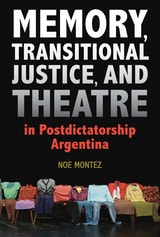
Memory, Transitional Justice, and Theatre in Postdictatorship Argentina
Noe Montez
Southern Illinois University Press, 2018
Montez explores how the sociohistorical phenomenon of the Teatroxlaidentidad—an annual showcase staged with the support of Argentina’s Grandmothers of the Plaza de Mayo—acted as a vehicle for drawing attention to the hundreds of children kidnapped from their families during the dictatorship and looks at why the memory narratives regarding the Malvinas Islands (also known as the Falklands) range from ideological appropriations of the islands, to absurdist commentaries about the failed war that signaled the dictatorship’s end, to the islands’ heavily contested status today.
Memory, Transitional Justice, and Theatre in Postdictatorship Argentina explores the vibrant role of theatrical engagement in postdictatorship Argentina, analyzes plays by artists long neglected in English-language articles and books, and explores the practicalities of staging performances in Latin America.
Memory-Theater and Postmodern Drama
Jeanette R. Malkin
University of Michigan Press, 1999
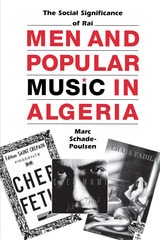
Men and Popular Music in Algeria
The Social Significance of RaïBy Marc Schade-Poulsen
University of Texas Press, 1999
Raï music is often called the voice of the voiceless in Algeria, a society currently swept by tragic conflict. Raï is the voice of Algerian men, young men caught between generations and classes, in political strife, and in economic inequality. In a ground-breaking study, anthropologist Marc Schade-Poulsen uses this popular music genre as a lens through which he views Algerian society, particularly male society. He situates raï within Algerian family life, moral codes, and broader power relations.
Schade-Poulsen did his research in the 1990s, in clubs, recording studios, at weddings, and with street musicians. He describes the history of raï, which emerged in the late 1970s and spread throughout North Africa at the same time the Islamist movement was growing to become the most potent socio-political movement in Algeria.
Outsiders consider raï to be Western in origin, but Schade-Poulsen shows its Islamic roots as well. The musicians do use Western instruments, but the music itself mixes Algerian popular songs and rhythms with the beat of American disco, Egyptian modalities, Moroccan wedding tunes, and the songs of Julio Iglesias. The lyrics deal with male-female relationships but also with generational relationships and the problems of youth, as they struggle to find a place in a conflicted society.
The study, in its innovative approach to music as a template of society, helps the reader understand the two major movements among today's Algerian youth: one toward the mosque and the other toward the West.
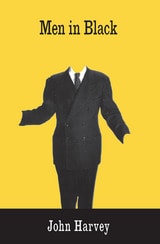
Men in Black
John Harvey
University of Chicago Press, 1995
"Why can't we pick out our own color?"
Joe:
"I tried that once, it don't work. You get four guys fighting over who's gonna be Mr. Black."
—Quentin Tarantino, Reservoir Dogs
Men's clothes went black in the nineteenth century. Dickens, Ruskin and Baudelaire all asked why it was, in an age of supreme wealth and power, that men wanted to dress as if going to a funeral. The answer is in this history of the color black. Over the last 1000 years there have been successive expansions in the wearing of black—from the Church to the Court, from the Court to the merchant class. Though black as fashion was often smart and elegant, its growth as a cultural marker was fed by several currents in Europe's history—in politics, asceticism, religious warfare. Only in the nineteenth century, however, did black fully come into its own as fashion, the most telling witnesses constantly saw connections between the taste for black and the forms of constraint with which European society regimented itself.
Concentrating on the general shift away from color that began around 1800, Harvey traces the transition to black from the court of Burgundy in the 15th century, through 16th-century Venice, 17th-century Spain and the Netherlands. He uses paintings from Van Eyck and Degas to Francis Bacon, religious art, period lithographs, wood engravings, costume books, newsphotos, movie stills and related sources in his compelling study of the meaning of color and clothes.
Although in the twentieth century tastes have moved toward new colors, black has retained its authority as well as its associations with strength and cruelty. At the same time black is still smart, and fashion keeps returning to black. It is, perhaps, the color that has come to acquire the greatest, most significant range of meaning in history.
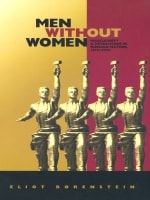
Men without Women
Masculinity and Revolution in Russian Fiction, 1917–1929Eliot Borenstein
Duke University Press, 2001
In such works as Red Cavalry by Isaac Babel, Envy by Yuri Olesha, and Chevengur by Andrei Platonov women are either absent or transformed into bodiless abstractions. Their absence, claims Borenstein, reflects the masculine values that are hallmarks of the post-revolutionary era: production rather than reproduction, participation in history rather than domestic ahistoricity, heavy industry, construction, and struggle. He identifies in this literature groups of “men without women” replacing the family, even while the metaphor of family is used as an organizing feature of their recurring revolutionary missions. With the passage of time, these characters’ relationships—just as those in the Soviet culture of the time—begin to resemble the family structure that was originally rejected and destroyed, with one important exception: the new “families” had no place for women. According to Borenstein, this masculinist myth found its most congenial audience during the early period of communism, but its hostility to women and family ties could not survive into the Stalinist era when women, home, and family were no longer seen as antithetical to socialism.
Drawing on the theory and writings of Levi-Strauss, Girard, Sedgwick, and others, Men Without Women will be of interest to students and scholars of Slavic literature and history as well as specialists in literary theory and gender studies.
Menander and the Birth of Domestic Drama
Mitch Brown
University of Wisconsin Press, 2024
The design of the Greek stage was such that the interiors of houses were almost never shown, which posed difficulties for a playwright interested in staging the domestic lives of ordinary people. Here, Mitch Brown dissects how Menander responded to this challenge. As Brown demonstrates, Menander successfully conjured offstage action and even characters in the audiences’ imaginations; these offstage universes, Brown argues, are fundamental to understanding Menander’s dramaturgy and its reception in later centuries. Menander’s offstage methods and the new type of play (domestic drama) that he inaugurated directly influenced Western theater into the early modern period—and the impact of his innovations can still be seen indirectly today.
Mentor and Muse
Essays from Poets to PoetsEdited by Blas Falconer, Beth Martinelli, and Helena Mesa
Southern Illinois University Press, 2010
In Mentor and Muse, a collection of twenty-nine insightful essays by some of today’s leading poetic minds, editors Blas Falconer, Beth Martinelli, and Helena Mesa have brought together an illuminating anthology that draws upon both established and emerging poets to create a one-of-a-kind resource and unlock the secrets of writing and revising poetry.
Gathered here are numerous experts eager to share their wisdom with other writers. Each author examines in detail a particular poetic element, shedding new light on the endless possibilities of poetic forms. Addressed within are such topics as the fluid possibilities of imagery in poetry; the duality of myth and the personal, and the power of one to unlock the other; the surprising versatility of traditional poetic forms; and the pleasure of collaboration with other poets. Also explored in depth are the formative roles of cultural identity and expectations, and their effect on composition; advice on how to develop one’s personal poetic style and approach; the importance of setting in reading and meaning; and the value of indirection in the lyric poem. Challenges to conventional concepts of beauty are examined through Shakespeare’s sonnets, and the ghost of Longfellow is called upon to guide students through the rewards and roadblocks of writing popular poetry. Poetic persona is demystified through Newton’s law of gravity, while the countless permutations of punctuation are revealed with analysis of e. e. cummings and W. S. Merwin.
The essays include the full text of the poems discussed, and detailed, relevant writing exercises that allow students the opportunity to directly implement the strategies they have learned. While many advanced topics such as authenticity, discordant music, and prosody are covered, this highly readable volume is as user-friendly as it is informative. Offering a variety of aesthetics and approaches to tackling the issues of composition, Mentor and Muse takes poets beyond the simple stages of poetic terms and strategies. These authorsinvite students to explore more advanced concepts, enabling them to draw on the traditions of the past while at the same time forging their own creative paths into the future.
Chosen as one of the "Best Books for Writers" by Poets & Writers magazine
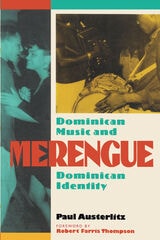
Merengue
Dominican Music and Dominican IdentityPaul Austerlitz
Temple University Press, 1997
Merengue—the quintessential Dominican dance music—has a long and complex history, both on the island and in the large immigrant community in New York City. In this ambitious work, Paul Austerlitz unravels the African and Iberian roots of merengue and traces its growth under dictator Rafael Trujillo and its renewed popularity as an international music.
Using extensive interviews as well as written commentaries, Austerlitz examines the historical and contemporary contexts in which merengue is performed and danced, its symbolic significance, its social functions, and its musical and choreographic structures. He tells the tale of merengue's political functions, and of its class and racial significance. He not only explores the various ethnic origins of this Ibero-African art form, but points out how some Dominicans have tried to deny its African roots.
In today's global society, mass culture often marks ethnic identity. Found throughout Dominican society, both at home and abroad, merengue is the prime marker of Dominican identity. By telling the story of this dance music, the author captures the meaning of mass and folk expression in contemporary ethnicity as well as the relationship between regional, national, and migrant culture and between rural/regional and urban/mass culture. Austerlitz also traces the impact of migration and global culture on the native music, itself already a vibrant intermixture of home-grown merengue forms.
From rural folk idiom to transnational mass music, merengue has had a long and colorful career. Its well-deserved popularity will make this book a must read for anyone interested in contemporary music; its complex history will make the book equally indispensable to anyone interested in cultural studies.

Merle Haggard
The Running KindBy David Cantwell
University of Texas Press, 2013
Merle Haggard has enjoyed artistic and professional triumphs few can match. He’s charted more than a hundred country hits, including thirty-eight number ones. He’s released dozens of studio albums and another half dozen or more live ones, performed upwards of ten thousand concerts, been inducted into the Country Music Hall of Fame, and seen his songs performed by artists as diverse as Lynryd Skynyrd, Elvis Costello, Tammy Wynette, Willie Nelson, the Grateful Dead, and Bob Dylan. In 2011 he was feted as a Kennedy Center Honoree. But until now, no one has taken an in-depth look at his career and body of work.
In Merle Haggard: The Running Kind, David Cantwell takes us on a revelatory journey through Haggard’s music and the life and times out of which it came. Covering the entire breadth of his career, Cantwell focuses especially on the 1960s and 1970s, when Haggard created some of his best-known and most influential music, which helped invent the America we live in today. Listening closely to a masterpiece-crowded catalogue (including songs such as “Okie from Muskogee,” “Sing Me Back Home,” “Mama Tried,” “Working Man Blues,” “Kern River,” “White Line Fever,” “Today I Started Loving You Again,” and “If We Make It through December,” among many more), Cantwell explores the fascinating contradictions—most of all, the desire for freedom in the face of limits set by the world or self-imposed—that define not only Haggard’s music and public persona but the very heart of American culture.
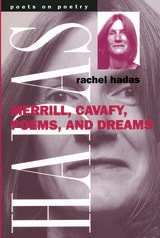
Merrill, Cavafy, Poems, and Dreams
Rachel Hadas
University of Michigan Press, 2000
The second half of the book combines explorations of various corners and horizons of the poetry scene, including neglected American poets and Hadas's thoughts on her own poetics and career. "Two Letters from New York" and "Tangled Web Sites" take bemused looks at literary or cultural landscapes. Hadas also looks inward: to dreams and dreamwork, to her dead mother's address book, to the emblematic drilling of a well in a country house. The range of selections includes essays, interviews, memoir, criticism, and a few of Hadas's own poems.
Rachel Hadas is the author of eleven books of poetry, essays, and translations. Her most recent book is Halfway Down the Hall: New and Selected Poems. She has received a Guggenheim Fellowship in Poetry and an American Academy-Institute of Arts and Letters Award in Literature, and is a member of the American Academy of Arts and Sciences. She is Professor of English at the Newark campus of Rutgers University.
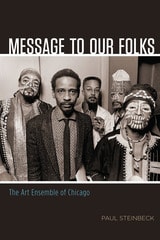
Message to Our Folks
The Art Ensemble of ChicagoPaul Steinbeck
University of Chicago Press, 2017
In Message to Our Folks, Paul Steinbeck combines musical analysis and historical inquiry to give us the definitive study of the Art Ensemble. In the book, he proposes a new theory of group improvisation that explains how the band members were able to improvise together in so many different styles while also drawing on an extensive repertoire of notated compositions. Steinbeck examines the multimedia dimensions of the Art Ensemble’s performances and the ways in which their distinctive model of social relations kept the group performing together for four decades. Message to Our Folks is a striking and valuable contribution to our understanding of one of the world’s premier musical groups.
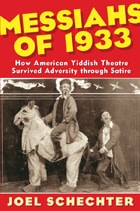
Messiahs of 1933
How American Yiddish Theatre Survived Adversity through SatireJoel Schechter
Temple University Press, 2008
Joel Schechter has rediscovered the funny and often politically-charged plays of the American Yiddish theatre of the 1930s. In Messiahs of 1933 he celebrates their satire, their radical imagination, and their commitment to social change. He introduces readers to the once-famous writers and actors—Moishe Nadir, David Pinski, Yosl Cutler, and others—who brought into artistic form their visions of peace, social justice, and satire for all.
Messiahs of 1933 greatly enlarges our understanding of Yiddish theatre and culture in the United States. It examines the innovative stage performances created by the Artef collective, the Modicut puppeteers, and the Yiddish Unit of the Federal Theatre Project. And it introduces to contemporary readers some of the most popular theatre actors of the 30s, including Leo Fuchs, Menasha Skulnik, and Yetta Zwerling. Throughout, it includes relevant photographs and contemporary comic strips, along with the first English-language publication of excerpts from the featured plays.
Mestizo Nations
Culture, Race, and Conformity in Latin American LiteratureJuan E. De Castro
University of Arizona Press, 2002
Through them, he delineates some of the ambiguities and contradictions that have beset this discourse. Among texts considered are the Indianist novel Iracema by the nineteenth-century Brazilian author José de Alencar; the Tradiciones peruanas, Peruvian Ricardo Palma's fictionalizations of national difference; and historical and sociological essays by the Peruvian Marxist José Carlos Mariátegui and the Brazilian intellectual Gilberto Freyre. And because questions raised by this discourse are equally relevant to postmodern concerns with national and transnational heterogeneity, De Castro also analyzes such recent examples as the Cuban dance band Los Van Van's use of Afrocentric lyrics; Richard Rodriguez's interpretations of North American reality; and points of contact and divergence between José María Arguedas's novel The Fox from Up Above and the Fox from Down Below and writings of Gloria Anzaldúa and Julia Kristeva.
By updating the concept of mestizaje as a critical tool for analyzing literary text and cultural trends—incorporating not only race, culture, and nationality but also gender, language, and politics—De Castro shows the implications of this Latin American discursive tradition for current critical debates in cultural and area studies. Mestizo Nations contains important insights for all Latin Americanists as a tool for understanding racial relations and cultural hybridization, creating not only an important commentary on Latin America but also a critique of American life in the age of multiculturalism.
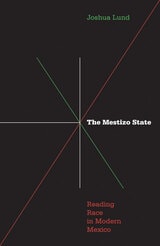
Mestizo State
Reading Race in Modern MexicoJoshua Lund
University of Minnesota Press, 2012
The Mestizo State examines how the ideas, images, and public discourse around race, nation, and citizen formation have been transformed in Mexico from the mid-nineteenth century to the present. Starting with the Porfiriato, Joshua Lund investigates the rise of a racialized “mestizo state,” its reinvention after the Mexican Revolution, and its mobilization as a critical lever that would act both on behalf of and against mainstream Mexican political culture during the long hegemony of the Partido Revolucionario Institucional.
Lund takes race as his object of critical reflection in the context of modern Mexico. An analysis that does not confuse race with mestizaje, indigeneity, African identity, or whiteness, the book sheds light on the history of the materialism of race as it unfolds within the cultural production of modern Mexico, grounded on close readings of four writers whose work explicitly challenged the politics of race in Mexico: Luis Alva, Ignacio Manuel Altamirano, Rosario Castellanos, and Elena Garro.
In seeking to address race as a cultural-political problematic, Lund considers race as integral to the production of the materiality of Mexican national history: constitutive of the nation form, a mediator of capitalist accumulation, and a central actor in the rise of modernity.
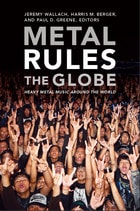
Metal Rules the Globe
Heavy Metal Music around the WorldJeremy Wallach, Harris M. Berger, and Paul D. Greene, eds.
Duke University Press, 2012
Contributors. Idelber Avelar, Albert Bell, Dan Bendrups, Harris M. Berger, Paul D. Greene, Ross Hagen, Sharon Hochhauser, Shuhei Hosokawa, Keith Kahn-Harris, Kei Kawano, Rajko Muršič,Steve Waksman, Jeremy Wallach, Robert Walser, Deena Weinstein, Cynthia P. Wong
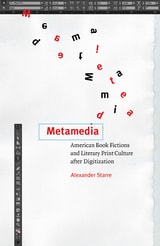
Metamedia
American Book Fictions and Literary Print Culture after DigitizationAlexander Starre
University of Iowa Press, 2015
Combining sustained textual analysis with impulses from the fields of book history, media studies, and systems theory, Starre explains the aesthetics and the cultural work of complex material fictions, such as Mark Z.Danielewski’s House of Leaves (2000), Chip Kidd’s The Cheese Monkeys (2001), Salvador Plascencia’s The People of Paper (2005), Reif Larsen’s The Selected Works of T. S. Spivet (2009), and Jonathan Safran Foer’s Tree of Codes (2010). He also broadens his analysis beyond the genre of the novel in an extensive account of the influential literary magazine McSweeney’s Quarterly Concern and its founder, Dave Eggers.
For this millennial generation of writers and publishers, the computer was never a threat to print culture, but a powerful tool to make better books. In careful close readings, Starre puts typefaces, layouts, and cover designs on the map of literary criticism. At the same time, the book steers clear of bibliophile nostalgia and technological euphoria as it follows writers, designers, and publishers in the process of shaping the surprising history of literary bookmaking after digitization.
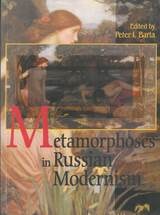
Metamorphosis in Russian Modernism
Peter I. Barta
Central European University Press, 2000
Metamorphosis of Language in Apuleius
A Study of Allusion in the NovelEllen D. Finkelpearl
University of Michigan Press, 1998
When Apuleius wrote his Metamorphoses, the novel--indeed the very concept of fiction in prose--was new. This study argues that Apuleius' repeated allusions to earlier Latin authors such as Vergil, Ovid, and Seneca represent an exploration on his part of the relationship between the novel and more established genres of the era. Apuleius' struggle with this tradition, Finkelpearl maintains, parallels the protagonist's move from an acceptance of the dominance of traditional forms to a sense of arrival and self- discovery.
An introductory chapter includes general discussion of the theory and practice of allusion. Finkelpearl then revisits the issues of parody in Apuleius. She also includes discussion of Apuleius' use of Vergil's Sinon, the Charite episode in relation to Apuleius' African origins, and the stepmother episode. Finally a new reading of Isis is offered, which emphasizes her associations with writing and matches the multiformity of the goddess with the novel's many voices.
This book will be of interest to scholars of literature and the origins of the novel, multiculturalism, and classical literature.
Ellen D. Finkelpearl is Associate Professor of Classics at Scripps College, Claremont, California.
Metaphor and Musical Thought
Michael Spitzer
University of Chicago Press, 2004
The experience of music is an abstract and elusive one, enough so that we're often forced to describe it using analogies to other forms and sensations: we say that music moves or rises like a physical form; that it contains the imagery of paintings or the grammar of language. In these and countless other ways, our discussions of music take the form of metaphor, attempting to describe music's abstractions by referencing more concrete and familiar experiences.
Michael Spitzer's Metaphor and Musical Thought uses this process to create a unique and insightful history of our relationship with music—the first ever book-length study of musical metaphor in any language. Treating issues of language, aesthetics, semiotics, and cognition, Spitzer offers an evaluation, a comprehensive history, and an original theory of the ways our cultural values have informed the metaphors we use to address music. And as he brings these discussions to bear on specific works of music and follows them through current debates on how music's meaning might be considered, what emerges is a clear and engaging guide to both the philosophy of musical thought and the history of musical analysis, from the seventeenth century to the present day. Spitzer writes engagingly for students of philosophy and aesthetics, as well as for music theorists and historians.
Metaphor and the Slave Trade in West African Literature
Laura T. Murphy
Ohio University Press, 2012
Metaphor and the Slave Trade provides compelling evidence of the hidden but unmistakable traces of the transatlantic slave trade that persist in West African discourse. Through an examination of metaphors that describe the trauma, loss, and suffering associated with the commerce in human lives, this book shows how the horrors of slavery are communicated from generation to generation.
Laura T. Murphy’s insightful new readings of canonical West African fiction, autobiography, drama, and poetry explore the relationship between memory and metaphor and emphasize how repressed or otherwise marginalized memories can be transmitted through images, tropes, rumors, and fears. By analyzing the unique codes through which West Africans have represented the slave trade, this work foregrounds African literary contributions to Black Atlantic discourse and draws attention to the archive that metaphor unlocks for scholars of all disciplines and fields of study.

Metapoesis
The Russian Tradition from Pushkin to ChekhovMichael C. Finke
Duke University Press, 1995
Jakobsonian poetics provides the framework for this approach, though Finke also draws freely upon a number of contemporary literary theorists. After elucidating the meaning of metapoesis in works by Pushkin, Gogol, and Chernyshevsky, he reveals its covert functioning in such masterpieces of realism as Dostoevsky’s The Idiot, Tolstoy’s Anna Karenina, and Chekhov’s "The Steppe." The result is a new interpretation and deeper understanding of these particular works, which in turn reorient our understanding of linguistic and literary "codes" and of the Russian literary tradition itself.
Of special interest to scholars of Russian literature, Metapoesis will also appeal to a broad range of readers and students of comparative literature, literary theory, and poetics.
Metaromanticism
Aesthetics, Literature, TheoryPaul Hamilton
University of Chicago Press, 2003
Through a close look at the aesthetics of Friedrich Schiller and Jean-Jacques Rousseau, and key works by Samuel Taylor Coleridge, Percy and Mary Shelley, John Keats, Sir Walter Scott, Jane Austen, and many others, Hamilton shows how the romantic movement's struggle with its own tenets was not an effort to seek an alternative way of thought, but instead a way of becoming what it already was. And yet, as he reveals, the romanticists were still not content with their own self-consciousness. Pushed to the limit, such contemplation either manifested itself as self-disgust or found aesthetic ideas regenerated in discourses outside of aesthetics altogether.
Meter Matters
Verse Cultures of the Long Nineteenth CenturyJason David Hall
Ohio University Press, 2011
Across the nineteenth century, meter mattered—in more ways and to more people than we might well appreciate today. For the period’s poets, metrical matters were a source of inspiration and often vehement debate. And the many readers, teachers, and pupils encountered meter and related topics in both institutional and popular forms.
The ten essays in Meter Matters showcase the range of metrical practice of poets from Wordsworth and Byron to Hopkins, Swinburne, and Tennyson; at the same time, the contributors bring into focus some of the metrical theorizing that shaped poetic thinking and responses to it throughout the nineteenth century. Paying close attention to the historical contours of Romantic and Victorian meters, as well as to the minute workings of the verse line, Meter Matters presents a fresh perspective on a subject that figured significantly in the century’s literature, and in its culture.
Mexican American Mojo
Popular Music, Dance, and Urban Culture in Los Angeles, 1935–1968Anthony Macías
Duke University Press, 2008
Macías conducted numerous interviews for Mexican American Mojo, and the voices of little-known artists and fans fill its pages. In addition, more famous musicians such as Ritchie Valens and Lalo Guerrero are considered anew in relation to their contemporaries and the city. Macías examines language, fashion, and subcultures to trace the history of hip and cool in Los Angeles as well as the Chicano influence on urban culture. He argues that a grass-roots “multicultural urban civility” that challenged the attempted containment of Mexican Americans and African Americans emerged in the neighborhoods, schools, nightclubs, dance halls, and auditoriums of mid-twentieth-century Los Angeles. So take a little trip with Macías, via streetcar or freeway, to a time when Los Angeles had advanced public high school music programs, segregated musicians’ union locals, a highbrow municipal Bureau of Music, independent R & B labels, and robust rock and roll and Latin music scenes.

Mexican Literature
A HistoryEdited by David William Foster
University of Texas Press, 1994
Mexico has a rich literary heritage that extends back over centuries to the Aztec and Mayan civilizations. This major reference work surveys more than five hundred years of Mexican literature from a sociocultural perspective. More than merely a catalog of names and titles, it examines in detail the literary phenomena that constitute Mexico's most significant and original contributions to literature.
Recognizing that no one scholar can authoritatively cover so much territory, David William Foster has assembled a group of specialists, some of them younger scholars who write from emerging trends in Latin American and Mexican literary scholarship. The topics they discuss include pre-Columbian indigenous writing (Joanna O'Connell), Colonial literature (Lee H. Dowling), Romanticism (Margarita Vargas), nineteenth-century prose fiction (Mario Martín Flores), Modernism (Bart L. Lewis), major twentieth-century genres (narrative, Lanin A. Gyurko; poetry, Adriana García; theater, Kirsten F. Nigro), the essay (Martin S. Stabb), literary criticism (Daniel Altamiranda), and literary journals (Luis Peña). Each essay offers detailed analysis of significant issues and major texts and includes an annotated bibliography of important critical sources and reference works.
Mexican Masculinities
Robert McKee Irwin
University of Minnesota Press, 2003
A fascinating examination of masculinity in nineteenth- and twentieth-century Mexico
The first of its kind and a powerful challenge to customary views of gender and sexuality in the life and literature of Mexico, this book traces literary representations of masculinity in Mexico from independence in 1810 to the 1960s, and shows how these intersect with the constructions of nation and nationality.
The rhetoric of “Mexicanness” makes constant use of images of masculinity, though it does so in shifting and often contradictory ways. Robert McKee Irwin’s work follows these shifts from the male homosocial bonding that was central to notions of national integration in the nineteenth century, to questioning of gender norms stirred by science and scandals at the turn of the century, to the virulent reaction against gender chaos after the Mexican revolution, to the association of Mexicanness with machismo and homophobia in the literature of the 1940s and 1950s—even as male homosexuality was established as an integral part of national culture.As the first historical study of how masculinity and, particularly, homosexuality were understood in Mexico in the national era, this book not only provides “queer readings” of most major canonical texts of the period in question, but also uncovers a variety of unknown texts from queer Mexican history, including the 1906 novel Los 41, which reenacts the scandal of a turn-of-the-century transvestite ball that launched modern discussion of homosexuality in Mexico. It is a radical undermining of the simple hetero/homosexual and masculine/feminine oppositions that have for so long informed views of the country’s national character.
Mexican Melodrama
Film and Nation from the Golden Age to the New WaveElena Lahr-Vivaz
University of Arizona Press, 2016
Mexico’s Golden Age of film—the period from the 1930s to the 1950s—is considered “golden” due to both the prestige of the era’s stars and the critical and popular success of the films released. Golden Age directors often turned to the tropes of melodrama and allegory to offer spectators an image of an idealized Mexico and to spur the formation of a spectatorship united through shared tears and laughter. In contrast, Lahr-Vivaz demonstrates that new-wave directors of the 1990s and 2000s use the melodramatic mode to present a vision of fragmentation and to open a space for critical resistance. In so doing, new-wave directors highlight the limitations rather than the possibilities of a unified spectatorship, and point to the need for spectators to assume a critical stance in the face of the exigencies of the present.
Written in an accessible style, Mexican Melodrama offers a timely comparative analysis of critically acclaimed films that will serve as key referents in discussions of Mexican cinema for years to come.
Mexico Reading the United States
Linda Egan
Vanderbilt University Press, 2009
In a time of ever-increasing migration of capital and human beings, this book turns on its head the usual perspective of U.S. economic and cultural dominance in order to deepen understanding of the bi-national relationship.
Mexico in Verse
A History of Music, Rhyme, and PowerEdited by Stephen Neufeld and Michael Matthews; Foreword by William H. Beezley
University of Arizona Press, 2015
Focusing on modern Mexico, from 1840 to the 1980s, this volume examines the cultural venues in which people articulated their understanding of the social, political, and economic change they witnessed taking place during times of tremendous upheaval, such as the Mexican-American War, the Porfiriato, and the Mexican Revolution. The words of diverse peoples—people of the street, of the field, of the cantinas—reveal the development of the modern nation. Neufeld and Matthews have chosen sources so far unexplored by Mexicanist scholars in order to investigate the ways that individuals interpreted—whether resisting or reinforcing—official narratives about formative historical moments.
The contributors offer new research that reveals how different social groups interpreted and understood the Mexican experience. The collected essays cover a wide range of topics: military life, railroad accidents, religious upheaval, children’s literature, alcohol consumption, and the 1985 earthquake. Each chapter provides a translated song or poem that encourages readers to participate in the interpretive practice of historical research and cultural scholarship. In this regard, Mexico in Verse serves both as a volume of collected essays and as a classroom-ready primary document reader.

Mexico, Nation in Transit
Contemporary Representations of Mexican Migration to the United StatesChristina L. Sisk
University of Arizona Press, 2011
Sisk’s transnational investigation moves easily across the US–Mexico border, analyzing films made on both sides, literature de la frontera, Mexican rock music, migrant narratives, and texts written by second- and third-generation immigrants. Included are the perspectives of those who left Mexico, those who were left behind, and the children who travel back “home.” Sisk discovers that the loss of Mexicans to the United States through emigration has had an effect on Mexico similar to the impact of the perceived Mexican invasion of the United States.
Spanning the social sciences and the humanities, Mexico, Nation in Transit poses a new transnational alternative to the postnational view that geopolitical borders are being erased by the forces of migration and globalization, and the nationalist view that borders must be strictly enforced. It shows that borders, like identities, are not easy to locate precisely.
Michael Field
Decadent ModernsSarah Parker
Ohio University Press, 2019
In the last twenty years, Michael Field has emerged as one of the most fascinating poets of the Victorian era. Through their collaborative partnership as “Michael Field,” Katharine Bradley and Edith Cooper engaged in the aesthetic and decadent movements of the fin de siècle, while their poetry and verse drama articulate ideas associated with the New Woman and boldly express queer and lesbian desire. Michael Field: Decadent Moderns extends the focus on these key literary and cultural contexts by emphasizing their continuing significance within twentieth-century literary modernism. Through a series of interdisciplinary essays, this book addresses Michael Field’s energetic engagements with a range of topics including ecology, perfume, tourism, art history, sculpture, formalism, classics, and book history. In doing so, Michael Field: Decadent Moderns highlights the modernity, radicalism, and relevance of their work, both within the nineteenth and twentieth centuries as well as in our own cultural moment.
Contributors: Leire Barrera-Medrano, Joseph Bristow, Jill R. Ehnenn, Sarah E. Kersh, Kristin Mahoney, Catherine Maxwell, Alex Murray, Sarah Parker, Margaret D. Stetz, Kate Thomas, and Ana Parejo Vadillo.
Michael Moore and the Rhetoric of Documentary
Edited by Thomas W. Benson and Brian J. Snee
Southern Illinois University Press, 2015
Not afraid to tackle provocative topics in American culture, from gun violence and labor policies to terrorism and health care, Michael Moore has earned both applause and invective in his career as a documentarian. In such polarizing films as Bowling for Columbine, Fahrenheit 9/11, and Sicko, Moore has established a unique voice of radical nostalgia for progressivism, and in doing so has become one of the most recognized documentary filmmakers of all time.
In the first in-depth study of Moore’s feature-length documentary films, editors Thomas W. Benson and Brian J. Snee have gathered leading rhetoric scholars to examine the production, rhetorical appeals, and audience reception of these films. Contributors critique the films primarily as modes of public argument and political art. Each essay is devoted to one of Moore’s films and traces in detail how each film invites specific audience responses.
Michael Moore and the Rhetoric of Documentary reveals not only the art, the argument, and the emotional appeals of Moore’s documentaries but also how these films have revolutionized the genre of documentary filmmaking.
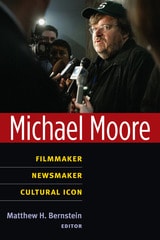
Michael Moore
Filmmaker, Newsmaker, Cultural IconMatthew Bernstein, Editor
University of Michigan Press, 2010
For more than twenty years, Michael Moore has transformed himself from a marginal filmmaker into a cultural icon, unofficial spokesperson for liberals and the Left. American conservatives constantly use him for target practice and target. Book author, film director, television personality, and Web presence, Moore is now a one-man cultural phenomenon. Although Michael Moore is a constant presence on the media landscape, this is the first volume to focus on the Moore phenomenom. It explores Moore's work in film and elsewhere, bringing diverse perspectives on his activities and status as voice of liberal America and the disenfranchised working class. Topics examined include the disjunction between Moore's celebrity status and everyman, middle-western persona, his self-mocking ironic sensibility, his tendency to diagnose American social and political problems in terms of class rather than gender, his reception abroad, and his uneasy relationship with the conventions of documentary filmmaking. The contributors are leading scholars and film critics, including Paul Arthur, Cary Elza, Jeffrey P. Jones, Douglas Kellner, Richard Kilborn, William Luhr, Charles Musser, Richard R. Ness, Miles Orvell, Richard Porton, Sergio Rizzo, Christopher Sharrett, Gaylyn Studlar, and David Teztlaff. The volume features both assessments of Moore's work in general and close analyses of his most successful films. The result is a definitive assessment of Moore's career to date.
Matthew Bernstein is Professor and Chair of Film Studies at Emory University. He is author of Walter Wanger: Hollywood Independent.
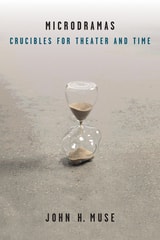
Microdramas
Crucibles for Theater and TimeJohn H. Muse
University of Michigan Press, 2017
Subjecting short plays to extended scrutiny upends assumptions about brief or minimal art, and about theatrical experience. The book shows that short performances often demand greater attention from audiences than plays that unfold more predictably. Microdramas put pressure on preconceptions about which aspects of theater might be fundamental and about what might qualify as an event. In the process, they suggest answers to crucial questions about time, spectatorship, and significance.

Microgroove
Forays into Other MusicJohn Corbett
Duke University Press, 2015

Middle English Prose
A Critical Guide to Major Authors and GenresEDWARDS, ANTHONY
Rutgers University Press, 1984
Midrash and Theory
Ancient Jewish Exegesis and Contempory Literary StudiesDavid Stern
Northwestern University Press, 1998
As midrash--the literature of classical Jewish Scriptural interpretation--has become the focus of new interest in contemporary literary circles, it has been invoked as a precursor of post-structuralist theory and criticism. At the same time, the midrashic imagination has undergone a revival in the larger Jewish community and shown itself capable of exercising a powerful influence and hold on a new type of contemporary Jewish writing. Stern examines this resurgence of fascination with ancient Jewish interpretation from the persepctive of the cultural relevance of midrash and its connection to its original historical and literary contexts.
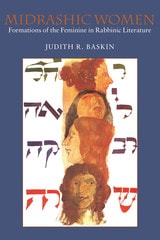
Midrashic Women
Formations of the Feminine in Rabbinic LiteratureJudith R. Baskin
Brandeis University Press, 2002

Migrant Sites
America, Place, and Diaspora LiteraturesDalia Kandiyoti
Dartmouth College Press, 2009
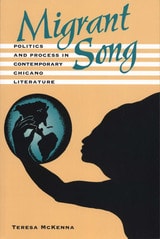
Migrant Song
Politics and Process in Contemporary Chicano LiteratureBy Teresa McKenna
University of Texas Press, 1996
Migration and continuity have shaped both the Chicano people and their oral and written literature. In this pathfinding study of Chicano literature, Teresa McKenna specifically explores how these works arise out of social, political, and psychological conflict and how the development of Chicano literature is inextricably embedded in this fact.
McKenna begins by appraising the evolution of Chicano literature from oral forms—including the important role of the corrido in the development of Chicano poetry. In subsequent chapters she examines the works of Richard Rodriguez and Rolando Hinojosa. She also devotes a chapter to the development of the Chicana voice in Chicano literature. Her epilogue considers the parallel development of Chicano literary theory and discusses some possible directions for research.
In McKenna's own words, "I believe that the future of this literature, as that of all literatures by people of color in the United States, rests largely on its being effectively introduced into the curricula at all levels, as well as its entrance into the critical consciousness of literary theory." This book will be an important step in that process.

Migrating Fictions
Gender, Race, and Citizenship in U.S. Internal DisplacementsAbigail G. H. Manzella
The Ohio State University Press, 2018
Winner, 2021 CCCC Outstanding Book Award
Migrating Fictions analyzes the role of race, gender, and citizenship in the major internal displacements of the 20th century in history and in narrative. Surveying the particular tactics employed by the United States during the Great Migration, the Dust Bowl, the Japanese American incarceration, and the migrant labor of the Southwest, Abigail G. H. Manzella reveals how the country’s past is imbued with governmentally (en)forced movements that diminished access to full citizenship rights for the laboring class, people of color, and women.
This work is the first book-length study to examine all of these movements together along with their literature, including Zora Neale Hurston’s Their Eyes Were Watching God, Sanora Babb’s Whose Names Are Unknown, Julie Otsuka’s When the Emperor Was Divine, Helena María Viramontes’s Under the Feet of Jesus, and Jesmyn Ward’s Salvage the Bones. Manzella shows how the United States’ history of spatial colonization within its own borders extends beyond isolated incidents into a pattern based on ideology about nation-building, citizenship, and labor. This book seeks to theorize a Thirdspace, an alternate location for social justice that acknowledges the precarity of the internally displaced person.

Migration and Identity in Nordic Literature
Edited by Martin Humpál and Helena Brezinová
Karolinum Press, 2022
Migration is a frequent topic of many debates nowadays, whether it concerns refugees from war-torn areas or the economic pros and cons of the mobility of multinational corporations and their employees. Yet such migration has always been a part of the human experience, and its dimensions—with its shifting nature, manifestations, and consequences—were often greater than we can imagine today.
In this book, ten scholars from Czechia, Denmark, the Netherlands, Norway, Poland, and Sweden focus on how migration has manifested itself in literature and culture through the nineteenth, twentieth, and early twenty-first centuries in Denmark, Norway, Sweden, Finland, and Iceland. Examining the theme of migration as it relates to questions of identity, both national and individual, the authors argue that migration almost always leads to a disturbance of identity and creates a potential for conflicts between individuals and larger groups. The book digs deep into such cases of disturbance, disruption, and hybridization of identity as they are represented in three centuries of literary works from the European North.