Results by title
3388 books match the query 'Fiction' and 173 start with m
My Family's Role in the World Revolution
and Other ProseBora Cosic
Northwestern University Press, 1997
During the German occupation of Belgrade, a family—including an alarmist mother, an eternally drunk father, two young aunts who swoon over American movie stars, and a playboy uncle—attempt to find any kind of work they can do at home. When the postwar Socialist society is being ushered in after the war, the narrator becomes the slogan-spouting ideological leader of the household, while his family tries—and often fails miserably—to take part in the "great change."
This volume also includes several Ćosić short stories, and recent essays on the war in the former Yugoslavia.

My Father's War
Fighting with the Buffalo Soldiers in World War IICarolyn Ross Johnston
University of Alabama Press, 2012
A compelling story of a unit of Buffalo Soldiers and their white commander fighting on the Italian front during World War II.
The 92nd Division of the Fifth Army was the only African American infantry division to see combat in Europe during 1944 and 1945, suffering more than 3,200 casualties. Members of this unit, known as Buffalo Soldiers, endured racial violence on the home front and experienced racism abroad. Engaged in combat for nine months, they were under the command of southern white infantry officers like their captain, Eugene E. Johnston.
Carolyn Ross Johnston draws on her father’s account of the war and her extensive interviews with other veterans of the 92nd Division to describe the experiences of a naïve southern white officer and his segregated unit on an intimate level. During the war, the protocol that required the assignment of southern white officers to command black units, both in Europe and in the Pacific theater, was often problematic, but Johnston seemed more successful than most, earning the trust and respect of his men at the same time that he learned to trust and respect them. Gene Johnston and the African American soldiers were transformed by the war and upon their return helped transform the nation.
My Father’s Books
Luan Starova; Translated by Christina E. Kramer
University of Wisconsin Press, 2012
In My Father’s Books, the first volume in Luan Starova’s multivolume Balkan Saga, he explores themes of history, displacement, and identity under three turbulent regimes—Ottoman, Fascist, and Stalinist—in the twentieth century. Weaving a story from the threads of his parents’ lives from 1926 to 1976, he offers a child’s-eye view of personal relationships in shifting political landscapes and an elegiac reminder of the enduring power of books to sustain a literate culture.
Through lyrical waves of memory, Starova reveals his family’s overlapping religious, linguistic, national, and cultural histories. His father left Constantinople as the Ottoman Empire collapsed, and the young family fled from Albania to Yugoslav Macedonia when Luan was a boy. His parents, cosmopolitan and well-traveled in their youth, and steeped in the cultures of both Orient and Occident, find themselves raising their children in yet another stagnant and repressive state. Against this backdrop, Starova remembers the protected spaces of his childhood—his mother’s walled garden, his father’s library, the cupboard holding the rarest and most precious of his father’s books. Preserving a lost heritage, these books also open up a world that seems wide, deep, and boundless.
My Father’s War
Stories of Midwestern MenBarton Sutter
University of Minnesota Press, 2000
Poignant and revealing stories from one of the Midwest’s leading authors.
Poignant and revealing stories from one of the Midwest’s leading authors.
"A compelling debut. These stories offer leisurely exposition and character development. . . . Their honesty and sensitivity will resonate." Publishers Weekly"These are wonderful stories-images of personal and societal growth that are at once hopeful and skeptical, loving and shrewd." New Orleans Times-Picayune"These magnificent stories are big-hearted and loving in a way I don’t think I’ve ever encountered. With a calm and compassionate hand, Barton Sutter reveals to us the true dignity of humankind, the necessity of heroes and history, and the unerring aim of hope. My Father’s War is a beautiful book." Bret LottIn this collection of stories, Barton Sutter shows us all the ways in which we are shaped by our surroundings. With an unswerving gaze, he portrays the rituals of growing up that we all experience, no matter how old we think we are.
My Haunted Home
StoriesVictoria Hood
University of Alabama Press, 2022
WINNER OF FC2’s RONALD SUKENICK INNOVATIVE FICTION PRIZE
Meditations on the ways grief is felt and harvested—the funny, the sorrowful, the surreal, and the unmentionable
The stories in My Haunted Home delve in startling ways into the lives of the obsessed, the grieving, and the truly haunted. Victoria Hood conjures a shifting range of narrators through an unstable range of worlds where mothers might be dead, girls compulsively shove peanuts inside their ears, agoraphobia traps people inside their houses, and cats won’t eat your soup. In “The Teeth, the Way I Smile,” a daughter who looks like her dead mother manifests grief both in her house and her body. In “Smelly Smelly,” a woman slowly comes to realize her boyfriend has been dead for weeks. In “You, Your Fault,” we explore the unfolding love of two women who love every part of each other—including the parts that fixate on arson and murder.
Each story is a bite-size piece of haunting candy on a necklace of obsession holding them together. Hood probes the worlds of what can be haunted, unpacking the ways in which hauntings can be manifested in physical forms, mentally harvested and lived through, and even a change in what is haunting.

My Heart Beats Fast
A NovelNadia Chonville; Translated from French by Corine Labridy
Vanderbilt University Press, 2026
Chonville’s novel is at the vanguard of a new Antillean literature that moves beyond créolité (the last identifiable literary movement in the Antillean canon) in several important ways: First, although it does reflect on the past (as indeed prescribed by the créolistes), it is firmly anchored in the present, which Chonville, a trained social scientist, captures unflinchingly. Second, it complexifies the Antilles gender landscape with characters whose intersectional realities are explored with depth and care.

My Immaculate Assassin
David Huddle
Tupelo Press, 2022
My Life as an Animal
StoriesLaurie Stone
Northwestern University Press, 2017
A woman meets a man and falls in love. She is sixty, a writer and lifelong New Yorker raised by garmentos. She thought this kind of thing wouldn’t happen again. He is English, so who knows what he thinks. He is fifty-six, a professor now living in Arizona, the son of a bespoke tailor. As the first of Laurie Stone’s linked stories begins, the writer contemplates what life would be like in the desert with the professor. As we learn how she became the person she is, we also come to know the artists and politics of the downtown scene of the ’70s, ’80s, and ’90s, a cultural milieu that remains alive in her. In sharply etched prose, Stone presents a woman constantly seduced by strangers, language, the streets— even a wildlife trail. Her characters realize that they feel at home in dislocation—in always living in two places at the same time: east and west, past and present, the bed and the grave (or copper urn). Love may not last, the writer knows. Then again, when has anything you thought about the future turned out right?
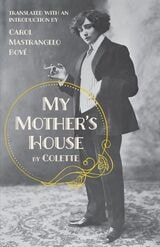
My Mother's House
Colette
Carnegie Mellon University Press, 2026
An updated translation of Colette’s revolutionary 1922 autobiographical collection that contains six previously untranslated chapters.
This book is a much-needed new translation of Colette’s classic La Maison de Claudine. A careful re-reading of the text was long overdue, given Colette’s evolution into one of the most admired French novelists in the modern world, the inadequacy of earlier translations, which omitted six significant chapters, and changes in contemporary attitudes on motherhood and sexual orientation. The controversial topic at the center of the novel, her passion for her mother Sido, animates her writing as a whole. As the BBC notes, “The Most Beloved French writer of all time. . . . An icon in her native France, Colette's scandalous life and works still captivate readers 150 years on from her birth, writes John Self.”
My Mother's Lover
Urs Widmer
Seagull Books, 2018
It’s Switzerland in the 1920s when the two lovers first meet. She is young, beautiful, and rich. In contrast, he can barely support himself and is interested only in music. By the end of their lives, he is a famous conductor and the richest man in the country, but she is penniless. And most important of all, no one knows of her love for him; it is a secret he took to his grave. Here begins Urs Widmer’s novel My Mother’s Lover.
Based on a real-life affair, My Mother’s Lover is the story of a lifelong and unspoken love for a man—recorded by the woman’s son, who begins this novel on the day his mother’s lover dies. Set against the backdrop of the Depression and World War II, it is a story of sacrifice and betrayal, passionate devotion, and inevitable suffering. Yet in Widmer’s hands, it is always entertaining and surprisingly comic—a unique kind of fairy tale.
My Mother's Lovers
(A Novel)Joy Passanante
University of Nevada Press, 2002
As a teenager, Lake joins her grandparents in Missouri and spends her youth seeking answers to her questions about the past, trying to understand the complex pattern of betrayals that shaped it. Only when she herself becomes party to a betrayal as devastating as any committed by her mother does Lake begin to understand.
Passanante writes with a keen eye for the details of behavior that reveal the yearnings and fears beneath the surface. She shows us that the path to understanding is never a smooth one, and that love is often far more complex than we can imagine. Western Literature Series.
My Mother's Silver Fox
Alois Hotschnig
Seagull Books, 2025
Heinz Fitz has only one tangible clue to his past: a worn piece of paper from the SS-Lebensborn program, a Nazi initiative designed to promote so-called racial purity. His mother, a Norwegian woman, fell in love with the wrong man—an Austrian soldier—during the German occupation. Betrayed and abandoned, she fled to Austria, only to be turned away by his family. Branded a collaborator in her homeland and a pariah in a foreign land, she was left to survive as best she could. Now, years later, her son is determined to piece together the fragments of his origins.
But every answer leads to more questions, and as he unearths painful truths, an alternative story—one of resilience, love, and survival—emerges from the darkness. Inspired by real events, Alois Hotschnig’s novel is both a fierce reckoning with history and a poignant tribute to a mother’s strength. A masterful meditation on memory and storytelling, My Mother’s Silver Fox asks whether the past can ever truly be understood—or if it will always slip through our grasp, like snow through our fingers.
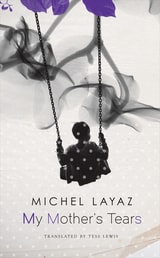
My Mother’s Tears
Michel Layaz
Seagull Books, 2019
The adult narrator of My Mother’s Tears has returned to clean out his childhood home after his mother’s death. In thirty short chapters, each focused on a talismanic object or resonant episode from his childhood, the narrator tries to solve the mystery behind the flood of tears with which his strikingly beautiful, intelligent, and inscrutable mother greeted his birth. Like insects preserved in amber, these objects—an artificial orchid, a statue, a pair of green pumps, a steak knife, a fishing rod and reel, among others—are surrounded by an aura that permeates the narrator’s life. Interspersed with these chapters are fragments from the narrator’s conversation with his present lover, a woman who demands that he verbally confront his past. This difficult conversation charts his gradual liberation from the psychological wounds he suffered growing up.
Not only an account of a son’s attempt to understand his enigmatic mother, My Mother’s Tears is also a moving novel about language and memory that explores the ambivalent power of words to hurt and to heal, to revive the past and to put childhood demons to rest.
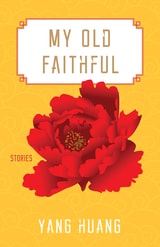
My Old Faithful
StoriesYang Huang
University of Massachusetts Press, 2018
Showing both the drama of familial intimacy and the ups and downs of the everyday, My Old Faithful introduces readers to a close-knit Chinese family. These ten interconnected short stories, which take place in China and the United States over a thirty-year period, merge to paint a nuanced portrait of family life, full of pain, surprises, and subtle acts of courage. Richly textured narratives from the mother, the father, the son, and the daughters play out against the backdrop of China's social and economic change.
With quiet humor and sharp insight into the ordinary, Yang Huang writes of a father who spanks his son out of love, a brother who betrays his sister, and a woman who returns to China after many years to find her country changed in ways both expected and startling.
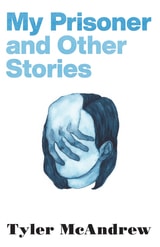
My Prisoner and Other Stories
Tyler McAndrew
The Ohio State University Press, 2025
Set largely in the Rust Belt of the 1990s and early 2000s, My Prisoner and Other Stories gives us protagonists who repeatedly confront helplessness in the face of others’ suffering. A teenage girl tries to help an elderly woman who has locked herself out of her house only to be shaken by the trauma and loneliness that the woman—a Holocaust survivor and recent widow—eventually shares with her. A schoolteacher writes letters to his cousin, who has schizophrenia and is serving a life sentence for the murder of three of their relatives. A middle school student makes a complicated gesture of charity after befriending the poor kid at his lunch table. Siblings seed the ground for an eccentric treasure hunter only to find that their prank leads them into unexpected emotional peril. The structural forces that stain life in late-capitalist America—the prison system, economic desperation—lurk throughout these muscular and empathetic tales, but in the face of endemic adversity, shrewd and loving characters strive for and sometimes achieve hope and tenderness. Tyler McAndrew shows us an unadorned America that can still tap its capacity for human kindness.
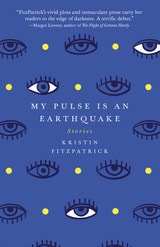
My Pulse Is an Earthquake
Kristin FitzPatrick
West Virginia University Press, 2015
The nine stories in My Pulse Is an Earthquake take place in the clutches of grief. Characters struggle to make sense of sudden losses of life, love, and community. From 1970 to the present day, children and young adults from the Rockies to the Appalachian Mountains guide readers through the valleys of their lives as dog breeders, immigrants, Catholic school delinquents, rookie policewomen, drummers, ballerinas, teenage brides, and an accountant who keeps a careful inventory of losses.
In each story, we see the darkness that can surface during the happy moments in life—weddings, births, promotions, the opening night of a director’s favorite play, or the best performance of a dancer’s career, when no one important is there to watch. We enter daydreams and night terrors where the dead are within reach, pointing out how they could have been saved. We wear their clothes and carry their teddy bears or vinyl records everywhere. We crawl around in caves and pound hammers into walls until our own hearts stop beating.
This collection explores how the unexpected harm to young, vibrant loved ones—from murder, kidnapping, battle, accident, natural disaster, swift illness, or stillbirth—can rupture families, and how the most unlikely healers can bring together those who remain.
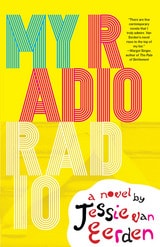
My Radio Radio
Jessie van Eerden
West Virginia University Press, 2016
The members of Dunlap Fellowship of All Things in Common share everything from their meager incomes to the only functioning toilet in the community house— everything, that is, except secrets. When Omi Ruth Wincott, the youngest member of the disintegrating common-purse community in this small Indiana town, loses her only brother, Woodrun, she withdraws from everyone and fixates on a secret desire: She wishes only for an extravagant head- stone to mark Woodrun’s grave, an expense that the strict, parsimonious community can’t—or won’t—pay for. In her loneliness, Omi Ruth’s only ties to the world remain her National Geographic magazines and a new resident in the house, Northrop, an old man caught between living and dying, maintained in a vegetative state by hospice care.
Observing everything with the keen eye of a girl with a photographic memory, Omi Ruth finds herself learning to grieve in the company of unlikely strangers. With the help of a homeless and pregnant Tracie Casteel, a rebellious Amish boy named Spencer Frye, and the smooth-talking Vaughn Buey who works third shift at Dunlap’s RV plant, Omi Ruth discovers that there are two things of which there is no shortage in the world’s common purse—love and loss.
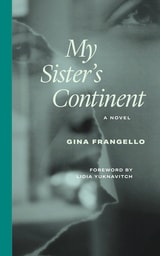
My Sister's Continent
A NovelGina Frangello, Lidia Yuknavitch
Northwestern University Press, 2026
Kirby is a young woman attempting to come to terms with a failed bout of therapy and the truth about her identical twin, Kendra. Since girlhood, Kirby both idolized and envied Kendra, a fearless and charismatic ballet dancer who commanded the attention of everyone in their orbit. In the aftermath of tragedy, Kirby is sent a case study by a former psychiatrist intent on publishing a distorted version of her family’s secrets. She responds by using Kendra’s private and revealing journals to reconstruct their final months together, as well as her own “disastrous” time in therapy, to voice her own truth.
Freud’s “Dora,” a young woman whose mysterious symptoms he contentiously chalked up to “hysteria,” appears at turns in the faces of each twin as they navigate a world of sexuality, familial dysfunction, and possibly-psychosomatic ailments. Reissued with a new foreword by Lidia Yuknavitch, Frangello’s groundbreaking early novel brings “Dora” into a new era.
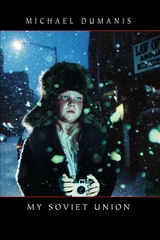
My Soviet Union
Michael Dumanis
University of Massachusetts Press, 2007
The speaker of the simultaneously funny and devastating poems in this remarkable first collection comes from a country that, like the Soviet Union, no longer exists, a place he treats with a mixture of nostalgia, disdain, and bewilderment as he strives to achieve a sense of order in his current disordered environment, a post-apocalyptic landscape with striking similarities to our own. He takes the reader through haunting and disjunctive childhood memories, on visits to Azerbaijan and West Des Moines, through the ravages of physical and spiritual illness, into and out of wars and ill-fated romantic escapades, as he carefully pieces together a complex narrative of self. This is a book of location and dis-location, intent and inaction, struggle and failure, restraint and mania, love and anger, savagery and healing, grief and merriment, elegy and ode. Technically, the poems-often litanies-are marked by syntactical variation, recurring imagery, paradoxical statement, cultural idioms, shifts between high and low diction, a carnivalesque sense of humor, and an elliptical approach to exposition. The speaker also takes on the identities of various personae in the book, including Joseph Cornell, Vladimir Mayakovsky, Pol Pot, a vaudevillian, a movie extra, minor dictators, vagrants, ambigendered lovers, and a lighthouse keeper on an uninhabited island.

Myself, Four Times
Maria Lazar
Seagull Books, 2026
Long unpublished and presumed lost, Myself, Four Times reveals Maria Lazar as a bold, psychologically acute feminist writer whose work deserves a central place in twentieth-century European literature.
Myself, Four Times is a rediscovered novel of friendship, desire, and self-invention by Maria Lazar (1895–1948), one of the most incisive and unjustly neglected voices of interwar Austrian literature. Written in Vienna in the late 1920s but never published in Lazar’s lifetime, the novel appears now for the first time, drawn from her literary estate.
The book follows four women—friends since their school days—whose lives unfold in strikingly different directions, yet remain inseparably bound from adolescence into adulthood. Set against the backdrop of the not-so-golden 1920s, it traces shared youth and first love alongside the darker currents of friendship: self-deception, betrayal, jealousy, and emotional manipulation. At the same time, Lazar charts women’s struggles for independence, identity, and fulfillment in a society poised between liberation and collapse.
With psychological acuity and social sharpness, Myself, Four Times captures both the exhilaration and the cost of female solidarity. Its long suppression mirrors Lazar’s own fate: a celebrated writer forced into exile by Nazism, silenced after she died in 1948, and only recently reclaimed as a major figure of twentieth-century European literature.

Mysterious Solidarities
Pascal Quignard
Seagull Books, 2020
This is a tale of dramatic episodes, told through intermingling voices and the atmospherics of the austere Breton landscape. Ultimately, it is a story of obsessional love and of a parallel sibling bond that is equally strong.
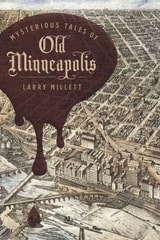
Mysterious Tales of Old Minneapolis
Larry Millett
University of Minnesota Press, 2025
Three novellas of murder and mystery in nineteenth-century Minneapolis
OWNER DIES UNDER STRANGE CIRCUMSTANCES AT MINNEAPOLIS MILL!
HOTEL BELLMAN FOUND DEAD IN OSCAR WILDE’S ROOM!
$10,000 REWARD FOR DISCOVERING MY MURDERER!
These headlines are just the beginning as Larry Millett returns to the scene of the crime in three tales of intrigue and murder in historic Minneapolis. The mind that brought us the intrepid Shadwell Rafferty now introduces three unlikely but talented new detectives—in-laws Sophia Westerly and Annie Nichols, and the incomparable Oscar Wilde—who are thrown into murder investigations amid flour milling, literary culture, and labor organizing in the burgeoning city.
Murder at the Falls takes us to the Perfection Flour Mill at St. Anthony Falls when one owner turns up dead under grotesque circumstances and suspicion lands on the other, plunging the city into a frenzy of dark speculation. In A Wilde Night at the Nicollet House, Oscar Wilde, in the midst of his 1882 North American tour and spouting witticisms as only he can, teams up with the long-time house detective at the Nicollet House Hotel to search for the murderer of the hotel bell captain found dead in his room. In The Death Committee, a champion lawyer of the working class, convinced his own murder is imminent, arranges for three citizens to investigate his death, with a $10,000 reward going to the one who finds the killer.
Shining light on the colorful characters and curious corners of Twin Cities history, Mysterious Tales of Old Minneapolis brings the nineteenth-century city to vibrant life (and dastardly death) in the spellbinding style that Larry Millett’s legion of loyal readers has come to love.
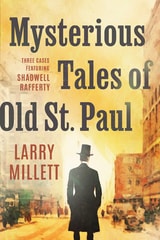
Mysterious Tales of Old St. Paul
Three Cases Featuring Shadwell RaffertyLarry Millett
University of Minnesota Press, 2024
Tales of murder and revenge: the early exploits of detective Shadwell Rafferty
Shadwell Rafferty’s last case may have led to his murder, but naturally—and fortunately, for followers of the indefatigable St. Paul detective—there’s more to the story. Mysterious Tales of Old St. Paul gathers three novellas from Larry Millett, casting back to Rafferty’s beginnings to recount a trio of intriguing cases that honed his skills before he joined forces with Sherlock Holmes.
In “Death in the News,” St. Paul citizens wake one morning to find that the sign on downtown’s tallest building that reads PIONEER PRESS has been altered—at considerable effort—to LIARS. An elaborate prank, yes, but it foreshadows a far worse crime, and Rafferty is on the case. In “The Birdman of Summit Avenue,” cats are turning up dead in the yards of St. Paul’s prominent citizens, and suspicion swiftly falls on the wealthy avian enthusiast Ambrose Harriman, but the case turns darker still when a neighborhood boy is found murdered in Harriman’s yard. In “The Gold King,” an enigmatic stranger arrives in town, calling himself the Gold King and announcing his plans to unearth hidden treasure, which eventually leads to a shocking conclusion.
Steeped in the mystery and history of nineteenth-century St. Paul, these interlocking detective stories feature the characters—and the local character—that have made the Shadwell Rafferty series irresistible. Spellbinding as ever, these stories also afford the curious pleasure of watching Rafferty find his footing on his way to becoming the consummate detective whose exploits have delighted readers again and again.