Results by title
8113 books match the query 'Literary Criticism' and 516 start with m
Memory’s Turn
Reckoning with Dictatorship in BrazilRebecca J. Atencio
University of Wisconsin Press, 2014
In clear and engaging prose, Rebecca J. Atencio tells the story of the slow turn to memory in Brazil, a turn that has taken place in both politics and in cultural production. She shows how testimonial literature, telenovelas, literary novels, theatrical plays, and memorials have interacted with policies adopted by the Brazilian state, often in unexpected ways. Under the right circumstances, official and cultural forms of reckoning combine in Brazil to produce what Atencio calls cycles of cultural memory. Novel meanings of the past are forged, and new cultural works are inspired, thus creating the possibility for further turns in the cycle.
The first book to analyze Brazil’s reckoning with dictatorship through both institutional and cultural means, Memory’s Turn is a rich, informative exploration of the interplay between these different modes of memory reconstruction.
Winner, Alfred B. Thomas Award, Southeastern Council of Latin American Studies
Honorable Mention, Roberto Reis Book Prize, Brazilian Studies Association
Men Who Hate Women and Women Who Kick Their Asses
Stieg Larsson's Millennium Trilogy in Feminist PerspectiveDonna King
Vanderbilt University Press, 2012
These lively and accessible essays expand the conversation in the blogosphere about the novels and films by connecting the controversies about gender roles to social trends in the real world.
Men without Women
Masculinity and Revolution in Russian Fiction, 1917–1929Eliot Borenstein
Duke University Press, 2001
In such works as Red Cavalry by Isaac Babel, Envy by Yuri Olesha, and Chevengur by Andrei Platonov women are either absent or transformed into bodiless abstractions. Their absence, claims Borenstein, reflects the masculine values that are hallmarks of the post-revolutionary era: production rather than reproduction, participation in history rather than domestic ahistoricity, heavy industry, construction, and struggle. He identifies in this literature groups of “men without women” replacing the family, even while the metaphor of family is used as an organizing feature of their recurring revolutionary missions. With the passage of time, these characters’ relationships—just as those in the Soviet culture of the time—begin to resemble the family structure that was originally rejected and destroyed, with one important exception: the new “families” had no place for women. According to Borenstein, this masculinist myth found its most congenial audience during the early period of communism, but its hostility to women and family ties could not survive into the Stalinist era when women, home, and family were no longer seen as antithetical to socialism.
Drawing on the theory and writings of Levi-Strauss, Girard, Sedgwick, and others, Men Without Women will be of interest to students and scholars of Slavic literature and history as well as specialists in literary theory and gender studies.

Menander 'Perikeiromene' or 'The Shorn Head'
Edited by William D. Furley
University of London Press, 2015
Merrill, Cavafy, Poems, and Dreams
Rachel Hadas
University of Michigan Press, 2000
The second half of the book combines explorations of various corners and horizons of the poetry scene, including neglected American poets and Hadas's thoughts on her own poetics and career. "Two Letters from New York" and "Tangled Web Sites" take bemused looks at literary or cultural landscapes. Hadas also looks inward: to dreams and dreamwork, to her dead mother's address book, to the emblematic drilling of a well in a country house. The range of selections includes essays, interviews, memoir, criticism, and a few of Hadas's own poems.
Rachel Hadas is the author of eleven books of poetry, essays, and translations. Her most recent book is Halfway Down the Hall: New and Selected Poems. She has received a Guggenheim Fellowship in Poetry and an American Academy-Institute of Arts and Letters Award in Literature, and is a member of the American Academy of Arts and Sciences. She is Professor of English at the Newark campus of Rutgers University.
Mestizo Nations
Culture, Race, and Conformity in Latin American LiteratureJuan E. De Castro
University of Arizona Press, 2002
Through them, he delineates some of the ambiguities and contradictions that have beset this discourse. Among texts considered are the Indianist novel Iracema by the nineteenth-century Brazilian author José de Alencar; the Tradiciones peruanas, Peruvian Ricardo Palma's fictionalizations of national difference; and historical and sociological essays by the Peruvian Marxist José Carlos Mariátegui and the Brazilian intellectual Gilberto Freyre. And because questions raised by this discourse are equally relevant to postmodern concerns with national and transnational heterogeneity, De Castro also analyzes such recent examples as the Cuban dance band Los Van Van's use of Afrocentric lyrics; Richard Rodriguez's interpretations of North American reality; and points of contact and divergence between José María Arguedas's novel The Fox from Up Above and the Fox from Down Below and writings of Gloria Anzaldúa and Julia Kristeva.
By updating the concept of mestizaje as a critical tool for analyzing literary text and cultural trends—incorporating not only race, culture, and nationality but also gender, language, and politics—De Castro shows the implications of this Latin American discursive tradition for current critical debates in cultural and area studies. Mestizo Nations contains important insights for all Latin Americanists as a tool for understanding racial relations and cultural hybridization, creating not only an important commentary on Latin America but also a critique of American life in the age of multiculturalism.
Mestizo State
Reading Race in Modern MexicoJoshua Lund
University of Minnesota Press, 2012
The Mestizo State examines how the ideas, images, and public discourse around race, nation, and citizen formation have been transformed in Mexico from the mid-nineteenth century to the present. Starting with the Porfiriato, Joshua Lund investigates the rise of a racialized “mestizo state,” its reinvention after the Mexican Revolution, and its mobilization as a critical lever that would act both on behalf of and against mainstream Mexican political culture during the long hegemony of the Partido Revolucionario Institucional.
Lund takes race as his object of critical reflection in the context of modern Mexico. An analysis that does not confuse race with mestizaje, indigeneity, African identity, or whiteness, the book sheds light on the history of the materialism of race as it unfolds within the cultural production of modern Mexico, grounded on close readings of four writers whose work explicitly challenged the politics of race in Mexico: Luis Alva, Ignacio Manuel Altamirano, Rosario Castellanos, and Elena Garro.
In seeking to address race as a cultural-political problematic, Lund considers race as integral to the production of the materiality of Mexican national history: constitutive of the nation form, a mediator of capitalist accumulation, and a central actor in the rise of modernity.
Metamedia
American Book Fictions and Literary Print Culture after DigitizationAlexander Starre
University of Iowa Press, 2015
Combining sustained textual analysis with impulses from the fields of book history, media studies, and systems theory, Starre explains the aesthetics and the cultural work of complex material fictions, such as Mark Z.Danielewski’s House of Leaves (2000), Chip Kidd’s The Cheese Monkeys (2001), Salvador Plascencia’s The People of Paper (2005), Reif Larsen’s The Selected Works of T. S. Spivet (2009), and Jonathan Safran Foer’s Tree of Codes (2010). He also broadens his analysis beyond the genre of the novel in an extensive account of the influential literary magazine McSweeney’s Quarterly Concern and its founder, Dave Eggers.
For this millennial generation of writers and publishers, the computer was never a threat to print culture, but a powerful tool to make better books. In careful close readings, Starre puts typefaces, layouts, and cover designs on the map of literary criticism. At the same time, the book steers clear of bibliophile nostalgia and technological euphoria as it follows writers, designers, and publishers in the process of shaping the surprising history of literary bookmaking after digitization.
Metamorphosis in Russian Modernism
Peter I. Barta
Central European University Press, 2000
Metamorphosis of Language in Apuleius
A Study of Allusion in the NovelEllen D. Finkelpearl
University of Michigan Press, 1998
When Apuleius wrote his Metamorphoses, the novel--indeed the very concept of fiction in prose--was new. This study argues that Apuleius' repeated allusions to earlier Latin authors such as Vergil, Ovid, and Seneca represent an exploration on his part of the relationship between the novel and more established genres of the era. Apuleius' struggle with this tradition, Finkelpearl maintains, parallels the protagonist's move from an acceptance of the dominance of traditional forms to a sense of arrival and self- discovery.
An introductory chapter includes general discussion of the theory and practice of allusion. Finkelpearl then revisits the issues of parody in Apuleius. She also includes discussion of Apuleius' use of Vergil's Sinon, the Charite episode in relation to Apuleius' African origins, and the stepmother episode. Finally a new reading of Isis is offered, which emphasizes her associations with writing and matches the multiformity of the goddess with the novel's many voices.
This book will be of interest to scholars of literature and the origins of the novel, multiculturalism, and classical literature.
Ellen D. Finkelpearl is Associate Professor of Classics at Scripps College, Claremont, California.
Metaphor and the Slave Trade in West African Literature
Laura T. Murphy
Ohio University Press, 2012
Metaphor and the Slave Trade provides compelling evidence of the hidden but unmistakable traces of the transatlantic slave trade that persist in West African discourse. Through an examination of metaphors that describe the trauma, loss, and suffering associated with the commerce in human lives, this book shows how the horrors of slavery are communicated from generation to generation.
Laura T. Murphy’s insightful new readings of canonical West African fiction, autobiography, drama, and poetry explore the relationship between memory and metaphor and emphasize how repressed or otherwise marginalized memories can be transmitted through images, tropes, rumors, and fears. By analyzing the unique codes through which West Africans have represented the slave trade, this work foregrounds African literary contributions to Black Atlantic discourse and draws attention to the archive that metaphor unlocks for scholars of all disciplines and fields of study.

Metapoesis
The Russian Tradition from Pushkin to ChekhovMichael C. Finke
Duke University Press, 1995
Jakobsonian poetics provides the framework for this approach, though Finke also draws freely upon a number of contemporary literary theorists. After elucidating the meaning of metapoesis in works by Pushkin, Gogol, and Chernyshevsky, he reveals its covert functioning in such masterpieces of realism as Dostoevsky’s The Idiot, Tolstoy’s Anna Karenina, and Chekhov’s "The Steppe." The result is a new interpretation and deeper understanding of these particular works, which in turn reorient our understanding of linguistic and literary "codes" and of the Russian literary tradition itself.
Of special interest to scholars of Russian literature, Metapoesis will also appeal to a broad range of readers and students of comparative literature, literary theory, and poetics.
Metaromanticism
Aesthetics, Literature, TheoryPaul Hamilton
University of Chicago Press, 2003
Through a close look at the aesthetics of Friedrich Schiller and Jean-Jacques Rousseau, and key works by Samuel Taylor Coleridge, Percy and Mary Shelley, John Keats, Sir Walter Scott, Jane Austen, and many others, Hamilton shows how the romantic movement's struggle with its own tenets was not an effort to seek an alternative way of thought, but instead a way of becoming what it already was. And yet, as he reveals, the romanticists were still not content with their own self-consciousness. Pushed to the limit, such contemplation either manifested itself as self-disgust or found aesthetic ideas regenerated in discourses outside of aesthetics altogether.
Metawritings
Toward a Theory of NonfictionJill Talbot
University of Iowa Press, 2012
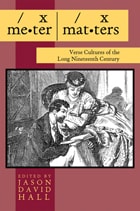
Meter Matters
Verse Cultures of the Long Nineteenth CenturyJason David Hall
Ohio University Press, 2011
Across the nineteenth century, meter mattered—in more ways and to more people than we might well appreciate today. For the period’s poets, metrical matters were a source of inspiration and often vehement debate. And the many readers, teachers, and pupils encountered meter and related topics in both institutional and popular forms.
The ten essays in Meter Matters showcase the range of metrical practice of poets from Wordsworth and Byron to Hopkins, Swinburne, and Tennyson; at the same time, the contributors bring into focus some of the metrical theorizing that shaped poetic thinking and responses to it throughout the nineteenth century. Paying close attention to the historical contours of Romantic and Victorian meters, as well as to the minute workings of the verse line, Meter Matters presents a fresh perspective on a subject that figured significantly in the century’s literature, and in its culture.
Meter in English
A Critical EngagementDavid Baker
University of Arkansas Press, 1997
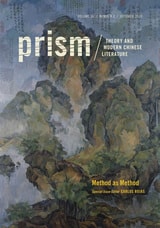
Method as Method
Carlos Rojas, special issue editor
Duke University Press, 2020
Contributors. Yomi Braester, Hsiao-hung Chang, Margaret Hillenbrand, Chun-kit Ko, Belinda Kong, Petrus Liu, Laikwan Pang, Christopher Rea, Carlos Rojas, Shuang Shen, Robin Visser, Lorraine Wong
Mexican Literature
A HistoryEdited by David William Foster
University of Texas Press, 1994
Mexico has a rich literary heritage that extends back over centuries to the Aztec and Mayan civilizations. This major reference work surveys more than five hundred years of Mexican literature from a sociocultural perspective. More than merely a catalog of names and titles, it examines in detail the literary phenomena that constitute Mexico's most significant and original contributions to literature.
Recognizing that no one scholar can authoritatively cover so much territory, David William Foster has assembled a group of specialists, some of them younger scholars who write from emerging trends in Latin American and Mexican literary scholarship. The topics they discuss include pre-Columbian indigenous writing (Joanna O'Connell), Colonial literature (Lee H. Dowling), Romanticism (Margarita Vargas), nineteenth-century prose fiction (Mario Martín Flores), Modernism (Bart L. Lewis), major twentieth-century genres (narrative, Lanin A. Gyurko; poetry, Adriana García; theater, Kirsten F. Nigro), the essay (Martin S. Stabb), literary criticism (Daniel Altamiranda), and literary journals (Luis Peña). Each essay offers detailed analysis of significant issues and major texts and includes an annotated bibliography of important critical sources and reference works.
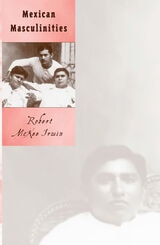
Mexican Masculinities
Robert McKee Irwin
University of Minnesota Press, 2003
A fascinating examination of masculinity in nineteenth- and twentieth-century Mexico
The first of its kind and a powerful challenge to customary views of gender and sexuality in the life and literature of Mexico, this book traces literary representations of masculinity in Mexico from independence in 1810 to the 1960s, and shows how these intersect with the constructions of nation and nationality.
The rhetoric of “Mexicanness” makes constant use of images of masculinity, though it does so in shifting and often contradictory ways. Robert McKee Irwin’s work follows these shifts from the male homosocial bonding that was central to notions of national integration in the nineteenth century, to questioning of gender norms stirred by science and scandals at the turn of the century, to the virulent reaction against gender chaos after the Mexican revolution, to the association of Mexicanness with machismo and homophobia in the literature of the 1940s and 1950s—even as male homosexuality was established as an integral part of national culture.As the first historical study of how masculinity and, particularly, homosexuality were understood in Mexico in the national era, this book not only provides “queer readings” of most major canonical texts of the period in question, but also uncovers a variety of unknown texts from queer Mexican history, including the 1906 novel Los 41, which reenacts the scandal of a turn-of-the-century transvestite ball that launched modern discussion of homosexuality in Mexico. It is a radical undermining of the simple hetero/homosexual and masculine/feminine oppositions that have for so long informed views of the country’s national character.
Mexico in Its Novel
A Nation's Search for IdentityBy John S. Brushwood
University of Texas Press, 1966
Mexico in Its Novel is a perceptive examination of the Mexican reality as revealed through the nation's novel. The author presents the Mexican novel as a cultural phenomenon: a manifestation of the impact of history upon the nation, an attempt by a people to come to grips with and understand what has happened and is happening to them.
Written in a clear and graceful style, this study examines the life of the novel as a genre against the background of Mexican chronology. It begins with a survey of the mid-twentieth-century novel, the Mexican novel which came of age in the period following the 1947 publication of Agustín Yáñez's The Edge of the Storm. During this time the novel resolved some of its most complicated problems and, as a result, offered a wider and deeper view of reality.
Having established this circumstance, John Brushwood goes back in time to the Conquest and then moves forward to the twentieth-century novel. Passing from the Colonial Period into the nineteenth century, the author recognizes the relationship between Romanticism and the desire for logical social behavior, and then views this relationship in the perspective of the Reform, an attempt to bring order out of chaos. The novel under the Díaz dictatorship is seen in three different phases, and the last Díaz chapter actually moves into the Revolution itself. The novel during the years of fighting is considered along with the first post-Revolutionary fiction. From that point the developing conflict within Mexican reality itself—a conflict between introversion and extroversion, nationalism and cosmopolitanism—reaches out to seek its solution in the novels of the first chapter.

Mexico, Nation in Transit
Contemporary Representations of Mexican Migration to the United StatesChristina L. Sisk
University of Arizona Press, 2011
Sisk’s transnational investigation moves easily across the US–Mexico border, analyzing films made on both sides, literature de la frontera, Mexican rock music, migrant narratives, and texts written by second- and third-generation immigrants. Included are the perspectives of those who left Mexico, those who were left behind, and the children who travel back “home.” Sisk discovers that the loss of Mexicans to the United States through emigration has had an effect on Mexico similar to the impact of the perceived Mexican invasion of the United States.
Spanning the social sciences and the humanities, Mexico, Nation in Transit poses a new transnational alternative to the postnational view that geopolitical borders are being erased by the forces of migration and globalization, and the nationalist view that borders must be strictly enforced. It shows that borders, like identities, are not easy to locate precisely.
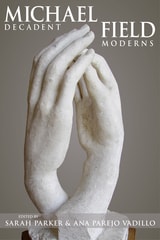
Michael Field
Decadent ModernsSarah Parker
Ohio University Press, 2019
In the last twenty years, Michael Field has emerged as one of the most fascinating poets of the Victorian era. Through their collaborative partnership as “Michael Field,” Katharine Bradley and Edith Cooper engaged in the aesthetic and decadent movements of the fin de siècle, while their poetry and verse drama articulate ideas associated with the New Woman and boldly express queer and lesbian desire. Michael Field: Decadent Moderns extends the focus on these key literary and cultural contexts by emphasizing their continuing significance within twentieth-century literary modernism. Through a series of interdisciplinary essays, this book addresses Michael Field’s energetic engagements with a range of topics including ecology, perfume, tourism, art history, sculpture, formalism, classics, and book history. In doing so, Michael Field: Decadent Moderns highlights the modernity, radicalism, and relevance of their work, both within the nineteenth and twentieth centuries as well as in our own cultural moment.
Contributors: Leire Barrera-Medrano, Joseph Bristow, Jill R. Ehnenn, Sarah E. Kersh, Kristin Mahoney, Catherine Maxwell, Alex Murray, Sarah Parker, Margaret D. Stetz, Kate Thomas, and Ana Parejo Vadillo.

Michigan Salvage
The Fiction of Bonnie Jo CampbellLisa DuRose
Michigan State University Press, 2023
Microdramas
Crucibles for Theater and TimeJohn H. Muse
University of Michigan Press, 2017
Subjecting short plays to extended scrutiny upends assumptions about brief or minimal art, and about theatrical experience. The book shows that short performances often demand greater attention from audiences than plays that unfold more predictably. Microdramas put pressure on preconceptions about which aspects of theater might be fundamental and about what might qualify as an event. In the process, they suggest answers to crucial questions about time, spectatorship, and significance.
Middle English Dictionary
A.1Robert E. Lewis, Editor-in-Chief
University of Michigan Press, 1956
Middle English Dictionary
A.2Robert E. Lewis, Editor-in-Chief
University of Michigan Press, 1956

Middle English Dictionary
A.3Robert E. Lewis, Editor-in-Chief
University of Michigan Press, 1956
Middle English Dictionary
A.4Robert E. Lewis, Editor-in-Chief
University of Michigan Press, 1957
Middle English Dictionary
B.1Robert E. Lewis, Editor-in-Chief
University of Michigan Press, 1957

Middle English Dictionary
B.2Robert E. Lewis, Editor-in-Chief
University of Michigan Press, 1957
Middle English Dictionary
B.3Robert E. Lewis, Editor-in-Chief
University of Michigan Press, 1957
Middle English Dictionary
B.4Robert E. Lewis, Editor-in-Chief
University of Michigan Press, 1958
Middle English Dictionary
B.5Robert E. Lewis, Editor-in-Chief
University of Michigan Press, 1958
Middle English Dictionary
C.1Robert E. Lewis, Editor-in-Chief
University of Michigan Press, 1959
Middle English Dictionary
C.2Robert E. Lewis, Editor-in-Chief
University of Michigan Press, 1959
Middle English Dictionary
C.3Robert E. Lewis, Editor-in-Chief
University of Michigan Press, 1959
Middle English Dictionary
C.4Robert E. Lewis, Editor-in-Chief
University of Michigan Press, 1960
Middle English Dictionary
C.5Robert E. Lewis, Editor-in-Chief
University of Michigan Press, 1960
Middle English Dictionary
C.6Robert E. Lewis, Editor-in-Chief
University of Michigan Press, 1960
Middle English Dictionary
D.1Robert E. Lewis, Editor-in-Chief
University of Michigan Press, 1961
Middle English Dictionary
D.2Robert E. Lewis, Editor-in-Chief
University of Michigan Press, 1961
Middle English Dictionary
D.3Robert E. Lewis, Editor-in-Chief
University of Michigan Press, 1961
Middle English Dictionary
D.4Robert E. Lewis, Editor-in-Chief
University of Michigan Press, 1962
Middle English Dictionary
D.5Robert E. Lewis, Editor-in-Chief
University of Michigan Press, 1962
Middle English Dictionary
E.1Robert E. Lewis, Editor-in-Chief
University of Michigan Press, 1952
Middle English Dictionary
E.2Robert E. Lewis, Editor-in-Chief
University of Michigan Press, 1953
Middle English Dictionary
E.3Robert E. Lewis, Editor-in-Chief
University of Michigan Press, 1953
Middle English Dictionary
F.1Robert E. Lewis, Editor-in-Chief
University of Michigan Press, 1953
Middle English Dictionary
F.2Robert E. Lewis, Editor-in-Chief
University of Michigan Press, 1954
Middle English Dictionary
F.3Robert E. Lewis, Editor-in-Chief
University of Michigan Press, 1954