Results by title
8642 books match the query '20th century' and 493 start with m
Modernism and Colonialism
British and Irish Literature, 1899–1939Richard Begam and Michael Valdez Moses, eds.
Duke University Press, 2007
Ranging over poetry, fiction, and criticism, the essays provide fresh appraisals of Joseph Conrad, T. S. Eliot, Ezra Pound, Virginia Woolf, D. H. Lawrence, Wyndham Lewis, E. M. Forster, W. B. Yeats, James Joyce, Elizabeth Bowen, Hugh MacDiarmid, and Evelyn Waugh, as well as Robert Louis Stevenson and H. Rider Haggard. The essays that bookend the collection connect the modernists to their Victorian precursors, to postwar literary critics, and to postcolonial poets. The rest treat major works written or published between 1899 and 1939, the boom years of literary modernism and the period during which the British empire reached its greatest geographic expanse. Among the essays are explorations of how primitivism figured in the fiction of Lawrence and Lewis; how, in Ulysses, Joyce used modernist techniques toward anticolonial ends; and how British imperialism inspired Conrad, Woolf, and Eliot to seek new aesthetic forms appropriate to the sense of dislocation they associated with empire.
Contributors. Nicholas Allen, Rita Barnard, Richard Begam, Nicholas Daly, Maria DiBattista, Ian Duncan, Jed Esty, Andrzej Gąsiorek, Declan Kiberd, Brian May, Michael Valdez Moses, Jahan Ramazani, Vincent Sherry

Modernism and Hegemony
A Materialist Critique of Aesthetic AgenciesNeil LarsenForeword by Jaime Concha
University of Minnesota Press, 1990
Modernism and Hegemony was first published in 1990. Minnesota Archive Editions uses digital technology to make long-unavailable books once again accessible, and are published unaltered from the original University of Minnesota Press editions.
In Modernism and Hegemony, Neil Larsen exposes the underlying political narratives of modernist aesthetic theory and practice. Unlike earlier Marxist critics, Larsen insists that modernist ideology be approached as a "displaced politics" and not simply as an aesthetic phenomenon. In this view, modernism is broadly ideological project comprising not only the literary-artist canon but also a wide array of theoretical discourses from aesthetics to philosophy, culture, and politics. Larsen gives postmodernism some credit for the apparent breakup of modernism, and for exposing the philosophical and political nature of its aesthetic stance. But he parts company with its ideological and epistemological notions, proposing to change the terms, and thus the framework, of the debate.
For Larsen, modernism is intimately linked to a crisis of representation that affected all aspects of life in the late nineteenth century - a period when capitalism itself was undergoing transformation from its "classical" free market phase into a more abstract, monopolistic and imperialistic stage. Larsen finds the resultant loosening of ties between individuals and society - the breakdown of social and historical agency - behind the growth of modernism. He employs speculative cross-readings of key texts by Marx and Adorno, an examination of Manet's "The Execution of Maximilian," and an analysis of modernism in a Third World setting to explain why modernism made special claims upon the aesthetic, and how it ultimately ascribed historical agency to "works of art."
Modernism and Music
An Anthology of SourcesEdited and with Commentary by Daniel Albright
University of Chicago Press, 2004
Modernism and the Harlem Renaissance
Houston A. Baker Jr.
University of Chicago Press, 1989
Modernism and the Nativist Resistance
Contemporary Chinese Fiction from TaiwanSung-sheng Yvonne Chang
Duke University Press, 1993
Situating her subject in its historical context, Sung-sheng Yvonne Chang traces the connection between Taiwan's Modernists and the liberal scholars of pre-Communist China. She discusses the Modernists' ambivalent relationship with contemporary Taiwan's conservative culture, and provides a detailed critical survey of the strife between the Modernists and the socialistically inclined, anti-Western Nativists. Chang's approach is comprehensive, combining Chinese and comparative perspectives. Employing the critical insights of Raymond Williams, Peter Burger, M. M. Bahktin, and Fredric Jameson, she investigates the complex issues involved in Chinese writers' appropriation of avant-gardism, aestheticism, and various other Western literary concepts and techniques. Within this framework, Chang offers original, challenging interpretations of major works by the best-known Chinese Modernists from Taiwan.
As an intensive introduction to a literature of considerable quality and impact, and as a case study of the global spread of Western literary Modernism, this book will be of great interest to students of Chinese and comparative literature, and to those who wish to understand the broad patterns of twentieth-century literary history.
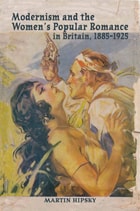
Modernism and the Women’s Popular Romance in Britain, 1885–1925
Martin Hipsky
Ohio University Press, 2011
Today’s mass-market romances have their precursors in late Victorian popular novels written by and for women. In Modernism and the Women’s Popular Romance Martin Hipsky scrutinizes some of the best-selling British fiction from the period 1885 to 1925, the era when romances, especially those by British women, were sold and read more widely than ever before or since.
Recent scholarship has explored the desires and anxieties addressed by both “low modern” and “high modernist” British culture in the decades straddling the turn of the twentieth century. In keeping with these new studies, Hipsky offers a nuanced portrait of an important phenomenon in the history of modern fiction. He puts popular romances by Mrs. Humphry Ward, Marie Corelli, the Baroness Orczy, Florence Barclay, Elinor Glyn, Victoria Cross, Ethel Dell, and E. M. Hull into direct relationship with the fiction of Virginia Woolf, Katherine Mansfield, James Joyce, and D. H. Lawrence, among other modernist greats.

Modernism at Mid-Century
The Architecture of the United States Air Force AcademyEdited by Robert Bruegmann
University of Chicago Press, 1994
The contributors to this volume (Jory Johnson, Robert Nauman, Sheri Olson, James Russell, and Kristen Schaffer) and editor Robert Bruegmann chronicle the complex history of the planning, design, and construction of the Air Force Academy. As the most conspicuous commission of the American military at the height of the Cold War, the design of the Academy generated intense popular interest and was a lightning rod for conflicting values in postwar society. The design, by architects Skidmore, Owings & Merrill, has been hailed as the final triumph of the International Style and as a monument to military bureaucracy.
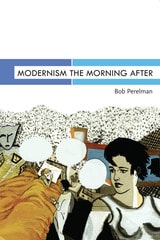
Modernism the Morning After
Bob Perelman
University of Alabama Press, 2017
Modernism the Morning After is a superb, lively, engaging series of essays and talks, dating from 1995 to 2016, by the eminent scholar, critic, and poet Bob Perelman. Throughout his career, Perelman has focused on the persistence of modernist ambition in poetry, with all of its admirable articulations and tragicomic short-circuits. Poetry, it turns out, is not simply “news that stays news,” as Ezra Pound postulated. Instead, as Perelman demonstrates, poetry often gropes toward whatever news can be found in the broader contexts of public speech—the cultural commons, the almost-real or much-too-real language of people and our hyperactive media.
Working in a variety of modes from the poetic to the dramatic to the conversational, and ranging across an expansive historical register from Dickinson, Whitman, and Dunbar in the nineteenth century to Kenneth Goldsmith and Stephen Colbert in the twenty-first, Perelman’s readings are unfailingly illuminating and, in many cases, his witty expositions take us strikingly close to the original intent of the text concerned.
Perelman also places intermittent, yet artful, pressure on some basic questions about the very nature of poetry. What does the transcription of poems tell us about them? How do hoaxes like the Ern Malley affair compel us to reconsider fundamental assumptions about what constitutes “authentic” poetry? How does the bathetic register relate to tones and idiom in recent poetic production? In Modernism the Morning After, Perelman writes as a poet, teacher, and critic, addressing a broad audience of readers and writers without choosing between them, inviting all to consider along with him modernism’s future through a dynamic consideration of its past.
Modernism
Representations of National CultureAhmet Ersoy
Central European University Press, 2010
Modernism
The Creation of Nation-StatesMichal Kopecek
Central European University Press, 2010
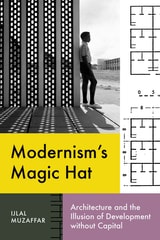
Modernism’s Magic Hat
Architecture and the Illusion of Development without CapitalIjlal Muzaffar
University of Texas Press, 2024
Examines the role of architecture in the history of global development and decolonization.
In Modernism’s Magic Hat, Ijlal Muzaffar examines how modern architects and planners help resolve one of the central dilemmas of the mid-twentieth-century world order: how to make decolonization plausible without accounting for centuries of capital drain under colonial rule. In the years after World War II, architects and planners found extensive opportunities in new international institutions—such as the World Bank, the UN, and the Ford Foundation—and helped shape new models of global intervention that displaced the burden of change onto the inhabitants. Muzaffar argues that architecture in this domain didn’t just symbolically represent power, but formed the material domain through which new modes of power acquired sense. Looking at a series of architectural projects across the world, from housing in Ghana to village planning in Nigeria and urban planning in Venezuela and Pakistan, Muzaffar explores how architects and planners shaped new ideas of time, land, climate, and the decolonizing body, making them appear as sources of untapped value. What resulted, Muzaffar argues, is a widespread belief in spontaneous Third World “development” without capital, which continues to foreclose any global discussion of colonial theft.
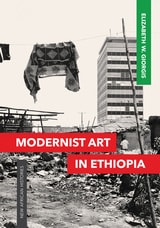
Modernist Art in Ethiopia
Elizabeth W. Giorgis
Ohio University Press, 2019
Short-listed for the Fage & Oliver Prize for outstanding scholarly work published on Africa.
Finalist, African Studies Association Book Prize.
Finalist, ASA Bethwell A. Ogot Prize for best book in east African studies.
If modernism initially came to Africa through colonial contact, what does Ethiopia’s inimitable historical condition—its independence save for five years under Italian occupation—mean for its own modernist tradition? In Modernist Art in Ethiopia—the first book-length study of the topic—Elizabeth W. Giorgis recognizes that her home country’s supposed singularity, particularly as it pertains to its history from 1900 to the present, cannot be conceived outside the broader colonial legacy. She uses the evolution of modernist art in Ethiopia to open up the intellectual, cultural, and political histories of it in a pan-African context.
Giorgis explores the varied precedents of the country’s political and intellectual history to understand the ways in which the import and range of visual narratives were mediated across different moments, and to reveal the conditions that account for the extraordinary dynamism of the visual arts in Ethiopia. In locating its arguments at the intersection of visual culture and literary and performance studies, Modernist Art in Ethiopia details how innovations in visual art intersected with shifts in philosophical and ideological narratives of modernity. The result is profoundly innovative work—a bold intellectual, cultural, and political history of Ethiopia, with art as its centerpiece.
Modernist Heresies
British Literary History, 1883–1924Damon Franke
The Ohio State University Press, 2008
Franke documents the untold history of the Cambridge Heretics Society and places the concerns of this discussion society in dialogue with contemporaneous literature by such authors as Pater, Hardy, Shaw, Joyce, Woolf, Lawrence, and Orwell. Since several highly influential figures of the modernist literati were members of the Heretics or in dialogue with the group, heresy and its relation to synthesis now become crucial to an understanding of modernist aesthetics and ethics.
From the 1880s through the 1920s, heresy commonly appears in literature as a discursive trope, and the literary mode of heresy shifts over the course of this time from one of syncretism to one based on the construction of modernist artificial or "synthetic" wholes. In Franke’s work, the discourse of heresy comes forth as a forgotten dimension of the origins of modernism, one deeply entrenched in Victorian blasphemy and the crisis in faith, and one pointing to the censorship of modernist literature and some of the first doctrines of literary criticism.
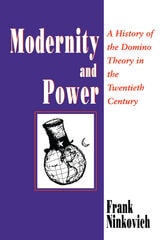
Modernity and Power
A History of the Domino Theory in the Twentieth CenturyFrank Ninkovich
University of Chicago Press, 1994
To emphasize the central role of symbolism and ideological assumptions in twentieth-century American statesmanship, Ninkovich focuses on the domino theory—a theory that departed radically from classic principles of political realism by sanctioning intervention in world regions with few financial or geographic claims on the national interest. Ninkovich insightfully traces the development of this global strategy from its first appearance early in the century through the Vietnam war.
Throughout the book, Ninkovich draws on primary sources to recover the worldview of the policy makers. He carefully assesses the coherence of their views rather than judge their actions against "objective" realities. Offering a new alternative to realpolitic and economic explanations of foreign policy, Modernity and Power will change the way we think about the history of U.S. international relations.
Modernity and Progress
Fitzgerald, Hemingway, OrwellRonald Berman
University of Alabama Press, 2007
Breaks new critical ground by exploring philosophical and aesthetic issues germane to the writings of three major modern literary figures.
In the 1920s and ‘30s, understandings of time, place, and civilization were subjected to a barrage of new conceptions. Ronald Berman probes the work of three writers who wrestled with one or more of these issues in ways of lasting significance.
Hemingway, Fitzgerald, and Orwell all grappled with fluid notions of time: Hemingway’s absolute present, Fitzgerald’s obsession with what might be and what might have been, and Orwell’s concerns with progress. For these authors, progress is also tied to competing senses of place--for Fitzgerald, the North versus the South; for Hemingway, America versus Europe. At stake for each is an understanding of what constitutes true civilization in a post-war world. Berman discusses Hemingway’s deployment of language in tackling the problems of thinking and knowing. Berman follows this notion further in examining the indisputable impact upon Hemingway’s prose of Paul Cézanne’s painting and the nature of perception.
Finally, Berman considers the influence on Orwell of Aristotle and Freud’s ideas of civilization, translated by Orwell into the fabric of 1984 and other writings.
Ronald Berman is Professor of English at the University of California at San Diego and past chairman of the National Endowment for the Humanities. He is author of six books, including “The Great Gatsby” and Fitzgerald’s World of Ideas and Fitzgerald-Wilson-Hemingway: Language and Experience.
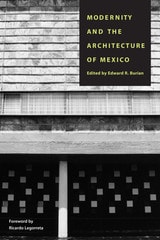
Modernity and the Architecture of Mexico
Edited by Edward R. Burian
University of Texas Press, 1997
Since the mid 1970s, there has been an extraordinary renewal of interest in early modern architecture, both as a way of gaining insight into contemporary architectural culture and as a reaction to neoconservative postmodernism. This book undertakes a critical reappraisal of the notion of modernity in Mexican architecture and its influence on a generation of Mexican architects whose works spanned the 1920s through the 1960s.
Nine essays by noted architects and architectural historians cover a range of topics from broad-based critical commentaries to discussions of individual architects and buildings. Among the latter are the architects Enrique del Moral, Juan O'Gorman, Carlos Obregón Santacilia, Juan Segura, Mario Pani, and the campus and stadium of the Ciudad Universitaria in Mexico City.
Relatively little has been published in English regarding this era in Mexican architecture. Thus, Modernity and the Architecture of Mexico will play a groundbreaking role in making the underlying assumptions, ideological and political constructs, and specific architect's agendas known to a wide audience in the humanities. Likewise, it should inspire greater appreciation for this undervalued body of works as an important contribution to the modern movement.
Modernity and the Jews in Western Social Thought
Chad Alan Goldberg
University of Chicago Press, 2017
In Modernity and the Jews in Western Social Thought, Chad Alan Goldberg brings us a major new study of Western social thought through the lens of Jews and Judaism. In France, where antisemites decried the French Revolution as the “Jewish Revolution,” Émile Durkheim challenged depictions of Jews as agents of revolutionary subversion or counterrevolutionary reaction. When German thinkers such as Karl Marx, Georg Simmel, Werner Sombart, and Max Weber debated the relationship of the Jews to modern industrial capitalism, they reproduced, in secularized form, cultural assumptions derived from Christian theology. In the United States, William Thomas, Robert Park, and their students conceived the modern city and its new modes of social organization in part by reference to the Jewish immigrants concentrating there. In all three countries, social thinkers invoked real or purported differences between Jews and gentiles to elucidate key dualisms of modern social thought. The Jews thus became an intermediary through which social thinkers discerned in a roundabout fashion the nature, problems, and trajectory of their own wider societies. Goldberg rounds out his fascinating study by proposing a novel explanation for why Jews were such an important cultural reference point. He suggests a rethinking of previous scholarship on Orientalism, Occidentalism, and European perceptions of America, arguing that history extends into the present, with the Jews—and now the Jewish state—continuing to serve as an intermediary for self-reflection in the twenty-first century.
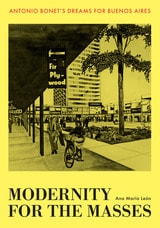
Modernity for the Masses
Antonio Bonet's Dreams for Buenos AiresBy Ana María León
University of Texas Press, 2021
2022 PROSE Award Finalist in Architecture and Urban Planning
2022 Association for Latin American Art Arvey Foundation Book Award, Honorable Mention
Throughout the early twentieth century, waves of migration brought working-class people to the outskirts of Buenos Aires. This prompted a dilemma: Where should these restive populations be situated relative to the city’s spatial politics? Might housing serve as a tool to discipline their behavior?
Enter Antonio Bonet, a Catalan architect inspired by the transatlantic modernist and surrealist movements. Ana María León follows Bonet's decades-long, state-backed quest to house Buenos Aires's diverse and fractious population. Working with totalitarian and populist regimes, Bonet developed three large-scale housing plans, each scuttled as a new government took over. Yet these incomplete plans—Bonet's dreams—teach us much about the relationship between modernism and state power.
Modernity for the Masses finds in Bonet's projects the disconnect between modern architecture’s discourse of emancipation and the reality of its rationalizing control. Although he and his patrons constantly glorified the people and depicted them in housing plans, Bonet never consulted them. Instead he succumbed to official and elite fears of the people's latent political power. In careful readings of Bonet's work, León discovers the progressive erasure of surrealism's psychological sensitivity, replaced with an impulse, realized in modernist design, to contain the increasingly empowered population.
Modernity on Endless Trial
Leszek Kolakowski
University of Chicago Press, 1990
"Exemplary. . . . It should be celebrated." —Arthur C. Danto, New York Times Book Review
"This book . . . express[es] Kolakowski's thought on God, man, reason, history, moral truth and original sin, prompted by observation of the dramatic struggle among Christianity, the Enlightenment and modern totalitarianism. It is a wonderful collection of topics." —Thomas Nagel, Times Literary Supplement
"No better antidote to bumper-sticker thinking exists than this collection of 24 'appeals for moderation in consistency,' and never has such an antidote been needed more than it is now." —Joseph Coates, Chicago Tribune
"Whether learned or humorous, these essays offer gems in prose of diamond hardness, precision, and brilliance." —Thomas D'Evelyn, The Christian Science Monitor
A "Notable Books of the Year 1991" selection, New York Times Book Review—a "Noted with Pleasure" selection, New York Times Book Review—a "Summer Reading 1991" selection, New York Times Book Review—a "Books of the Year" selection, The Times.
Modernizing Main Street
Architecture and Consumer Culture in the New DealGabrielle Esperdy
University of Chicago Press, 2008
Esperdy argues that these updated storefronts served a range of complex purposes, such as stimulating public consumption, extending the New Deal’s influence, reviving a stagnant construction industry, and introducing European modernist design to the everyday landscape. She goes on to show that these diverse roles are inseparable, woven together not only by the crisis of the Depression, but also by the pressures of bourgeoning consumerism. As the decade’s two major cultural forces, Esperdy concludes, consumerism and the Depression transformed the storefront from a seemingly insignificant element of the built environment into a potent site for the physical and rhetorical staging of recovery and progress.
Modernizing Repression
Police Training and Nation-Building in the American CenturyJeremy Kuzmarov
University of Massachusetts Press, 2012
As American troops became bogged down first in Iraq and then Afghanistan, a key component of U.S. strategy was to build up local police and security forces in an attempt to establish law and order. This approach, Jeremy Kuzmarov shows, is consistent with practices honed over more than a century in developing nations within the expanding orbit of the American empire. From the conquest of the Philippines and Haiti at the turn of the twentieth century through Cold War interventions and the War on Terror, police training has been valued as a cost-effective means of suppressing radical and nationalist movements, precluding the need for direct U.S. military intervention and thereby avoiding the public opposition it often arouses.
Unlike the spectacular but ephemeral pyrotechnics of the battlefield, police training programs have had lasting consequences for countries under the American imperial umbrella, fostering new elites, creating powerful tools of social control, and stifling political reform. These programs have also backfired, breeding widespread resistance, violence, and instability—telltale signs of “blowback” that has done more to undermine than advance U.S. strategic interests abroad.
Modes of Faith
Secular Surrogates for Lost Religious BeliefTheodore Ziolkowski
University of Chicago Press, 2007
In the decades surrounding World War I, religious belief receded in the face of radical new ideas such as Marxism, modern science, Nietzschean philosophy, and critical theology. Modes of Faith addresses both this decline of religious belief and the new modes of secular faith that took religion’s place in the minds of many writers and poets.
Theodore Ziolkowski here examines the motives for this embrace of the secular, locating new modes of faith in art, escapist travel, socialism, politicized myth, and utopian visions. James Joyce, he reveals, turned to art as an escape while Hermann Hesse made a pilgrimage to India in search of enlightenment. Other writers, such as Roger Martin du Gard and Thomas Mann, sought temporary solace in communism or myth. And H. G. Wells, Ziolkowski argues, took refuge in utopian dreams projected in another dimension altogether.
Rooted in innovative and careful comparative reading of the work of writers from France, England, Germany, Italy, and Russia, Modes of Faith is a critical masterpiece by a distinguished literary scholar that offers an abundance of insight to anyone interested in the human compulsion to believe in forces that transcend the individual.
Mohandas Gandhi
Experiments in Civil DisobedienceTalat Ahmed
Pluto Press, 2016
This biography examines his campaigns from South Africa to India to evaluate the successes and failures of non-violent resistance. Seventy years after his death, his legacy remains contested: was he a saint, revolutionary, class conciliator, or self-obsessed spiritual zealot?
The contradictions of Gandhi’s politics are unpicked through an analysis of the social forces at play in the mass movement around him. Entrusted to liberate the oppressed of India, his key support base were industrialists, landlords and the rich peasantry. Gandhi’s moral imperatives often clashed with these vested material interests, as well as with more radical currents to his left.
Today, our world is scarred by permanent wars, racism and violence, environmental destruction and economic crisis. Can non-violent resistance win against state and corporate power? This book explores Gandhi’s experiments in civil disobedience to assess their relevance for struggles today.
Moisture of the Earth
Mary Robinson, Civil Rights and Textile Union ActivistAn Oral History, Compiled and Edited by Fran Leeper Buss
University of Michigan Press, 2009
Mom
The Transformation of Motherhood in Modern AmericaRebecca Jo Plant
University of Chicago Press, 2010
Monetary Divergence
Domestic Policy Autonomy in the Post-Bretton Woods EraDavid H. Bearce
University of Michigan Press, 2007
"In a meticulously researched study, David Bearce demonstrates that, contrary to predictions, financial globalization has not resulted in a systematic convergence of national monetary policies. The book is a must-read for students of the political economy of international finance. Highlighting the critical role of partisan politics in determining policy outcomes, Bearce adds a new and important dimension to our understanding of the impacts of international capital mobility in the contemporary era."
—Benjamin Jerry Cohen, University of California, Santa Barbara
"Bearce offers a compelling analysis of partisan economic policy in an open economy. By analyzing both fiscal and monetary policies, Bearce extends our understanding of how the electoral imperative conditions policy behavior. His conclusions will have to be addressed in any
future debate about the topic."
—William Bernhard, University of Illinois at Urbana-Champaign
"Interest group divisions over exchange rates and macroeconomic policy have been at the center of international political economy research for about 20 years. Political scientists have studied these cleavages, focusing on the policy interests of various industry groups. On a separate but parallel track, another group of researchers explored the relationship between partisan politics and macroeconomic policy choices. In this exceptionally well researched book, Bearce integrates these two analytical traditions. Noting that industry groups are typically important organized constituents in left-wing and right-wing political parties, Bearce demonstrates how macroeconomic policy outcomes in advanced countries vary systematically with the alternation of political parties in government."
—J. Lawrence Broz, University of California, San Diego
David H. Bearce is Assistant Professor of Political Science at the University of Pittsburgh.
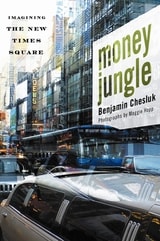
Money Jungle
Imagining the New Times SquareChesluk, Benjamin
Rutgers University Press, 2008
For more than a century, Times Square has mesmerized the world with the spectacle of its dazzling supersigns, its theaters, and its often-seedy nightlife. New York City’s iconic crossroads has drawn crowds of revelers, thrill-seekers, and other urban denizens, not to mention lavish outpourings of advertising and development money.
Many have hotly debated the recent transformation of this legendary intersection, with voices typically falling into two opposing camps. Some applaud a blighted red-light district becoming a big-budget, mainstream destination. Others lament an urban zone of lawless possibility being replaced by a Disneyfied, theme-park version of New York. In Money Jungle, Benjamin Chesluk shows that what is really at stake in Times Square are fundamental questions about city life—questions of power, pleasure, and what it means to be a citizen in contemporary urban space.
Chesluk weaves together surprising stories of everyday life in and around the Times Square redevelopment, tracing the connections between people from every level of this grand project in social and spatial engineering: the developers, architects, and designers responsible for reshaping the urban public spaces of Times Square and Forty-second Street; the experimental Midtown Community Court and its Times Square Ink. job-training program for misdemeanor criminals; encounters between NYPD officers and residents of Hell’s Kitchen; and angry confrontations between city planners and neighborhood activists over the future of the area.
With an eye for offbeat, telling details and a perspective that is at once sympathetic and critical, Chesluk documents how the redevelopment has tried, sometimes successfully and sometimes not, to reshape the people and places of Times Square. The result is a colorful and engaging portrait, illustrated by stunning photographs by long-time local photographer Maggie Hopp, of the street life, politics, economics, and cultural forces that mold America’s urban centers.

Money Trees
The Douglas Fir and American Forestry, 1900-1944Emily K. Brock
Oregon State University Press, 2015
Money Trees is an interdisciplinary history of the crucial decades that shaped the modern American conception of the value of the forest. It begins with early 20th century environmental changes in the Douglas Fir forests of the Pacific Northwest, which led to increasing divisiveness and controversy among foresters. Brock balances this regional story with a national view of the intellectual and political currents that governed forest management, marshaling archival evidence from industry, government, and scientific sources.
An important contribution to environmental scholarship, Money Trees offers a nuanced vision of forestry’s history and its past relationship to both wilderness activism and scientific ecology. With fresh perspectives on well-known environmental figures such as Bob Marshall and Gifford Pinchot, it will add to the conversation among scholars in environmental history, history of science, and the history of the American West. It will be welcomed as a key resource across the spectrum of environmental studies, and by anyone interested in natural resources, land management, the role of science in environmentalism, and the modern wilderness movement.
Money and Modernity
Pound, Williams, and the Spirit of JeffersonAlec Marsh
University of Alabama Press, 1998
Money in the Air
Art Dealers and the Making of a Transatlantic Market, 1880–1930Gail Feigenbaum
J. Paul Getty Trust, The, 2024
“There was money in the air, ever so much money,” wrote Henry James in 1907, reflecting on the American appetite for art acquisitions. Indeed, collectors such as Henry Clay Frick and Andrew W. Mellon are credited with bringing noteworthy European art to the United States, with their collections forming the backbone of major American museums today. But what of the dealers, who possessed the expertise in art and recognized the potential of developing a new market model on both sides of the Atlantic?
Money in the Air investigates the often-overlooked role of these dealers in creating an international art world. Contributors examine the histories of well-known international firms like Duveen Brothers, M. Knoedler & Co., and Goupil & Cie and their relationships with American clients, as well as accounts of other remarkable dealers active in the transatlantic art market. Drawing on dealer archives, scholars reveal compelling findings, including previously unknown partnerships and systems of cooperation. This volume offers new perspectives on the development of art collections that formed the core of American art museums, such as the National Gallery of Art, the Metropolitan Museum of Art, and the Frick Collection.
Money, Murder, and Dominick Dunne
A Life in Several ActsRobert Hofler
University of Wisconsin Press, 2019
Dunne admitted to inventing himself, and it was that public persona he wrote about in his own memoir, The Way We Lived Then. Left out of that account, but brought to light here, were his intense rivalry with his brother John Gregory, the gay affairs and relationships he had throughout his marriage and beyond, and his fights with editors at Vanity Fair. Robert Hofler also reveals the painful rift in the family after the murder of Dominick's daughter, Dominique—compounded by his coverage of her killer's trial, which launched his career as a reporter.
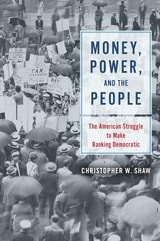
Money, Power, and the People
The American Struggle to Make Banking DemocraticChristopher W. Shaw
University of Chicago Press, 2019
Yet the situation was vastly different a century ago, as Christopher W. Shaw shows. This book upends the conventional thinking that financial policy in the early twentieth century was set primarily by the needs and demands of bankers. Shaw shows that banking and politics were directly shaped by the literal and symbolic investments of the grassroots. This engagement remade financial institutions and the national economy, through populist pressure and the establishment of federal regulatory programs and agencies like the Farm Credit System and the Federal Deposit Insurance Corporation. Shaw reveals the surprising groundswell behind seemingly arcane legislation, as well as the power of the people to demand serious political repercussions for the banks that caused the Great Depression. One result of this sustained interest and pressure was legislation and regulation that brought on a long period of relative financial stability, with a reduced frequency of economic booms and busts. Ironically, this stability led to the decline of the very banking politics that brought it about.
Giving voice to a broad swath of American figures, including workers, farmers, politicians, and bankers alike, Money, Power, and the People recasts our understanding of what might be possible in balancing the needs of the people with those of their financial institutions.
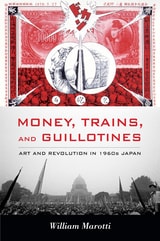
Money, Trains, and Guillotines
Art and Revolution in 1960s JapanWilliam Marotti
Duke University Press, 2013
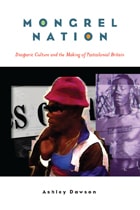
Mongrel Nation
Diasporic Culture and the Making of Postcolonial BritainAshley Dawson
University of Michigan Press, 2007
Mongrel Nation surveys the history of the United Kingdom’s African, Asian, and Caribbean populations from 1948 to the present, working at the juncture of cultural studies, literary criticism, and postcolonial theory. Ashley Dawson argues that during the past fifty years Asian and black intellectuals from Sam Selvon to Zadie Smith have continually challenged the United Kingdom’s exclusionary definitions of citizenship, using innovative forms of cultural expression to reconfigure definitions of belonging in the postcolonial age. By examining popular culture and exploring topics such as the nexus of race and gender, the growth of transnational politics, and the clash between first- and second-generation immigrants, Dawson broadens and enlivens the field of postcolonial studies.
Mongrel Nation gives readers a broad landscape from which to view the shifting currents of politics, literature, and culture in postcolonial Britain. At a time when the contradictions of expansionist braggadocio again dominate the world stage, Mongrel Nation usefully illuminates the legacy of imperialism and suggests that creative voices of resistance can never be silenced.Dawson
“Elegant, eloquent, and full of imaginative insight, Mongrel Nation is a refreshing, engaged, and informative addition to post-colonial and diasporic literary scholarship.”
—Hazel V. Carby, Yale University
“Eloquent and strong, insightful and historically precise, lively and engaging, Mongrel Nation is an expansive history of twentieth-century internationalist encounters that provides a broader landscape from which to understand currents, shifts, and historical junctures that shaped the international postcolonial imagination.”
—May Joseph, Pratt Institute
Ashley Dawson is Associate Professor of English at the City University of New York’s Graduate Center and the College of Staten Island. He is coeditor of the forthcoming Exceptional State: Contemporary U.S. Culture and the New Imperialism.
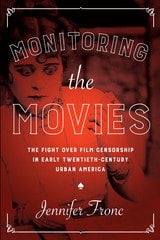
Monitoring the Movies
The Fight over Film Censorship in Early Twentieth-Century Urban AmericaBy Jennifer Fronc
University of Texas Press, 2017
As movies took the country by storm in the early twentieth century, Americans argued fiercely about whether municipal or state authorities should step in to control what people could watch when they went to movie theaters, which seemed to be springing up on every corner. Many who opposed the governmental regulation of film conceded that some entity—boards populated by trusted civic leaders, for example—needed to safeguard the public good. The National Board of Review of Motion Pictures (NB), a civic group founded in New York City in 1909, emerged as a national cultural chaperon well suited to protect this emerging form of expression from state incursions.
Using the National Board’s extensive files, Monitoring the Movies offers the first full-length study of the NB and its campaign against motion-picture censorship. Jennifer Fronc traces the NB’s Progressive-era founding in New York; its evolving set of “standards” for directors, producers, municipal officers, and citizens; its “city plan,” which called on citizens to report screenings of condemned movies to local officials; and the spread of the NB’s influence into the urban South. Ultimately, Monitoring the Movies shows how Americans grappled with the issues that arose alongside the powerful new medium of film: the extent of the right to produce and consume images and the proper scope of government control over what citizens can see and show.
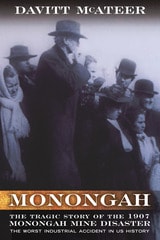
Monongah
The Tragic Story of the 1907 Monongah Mine DisasterDAVITT MCATEER
West Virginia University Press, 2014
New paperback edition with an introduction by Robert B. Reich
Monongah: The Tragic Story of the 1907 Monongah Mine Disaster documents the events and conditions that led to the worst industrial accident in the history of the United States. This mining accident claimed hundreds of lives on the morning of December 6, 1907 and McAteer, an expert on mine and workplace health and safety, delves deeply into the economic forces and social-political landscape of the mining communities of north central West Virginia to expose the truth behind this tragedy. After nearly thirty years of exhaustive research, McAteer determines that close to 500 men and boys—many of them immigrants—lost their lives that day, leaving hundreds of women widowed and more than one thousand children orphaned.
The tragedy at Monongah led to a greater awareness of industrial working conditions, and ultimately to the Federal Coal Mine Health and Safety Act of 1969, which McAteer helped to enact. This new paperback edition includes an introduction by Robert B. Reich, Chancellor’s Professor of Public Policy at the University of California at Berkeley and Secretary of Labor during the Clinton administration.

Monster Fire at Minong
Wisconsin’s Five Mile Tower Fire of 1977Bill Matthias
Wisconsin Historical Society Press, 2010
Monstrous Work and Radical Satisfaction
Black Women Writing under SegregationEve Dunbar
University of Minnesota Press, 2024
Radical Black feminist refusal through the works of mid-twentieth-century African American women writers
Monstrous Work and Radical Satisfaction offers new and insightful readings of African American women’s writings in the 1930s–1950s, illustrating how these writers centered Black women’s satisfaction as radical resistance to the false and incomplete promise of liberal racial integration. Eve Dunbar examines the writings of Ann Petry, Dorothy West, Alice Childress, and Gwendolyn Brooks to show how these women explored self-fulfillment over normative and sanctioned models of national belonging.
Paying close attention to literary moments of disruption, miscommunication, or confusion rather than ease, assimilation, or mutual understanding around race and gender, Dunbar tracks these writers’ dissatisfaction with American race relations. She shows how Petry, West, Childress, and Brooks redeploy the idea of monstrous work to offer potential modalities for registering Black women’s capacity to locate satisfaction within the domestic and interpersonal.
While racial integration may satisfy the national idea of equality and inclusion, it has not met the long-term needs of Black people’s quest for equity. Dunbar responds, demonstrating how these mid-century women offer new blueprints for Black life by creating narrative models for radical satisfaction: Black women’s completeness, joy, and happiness outside the bounds of normative racial inclusion.
Montage of a Dream
The Art and Life of Langston HughesEdited by John Edgar Tidwell & Cheryl R. Ragar, Foreword by Arnold Rampersad
University of Missouri Press, 2007
Over a forty-six-year career, Langston Hughes experimented with black folk expressive culture, creating an enduring body of extraordinary imaginative and critical writing. Riding the crest of African American creative energy from the Harlem Renaissance to the onset of Black Power, he commanded an artistic prowess that survives in the legacy he bequeathed to a younger generation of writers, including award winners Alice Walker, Paule Marshall, and Amiri Baraka.
Montage of a Dream extends and deepens previous scholarship, multiplying the ways in which Hughes’s diverse body of writing can be explored. The contributors, including such distinguished scholars as Steven Tracy, Trudier Harris, Juda Bennett, Lorenzo Thomas, and Christopher C. De Santis, carefully reexamine the significance of his work and life for their continuing relevance to American, African American, and diasporic literatures and cultures.
Probing anew among Hughes’s fiction, biographies, poetry, drama, essays, and other writings, the contributors assert fresh perspectives on the often overlooked “Luani of the Jungles” and Black Magic and offer insightful rereadings of such familiar pieces as “Cora Unashamed,” “Slave on the Block,” and Not without Laughter. In addition to analyzing specific works, the contributors astutely consider subjects either lightly explored by or unavailable to earlier scholars, including dance, queer studies, black masculinity, and children’s literature. Some investigate Hughes’s use of religious themes and his passion for the blues as the fabric of black art and life; others ponder more vexing questions such as Hughes’s sexuality and his relationship with his mother, as revealed in the letters she sent him in the last decade of her life.
Montage of a Dream richly captures the power of one man’s art to imagine an America holding fast to its ideals while forging unity out of its cultural diversity. By showing that Langston Hughes continues to speak to the fundamentals of human nature, this comprehensive reconsideration invites a renewed appreciation of Hughes’s work—and encourages new readers to discover his enduring relevance as they seek to understand the world in which we all live.
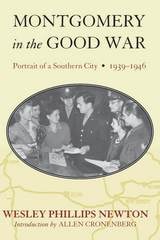
Montgomery in the Good War
Portrait of a Southern City, 1939-1946Wesley Phillips Newton
University of Alabama Press, 2000
One city. One war. A story of transformation at home and abroad.
Using newspaper accounts, interviews, letters, journals, and his own memory of the time, Wesley Newton reconstructs wartime-era Montgomery, Alabama--a sleepy southern capital that was transformed irreversibly during World War II.
The war affected every segment of Montgomery society: black and white, rich and poor, male and female, those who fought in Europe and the Pacific and those who stayed on the home front. Newton follows Montgomerians chronologically through the war from Pearl Harbor to Hiroshima as they experience patriotism, draft and enlistment, rationing, scarcity drives, and the deaths of loved ones. His use of small vignettes based on personal recollections adds drama and poignancy to the story.
Montgomery in the Good War is an important reminder that wars are waged at home as well as abroad and that their impact reverberates well beyond those who fight on the front lines. Those who came of age during the war will recognize themselves in this moving volume. It will also be enlightening to those who have lived in times of relative peace.
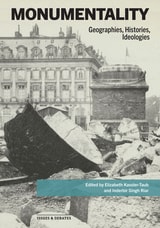
Monumentality
Geographies, Histories, IdeologiesElizabeth Kassler-Taub
J. Paul Getty Trust, The, 0
An exploration of how monuments—both physical and conceptual—shape memory, identity, and public debate across cultures and time.
This compelling volume invites readers to reimagine how monuments shape history, identity, and public space. Monumentality is explored as a dynamic and contested idea—one that moves beyond grand buildings and enduring structures to understand how societies remember the past and envision the future.
Engaging scholarly essays, accompanied by focused reflections on objects held in Getty collections, analyze the emotional, ideological, and technological dimensions of monuments by tracing their changing meanings across cultures and historical periods. Spanning themes of destruction, circulation, territorialization, and empire, the book investigates topics such as the ruin aesthetic of the Paris Commune, the material remnants of Buddhism in India, the construction of Cold War dams, and the influence of Almohad minaret architecture. Throughout, readers will encounter the enduring effects of colonialism, modernization, and settlements on societies around the world—from nineteenth-century West Africa to postwar Japan and Guam to present-day Israel and Ukraine.
Together, these studies integrate histories of art, architecture, and urban landscapes to examine the role of monuments in contemporary life. Monumentality offers fresh perspectives on what we choose to honor, why the past is preserved (or forgotten), and how the complex narratives embedded in memorials or public art condition our experience of the present.

Moorings and Metaphors
Figures of Culture and Gender in Black Women's LiteratureKarla F. Holloway
Rutgers University Press, 1991
Proceeding from a consideration of the imaginative textual languages of contemporary African-American and West African writers, Holloway asserts the intertextuality of black women's literature across two continents. She argues the subtext of culture as the source of metaphor and language, analyzes narrative structures and linguistic processes, and develops a combined theoretical/critical apparatus and vocabulary for interpreting these writers' works. The cultural sources and spiritual considerations that inhere in these textual languages are discussed within the framework Holloway employs of patterns of revision, (re)membrance, and recursion--all of which are vehicles for expressive modes inscribed at the narrative level. Her critical reading of contemporary black women's writing in the United States and West Africa is unique, radical, and sure to be controversial.

Moral Philosophy Of Moore
Robert Peter Sylvester, edited by Ray Perkins, Jr. and R. W. Sleeper, foreword by Tom Regan
Temple University Press, 1990
This study of G. E. Moore’s work in moral philosophy draws upon a close examination of the early essays that preceded the writing of Principia Ethica in order to ground the author’s view that Moore’s famous "naturalistic fallacy argument" of Principia has been widely misunderstood. At the time of his death in 1986, Robert Peter Sylvester was in the process of preparing this book for publication. That process has been brought to completion by Ray Perkins, Jr., and R. W. Sleeper. Sylvester’s reappraisal of the moral philosophy of G. E. Moore argues that criticism of the work of this major twentieth-century British philosopher has been based on misinterpretation of his unified position. He treats Moore’s ideas about "What is Good?", "What things are Good?" and "What ought we to do?" as forming a coherent system.
To bring this work up to date since the author’s death, the editors have provided a bibliographic essay following each chapter in which recent scholarship is discussed.
Morality and Architecture Revisited
David Watkin
University of Chicago Press, 2001
Here, for the first time, is the story of the book's impact. In writing his groundbreaking polemic, David Watkin had taken on the entire modernist establishment, tracing it back to Pugin, Viollet-le-Duc, Corbusier, and others who claimed that their chosen style had to be truthful and rational, reflecting society's needs. Any critic of this style was considered antisocial and immoral. Only covertly did the giants of the architectural establishment support the author. Watkin gives an overview of what has happened since the book's publication, arguing that many of the old fallacies still persist. This return to the attack is a revelation for anyone concerned architecture's past and future.
Morality and Architecture Revisited contains the entire text of the book Morality and Architecture , plus additonal material by David Wakin on the controversy that the the book created.
More Adventures with Britannia
Personalities, Politics and Culture in BritainEdited by Wm. Roger Louis
University of Texas Press, 1998
Collecting the interpretations of outstanding writers on the literature and history of modern Britain, this book deals with a rich variety of themes, some familiar, many unexpected, taking the reader on a highly engaging excursion through British life and intellectual biography. The scope includes not only the personalities, politics, and culture of England, Wales, Scotland, and Ireland, but also the interaction of British and other societies throughout the world.
More Important Than the Music
A History of Jazz DiscographyBruce D. Epperson
University of Chicago Press, 2013
More Nights than Days
A Survey of Writings of Child Genocide SurvivorsYudit Kiss
Central European University Press, 2023
More Nights Than Days is a unique exploration of the experience of children who survived the Holocaust—including Roma and Sinti victims—and the genocides in Cambodia, Rwanda, and Bosnia. Children are among the principal victims of armed conflicts and slaughters; nonetheless, they perceive events through the prism of their unique perspective and have a range of coping techniques adults don't possess.
This overview of writings of ninety-one child survivors bears evidence from a wide range of human ruthlessness. The author presents little-known texts along with famous memoirs and autobiographical fiction, with abundant quotations. Many of these are not only compelling as historical testimony, but poetic and stirringly expressive. Yudit Kiss has not written a historical study or literary criticism of the children’s books. She explores, instead, what the authors went through and what they felt and understood about their experience. An accessible and captivating reading, this volume presents a close-up, human size dimension of the destruction. The books written by child survivors also describe the resources and means that helped them to remain human even in the deepest well of inhumanity, offering precious lessons about resistance and resilience.M

More Tales of the Defective Detective in the Pulps
Gary Hoppenstand, Garyn G. Roberts, and Ray B. Browne
University of Wisconsin Press, 1985

More Than Science and Sputnik
The National Defense Education Act of 1958Wayne J. Urban
University of Alabama Press, 2010
Sparked by dramatic Soviet achievements, particularly in nuclear technology and the development of the Sputnik space orbiter, the United States responded in the late 1950s with an extraordinary federal investment in education. Designed to overcome a perceived national failure to produce enough qualified scientists, engineers, and mathematicians to compete with the Communist bloc, the effort resulted in the National Defense Education Act of 1958 (NDEA). Representative Carl Elliott and Senator Lister Hill both from Alabama, and then Assistant Secretary of Health, Education, and Welfare, Elliot Richardson were the prime movers in shaping of this landmark legislation.
More than Science and Sputnik analyzes primary documents of the three leaders to describe the political process that established the NDEA. The book illustrates what the assumptions of the key players were, and why they believed the act was needed.

More Than Words
A Memoir of a Writing LifeJerry Apps
Wisconsin Historical Society Press, 2022