Results by title
482 books match the query '17th century' and 15 start with n
Narratives of Adversity
Jesuits on the Eastern Peripheries of the Habsburg Realms (1640–1773)Paul J. Shore
Central European University Press, 2012
Neither Hee Nor Any of His Companie Did Return Againe
Failed Colonies in the Caribbean and Latin America, 1492–1865David MacDonald
Westholme Publishing, 2023
In Neither Hee Nor Any of His Companie Did Return Againe: Failed Colonies in the Caribbean and Latin America, 1492–1865, historians David MacDonald and Raine Waters examine the European, and later American, failures to establish permanent settlements in the region. Beginning with Columbus’s ill-conceived ventures, the authors discuss the efforts, from German claims in Venezuela and Scottish attempts in Panama to defeated Confederates fleeing to Mexico, Brazil, and elsewhere. For each colony, the primary source information is contextualized and evaluated. Along the way, the authors determine commonalities across these ill-fated colonies as well as underscore the fact that while Indigenous peoples of the region often vigorously resisted predatory European colonization, their numbers were decimated by relentless warfare, slave raids, and European diseases. As Indian populations declined, colonists imported African slaves in large numbers. The brutal treatment of slaves resulted in those who escaped creating their own settlements that existed in a state of endemic warfare with European colonists. An important contribution to Atlantic World studies, this volume reveals the fine line between colonies that thrived and those that failed.
New Israel / New England
Jews and Puritans in Early AmericaMichael Hoberman
University of Massachusetts Press, 2011
More often than not, Michael Hoberman shows, Puritans thought and wrote about Jews in order to resolve their own theological and cultural dilemmas. A number of prominent New Englanders, including Roger Williams, Increase Mather, Samuel Sewall, Benjamin Colman, Cotton Mather, Jonathan Edwards, and Ezra Stiles, wrote extensively about post-biblical Jews, in some cases drawing on their own personal acquaintance with Jewish contemporaries.
Among the intriguing episodes that Hoberman investigates is the recruitment and conversion of Harvard's first permanent instructor of Hebrew, the Jewish-born Judah Monis. Later chapters describe the ecumenical friendship between Newport minister Ezra Stiles and Haim Carigal, an itinerant rabbi from Palestine, as well as the life and career of Moses Michael Hays, the prominent freemason who was Boston's first permanently established Jewish businessman, a founder of its insurance industry, an early sponsor of the Bank of Massachusetts, and a personal friend of Paul Revere.
New Science, New World
Denise Albanese
Duke University Press, 1996
Albanese reads the inaugurators of the scientific revolution against the canonical authors of early modern literature, discussing Galileo’s Dialogue on the Two Chief World Systems and Bacon’s New Atlantis as well as Milton’s Paradise Lost and Shakespeare’s The Tempest. She examines how the newness or “novelty” of investigating nature is expressed through representations of the New World, including the native, the feminine, the body, and the heavens. “New” is therefore shown to be a double sign, referring both to the excitement associated with a knowledge oriented away from past practices, and to the oppression and domination typical of the colonialist enterprise. Exploring the connections between the New World and the New Science, and the simultaneously emerging patterns of thought and forms of writing characteristic of modernity, Albanese insists that science is at its inception a form of power-knowledge, and that the modern and postmodern division of “Two Cultures,” the literary and the scientific, has its antecedents in the early modern world.
New Science, New World makes an important contribution to feminist, new historicist, and cultural materialist debates about the extent to which the culture of seventeenth-century England is proto-modern. It will offer scholars and students from a wide range of fields a new critical model for historical practice.
New Technologies and Renaissance Studies
Edited by William R. Bowen and Raymond G. Siemens
Iter Press, 2008
The first volume of the series, New Technologies and Renaissance Studies, presents a collection of contributions to one ongoing forum for the dialogue which lies at the heart of the book series, the annual "conference within a conference" of the same name which takes place during the Renaissance Society of America gathering, dedicated specifically to the intersection of computational methods and Renaissance studies. Papers in this volume exemplify those fruitful and productive exchanges, from their inception at the 2001 meeting in Chicago to the 2005 meeting in Cambridge.
New Technologies and Renaissance Studies II
Edited by Tassie Gniady, Kris McAbee, Jessica Murphy
Iter Press, 2014
In the fourth volume of the New Technologies in Medieval and Renaissance Studies series, volume editors Tassie Gniady, Kris McAbee, and Jessica Murphy bring together some of the best work from the New Technologies in Medieval and Renaissance Studies panels at the Renaissance Society of America (RSA) annual meetings for the years 2004–2010. These essays demonstrate a dedication to grounding the use of “newest” practices in the theories of the early modern period. At the same time, the essays are interested in the moment—the needs of scholars then, the theories of media that informed current understanding, and the tools used to conduct studies.
New Technologies and Renaissance Studies III
Edited by Matthew Evan Davis and Colin Wilder
Iter Press, 2022
New Ways of Looking at Old Texts, VI
Papers of the Renaissance English Text Society 2011-2016Edited by Arthur F. Marotti
Arizona Center for Medieval and Renaissance Studies, 2019
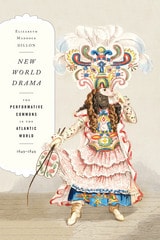
New World Drama
The Performative Commons in the Atlantic World, 1649-1849Elizabeth Maddock Dillon
Duke University Press, 2014
Audiences in London eagerly watched the royal slave, Oroonoko, tortured on stage, while audiences in Charleston and Kingston were forbidden from watching the same scene. Audiences in Kingston and New York City exuberantly participated in the slaying of Richard III on stage, enacting the rise of the "people," and Native American leaders were enjoined to watch actors in blackface "jump Jim Crow." Dillon argues that the theater served as a "performative commons," staging debates over representation in a political world based on popular sovereignty. Her book is a capacious account of performance, aesthetics, and modernity in the eighteenth-century Atlantic world.
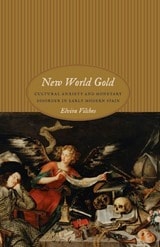
New World Gold
Cultural Anxiety and Monetary Disorder in Early Modern SpainElvira Vilches
University of Chicago Press, 2010
The discovery of the New World was initially a cause for celebration. But the vast amounts of gold that Columbus and other explorers claimed from these lands altered Spanish society. The influx of such wealth contributed to the expansion of the Spanish empire, but also it raised doubts and insecurities about the meaning and function of money, the ideals of court and civility, and the structure of commerce and credit. New World Gold shows that, far from being a stabilizing force, the flow of gold from the Americas created anxieties among Spaniards and shaped a host of distinct behaviors, cultural practices, and intellectual pursuits on both sides of the Atlantic.
Elvira Vilches examines economic treatises, stories of travel and conquest, moralist writings, fiction, poetry, and drama to reveal that New World gold ultimately became a problematic source of power that destabilized Spain’s sense of trust, truth, and worth. These cultural anxieties, she argues, rendered the discovery of gold paradoxically disastrous for Spanish society. Combining economic thought, social history, and literary theory in trans-Atlantic contexts, New World Gold unveils the dark side of Spain’s Golden Age.
Newton
Kosmos - Bios - LogosIrena Stepánová
Karolinum Press, 2014
None a Stranger There
England and/in Europe on the Early Modern StageEdited by Scott Oldenburg and Matteo Pangallo
University of Alabama Press, 2025
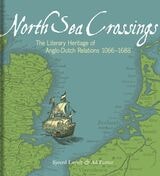
North Sea Crossings
The Literary Heritage of Anglo-Dutch Relations 1066–1688Sjoerd Levelt and Ad Putter
Bodleian Library Publishing, 2022
This richly illustrated book tells the story of cultural exchange between the people of the Low Countries and England in the Middle Ages and the Early Modern period, revealing how Anglo-Dutch connections changed the literary landscape on both sides of the North Sea.
Ranging from the Norman Conquest of 1066 to the “Glorious Revolution” of 1688, North Sea Crossings uncovers the lasting impact of contacts and collaborations between Dutch and English speakers on historical writing, map-making, manuscript production, and early printing. The literary heritage of Anglo-Dutch relations is explored and lavishly illustrated through a unique collection of manuscripts, early prints, maps, and other treasures from the Bodleian Library.

Novalis, Spinoza, and the Limits of Romantic Materialism
Siarhei Biareishyk
Northwestern University Press, 2026
Offering an innovative and illuminating new reading of Spinoza and Novalis
This rigorously researched study reframes our understanding of the intellectual currents in Germany around 1800 through a careful reinterpretation of its key thinker, Novalis, in conversation with Spinoza’s philosophy. Siarhei Biareishyk presents an alternative to the standard narrative that resolutely links emergent modernity and secularization to philosophical “idealism” by showing how Spinozan materialism informs the scientific experiments, metaphysical inquiries, and political debates of Novalis and his contemporaries. Shifting our focus away from the historical interpretation of Novalis as a mystic and theorist of subjectivity, Biareishyk elaborates on the Spinozan materialist strain in Novalis in three key domains: ontology and the conception of nature, theories of singularity and individuation, and the concept of the political. He brings current romanticist scholarship into conversation with contemporary discussions of Spinoza in continental philosophy, in the Marxist tradition particularly, demonstrating that the Spinoza–Novalis encounter provides a viable alternative—in its articulation of causality, dialectics, and the political—to the dominant conceptual apparatuses of both Kant and Hegel.
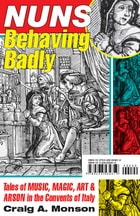
Nuns Behaving Badly
Tales of Music, Magic, Art, and Arson in the Convents of ItalyCraig A. Monson
University of Chicago Press, 2010
Witchcraft. Arson. Going AWOL. Some nuns in sixteenth- and seventeenth-century Italy strayed far from the paradigms of monastic life. Cloistered in convents, subjected to stifling hierarchy, repressed, and occasionally persecuted by their male superiors, these women circumvented authority in sometimes extraordinary ways. But tales of their transgressions have long been buried in the Vatican Secret Archive. That is, until now.
In Nuns Behaving Badly, Craig A. Monson resurrects forgotten tales and restores to life the long-silent voices of these cloistered heroines. Here we meet nuns who dared speak out about physical assault and sexual impropriety (some real, some imagined). Others were only guilty of misjudgment or defacing valuable artwork that offended their sensibilities. But what unites the women and their stories is the challenges they faced: these were women trying to find their way within the Catholicism of their day and through the strict limits it imposed on them. Monson introduces us to women who were occasionally desperate to flee cloistered life, as when an entire community conspired to torch their convent and be set free. But more often, he shows us nuns just trying to live their lives. When they were crossed—by powerful priests who claimed to know what was best for them—bad behavior could escalate from mere troublemaking to open confrontation.
In resurrecting these long-forgotten tales and trials, Monson also draws attention to the predicament of modern religious women, whose “misbehavior”—seeking ordination as priests or refusing to give up their endowments to pay for priestly wrongdoing in their own archdioceses—continues even today. The nuns of early modern Italy, Monson shows, set the standard for religious transgression in their own age—and beyond.