Results by title
805 books match the query '18th century' and 21 start with n

Napoleon’s Garden Island
Lost and Old Gardens of St Helena, South Atlantic OceanDonal P. McCracken
Royal Botanic Gardens, Kew, 2022
Though the South Atlantic island of St. Helena is best known as the site of Napoleon’s exile following his final defeat in 1815, this remote locale also has a rich gardening heritage and a population of highly diverse flora, both exotic and endemic. This is due to St. Helena’s history as a stopover for the vast East India Company fleets on their way to Europe, whose cargo holds carried not only spices but also plants from China, Malaysia, and India. As a result, St. Helena became a botanical hub and the island’s private plantation houses cultivated a number of extraordinarily varied gardens.
Illustrated throughout with drawings, maps, and archival materials, Napoleon’s Garden Island looks to St. Helena’s past and future alike. McCracken explores the island’s native and introduced flora, ultimately appealing for the establishment of a new permanent garden to showcase this singular botanical blend. Turning away from the military matters that characterize most other books about St. Helena’s history, Napoleon’s Garden Island highights how a dazzling assortment of plants have thrived thousands of miles from their nearest neighbors.
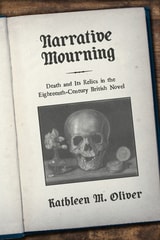
Narrative Mourning
Death and Its Relics in the Eighteenth-Century British NovelKathleen M. Oliver
Bucknell University Press, 2020
Published by Bucknell University Press. Distributed worldwide by Rutgers University Press.
Narrative of the Persecutions of Agnes Beaumont
Vera J. Camden
Michigan State University Press, 2002
This is a critical edition, based on the Agnes Beaumont manuscripts in the British Library: Beaumont's homely account of the persecutions she endured from her father and suitor because of riding horseback behind the great preacher to a meeting is here presented in its original form. She rejects the traditional doctrine of women's subordination.

Narratives of Adversity
Jesuits on the Eastern Peripheries of the Habsburg Realms (1640–1773)Paul J. Shore
Central European University Press, 2012
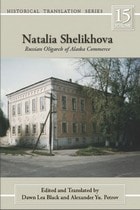
Natalia Shelikhova
Russian Oligarch of Alaska CommerceEdited by Dawn Lea Black and Alexander Petrov
University of Alaska Press, 2010
This volume makes available for the first time in English a variety of primary source materials relating to the life and work of Natalia Shelikov, a pioneering nineteenth-century Russian-American businesswoman. As a principal of the Russian-American Company, Shelikov worked in Alaska, and her business acumen and wide-ranging connections—including the empress of Russia and a swathe of northern leaders—were crucial to the growth of Alaska’s economy, as well as to the welfare of the Native people, in whose life and culture she took a strong interest. The letters, petitions, and personal documents presented here will be indispensable for students of Alaska and nineteenth-century women’s history.

Native Land Talk
Indigenous and Arrivant Rights TheoriesYael Ben-zvi
Dartmouth College Press, 2018
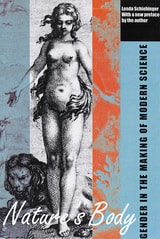
Nature's Body
Gender in the Making of Modern ScienceSchiebinger, Londa
Rutgers University Press, 2004
Eighteenth-century natural historians created a peculiar, and peculiarly durable, vision of nature—one that embodied the sexual and racial tensions of that era. When plants were found to reproduce sexually, eighteenth-century botanists ascribed to them passionate relations, polyandrous marriages, and suicidal incest, and accounts of steamy plant sex began to infiltrate the botanical literature of the day. Naturalists also turned their attention to the great apes just becoming known to eighteenth-century Europeans, clothing the females in silk vestments and training them to sip tea with the modest demeanor of English matrons, while imagining the males of the species fully capable of ravishing women.
Written with humor and meticulous detail, Nature’s Body draws on these and other examples to uncover the ways in which assumptions about gender, sex, and race have shaped scientific explanations of nature. Schiebinger offers a rich cultural history of science and a timely and passionate argument that science must be restructured in order to get it right.

Naval Leadership in the Atlantic World
The Age of Reform and Revolution, 1700–1850Richard Harding and Agustín Guimerá
University of Westminster Press, 2017
The naval leader has taken centre stage in traditional naval histories. However, while the historical narrative has been fairly consistent the development of various navies has been accompanied by assumptions, challenges and competing visions of the social characteristics of naval leaders and of their function. Whilst leadership has been a constant theme in historical studies, it has not been scrutinised as a phenomenon in its own right. This book examines the critical period in Europe between 1700 -1850, when political, economic and cultural shifts were bringing about a new understanding of the individual and of society. Bringing together context with a focus on naval leadership as a phenomenon is at the heart of this book, a unique collaborative venture between British, French and Spanish scholars. As globalisation develops in the twenty-first century the significance of navies looks set to increase. This volume of essays aims to place naval leadership in its historical context.
An electronic version of this book is freely available, thanks to the support of libraries working with Knowledge Unlatched. KU is a collaborative initiative designed to make high quality books Open Access for the public good. The Open Access ISBN for this book is 978-1-911534-76-1. More information about the initiative and details about KU’s Open Access programme can be found at www.knowledgeunlatched.org
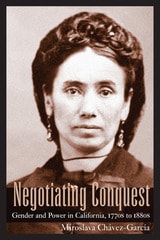
Negotiating Conquest
Gender and Power in California, 1770s to 1880sMiroslava Chávez-García
University of Arizona Press, 2004
Negotiating Conquest begins with an examination of how gender and ethnicity shaped the policies and practices of the Spanish conquest, showing that Hispanic women, marriage, and the family played a central role in producing a stable society on Mexico’s northernmost frontier. It then examines how gender, law, property, and ethnicity shaped social and class relations among Mexicans and native peoples, focusing particularly on how women dealt with the gender-, class-, and ethnic-based hierarchies that gave Mexican men patriarchal authority. With the American takeover in 1846, the text’s focus shifts to how the imposition of foreign legal, economic, linguistic, and cultural norms affected the status of Mexican women, male-female relations, and the family. Addressing such issues as divorce, legitimacy, and inheritance, it describes the manner in which the conquest weakened the economic position of both Mexican women and men while at the same time increasing the leverage of Mexican women in their personal and social relationships with men.
Drawing on archival materials—including dozens of legal cases—that have been largely ignored by other scholars, Chávez-García examines federal, state, and municipal laws across many periods in order to reveal how women used changing laws, institutions, and norms governing property, marriage and sexuality, and family relations to assert and protect their rights. By showing that mexicanas contested the limits of male rule and insisted that patriarchal relationships be based on reciprocity, Negotiating Conquest expands our knowledge of how patriarchy functioned and evolved as it reveals the ways in which conquest can transform social relationships in both family and community.
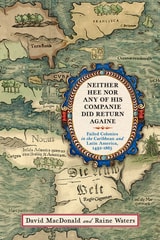
Neither Hee Nor Any of His Companie Did Return Againe
Failed Colonies in the Caribbean and Latin America, 1492–1865David MacDonald
Westholme Publishing, 2023
In Neither Hee Nor Any of His Companie Did Return Againe: Failed Colonies in the Caribbean and Latin America, 1492–1865, historians David MacDonald and Raine Waters examine the European, and later American, failures to establish permanent settlements in the region. Beginning with Columbus’s ill-conceived ventures, the authors discuss the efforts, from German claims in Venezuela and Scottish attempts in Panama to defeated Confederates fleeing to Mexico, Brazil, and elsewhere. For each colony, the primary source information is contextualized and evaluated. Along the way, the authors determine commonalities across these ill-fated colonies as well as underscore the fact that while Indigenous peoples of the region often vigorously resisted predatory European colonization, their numbers were decimated by relentless warfare, slave raids, and European diseases. As Indian populations declined, colonists imported African slaves in large numbers. The brutal treatment of slaves resulted in those who escaped creating their own settlements that existed in a state of endemic warfare with European colonists. An important contribution to Atlantic World studies, this volume reveals the fine line between colonies that thrived and those that failed.

Neither Separate Nor Equal
Congress in the 1790sKenneth R. Bowling
Ohio University Press, 2000
Scholars today take for granted the existence of a “wall of separation” dividing the three branches of the federal government. Neither Separate nor Equal: Congress in the 1790s demonstrates that such lines of separation among the legislative, executive, and judicial branches, however, were neither so clearly delineated nor observed in the first decade of the federal government's history.
The first two essays describe the social and cultural milieu attending the movement of the republican court from New York to Philadelphia and the physical and social environment of Philadelphia in the 1790s. The following section examines the congressional career of New York's Egbert Benson, the senatorial career of Robert Morris as an expression of his economic interests, the vigorous opposition of Rep. William Branch Giles to the Federalist policies of the Washington administration, and finally the underappreciated role of congressional spouses.
The last five essays concentrate on areas of interbranch cooperation and conflict. In particular, they discuss the meaning of separation of powers in the 1790s, Washington as an active president with Congress, the contrast between Hamilton's and Jefferson's exercise of political influence with Congress, and John Adams's relationship with Congress during the Quasi-War crisis.
The essays in this collection, the second volume of the series Perspectives on the History of Congress, 1789-1801, originated in two conferences held in 1995 and 1996 by the United States Capitol Historical Society.

New Israel / New England
Jews and Puritans in Early AmericaMichael Hoberman
University of Massachusetts Press, 2011
More often than not, Michael Hoberman shows, Puritans thought and wrote about Jews in order to resolve their own theological and cultural dilemmas. A number of prominent New Englanders, including Roger Williams, Increase Mather, Samuel Sewall, Benjamin Colman, Cotton Mather, Jonathan Edwards, and Ezra Stiles, wrote extensively about post-biblical Jews, in some cases drawing on their own personal acquaintance with Jewish contemporaries.
Among the intriguing episodes that Hoberman investigates is the recruitment and conversion of Harvard's first permanent instructor of Hebrew, the Jewish-born Judah Monis. Later chapters describe the ecumenical friendship between Newport minister Ezra Stiles and Haim Carigal, an itinerant rabbi from Palestine, as well as the life and career of Moses Michael Hays, the prominent freemason who was Boston's first permanently established Jewish businessman, a founder of its insurance industry, an early sponsor of the Bank of Massachusetts, and a personal friend of Paul Revere.
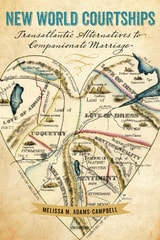
New World Courtships
Transatlantic Alternatives to Companionate MarriageMelissa M. Adams-Campbell
Dartmouth College Press, 2015

New World Drama
The Performative Commons in the Atlantic World, 1649-1849Elizabeth Maddock Dillon
Duke University Press, 2014
Audiences in London eagerly watched the royal slave, Oroonoko, tortured on stage, while audiences in Charleston and Kingston were forbidden from watching the same scene. Audiences in Kingston and New York City exuberantly participated in the slaying of Richard III on stage, enacting the rise of the "people," and Native American leaders were enjoined to watch actors in blackface "jump Jim Crow." Dillon argues that the theater served as a "performative commons," staging debates over representation in a political world based on popular sovereignty. Her book is a capacious account of performance, aesthetics, and modernity in the eighteenth-century Atlantic world.
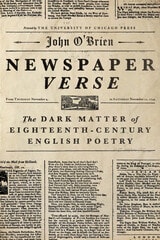
Newspaper Verse
The Dark Matter of Eighteenth-Century English PoetryJohn O'Brien
University of Chicago Press, 0
A study of the popular but forgotten poetry published in eighteenth-century English newspapers and their overlooked influence on the canonical work from the period.
The first book-length study of its kind, Newspaper Verse focuses on poetry published in English-language newspapers during the long eighteenth century, including odes, couplets, news poems, ballads, and elegies by such famous poets as Jonathan Swift, Samuel Taylor Coleridge, Alexander Pope, Elizabeth Carter, and Thomas Gray and also verse by lesser-known or anonymous writers. For John O’Brien, these texts constitute something like the dark matter of eighteenth-century letters: the most widely read poetry in the period and yet unincorporated into existing narratives of eighteenth-century English literature. By engaging with these forgotten poems, O’Brien demonstrates how popular media enabled poetry to thrive and recovers their rich influence on the shape of English literary history.
Newton
Kosmos - Bios - LogosIrena Stepánová
Karolinum Press, 2014
No Country for Travellers?
British Visitors to Spain and Portugal, 1760–1820Rosemary Sweet and Richard Ansell
University College London, 2025
Using extensive archival and printed sources left by contemporary travelers, No Country for Travellers? explores the rise and nature of British travel to Spain and Portugal in the late eighteenth and early nineteenth centuries. Not only is it the first book to address the trend of travelers to the Iberian Peninsula during this time, revealing the extent of British interest in Islamic Spain before the Romantic era, but it also brings to light the role of non-combatant travelers to Iberia during the Peninsular War. Beyond uncovering a previously overlooked dimension of the Peninsular War, this history contends with stereotypes of Iberia that were embedded in early modern confessional and civilizational hierarchies.
Notorious Facts
Publicity in Romantic England, 1780–1830James Mulvihill
University of Delaware Press, 2012
Notorious Facts examines the sensationalistic confounding of persons and principles in the public life of Romantic England (1780–1830). Its purview is limited to five decades straddling the late eighteenth and early nineteenth centuries, but its trajectory, moving from a politics rendered in personal terms to a politics of personality, describes a shift still in process today. The study’s chapters draw on a motley body of literature (pamphlets, secret histories, and the like) that at first glance seems uncharacteristic of what literary historians call the English Romantic period. Viewed in the context of something called late Georgian England, these texts seem more indigenous, but if the canonical revisionism of the last few decades should teach us anything, it is that a Romanticism encompassing all romanticisms ideally excludes nothing.
In its heroic Enlightenment sense, publicity is concerned with exposing the workings of power for all to see. A good deal may be inferred about publicity in Romantic England from primary texts in which this salutary function is at once espoused and subverted. These texts—the mostly nameless or pseudonymous authors of the age’s pamphlet literature are the heroes and villains of the piece—almost invariably claim to speak from a disinterested conception of publicity while putting its methods of critical exposure to wholly self-interested purposes. This study examines well-known authors of the period like Jeremy Bentham, Samuel Taylor Coleridge, and William Hazlitt, as well as pamphleteers like John Horne Tooke, Philip Withers, and Nathaniel Jefferys. Other figures include authors of secret history like Thomas Ashe, Mary Anne Clarke, Lewis Goldsmith, and Joseph Haslewood in addition to notorious figures in their own right such as the Prince and Princess of Wales, Mrs. Fitzherbert, and the Reverend Edward Irving. Among the topics treated are treasonous libel, royal scandal, secret history, and celebrity.
Published by University of Delaware Press. Distributed worldwide by Rutgers University Press.

Novalis, Spinoza, and the Limits of Romantic Materialism
Siarhei Biareishyk
Northwestern University Press, 2026
Offering an innovative and illuminating new reading of Spinoza and Novalis
This rigorously researched study reframes our understanding of the intellectual currents in Germany around 1800 through a careful reinterpretation of its key thinker, Novalis, in conversation with Spinoza’s philosophy. Siarhei Biareishyk presents an alternative to the standard narrative that resolutely links emergent modernity and secularization to philosophical “idealism” by showing how Spinozan materialism informs the scientific experiments, metaphysical inquiries, and political debates of Novalis and his contemporaries. Shifting our focus away from the historical interpretation of Novalis as a mystic and theorist of subjectivity, Biareishyk elaborates on the Spinozan materialist strain in Novalis in three key domains: ontology and the conception of nature, theories of singularity and individuation, and the concept of the political. He brings current romanticist scholarship into conversation with contemporary discussions of Spinoza in continental philosophy, in the Marxist tradition particularly, demonstrating that the Spinoza–Novalis encounter provides a viable alternative—in its articulation of causality, dialectics, and the political—to the dominant conceptual apparatuses of both Kant and Hegel.

Novalis
Signs of RevolutionWilliam Arctander O Brien
Duke University Press, 1994
A member of the generation of the 1770s that included Hegel, Hölderlin, and Schelling, Hardenberg was an avid follower of the French Revolution, a semiotician avant la lettre, and a prescient critic of religion. Yet in 1802, only a year after his death, the writer who had scandalized the Prussian court was marketed to a nation at war as a reactionary patriot, a sweet versifier of Idealism, and a morbid mystic. Identifying the break between Hardenberg’s own early Romanticism and the late Romanticism that falsified it, Novalis shows us a writer fully engaged in revolutionary politics and examines his semiotic readings of philosophy and of the political, scientific, and religious institutions of the day. Drawing on the full range of Novalis’s writings, including his poetry, notebooks, novels, and journals, O’Brien situates his semiotics between those of the eighteenth century and those of the twentieth and demonstrates the manner in which a concern for signs and language permeated all aspects of his thought.
The most extensive study of Hardenberg available in English, Novalis makes this revolutionary theoretician visible for the first time. Mining a crucial chapter in the history of semiotics and social theory, it suggests fruitful, sometimes problematic connections between semiotic, historical, "deconstructive," and philological practices as it presents a portrait of one of the most complex figures in literary history. Indispensable for scholars of German Romanticism, Novalis will also be of interest to students of comparative literature and European intellectual history.

Novel Bodies
Disability and Sexuality in Eighteenth-Century British LiteratureJason S. Farr
Bucknell University Press, 2019
Published by Bucknell University Press. Distributed worldwide by Rutgers University Press.