60 books match the query '1947-' and 3 start with n
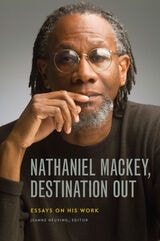
cover of Nathaniel Mackey, Destination Out: Essays on His Work

Nathaniel Mackey, Destination Out

Essays on His Work

Jeanne Heuving

University of Iowa Press, 2021

In this first book of essays devoted entirely to Nathaniel Mackey’s work, prominent critics respond to a major oeuvre that is at once affirmative and utopic, negational and dystopic. Drawing on multiple genealogies and traditions, primarily from African and African diaspora histories and cultures, Mackey’s work envisions cultural creation as cross-cultural, based in the damaging relationships of Africans brought against their will to the Americas and the resulting innovations of New World African literatures and music.

This collection is organized through broad topics in order to provide entrances into his challenging work: myth, literature, and seriality; music, performance, and collaboration; syncretism, synopsis, and what-saying. It engages Mackey’s spiritual and esoteric disposition along with his attention to what Amiri Baraka called the “enraged sociologies” of Black music. In his manifesto “Destination Out,” Mackey describes his work as “wanting to bid all givens goodbye” and as “centrifugal.” It is also centripetal, manifesting a reflexive interiority that creates itself through recurring forms.
 
Contributors: Maria Damon, Joseph Donahue, Rachel Blau DuPlessis, Norman Finkelstein, Luke Harley, Paul Jaussen, Adalaide Morris, Fred Moten, Peter O’Leary, Anthony Reed
[more]
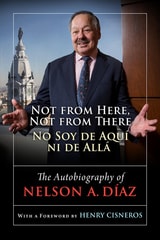
cover of Not from Here, Not from There/No Soy de Aquí ni de Allá: The Autobiography of Nelson Díaz

Not from Here, Not from There/No Soy de Aquí ni de Allá

The Autobiography of Nelson Díaz

Nelson A. Díaz

Temple University Press, 2018

Raised in the squalor of a New York tenement until he was 10 years old, Nelson Díaz saw his life change when his family moved to a brand-new high-rise project in West Harlem in the 1950s. That experience, along with lessons learned as the only Latino law student at Temple University, would drive him throughout his life as a lawyer and activist, fighting for the expansion of rights for all Americans.

“No soy de aquí ni de allá” is a mantra for Puerto Ricans who feel like foreigners wherever they are and who seek a place for themselves. In his inspiring autobiography, Not from Here, Not from There, Díaz tells the story of his struggles and triumphs as his perspective widened from the New York streets and law school classrooms to the halls of power in Philadelphia and Washington, DC. Whether as a leader in economic development, a pioneer in court reform, or a champion of fair housing, Díaz has never stopped advocating for others. Díaz was happy to be the first Latino to “do something,” but he never wanted to be the last. This story of an outsider who worked his way to the inside offers powerful lessons on finding a place in the world by creating spaces where everyone is welcome.
[more]
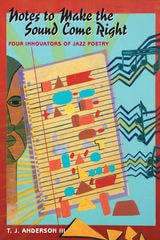
cover of Notes to Make the Sound Come Right: Four Innovators of Jazz Poetry

Notes to Make the Sound Come Right

Four Innovators of Jazz Poetry

T.J. Anderson III

University of Arkansas Press, 2004

In “When Malindy Sings” the great African American poet Paul Laurence Dunbar writes about the power of African American music, the “notes to make the sound come right.” In this book T. J. Anderson III, son of the brilliant composer, Thomas Anderson Jr., asserts that jazz became in the twentieth century not only a way of revising old musical forms, such as the spiritual and work song, but also a way of examining the African American social and cultural experience. He traces the growing history of jazz poetry and examines the work of four innovative and critically acclaimed African American poets whose work is informed by a jazz aesthetic: Stephen Jonas (1925?–1970) and the unjustly overlooked Bob Kaufman (1925–1986), who have affinities with Beat poetry; Jayne Cortez (1936– ), whose work is rooted in surrealism; and the difficult and demanding Nathaniel Mackey (1947– ), who has links to the language writers. Each fashioned a significant and vibrant body of work that employs several of the key elements of jazz. Anderson shows that through their use of complex musical and narrative weaves these poets incorporate both the tonal and performative structures of jazz and create work that articulates the African journey. From improvisation to polyrhythm, they crafted a unique poetics that expresses a profound debt to African American culture, one that highlights the crucial connection between music and literary production and links them to such contemporary writers as Michael Harper, Amiri Baraka, and Yusef Komunyakaa, as well as young recording artists—United Future Organization, Us3, and Groove Collection—who have successfully merged hip-hop poetry and jazz.
[more]