Results by title
52 books match the query '1949-' and 4 start with n

National Past-Times
Narrative, Representation, and Power in Modern ChinaAnn Anagnost
Duke University Press, 1997
Using interviews and participant observation as well as close readings of official documents, propaganda materials, and popular media, Anagnost notes the discontinuities in the nation’s narrative—moments where this narrative has been radically reorganized at critical junctures in China’s modern history. Covering a broad range of issues relating to representation and power—issues that have presented themselves with particular clarity in the years since the violent crackdown on the student movement of 1989—National Past-Times critiques the ambiguous possibilities produced by the market, as well as new opportunities for "unfreedom" in the discipline of labor and the commodification of women. Anagnost begins with a retrospective reflection on the practice of "speaking bitterness" in socialist revolutionary practice. Subsequent essays discuss the culture debates of the 1980s, the discourse of social disorder, the issue of population control, the film The Story of Qiu Ju, and anomalies at the theme park "Splendid China."
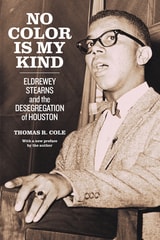
No Color Is My Kind
Eldrewey Stearns and the Desegregation of HoustonThomas R. Cole
University of Texas Press, 2021
In 1959, a Black man named Eldrewey Stearns was beaten by Houston police after being stopped for a traffic violation. He was not the first to suffer such brutality, but the incident sparked Stearns’s conscience and six months later he was leading the first sit-in west of the Mississippi River. No Color Is My Kind, first published in 1997, introduced readers to Stearns, including his work as a civil rights leader and lawyer in Houston’s desegregation movement between 1959 and 1963. This remarkable and important history, however, was nearly lost to bipolar affective disorder. Stearns was a fifty-two-year-old patient in a Galveston psychiatric hospital when Thomas Cole first met him in 1984. Over the course of a decade, Cole and Stearns slowly recovered the details of Stearns’s life before his slide into mental illness, writing a story that is more relevant today than ever.
In this new edition, Cole fills in the gaps between the late 1990s and now, providing an update on the progress of civil rights in Houston and Stearns himself. He also reflects on his tumultuous and often painful collaboration with Stearns, challenging readers to be part of his journey to understand the struggles of a Black man’s complex life. At once poignant, tragic, and emotionally charged, No Color Is My Kind is essential reading as the current movement for racial reconciliation gathers momentum.
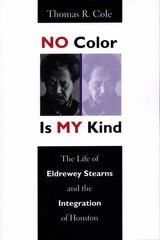
No Color Is My Kind
The Life of Eldrewey Stearns and the Integration of HoustonBy Thomas R. Cole
University of Texas Press, 1997
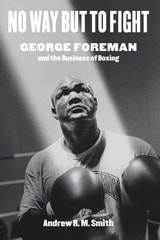
No Way but to Fight
George Foreman and the Business of BoxingBy Andrew R. M. Smith
University of Texas Press, 2020
Olympic gold medalist. Two-time world heavyweight champion. Hall of Famer. Infomercial and reality TV star. George Foreman’s fighting ability is matched only by his acumen for selling. Yet the complete story of Foreman’s rise from urban poverty to global celebrity has never been told until now.
Raised in Houston’s “Bloody Fifth” Ward, battling against scarcity in housing and food, young Foreman fought sometimes for survival and other times just for fun. But when a government program rescued him from poverty and introduced him to the sport of boxing, his life changed forever.
In No Way but to Fight, Andrew R. M. Smith traces Foreman’s life and career from the Great Migration to the Great Society, through the Cold War and culture wars, out of urban Houston and onto the world stage where he discovered that fame brought new challenges. Drawing on new interviews with George Foreman and declassified government documents, as well as more than fifty domestic and international newspapers and magazines, Smith brings to life the exhilarating story of a true American icon. No Way but to Fight is an epic worthy of a champion.