Results by title
1713 books match the query '21St Century' and 54 start with n

NEWSPEAK in the 21st Century
David Cromwell and David Edwards
Pluto Press, 2009
Since 2001, Media Lens has encouraged thousands of readers to challenge the filtered and distorted version of the world provided by major newspapers and broadcasters. The media responses, collected in Newspeak, are an exposé of the arrogance and servility to power of our leading journalists and editors, starring Andrew Marr, Alan Rusbridger, Roger Alton, Jon Snow, Jeremy Bowen and even George Monbiot.
Picking up where the highly acclaimed and successful Guardians of Power (2006) left off, Newspeak is packed with forensic media analysis, revealing the lethal bias in "balanced" reporting. Even the "best" UK media -- the Guardian, the Independent, Channel 4 News and the BBC -- turn out to be cheerleaders for government, business and war.
Alongside an A-Z of BBC propaganda and chapters on Iraq and climate change, Newspeak focuses on the demonisation of Iran and Venezuela, the Israel-Palestine conflict, the myth of impartial reporting and the dark art of smearing dissidents.

NOVEL PROFESSIONS
INTERESTED DISINTEREST AND THE MAKING OF THE VICTORIAN NOVELJennifer Ruth
The Ohio State University Press, 2006

Narrative Interplay in the Digital Era
Generative AI, Alternate Reality Games, and the Future of Interactive PedagogyEdited by Andrew Klobucar
Intellect Books, 2025
In Narrative Interplay in the Digital Era, leading scholars and artists explore how digital narratives, alternate reality games, and AI-driven storytelling reshape how we create, experience, and teach interactive fiction. This collection moves beyond traditional analysis and examines the social and artistic dimensions of interactivity, highlighting how narratives unfold dynamically through player engagement and machine collaboration.
Organized into three sections—alternate realities, digital interactive fiction, and the politics of gaming—this book reveals the evolving role of play and interactivity in contemporary education, creative expression, and online culture. Contributors offer insights from inside the creative process, centering the perspectives of game designers and artists to shed light on how interactive stories emerge at the intersection of technology and human imagination.
A practical resource for researchers in game studies, electronic literature, and digital storytelling, this collection also speaks to educators and creators eager to explore how AI and interactivity are redefining the future of narrative.
Narrative in the Anthropocene
Erin James
The Ohio State University Press, 2022
Native Evangelism in Central Mexico
By Hugo G. Nutini and Jean F. Nutini
University of Texas Press, 2014
Evangelical Christianity is Mexico’s fastest-growing religious movement, with about ten million adherents today. Most belong to Protestant denominations introduced from the United States (e.g., Jehovah’s Witnesses, Seventh-day Adventists), but perhaps as many as 800,000 are members of homegrown, “native” evangelical sects. These native Mexican sects share much with the American denominations of which they are spinoffs. For instance, they are Trinitarian, Anabaptist, and Millenarian; they emphasize a personal relationship with God, totally rejecting intermediation by saints; and they insist that they are the only true Christians. Beyond that, each native sect has its distinctive characteristics.
This book focuses on two sharply contrastive native evangelical sects in Central Mexico: Amistad y Vida (Friendship and Life) and La Luz del Mundo (The Light of the World). The former, founded in 1982, now has perhaps 120,000 adherents nationwide. It is nonhierarchical, extremely egalitarian, and has no dogmatic directives. It is a cheerful religion that emphasizes charity, community service, and personal kindness as the path to salvation. It attracts new members, mainly from the urban middle class, through personal example rather than proselytizing. La Luz del Mundo, founded in 1926, now has about 350,000 members in Mexico and perhaps one million in the hemisphere. It is hierarchically organized and demands total devotion to the sect’s founder and his son, who are seen as direct links to Jesus on Earth. It is a proselytizing sect that recruits mainly among the urban poor by providing economic benefits within the congregations, but does no community service as such.
Based on ten years of fieldwork (1996–2006) and contextualized by nearly fifty years of anthropological study in the region, Native Evangelism in Central Mexico presents the first ethnography of Mexico’s native evangelical congregations.

Native Voices
Indigenous American Poetry, Craft, and ConversationsEdited by CMarie Fuhrman and Dean Rader
Tupelo Press, 2019
In this groundbreaking anthology of Indigenous poetry and prose, Native poems, stories, and essays are informed with a knowledge of both what has been lost and what is being restored. It offers a diverse collection of stories told by Indigenous writers about themselves, their histories, and their present. It is a celebration of culture and the possibilities of language.
Featuring forty-four poets, including Ishmael Hope, Bojan Louis, Ruby Murray, Simon Ortiz, Leslie Marmon Silko, Luci Tapahonso, Joy Harjo, dg okpik, Sherwin Bitsui, Heid E. Erdrich, Layli Long Soldier, and Orlando White.
Original influence essays by Diane Glancy on Lorca, Chrystos on Audre Lorde, Louise Erdrich on Elizabeth Bishop, LeAnne Howe on W. D. Snodgrass, Allison Hedge Coke on Delmore Schwartz, Suzanne Rancourt on Ai, and M. L. Smoker on Richard Hugo, among others.
And, a selection of resonant work chosen from previous generations of Native artists.
“There really is no better anthology out there that collects indigenous poets publishing from 1960 to the present.” — Dean Rader, co-editor
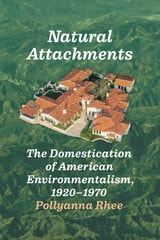
Natural Attachments
The Domestication of American Environmentalism, 1920–1970Pollyanna Rhee
University of Chicago Press, 2025
A massive oil spill in the Pacific Ocean near Santa Barbara, California, in 1969 quickly became a landmark in the history of American environmentalism, helping to inspire the creation of both the Environmental Protection Agency and Earth Day. But what role did the history of Santa Barbara itself play in this? As Pollyanna Rhee shows, the city’s past and demographics were essential to the portrayal of the oil spill as momentous. Moreover, well-off and influential Santa Barbarans were positioned to “domesticate” the larger environmental movement by embodying the argument that individual homes and families—not society as a whole—needed protection from environmental abuses. This soon would put environmental rhetoric and power to fundamentally conservative—not radical—ends.
Natural Attachments
The Domestication of American Environmentalism, 1920–1970Pollyanna Rhee
University of Chicago Press, 2025
A nuanced analysis takes a California oil spill as its point of departure to show how affluent homeowners pushed for an environmentalism that would protect not only the earth but also property and community norms.
A massive oil spill in the Pacific Ocean near Santa Barbara, California, in 1969 quickly became a landmark in the history of American environmentalism, helping to inspire the creation of both the Environmental Protection Agency and Earth Day. But what role did the history of Santa Barbara itself play in this? As Pollyanna Rhee shows, the city’s past and demographics were essential to the portrayal of the oil spill as momentous. Moreover, well-off and influential Santa Barbarans were positioned to “domesticate” the larger environmental movement by embodying the argument that individual homes and families—not society as a whole—needed protection from environmental abuses. This soon would put environmental rhetoric and power to fundamentally conservative—not radical—ends.
Nature in Translation
Japanese Tourism Encounters the Canadian RockiesShiho Satsuka
Duke University Press, 2015
Nature's Burdens
Conservation and American Politics, The Reagan Era to the PresentDaniel Nelson
Utah State University Press, 2017
Nature’s Burdens is a political and intellectual history of American natural resource conservation from the 1980s into the twenty-first century—a period of intense political turmoil, shifting priorities among federal policymakers, and changing ideas about the goals of conservation. Telling a story of persistent activism, conflict, and frustration but also of striking achievement, it is an account of how new ideas and policies regarding human relationships to plants, animals, and their surroundings have become vital features of modern environmentalism.
In the 1960s and 1970s, Congress embraced the largely dormant movement to preserve distinctive landscapes and the growing demand for outdoor recreation, establishing an unprecedented number of parks, monuments, and recreation areas. The election of Ronald Reagan and a shift to a Republican-controlled Senate brought this activity to an abrupt halt and introduced a period of intense partisanship and legislative gridlock that extends to the present. In this political climate, three developments largely defined the role of conservation in contemporary society: environmental organizations have struggled to defend the legal status quo, private land conservation has become increasingly important, and the emergence of potent scientific voices has promoted the protection of animals and plants and injected a new sense of urgency into the larger cause.
These developments mark this period as a distinctive and important chapter in the history of American conservation. Scrupulously researched, scientifically and politically well informed, concise, and accessibly written, Nature’s Burdens is the most comprehensive examination of recent efforts to protect and enhance the natural world. It will be of interest to environmental historians, environmental activists, and any general reader interested in conservation.
Navigating White News
Asian American Journalists at WorkDavid C Oh
Rutgers University Press, 2023
Combining critical race studies with cultural production studies, Navigating White News: Asian American Journalists at Work is the only academic book to examine the ways that racial identification and activation matters in their understanding of news. This adds to the existing literature on race and the sociology of news by examining intra-racial differences in the ways they navigate and understand White newsrooms. Employing in-depth interviews with twenty Asian American journalists who are actively working in large and small newsrooms across the United States, Navigating White News: Asian American Journalists at Work argues that Asian American reporters for whom racial identities are important questioned what counted as news, questioned the implicitly White perspective of objectivity, and actively worked toward providing more complex, substantive coverage of Asian American communities. For Asian American reporters for whom racial identity was not meaningful, they were more invested in existing professional norms. Regardless, all journalists understood that news is a predominantly and culturally White institution.

Negotiated Reform
The Multilevel Governance of Financial RegulationEdited by Renate Mayntz
Campus Verlag, 2016
Negotiating in Civil Conflict
Constitutional Construction and Imperfect Bargaining in IraqHaider Ala Hamoudi
University of Chicago Press, 2013
Nemerov's Door
EssaysRobert Wrigley
Tupelo Press, 2021
Neodomestic American Fiction
Kristin J. Jacobson
The Ohio State University Press, 2010
Neoliberal Apartheid
Palestine/Israel and South Africa after 1994Andy Clarno
University of Chicago Press, 2017
After a decade of research in the Johannesburg and Jerusalem regions, Andy Clarno presents here a detailed ethnographic study of the precariousness of the poor in Alexandra township, the dynamics of colonization and enclosure in Bethlehem, the growth of fortress suburbs and private security in Johannesburg, and the regime of security coordination between the Israeli military and the Palestinian Authority in the West Bank. The first comparative study of the changes in these two areas since the early 1990s, the book addresses the limitations of liberation in South Africa, highlights the impact of neoliberal restructuring in Palestine, and argues that a new form of neoliberal apartheid has emerged in both contexts.
Neoliberal Chicago
Edited by Larry Bennett, Roberta Garner, and Euan Hague
University of Illinois Press, 2017
Neoliberalism and Commodity Production in Mexico
Thomas Weaver
University Press of Colorado, 2012
Detailed ethnographic fieldwork shows how foreign investment, privatization, deregulation, and elimination of welfare benefits have devastated national industries and natural resources and threatened agriculture, driving the campesinos and working class deeper into poverty. Focusing on specific commodity chains and the changes to production and marketing under neoliberalism, the contributors highlight the detrimental impacts of policies by telling the stories of those most affected by these changes. They detail the complex interplay of local and global forces, from the politically mediated systems of demand found at the local level to the increasingly powerful municipal and state governments and the global trade and banking institutions.
Sharing a common theoretical perspective and method throughout the chapters, Neoliberalism and Commodity Production in Mexico is a multi-sited ethnography that makes a significant contribution to studies of neoliberal ideology in practice.
Neoliberalism and Contemporary American Literature
Edited by Liam Kennedy and Stephen Shapiro
Dartmouth College Press, 2019
Net Values
Environmental, Economic, and Social Entanglements in the Gulf of CaliforniaNicole D. Peterson
University of Arizona Press, 2025
In Loreto, Baja California Sur, Mexico, artisanal fishing families and staff of Loreto Bay National Park face an array of choices as tourism, environmental concerns, and economic precarity challenge livelihoods and natural resource availability. In Net Values, Nicole D. Peterson offers a critical examination of how the idea of “choice” is understood, and what it means for policies, planning, and programs to ignore the social, political, economic, and cultural contexts surrounding these choices.
Anchored by more than twenty years of research, Peterson provides insight into the fishing community of Loreto and reveals an important role in decision-making that diverges from previous studies. She argues that decisions about fishing, natural resource management, and other aspects of life are influenced by context, values, and expectations in ways that go beyond the typical psychological or cognitive theories of choice. Instead, Net Values highlights the ways that choices are constrained and enabled by values and expectations of cultures, histories, relationships, and experiences, both personal and shared. Peterson answers questions such as “why do the fishermen fish?” or “what is the marine park staff doing?” These decisions and choices are related to the larger implication addressed by this book: that in order to make effective policies around natural resource management and other issues, we must understand how those potential policies interact with the decision processes already underway.
Divided into five chapters, Net Values is rich in ethnographic detail, drawing from real people to inform the narratives, chapters, and theoretical elaboration. Peterson’s interactions with fishers such as Don Javier and his family and friends support the ideas offered around choice, values, and strategies, connecting ideas to real experiences.
Networked Poetics
The Digital Turn in Southern African PoetrySusanna L. Sacks
University of Massachusetts Press, 2024
Winner of the 2025 MLA Scaglione Prize for African Studies
Simultaneously transnational and local, poetry in the twenty-first century is produced across digital networks, shaped through local communities, and evaluated on a global scale. It might start on social media, where a video of a poet circulates and goes viral, gaining international attention without ever going through traditional modes of publication. In Networked Poetics, Susanna L. Sacks introduces readers to the southern African poetry scene in Malawi, Zimbabwe, and South Africa, illustrating how contemporary poetry is shaped, from inception to canonization, by the influence of digital media publication.
Interweaving ethnographic observation and extensive literary analysis, Sacks demonstrates that, as more artists in Africa reach wider audiences through online publication, poetic form has shifted to reflect social media’s aesthetic norms of urgency, immediacy, and populism. These changes have, in turn, challenged elite processes of valuation, forcing literary institutions like prizes, festivals, and curricula to accommodate the digital turn.
Networking China
The Digital Transformation of the Chinese EconomyYu Hong
University of Illinois Press, 2017
Nevada's Great Recession
Looking Back, Moving ForwardElliott Parker
University of Nevada Press, 2017
This is a different kind of economics book. Parker uses his expertise from doing research on the East Asian fiscal crisis to give profound insights into what happened and how to avoid future catastrophes. Marshall personalizes it by providing vignettes of what it was actually like to be in the trenches and fighting the inevitable political battles that came up, and counteracting some of the falsehoods that certain politicians were spreading about the recession.
Parker and Marshall’s book should be required reading for not only every single elected official in Nevada, but for any private citizen who cares about the public good.
Never on Time, Always in Time
Narrative Form and the Queer SensoriumKate McCullough
The Ohio State University Press, 2024
New Brunswick, New Jersey
The Decline and Revitalization of Urban AmericaListokin, David
Rutgers University Press, 2016
New Cathay
Contemporary Chinese PoetryEdited by Ming Di
Tupelo Press, 2013

New Directions in Israeli Media
Film, Television, and Digital ContentEdited by Yaron Peleg, Eran Kaplan, and Ido Rosen
University of Texas Press, 2025
A comprehensive analysis of the major trends and developments in contemporary Israeli media.
In the twenty-first century, Israeli filmmaking has transformed from a localized industry into a globally recognized and diverse national cinema, its filmmakers gaining prominence internationally and introducing new themes, aesthetics, and voices to the scene. At the same time, Israeli television shows have emerged as a dominant force, propelled by the spread of streaming. Through the rise of online content creation and consumption, especially in the 2010s, new voices have revolutionized the creative landscape.
With Israel’s position at the cutting edge of technology and virtual platforms, Israeli media has seen a boom, winning prizes at international film festivals and adapting shows like Euphoria, Homeland, and Fauda for wider audiences. In New Directions in Israeli Media, thirteen contributors detail the shifting dynamics of Israeli cinema, television, and online content in the digital age, exploring how globalization, technological advances, and changing audience preferences are reshaping creative industries. Editors Yaron Peleg, Eran Kaplan, and Ido Rosen have assembled a volume that prompts critical reflection on the intersection of art, technology, and culture in a rapidly changing media landscape.
New Downtown Now
An Anthology Of New Theater From Downtown New YorkMac Wellman
University of Minnesota Press, 2006
New Short Fiction from Cuba
Jacqueline Loss and Esther Whitfield
Northwestern University Press, 2007
An eclectic selection, the stories offer an exhilarating sense of a rich literary diversity and cultural history, an experience of Cuban literature that has rarely been available to an English audience. They differ widely, even wildly, in style and theme: from an impromptu encounter with Ernest Hemingway to an imagined romance mapped onto Cuba’s foundational nineteenth-century novel; from a witty, Borgesian satire on bureaucracy and officialist identity to a gothic adventure in homosexual voyeurism and mental illness; from an allegorical travelogue set in repressive China to a semi-surreal celebration of angels in Havana. These are the voices of Cuban fiction today, reflecting the past, anticipating the future, and composing in their infinite variety the stories of their culture.
New Stories from the Midwest
Jason Lee Brown
Ohio University Press, 2011
New Stories from the Midwest presents a collection of stories that celebrate an American region too often ignored in discussions about distinctive regional literature. The editors solicited nominations from more than three hundred magazines, literary journals, and small presses, and narrowed the selection to nineteen authors comprising prize winners and new and established authors.
The stories, written by midwestern writers or focusing on the Midwest, demonstrate how the quality of fiction from and about the heart of the country rivals that of any other region.
The anthology includes an introduction from Lee Martin and short fiction by emerging and established writers such as Rosellen Brown, Bonnie Jo Campbell, Christie Hodgen, Gregory Blake Smith, and Benjamin Percy.
New Stories from the Southwest
D. Seth Horton
Ohio University Press, 2008
The beauty and barrenness of the southwestern landscape naturallylends itself to the art of storytellers. It is a land of heat and dryness, aland of spirits, a land that is misunderstood by those living along thecoasts.
New Stories from the Southwest presents nineteen short stories that appeared in North American periodicals between January and December 2006. Though many of these stories vary by aesthetics, tone, voice, and almost any other craft category one might wish to use, they are nevertheless bound together by at least one factor, which is that the landscape of the region plays a key role in their narratives. They each evoke and explore what it means to exist in thisunique corner of the country.
Selected by editor D. Seth Horton, the former fiction editor for the Sonora Review, from a wide cross-section of journals and magazines, and with a foreword by noted writer Ray Gonzalez, New Stories from the Southwest presents a generous sampling of the best of contemporary fiction situated in this often overlooked area of the country. Swallow Press is particularly pleased to publish this wide-ranging collection of stories from both new and established writers.
Contributors to New Stories from the Southwest are:
- Alan Cheuse
- Matt Clark
- Lorien Crow
- Kathleen De Azvedo
- Alan Elyshevitz
- Marcela Fuentes
- Dennis Fulgoni
- Ray Gonzalez
- Anna Green
- Donald Lucio Hurd
- Toni Jensen
- Charles Kemnitz
- Elmo Lum
- Tom McWhorter
- S. G. Miller
- Peter Rock
- Alicita Rodriguez
- John Tait
- Patrick Tobin
- Valery Varble
New Strategies for Wicked Problems
Science and Solutions in the 21st CenturyEdward P. Weber
Oregon State University Press, 2017
We now live in a world full of wicked problems, most of them urgent challenges calling out for creative, democratic, and effective solutions. Ed Weber, Denise Lach, and Brent Steele, of the Oregon State University School of Public Policy, solicited papers from a wide variety of accomplished scholars in the fields of science, politics, and policy with significant research experience to address this challenge. The resultant collection focuses on major contemporary environmental and natural resource policy issues, and proposes an assortment of alternative problem-solving methodologies to tackle such problems.
New Strategies for Wicked Problems will appeal to scholars, students, and decision-makers wrestling with wicked problems and “post-normal” science settings beyond simply environmental and natural resource-based issues. It will provide much needed guidance to policymakers, citizens, public managers, and various stakeholders who are struggling with wicked problems in their professional lives.
Other Contributors:
Tanya Heikkila
Helen Ingram
Ann C. Keller
Bob Lackey
Anna Pakenham Stevenson
Christopher M. Weible
Daniel R. Williams
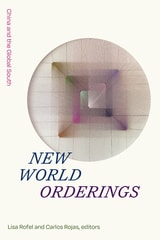
New World Orderings
China and the Global SouthLisa Rofel and Carlos Rojas, editors
Duke University Press, 2022
Contributors. Andrea Bachner, Luciano Damián Bolinaga, Nellie Chu, Rachel Cypher, Mingwei Huang, T. Tu Huynh, Yu-lin Lee, Ng Kim Chew, Lisa Rofel, Carlos Rojas, Shuang Shen, Derek Sheridan, Nicolai Volland
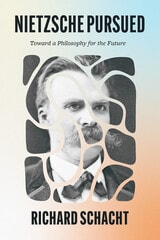
Nietzsche Pursued
Toward a Philosophy for the FutureRichard Schacht
University of Chicago Press, 2024
Nietzsche advocated for a post-theistic “philosophy of the future”—a new approach to human reality that would bend Western thought away from nihilism in a life-affirming, value-creative direction. His early demise left this endeavor only just begun. In Nietzsche Pursued, Richard Schacht examines Nietzsche’s revisionist approach to familiar philosophical topics, exploring how some may be further pursued in Nietzschean ways.
Each chapter focuses on one topic that is central to Nietzsche's vision of what philosophy can and should be and do. Among them: his kind of naturalism, humanity, perspectivism, morality, and music. Building on his analysis in Nietzsche’s Kind of Philosophy, Schacht invites readers to see with new appreciation the ongoing significance of Nietzsche’s thought for philosophy’s future.
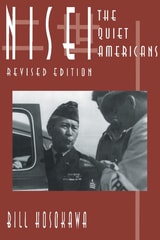
Nisei
The Quiet Americans, Revised EditionBill Hosokawa
University Press of Colorado, 2002
As Hosokawa additionally demonstrates, since World War II, Japanese Americans have achieved exceptional social, economic, and political progress. Their efforts led to apologies by four U.S. presidents for wartime injustices and redress through the landmark Civil Liberties Act of 1988. Brought up-to-date in this newly revised edition, Nisei details the transformation of these "quiet Americans" from despised security risks to respected citizens.
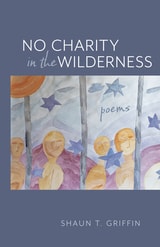
No Charity in the Wilderness
PoemsShaun T. Griffin
University of Nevada Press, 2024
Griffin has spent many decades in the high desert trying to find the way forward—when what he knows has been challenged and still there is breath on the horizon. One day an ancient Chinese poet comes to visit: "Snow deepens/ to quiet what I once believed, and Wang Wei stoops from the spine:/ this is how you become silence." Even if you doubt the old poet's counsel, like Griffin, you want to journey with him into the wilderness.
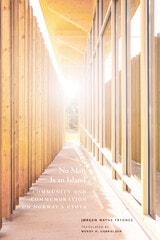
No Man Is An Island
Community and Commemoration on Norway's UtøyaJørgen Watne Frydnes, translated by Wendy H. Gabrielsen
University of Massachusetts Press, 2025
On July 22, 2011, a white supremacist killed eight people at Oslo’s Government Center in Norway and then terrorized the idyllic island of Utøya, where he executed sixty-nine more people, mostly teenagers. The country had never suffered such a massacre, and in the aftermath, the entire population was reeling.
Utøya, the Norwegian Labor Party’s summer camp for youth, a beloved place where many Norwegians learned about democratic values and processes, made lifelong friendships, and developed a vision for a just society, became mired in grief and discord. When Jørgen Watne Frydnes took on the daunting task of rebuilding the island and charting its future, he had to figure out a compassionate and just way forward. He made a radical decision: he set out to talk with each family of a murdered person, seeking to understand their needs and their hopes so that the future of the island could include their wishes and concerns. This emotionally grueling work, which was never considered in the scholarly literature on commemoration, led to a true renewal of Utøya, resulting in a meaningful memorial to those who were lost as well as beautiful surroundings for campers who come there to study democracy and peace.
Frydnes’s narrative, originally published in Norwegian, is structured around the seasons of the year and the landscape of the island, and tracks one person’s account of learning how to remember, commemorate, and honor the dead, and acknowledge a mass tragedy, and yet also create a nurturing, aspirational space for hope.
No Peer Rivals
American Grand Strategy in the Era of Great Power CompetitionIonut Popescu
University of Michigan Press, 2025
No Peer Rivals takes a major staple of International Relations scholarship—the offensive realist paradigm—and develops a comprehensive and practical grand strategy for the United States in this new era of Great Power Competition. The No Peer Rival framework is grounded in a realistic assessment of the most likely courses of action adopted by China, Russia, and other important regional powers. It prioritizes great power rivalry over other strategic goals, and identifies China as the biggest threat to America’s unique position in the international system. This grand strategic approach carefully aligns the domestic sources of national power (economic strength, energy security, and technological prowess) to America’s foreign policy and national security objectives. In addition to recommending necessary changes to America’s military and diplomatic strategies, No Peer Rivals also demonstrates that a realistic approach to industrial policy, international trade, energy production, and technological superiority offers the best chance for developing the sinews of power needed to outcompete Beijing in the long run.
No Place for Home
Terror and Race in Literature After 9/11Jay Shelat
University of Minnesota Press, 2027
Exploring contemporary literature to expose how post-9/11 counterterror strategies are used to unhome families of color
More than a quarter of a century after 9/11, the global war on terror continues to rage in the name of homeland security. Through literature and archival research, Jay Shelat shows how war, Islamophobia, police brutality, and other state-sponsored legal and social maneuvers are used to revoke and control Brown and Black families and their belonging, and why the empire always starts at home.
By exploring insurgent narratives in fiction and poetry by writers of color such as Kamila Shamsie, N. K. Jemisin, and Dur e Aziz Amna, No Place for Home traces the long history of white supremacy infiltrating family life. Shelat expands this picture to include records, laws, brochures, executive orders, and other forms of documentation to illuminate how domesticity is posited as conditional—dependent on racial permission—in the United States. Woven through this nuanced exploration of radicalized violence in the US since the attacks are discussions of stubborn identity, queer kinship, and community organizing.
No Place for Home analyzes post-9/11 literature as a crucial informant for our understanding of how the war on terror has evolved into its current state. In doing so, Shelat charts a radical, healing way forward.
Retail e-book files for this title are screen-reader friendly with images accompanied by short alt text and/or extended descriptions.

No. 10
The Geography of Power at Downing StreetJack Brown
Haus Publishing, 2019
Written by Number 10’s first ever ‘Researcher in Residence,’ with unprecedented access to people and papers, No. 10: The Geography of Power at Downing Street sheds new light on unexplored aspects of Prime Ministers’ lives. Jack Brown tells the story of the intimately entwined relationships between the house and its post-war residents, telling how each occupant’s use and modification of the building reveals their own values and approaches to the office of Prime Minister. The book reveals how and why Prime Ministers have stamped their personalities and philosophies upon Number 10 and how the building has directly affected the ability of some Prime Ministers to perform the role. Both fascinating and extremely revealing, No. 10 offers an intimate account of British political power and the building at its core. It is essential reading for anyone interested in the nature and history of British politics.
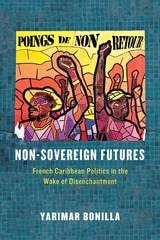
Non-Sovereign Futures
French Caribbean Politics in the Wake of DisenchantmentYarimar Bonilla
University of Chicago Press, 2015
Through a deep ethnography of Guadeloupean labor activism, Bonilla examines how Caribbean political actors navigate the conflicting norms and desires produced by the modernist project of postcolonial sovereignty. Exploring the political and historical imaginaries of activist communities, she examines their attempts to forge new visions for the future by reconfiguring narratives of the past, especially the histories of colonialism and slavery. Drawing from nearly a decade of ethnographic research, she shows that political participation—even in failed movements—has social impacts beyond simple material or economic gains. Ultimately, she uses the cases of Guadeloupe and the Caribbean at large to offer a more sophisticated conception of the possibilities of sovereignty in the postcolonial era.

Nonreligious Lifeworlds in Egypt
Sense-Making, Emotion, and EmbodimentKarin van Nieuwkerk
University of Texas Press, 2026
An analysis of the growing visibility of nonreligion in Egypt.
Egypt's 2011 Uprising, while often perceived as a failed revolution, nonetheless nonetheless had durable social effects. Among these has been a rise in expressing atheism and agnosticism, especially among educated and affluent youth—the country’s future leaders.
An intimate ethnography, Nonreligious Lifeworlds in Egypt explores the intellectual and emotional transformations of atheists and agnostics inspired by the aspirational freedom-seeking of the Arab Spring. Rejecting both of Egypt’s dominant religious traditions, Islam and Coptic Christianity, nonreligious people are widely viewed as agents of moral outrage. Amid media-driven panics, their sanity is often questioned by their own families as they experiment with new ways of living and relating. Drawing from in-depth fieldwork, interviews, and social media analysis, Karin van Nieuwkerk reveals her interlocutors’ changing perspectives on sex and gender, eating and drinking, and life and death. Above all, she emphasizes the affective experiences of renouncing religion, marked by anxiety and regret—but also liberation and relief. With rigor and compassion, Van Nieuwkerk opens our minds to the arduous process of exchanging established norms for self-determination.
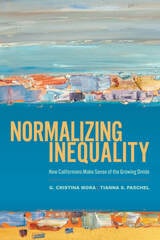
Normalizing Inequality
How Californians Make Sense of the Growing DivideG. Cristina Mora
Russell Sage Foundation, 2026
California has long been mythologized as the quintessential land of opportunity and reinvention—a place where anyone, regardless of origin, can forge a new life and realize their aspirations. Yet beneath this gilded narrative lies a starker reality: California ranks among the most unequal states in one of the world's most unequal countries, where the middle class finds itself increasingly squeezed. Economic inequality is not an anomaly but part of a broader global phenomenon, as disparities deepen across the world. While we know a lot about its contours, its evolution over time and its intersections with race and immigration, we understand far less about how ordinary people interpret and internalize it. In Normalizing Inequality, sociologists G. Cristina Mora and Tianna S. Paschel illuminate how middle-class Californians perceive and come to accept the inequalities that surround them.
Drawing on extensive interviews and surveys, Mora and Paschel uncover a profound paradox at the heart of middle-class consciousness. They find that Californians are keenly aware of the systemic causes of inequality—they recognize policies engineered to benefit the wealthy, they acknowledge how structural racism makes it hard for some groups to get ahead—yet they consistently minimize these forces. Instead, they gravitate toward explanations rooted in individualism, moral character, and the idea that things are worse in other places. Racism and racial inequality in California become palatable when framed as "not as bad as the South." Immigrant exploitation, however severe, transforms into evidence of the American Dream fulfilled simply upon arrival. Economic pressures that displace others become surmountable through personal industriousness and forbearance.
These beliefs about inequality grow more troubling still. Middle-class Californians sometimes blame disempowered people for their circumstances—acknowledging structural barriers facing homeless and undocumented populations while simultaneously faulting them for insufficient drive or criminal behavior that compounds their difficulties. When contemplating California's future, interviewees envision economic prosperity propelled by technological innovation, yet remain curiously unconcerned with how present inequalities might shape that tomorrow. Their imagined future is one where White and Asian American populations thrive, while Black, Latino, and economically marginalized Californians either vanish through displacement or fade into irrelevance. As respondents use these interpretive frameworks to make sense of inequality, they lean heavily on California's foundational narratives of opportunity, sanctuary and multiracial promise.
Normalizing Inequality offers an incisive examination of how ordinary citizens make sense of inequality and, through that very process of sense-making, how they tolerate and passively reproduce the conditions they often claim to deplore.
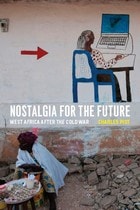
Nostalgia for the Future
West Africa after the Cold WarCharles Piot
University of Chicago Press, 2010
Since the end of the cold war, Africa has seen a dramatic rise in new political and religious phenomena, including an eviscerated privatized state, neoliberal NGOs, Pentecostalism, a resurgence in accusations of witchcraft, a culture of scamming and fraud, and, in some countries, a nearly universal wish to emigrate. Drawing on fieldwork in Togo, Charles Piot suggests that a new biopolitics after state sovereignty is remaking the face of one of the world’s poorest regions.
In a country where playing the U.S. Department of State’s green card lottery is a national pastime and the preponderance of cybercafés and Western Union branches signals a widespread desire to connect to the rest of the world, Nostalgia for the Future makes clear that the cultural and political terrain that underlies postcolonial theory has shifted. In order to map out this new terrain, Piot enters into critical dialogue with a host of important theorists, including Agamben, Hardt and Negri, Deleuze, and Mbembe. The result is a deft interweaving of rich observations of Togolese life with profound insights into the new, globalized world in which that life takes place.
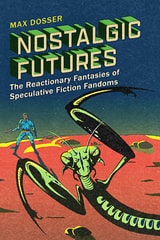
Nostalgic Futures
The Reactionary Fantasies of Speculative Fiction FandomsMax Dosser
Rutgers University Press, 2026
Speculative fiction imagines impossible futures and alternative pasts, alien species and angelic monsters, technological marvels and magical solutions. In recent years, however, many in its fandoms have protested the inclusion of nonwhite, nonmale, and nonheterosexual characters as betrayals of their beloved media for the sake of “wokeness.” Nostalgic Futures: The Reactionary Fantasies of Speculative Fiction Fandoms examines how contemporary fan controversies— particularly those surrounding gender, race, and sexuality in speculative fiction media—intersect with reactionary movements within and beyond fandom. This book explores how the nostalgic fantasies of fans and far-right movements contribute to broader reactionary discourses, shaping not only the past they long for but the future they fear. From the Hugo Awards and PuppyGate to Star Wars’ #NotMyJedi to Mass Effect and The Last of Us boycotts, Nostalgic Futures reveals how speculative fiction fandom has become a site of contestation over our visions of the past, present, and future.
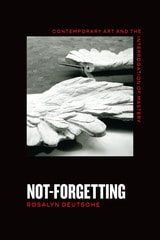
Not-Forgetting
Contemporary Art and the Interrogation of MasteryRosalyn Deutsche
University of Chicago Press, 2022
Amid times of emboldened cruelty and perpetual war, Rosalyn Deutsche links contemporary art to three practices that counter the prevailing destructiveness: psychoanalytic feminism, radical democracy, and war resistance. Deutsche considers how art joins these radical practices to challenge desires for mastery and dominion, which are encapsulated in the Eurocentric conception of the human that goes under the name “Man” and is driven by deadly inclinations that Deutsche calls masculinist. The masculinist subject—as an individual or a group—universalizes itself, claims to speak on behalf of humanity, and meets differences with conquest.
Analyzing artworks by Christopher D’Arcangelo, Robert Filliou, Hans Haacke, Mary Kelly, Silvia Kolbowski, Barbara Kruger, Louise Lawler, Martha Rosler, James Welling, and Krzysztof Wodiczko, Deutsche illuminates the diverse ways in which they expose, question, and trouble the visual fantasies that express masculinist desire. Undermining the mastering subject, these artworks invite viewers to question the positions they assume in relation to others. Together, the essays in Not-Forgetting, written between 1999 and 2020, argue that this art offers a unique contribution to building a less cruel and violent society.
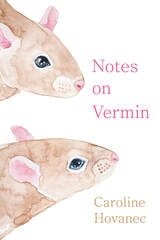
Notes on Vermin
Caroline Hovanec
University of Michigan Press, 2025
Notes on Vermin is an atlas of the literary vermin that appear in modern and contemporary literature, from Franz Kafka’s gigantic insect to Richard Wright’s city rats to Namwali Serpell’s storytelling mosquitoes. As parasites, trespassers, and collectives, vermin animals prove useful to writers who seek to represent life in the margins of power. Drawing on psychoanalysis, cultural studies, eco-Marxism, and biopolitics, this book explores four uses for literary vermin: as figures for the repressed thought, the uncommitted fugitive, the freeloading parasite, and the surplus life. In a series of short, accessible, interlinked essays, Notes on Vermin explores what animal pests can show us about our cultures, our environments, and ourselves.
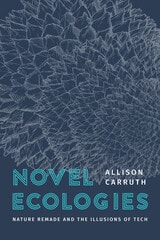
Novel Ecologies
Nature Remade and the Illusions of TechAllison Carruth
University of Chicago Press, 2025
Allison Carruth’s Novel Ecologies shows how the tech industry has taken up the wilderness mythologies that shaped one strain of American environmentalism over the last century. Calling this twenty-first-century environmental imagination Nature Remade, Carruth describes a distinctly West Coast framework that is at once nostalgic and futuristic. Through three case studies (synthetic wildlife, the digital cloud, and space colonization), the book shows Nature Remade to be a quasi-religious belief in venture capitalism and big tech. This paradigm thus imagines a future in which species, ecosystems, and entire planets are re-generated and re-created through engineering.
Novel Ecologies challenges the conviction that climate change and other environmental crises must be met with ever larger-scale forms of technological intervention. Against the new worlds conjured by Google, Meta, Open AI, Amazon, SpaceX, and a host of lesser-known start-ups, Carruth marshals writers and artists who imagine provisionally hopeful environmental futures while refusing to forget the histories that have made the world what it is. On this track of the book, Carruth discusses the works of Octavia Butler, Becky Chambers, Jennifer Egan, Ruth Ozeki, Craig Santos Perez, Tracy K. Smith, Jeff VanderMeer, Saya Woolfalk, and many more. Their novels, poems, installation artworks, and expressive media offer a speculative world built on livable communities rather than engineered lifeforms.
Novel Subjects
Authorship as Radical Self-Care in Multiethnic American NarrativesLeah A. Milne
University of Iowa Press, 2021
In Novel Subjects, Leah Milne offers a new way to look at multicultural literature by focusing on scenes of writing in contemporary works by authors with marginalized identities. These scenes, she argues, establish authorship as a form of radical self-care—a term we owe to Audre Lorde, who defines self-care as self-preservation and “an act of political warfare.”
In engaging in this battle, the works discussed in this study confront limitations on ethnicity and nationality wrought by the institutionalization of multiculturalism. They also focus on identities whose mere presence on the cultural landscape is often perceived as vindictive or willful. Analyzing recent texts by Carmen Maria Machado, Louise Erdrich, Ruth Ozeki, Toni Morrison, and more, Milne connects works across cultures and nationalities in search of reasons for this recent trend of depicting writers as characters in multicultural texts. Her exploration uncovers fiction that embrace unacceptable or marginalized modes of storytelling—such as plagiarism, historical revisions, jokes, and lies—as well as inauthentic, invisible, and unexceptional subjects. These works ultimately reveal a shared goal of expanding the borders of belonging in ethnic and cultural groups, and thus add to the ever-evolving conversations surrounding both multicultural literature and self-care.
Novels by Aliens
Weird Tales and the Twenty-First CenturyKate Marshall
University of Chicago Press, 2023
Twenty-first-century fiction and theory have taken a decidedly weird turn. They both show a marked interest in the nonhuman and in the preternatural moods that the nonhuman often evokes. Writers of fiction and criticism are avidly experimenting with strange, even alien perspectives and protagonists. Kate Marshall’s Novels by Aliens explores this development broadly while focusing on problems of genre fiction. She identifies three key generic hybrids that harness a longing for the nonhuman: the old weird, an alternative tradition within naturalism and modernism for the twenty-first century’s cowboys and aliens; cosmic realism, the reach for words legible only from space in otherwise terrestrial narratives; and pseudoscience fiction, which imagines speculative futures beyond human life on earth. Offering sharp and surprising insights about a breathtaking range of authors, from Edgar Rice Burroughs to Kazuo Ishiguro, Willa Cather to Maggie Nelson, Novels by Aliens tells the story of how genre became mood in the twenty-first century.