Results by title
196 books match the query 'Activism & Social Justice' and 4 start with n
Next to Godliness
Confronting Dirt and Despair in Progressive Era New York CityDaniel Burnstein
University of Illinois Press, 2010
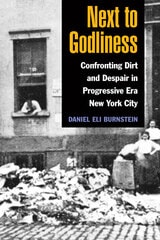
To many Progressive Era reformers, the extent of street cleanliness was an important gauge for determining whether a city was providing the conditions necessary for impoverished immigrants to attain a state of "decency"--a level of individual well-being and morality that would help ensure a healthy and orderly city. Daniel Eli Burnstein's study examines prominent street sanitation issues in Progressive Era New York City--ranging from garbage strikes to "juvenile cleaning leagues"--to explore how middle-class reformers amassed a cross-class and cross-ethnic base of support for social reform measures to a degree greater than in practically any other period of prosperity in U.S. history. The struggle for enhanced civic sanitation serves as a window for viewing Progressive Era social reformers' attitudes, particularly their emphasis on mutual obligations between the haves and have-nots, and their recognition of the role of negative social and physical conditions in influencing individual behaviors.
[more]
No One Ever Asked
The Untold Story of a Civil Rights WorkerArnold Rochvarg
University of Missouri Press, 2025
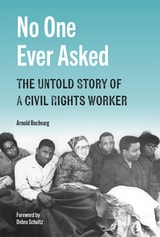
This engaging work by legal scholar Arnold Rochvarg presents a narrative history of the mid-1960s civil rights movement centered around the experiences of a white woman from Philadelphia, Pennsylvania, who quit college to join the movement and became involved with many of the important events and persons of the day.
Rochvarg, the cousin of the woman around whom the narrative revolves, had for over fifty years been intrigued by the mystery surrounding the seven-year disappearance of his cousin Iris during the 1960s. Once he finally approached her about her rumored involvement in the civil rights movement, she generously shared her experiences with him and arranged for him to meet others with whom she had worked. His book corroborates and enhances the stories he was told through traditional research based on primary and secondary sources.
More than a review of significant events of the mid-1960s, No One Ever Asked is also the story of the challenges and sacrifices of young civil rights workers both Black and white, young persons who not only faced violence and personal harm, but in many cases became estranged from their families because of their involvement in the movement. Rochvarg approaches history from the “bottom-up,” focusing on persons whose stories have never been told but have something to add to an understanding of the history of the movement. Many of them, even sixty years later, have never shared their stories because, as in the case of the central character of this book, no one ever asked them.
[more]
Nonviolence
An Idea Whose Time Has ComeRamin Jahanbegloo
Haus Publishing, 2023
A powerful book on the importance of committing to nonviolence.
In this compact book, Ramin Jahanbegloo argues that the time has come for humanity to renew its political, economic, and cultural commitment to the idea of nonviolence. At the core of the work of such towering fighters against oppression as Mahatma Gandhi, Martin Luther King Jr., Nelson Mandela, the Dalai Lama, and Václav Havel, the idea of nonviolence still has much to teach us and much work to do in the ongoing fight for justice worldwide.
In this compact book, Ramin Jahanbegloo argues that the time has come for humanity to renew its political, economic, and cultural commitment to the idea of nonviolence. At the core of the work of such towering fighters against oppression as Mahatma Gandhi, Martin Luther King Jr., Nelson Mandela, the Dalai Lama, and Václav Havel, the idea of nonviolence still has much to teach us and much work to do in the ongoing fight for justice worldwide.
[more]
Nuclear Nuevo México
Colonialism and the Effects of the Nuclear Industrial Complex on NuevomexicanosMyrriah Gómez
University of Arizona Press, 2022
In the 1940s military and scientific personnel chose the Pajarito Plateau to site Project Y of the secret Manhattan Project, where scientists developed the atomic bomb. Nuevomexicanas/os and Tewa people were forcibly dispossessed from their ranches and sacred land in north-central New Mexico with inequitable or no compensation.
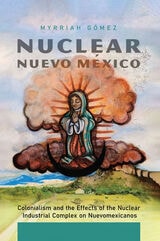
Contrary to previous works that suppress Nuevomexicana/o presence throughout U.S. nuclear history, Nuclear Nuevo México focuses on recovering the voices and stories that have been lost or ignored in the telling of this history. By recuperating these narratives, Myrriah Gómez tells a new story of New Mexico, one in which the nuclear history is not separate from the collective colonial history of Nuevo México but instead demonstrates how earlier eras of settler colonialism laid the foundation for nuclear colonialism in New Mexico.
Gómez examines the experiences of Nuevomexicanas/os who have been impacted by the nuclear industrial complex, both the weapons industry and the commercial industry. Gómez argues that Los Alamos was created as a racist project that targeted poor and working-class Nuevomexicana/o farming families, along with their Pueblo neighbors, to create a nuclear empire. The resulting imperialism has left a legacy of disease and distress throughout New Mexico that continues today.
[more]