Results by title
314 books match the query 'African' and 8 start with n

Naija Marxisms
Revolutionary Thought in NigeriaAdam Mayer
Pluto Press, 2016
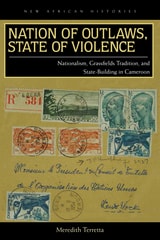
Nation of Outlaws, State of Violence
Nationalism, Grassfields Tradition, and State Building in CameroonMeredith Terretta
Ohio University Press, 2014
Nation of Outlaws, State of Violence is the first extensive history of Cameroonian nationalism to consider the global and local influences that shaped the movement within the French and British Cameroons and beyond. Drawing on the archives of the United Nations, France, Great Britain, Ghana, and Cameroon, as well as oral sources, Nation of Outlaws, State of Violence chronicles the spread of the Union des populations du Cameroun (UPC) nationalist movement from the late 1940s into the first postcolonial decade. It shows how, in the French and British Cameroon territories administered as UN Trusteeships after the Second World War, notions of international human rights, the promise of Third World independence, Pan-African federation, and national citizenship blended with local political and spiritual practices that resurfaced as the period of European rule came to a close. After French and British administrators banned the party in the mid-1950s, UPC nationalists adopted violence as a revolutionary strategy. In the 1960s, the nationalist vision disintegrated. The postcolonial regime labeled UPC nationalists “outlaws” and rounded them up for imprisonment or execution as the state shifted to single-party rule in 1966.
Nation of Outlaws, State of Violence traces the connection between local and transregional politics in the age of Africa’s decolonization and the early decades of the Cold War. Rather than stop at official independence as most conventional histories of African nationalist movements do, this book considers postindependence events as crucial to the history of Cameroonian nationalism and to an understanding of the postcolonial government that came to power on 1 January 1960. While the history of the UPC is a story that ends with the party’s failure to gain access to political power with independence, it is also a story of the postcolonial state’s failure to become a nation.
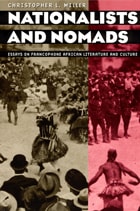
Nationalists and Nomads
Essays on Francophone African Literature and CultureChristopher L. Miller
University of Chicago Press, 1999
Miller ranges from the beginnings of francophone African literature—which he traces not to the 1930s Negritude movement but to the largely unknown, virulently radical writings of Africans in Paris in the 1920s—to the evolving relations between African literature and nationalism in the 1980s and 1990s. Throughout he aims to offset the contemporary emphasis on the postcolonial at the expense of the colonial, arguing that both are equally complex, with powerful ambiguities. Arguing against blanket advocacy of any one model (such as nationalism or hybridity) to explain these ambiguities, Miller instead seeks a form of thought that can read and recognize the realities of both identity and difference.
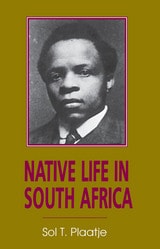
Native Life In South Africa
Before and Since the European War and the Boer RebellionSol T. Plaatje
Ohio University Press, 1991
First published in 1916 and one of South Africa’s great political books, Native Life in South Africa was first and foremost a response to the Native’s Land Act of 1913, and was written by one of the most gifted and influential writers and journalists of his generation. Sol T. Plaatje provides an account of the origins of this crucially important piece of legislation and a devastating description of its immediate effects.
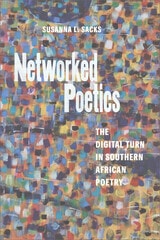
Networked Poetics
The Digital Turn in Southern African PoetrySusanna L. Sacks
University of Massachusetts Press, 2024
Winner of the 2025 MLA Scaglione Prize for African Studies
Simultaneously transnational and local, poetry in the twenty-first century is produced across digital networks, shaped through local communities, and evaluated on a global scale. It might start on social media, where a video of a poet circulates and goes viral, gaining international attention without ever going through traditional modes of publication. In Networked Poetics, Susanna L. Sacks introduces readers to the southern African poetry scene in Malawi, Zimbabwe, and South Africa, illustrating how contemporary poetry is shaped, from inception to canonization, by the influence of digital media publication.
Interweaving ethnographic observation and extensive literary analysis, Sacks demonstrates that, as more artists in Africa reach wider audiences through online publication, poetic form has shifted to reflect social media’s aesthetic norms of urgency, immediacy, and populism. These changes have, in turn, challenged elite processes of valuation, forcing literary institutions like prizes, festivals, and curricula to accommodate the digital turn.
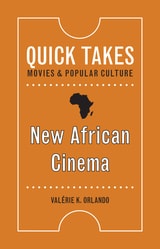
New African Cinema
Orlando, Valérie K
Rutgers University Press, 2017
Orlando illuminates the diverse themes evident in the works of filmmakers such as Ousmane Sembène’s Ceddo (Senegal, 1977), Sarah Maldoror’s Sambizanga (Angola, 1972), Assia Djebar’s La Nouba des femmes de Mont Chenoua (The Circle of women of Mount Chenoua, Algeria, 1978), Zézé Gamboa’s The Hero (Angola, 2004) and Abderrahmane Sissako’s Timbuktu (Mauritania, 2014), among others. Orlando also considers the influence of major African film schools and their traditions, as well as European and American influences on the marketing and distribution of African film. For those familiar with the polemics of African film, or new to them, Orlando offers a cogent analytical approach that is engaging.
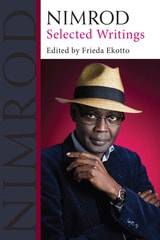
Nimrod
Selected WritingsFrieda Ekotto, editor
University of Michigan Press, 2018
The Chadian writer Nimrod—philosopher, poet, novelist, and essayist—is one of the most dynamic and vital voices in contemporary African literature and thought. Yet little of Nimrod’s writing has been translated into English until now. Introductory material by Frieda Ekotto provides context for Nimrod’s work and demonstrates the urgency of making it available beyond Francophone Africa to a broader global audience.
At the heart of this volume are Nimrod’s essays on Léopold Sédar Senghor, a key figure in the literary and aesthetic Négritude movement of the 1930s and president of Senegal from 1945 through 1980. Widely dismissed in recent decades as problematically essentialist, Senghorian Negritude articulated notions of “blackness” as a way of transcending deep divisions across a Black Diaspora under French colonial rule. Nimrod offers a nuanced reading of Senghor, drawing out the full complexities of Senghor’s philosophy and reevaluating how race and colonialism function in a French-speaking space.
Also included in this volume are Nimrod’s essays on literature from the 2008 collection, The New French Matter (La nouvelle chose française). Representing his prose fiction is his 2010 work, Rivers’ Gold (L’or des rivières). Also featured are some of Nimrod’s best-loved poems, in both English translation and the original French.
The works selected and translated for this volume showcase Nimrod’s versatility, his intellectual liveliness, and his exploration of questions of aesthetics in African literature, philosophy, and linguistics. Nimrod: Selected Writings marks a significant contribution toward engaging a broader audience with one of the vital voices of our time. This book will be essential reading for Anglophone students and scholars of African philosophy, literature, poetry, and critical theory, and will offer a welcome introduction to Nimrod for general readers of contemporary international writing.
Nomadic Voices of Exile
Feminine Identity in the Francophone Literature of the MaghrebValérie K. Orlando
Ohio University Press, 1999
Contemporary French writing on the Maghreb—that part of Africa above the Sahara—is truly postmodern in scope, the rich product of multifaceted histories promoting the blending of two worlds, two identities, two cultures, and two languages.
Nomadic Voices of Exile demonstrates how that postmodern sentiment has altered perceptions concerning Maghrebian feminine identity since the end of the French-colonial era. The authors discussed here, both those who reside in the Maghreb and those who have had to seek asylum in France, find themselves at the intersection of French and North African viewpoints, exposing a complicated world that must be negotiated and redefined.
In looking at the authors whose writings extend beyond a gender-based dialogue to include such issues as race, politics, religion, and history, Valérie Orlando explores the rich and changing landscape of the literature and the culture, addresses the stereotypes that have defined the past, and navigates the space of the exiled, a space previously at the peripheries of Western discourse.
Nomadic Voices of Exile will be useful to a variety of classrooms—women’s studies, Middle East studies, Francophone literature, Third World women writers—and to anyone interested in postcolonial and postmodern theory and philosophy and the history of the Maghreb through literature.