157 books match the query 'African Americans in literature' and 5 start with n
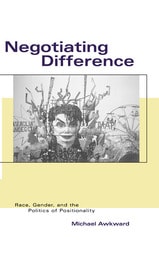
cover of Negotiating Difference: Race, Gender, and the Politics of Positionality

Negotiating Difference

Race, Gender, and the Politics of Positionality

Michael Awkward

University of Chicago Press, 1995

Encamped within the limits of experience and "authenticity," critics today often stake out their positions according to race and ethnicity, sexuality and gender, and vigilantly guard the boundaries against any incursions into their privileged territory. In this book, Michael Awkward raids the borders of contemporary criticism to show how debilitating such "protectionist" stances can be and how much might be gained by crossing our cultural boundaries.

From Spike Lee's She's Gotta Have It to Michael Jackson's physical transmutations, from Toni Morrison's Song of Solomon to August Wilson's Fences, from male scholars' investments in feminism to white scholars' in black texts—Awkward explores cultural moments that challenge the exclusive critical authority of race and gender. In each instance he confronts the question: What do artists, scholars, and others concerned with representations of Afro-American life make of the view that gender, race, and sexuality circumscribe their own and others' lives and narratives? Throughout he demonstrates the perils and merits of the sort of "boundary crossing" this book ultimately makes: a black male feminism.

In pursuing a black male feminist criticism, Awkward's study acknowledges the complexities of interpretation in an age when a variety of powerful discourses have proliferated on the subject of racial, gendered, and sexual difference; at the same time, it identifies this proliferation as an opportunity to negotiate seemingly fixed cultural and critical positions.
[more]
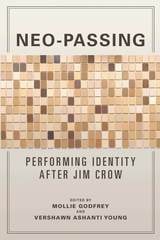
cover of Neo-Passing: Performing Identity after Jim Crow

Neo-Passing

Performing Identity after Jim Crow

Edited by Mollie Godfrey and Vershawn Ashanti Young: Foreword by Gayle Wald Afterword by Michele Elam

University of Illinois Press, 2018
African Americans once passed as whites to escape the pains of racism. Today's neo-passing has pushed the old idea of passing in extraordinary new directions. A white author uses an Asian pen name; heterosexuals live "out" as gay; and, irony of ironies, whites try to pass as black. Mollie Godfrey and Vershawn Ashanti Young present essays that explore practices, performances, and texts of neo-passing in our supposedly postracial moment. The authors move from the postracial imagery of Angry Black White Boy and the issues of sexual orientation and race in ZZ Packer's short fiction to the politics of Dave Chappelle's skits as a black President George W. Bush. Together, the works reveal that the questions raised by neo-passing—questions about performing and contesting identity in relation to social norms—remain as relevant today as in the past. Contributors: Derek Adams, Christopher M. Brown, Martha J. Cutter, Marcia Alesan Dawkins, Michele Elam, Alisha Gaines, Jennifer Glaser, Allyson Hobbs, Brandon J. Manning, Loran Marsan, Lara Narcisi, Eden Osucha, Gayle Wald, and Deborah Elizabeth Whaley
[more]
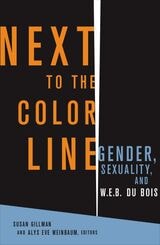
cover of Next to the Color Line: Gender, Sexuality, and W. E. B. Du Bois

Next to the Color Line

Gender, Sexuality, and W. E. B. Du Bois

Susan Gillman

University of Minnesota Press, 2007
Although W. E. B. Du Bois did not often pursue the connections between the “Negro question” that defined so much of his intellectual life and the “woman question” that engaged writers and feminist activists around him, Next to the Color Line argues that within Du Bois’s work is a politics of juxtaposition that connects race, gender, sexuality, and justice.This provocative collection investigates a set of political formulations and rhetorical strategies by which Du Bois approached, used, and repressed issues of gender and sexuality. The essays in Next to the Color Line propose a return to Du Bois, not only to reassess his politics but also to demonstrate his relevance for today’s scholarly and political concerns.Contributors: Hazel V. Carby, Yale U; Vilashini Cooppan, U of California, Santa Cruz; Brent Hayes Edwards, Rutgers U; Michele Elam, Stanford U; Roderick A. Ferguson, U of Minnesota; Joy James, Williams College; Fred Moten, U of Southern California; Shawn Michelle Smith, St. Louis U; Mason Stokes, Skidmore College; Claudia Tate, Princeton U; Paul C. Taylor, Temple U.Susan Gillman is professor of literature at the University of California, Santa Cruz. Alys Eve Weinbaum is associate professor of English at the University of Washington, Seattle.
[more]
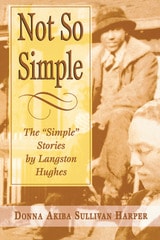
cover of Not So Simple: The "Simple" Stories by Langston Hughes

Not So Simple

The "Simple" Stories by Langston Hughes

Donna Akiba Sullivan Harper

University of Missouri Press, 1995

The "Simple" stories, Langston Hughes's satirical pieces featuring Harlem's Jesse B. Semple, have been lauded as Hughes's greatest contribution to American fiction.  In Not So Simple, Donna Akiba Sullivan Harper provides the first full historical analysis of the Simple stories.

Harper traces the evolution and development of Simple from his 1943 appearance in Hughes's weekly Chicago Defender column through his 1965 farewell in the New York Post. Drawing on correspondence and manuscripts of the stories, Harper explores the development of the Simple collections, from Simple Speaks His Mind (1950) to Simple's Uncle Sam (1965), providing fresh and provocative perspectives on both Hughes and the characters who populate his stories.

Harper discusses the nature of Simple, Harlem's "everyman", and the way in which Hughes used his character both to teach fellow Harlem residents about their connection to world events and to give black literature a hero whose "day-after-day heroism" would exemplify greatness. She explores the psychological, sociological, and literary meanings behind the Simple stories, and suggests ways in which the stories illustrate lessons of American history and political science. She also examines the roles played by women in these humorously ironic fictions. Ultimately, Hughes's attitudes as an author are measured against the views of other prominent African American writers.

Demonstrating the richness and complexity of this Langston Hughes character and the Harlem he inhabited. Not So Simple makes an important contribution to the study of American literature.


[more]
cover of Novel Bondage: Slavery, Marriage, and Freedom in Nineteenth-Century America

Novel Bondage

Slavery, Marriage, and Freedom in Nineteenth-Century America

Tess Chakkalakal

University of Illinois Press, 2013

Novel Bondage unravels the interconnections between marriage, slavery, and freedom through renewed readings of canonical nineteenth-century novels and short stories by black and white authors. Situating close readings of fiction alongside archival material concerning the actual marriages of authors such as Lydia Maria Child, Harriet Beecher Stowe, William Wells Brown, and Frank J. Webb, Chakkalakal examines how these early novels established literary conventions for describing the domestic lives of American slaves in describing their aspirations for personal and civic freedom. Exploring this theme in post-Civil War works by Frances E.W. Harper and Charles Chesnutt, she further reveals how the slave-marriage plot served as a fictional model for reforming marriage laws. Chakkalakal invites readers to rethink the "marital work" of nineteenth-century fiction and the historical role it played in shaping our understanding of the literary and political meaning of marriage, then and now.
[more]