Results by title
402 books match the query 'American poetry' and 4 start with n

Native Voices
Indigenous American Poetry, Craft, and ConversationsEdited by CMarie Fuhrman and Dean Rader
Tupelo Press, 2019
“I write from a continuous space of erasure. Poetry was the one way that I was able to hold onto…my history, geography, and language.” — Craig Santos Perez, contributor
In this groundbreaking anthology of Indigenous poetry and prose, Native poems, stories, and essays are informed with a knowledge of both what has been lost and what is being restored. It offers a diverse collection of stories told by Indigenous writers about themselves, their histories, and their present. It is a celebration of culture and the possibilities of language.
Featuring forty-four poets, including Ishmael Hope, Bojan Louis, Ruby Murray, Simon Ortiz, Leslie Marmon Silko, Luci Tapahonso, Joy Harjo, dg okpik, Sherwin Bitsui, Heid E. Erdrich, Layli Long Soldier, and Orlando White.
Original influence essays by Diane Glancy on Lorca, Chrystos on Audre Lorde, Louise Erdrich on Elizabeth Bishop, LeAnne Howe on W. D. Snodgrass, Allison Hedge Coke on Delmore Schwartz, Suzanne Rancourt on Ai, and M. L. Smoker on Richard Hugo, among others.
And, a selection of resonant work chosen from previous generations of Native artists.
“There really is no better anthology out there that collects indigenous poets publishing from 1960 to the present.” — Dean Rader, co-editor
[more]
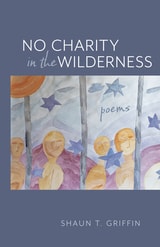
No Charity in the Wilderness
PoemsShaun T. Griffin
University of Nevada Press, 2024
No Charity in the Wilderness is a long journey into the new American West. From the southern border to the isolating two-lane highways in the desert, this collection is a prayer of reconciliation with so much that troubles us—those who live without resources or voices—and their possible future in this ever-changing landscape of desire.
Griffin has spent many decades in the high desert trying to find the way forward—when what he knows has been challenged and still there is breath on the horizon. One day an ancient Chinese poet comes to visit: "Snow deepens/ to quiet what I once believed, and Wang Wei stoops from the spine:/ this is how you become silence." Even if you doubt the old poet's counsel, like Griffin, you want to journey with him into the wilderness.
Griffin has spent many decades in the high desert trying to find the way forward—when what he knows has been challenged and still there is breath on the horizon. One day an ancient Chinese poet comes to visit: "Snow deepens/ to quiet what I once believed, and Wang Wei stoops from the spine:/ this is how you become silence." Even if you doubt the old poet's counsel, like Griffin, you want to journey with him into the wilderness.
[more]
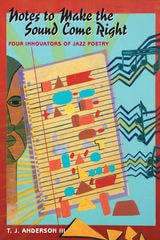
Notes to Make the Sound Come Right
Four Innovators of Jazz PoetryT.J. Anderson III
University of Arkansas Press, 2004
In “When Malindy Sings” the great African American poet Paul Laurence Dunbar writes about the power of African American music, the “notes to make the sound come right.” In this book T. J. Anderson III, son of the brilliant composer, Thomas Anderson Jr., asserts that jazz became in the twentieth century not only a way of revising old musical forms, such as the spiritual and work song, but also a way of examining the African American social and cultural experience. He traces the growing history of jazz poetry and examines the work of four innovative and critically acclaimed African American poets whose work is informed by a jazz aesthetic: Stephen Jonas (1925?–1970) and the unjustly overlooked Bob Kaufman (1925–1986), who have affinities with Beat poetry; Jayne Cortez (1936– ), whose work is rooted in surrealism; and the difficult and demanding Nathaniel Mackey (1947– ), who has links to the language writers. Each fashioned a significant and vibrant body of work that employs several of the key elements of jazz. Anderson shows that through their use of complex musical and narrative weaves these poets incorporate both the tonal and performative structures of jazz and create work that articulates the African journey. From improvisation to polyrhythm, they crafted a unique poetics that expresses a profound debt to African American culture, one that highlights the crucial connection between music and literary production and links them to such contemporary writers as Michael Harper, Amiri Baraka, and Yusef Komunyakaa, as well as young recording artists—United Future Organization, Us3, and Groove Collection—who have successfully merged hip-hop poetry and jazz.
[more]
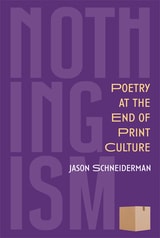
Nothingism
Poetry at the End of Print CultureJason Schneiderman
University of Michigan Press, 2025
What is the internet doing to poetry? Good question! In Nothingism, Jason Schneiderman grapples with the way that digital culture has begun to reshape America’s poetry landscape, examining this profound shift in the way that poetry is written, read, and taught. He dives into the history of the poetic line and how previous media (oral, manuscript, print) have shaped our understanding of exactly what a poem is. In considering the transformations of poetry in the digital age, he finds that the transition from print to digital culture mirrors the earlier transition from manuscript to print culture.
In this collection, the essays range from blistering manifesto to deep historical dives to gentle classroom guidance to considerations of the poems of James Merrill and Agha Shahid Ali, moving between the theoretical and the practical. Nothingism is both deeply personal and highly erudite, providing an engaging and scholarly account of reading, writing, and teaching poetry as our world continues its unsupervised lurch toward digital culture.
In this collection, the essays range from blistering manifesto to deep historical dives to gentle classroom guidance to considerations of the poems of James Merrill and Agha Shahid Ali, moving between the theoretical and the practical. Nothingism is both deeply personal and highly erudite, providing an engaging and scholarly account of reading, writing, and teaching poetry as our world continues its unsupervised lurch toward digital culture.
[more]