Results by title
234 books match the query 'Americas (North, Central, South, West Indies)' and 7 start with n

Natural Born Celebrities
Serial Killers in American CultureDavid Schmid
University of Chicago Press, 2005
David Schmid provides a historical account of how serial killers became famous and how that fame has been used in popular media and the corridors of the FBI alike. Ranging from H. H. Holmes, whose killing spree during the 1893 Chicago World's Fair inspired The Devil in the White City, right up to Aileen Wuornos, the lesbian prostitute whose vicious murder of seven men would serve as the basis for the hit film Monster, Schmid unveils a new understanding of serial killers by emphasizing both the social dimensions of their crimes and their susceptibility to multiple interpretations and uses. He also explores why serial killers have become endemic in popular culture, from their depiction in The Silence of the Lambs and The X-Files to their becoming the stuff of trading cards and even Web sites where you can buy their hair and nail clippings.
Bringing his fascinating history right up to the present, Schmid ultimately argues that America needs the perversely familiar figure of the serial killer now more than ever to manage the fear posed by Osama bin Laden since September 11.
Natural Rebels
A Social History of Enslaved Women in BarbadosHilary McD Beckles
Rutgers University Press, 2012
Beckles details the daily lives of slave women in conditions of extreme exploitation. They suffered from harsh conditions, cruel punishments, malnutrition, disease, high mortality, and fear of abandonment when they were too old to work. He described the various categories and responsibilities of slaves, and the roles of children in the slave economy. Beckles looks at family structures and the complexities of interracial unions. He also shows how female slaves regularly resisted slavery, using both violent and nonviolent means. They never accommodated themselves to the system; as natural rebels, they fought in any way they could for survival.
Natural Rebels
A Social History of Enslaved Women in BarbadosBeckles, Hilary
Rutgers University Press, 1990
Beckles details the daily lives of slave women in conditions of extreme exploitation. They suffered from harsh conditions, cruel punishments, malnutrition, disease, high mortality, and fear of abandonment when they were too old to work. He described the various categories and responsibilities of slaves, and the roles of children in the slave economy. Beckles looks at family structures and the complexities of interracial unions. He also shows how female slaves regularly resisted slavery, using both violent and nonviolent means. They never accommodated themselves to the system; as natural rebels, they fought in any way they could for survival.
Natural Visions
The Power of Images in American Environmental ReformFinis Dunaway
University of Chicago Press, 2005
In Natural Visions, Finis Dunaway tells the story of how visual imagery—such as wilderness photographs, New Deal documentary films, and Sierra Club coffee-table books—shaped modern perceptions of the natural world. By examining the relationship between the camera and environmental politics through detailed studies of key artists and activists, Dunaway captures the emotional and spiritual meaning that became associated with the American landscape. Throughout the book, he reveals how photographers and filmmakers adapted longstanding traditions in American culture—the Puritan jeremiad, the romantic sublime, and the frontier myth—to literally picture nature as a place of grace for the individual and the nation.
Beautifully illustrated with photographs by Ansel Adams, Eliot Porter, and a host of other artists, Natural Visions will appeal to a wide range of readers interested in American cultural history, the visual arts, and environmentalism.
New Jersey Cemeteries and Tombstones
History in the LandscapeVeit, Richard F
Rutgers University Press, 2008
From the earliest memorials used by Native Americans to the elaborate structures of the present day, Richard Veit and Mark Nonestied use grave markers to take an off-beat look at New Jersey’s history that is both fascinating and unique.
New Jersey Cemeteries and Tombstones presents a culturally diverse account of New Jersey’s historic burial places from High Point to Cape May and from the banks of the Delaware to the ocean-washed Shore, to explain what cemeteries tell us about people and the communities in which they lived. The evidence ranges from somber seventeenth-century decorations such as hourglasses and skulls that denoted the brevity of colonial life, to modern times where memorials, such as a life-size granite Mercedes Benz, reflect the materialism of the new millennium. Also considered are contemporary novelties such as pet cemeteries and what they reveal about today’s culture. To tell their story the authors visited more than 1,000 burial grounds and interviewed numerous monument dealers and cemetarians.
This richly illustrated book is essential reading for history buffs and indeed anyone who has ever wandered inquisitively through their local cemeteries.
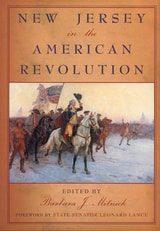
New Jersey in the American Revolution
Mitnick, Barbara J
Rutgers University Press, 2005
Barbara J. Mitnick has edited a remarkably comprehensive anthology, bringing new life to the rich and turbulent late eighteenth-century period in New Jersey. Originally conceived as a legacy of the state's 225th Anniversary of the Revolution Celebration Commission and sponsored by the Washington Association of New Jersey, the volume brings together contributions by twelve outstanding and recognized experts on New Jersey history.
Chapters explore topics including New Jersey as the "Crossroads of the Revolution," important military campaigns, the 1776 Constitution, and the significant contribution of blacks, Native Americans, and women. Reflecting the contemporary view that the war's impact extended beyond military engagements, original essays also discuss the fine and decorative arts, literature, architecture, archaeology, and social and economic conditions. The reader is presented with a picture of life in New Jersey both separate from as well as connected to the fight for American independence and the establishment of the nation.
Fresh and significant observations, including the fact that soldiers fought 238 battles on New Jersey soil (more than any other state) and that the social and political changes resulting from the war were more revolutionary than evolutionary make this accessibly written, beautifully illustrated volume appeal to the lay reader as well as scholars of New Jersey and Revolutionary War history.
No Place of Grace
Antimodernism and the Transformation of American Culture, 1880–1920T. J. Jackson Lears
University of Chicago Press, 1994
"It's an understatement to call No Place of Grace a brilliant book. . . . It's the first clear sign I've seen that my generation, after marching through the '60s and jogging through the '70s might be pausing to examine what we've learned, and to teach it."—Walter Kendrick, Village Voice
"One can justly make the claim that No Place of Grace restores and reinterprets a crucial part of American history. Lears's method is impeccable."—Ann Douglas, The Nation