Results by title
855 books match the query 'Architecture' and 19 start with n
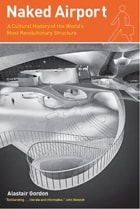
Naked Airport
A Cultural History of the World's Most Revolutionary StructureAlastair Gordon
University of Chicago Press, 2008
From global politics to action movies to the daily commute, Gordon shows how the airport has changed our sense of time, distance, and style, and ultimately the way cities are built and business is done. He introduces the people who shaped and were shaped by this place of sudden transition: pilots like Charles Lindbergh, architects like Le Corbusier, and political figures like Fiorello LaGuardia and Adolf Hitler. Naked Airport is a profoundly original history of a long-neglected yet central component of modern life.
“This charming history documents why airports have always been such intriguing places. Gordon wittily deconstructs air terminal architecture. . . . Here is a book with more than enough quirky details to last a long layover.”—People
“[A] splendid cultural history.”—Atlantic Monthly
“Gordon, an architecture and design critic, tells his story well, bringing to life some of the main characters and highlighting some of the important issues concerning urbanism and airports.”—Michael Roth, San Francisco Chronicle
“Gordon provides a truly compelling account of how airports had over the course of three-quarters of a century become the locus of not only modern dreams but postmodern nightmares as well. Don’t leave home without it.”—Terence Riley, director of the Miami Art Museum

Narrating the City
Mediated Representations of Architecture, Urban Forms and Social LifeEdited by Aysegül Akçay Kavakoglu, Türkan Nihan Haciömeroglu, and Lisa Landrum
Intellect Books, 2020
An analysis of the ways film and media create topographies of cities, architecture, and metropolitan experiences.
Narrating the City examines how film and related visual media offer insights and commentary on the city as both a constructed object and a lived social experience. It brings together filmmakers, architects, digital artists, designers, and media journalists who critically read, reinterpret, and create narratives of the city. Analyzing a variety of international films and placing them in dialogue with video art, photographic narratives, and emerging digital image-based technologies, the authors explore the expanding range of “mediated” narratives of contemporary architecture and urban culture from both a media and a sociological standpoint.
The authors explore how moving-image narratives can create cinematic topographies, presenting familiar cities and modes of seeing in unfamiliar ways. The authors then turn to the new age of digital image making and consumption, revealing new techniques of representation, mediation, and augmentation of sensorial reality for city dwellers. The book’s emphasis on narrative also offers insights into critical societal issues including cultural identity, diversity, memory, and spatial politics, as they are both informed by and represented in various media.
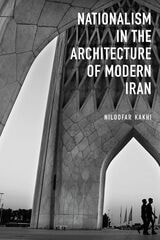
Nationalism in Architecture of Modern Iran
Niloofar Kakhi
Gingko, 2023
Nationalism in Architecture of Modern Iran is the first comprehensive book on modern architecture in Iran to be published in English. It addresses the relationship between nationalism and architecture in Iran and discusses the role Western architects played in the development of modern architecture in the country while introducing some of the most significant and recent projects in Iran. It investigates what it means to design a building that bears an Iranian or Islamic-Iranian identity and how to construct a conceptual platform for critically assessing representations of national identity in contemporary architecture. This book will directly help practicing architects and policymakers of the built environment, especially in Iran, as well as give a comprehensive understanding of the modern history of architecture in Iran to art historians and a broader audience. It introduces some of the most significant and recent projects in Iran for the first time.
Navajo Architecture
Forms, History, DistributionsStephen C. Jett and Virginia E. Spencer
University of Arizona Press, 1981
Stephen C. Jett and Virginia E. Spencer have devoted years of fieldwork to studying the origin, evolution, and construction of Navajo buildings: not only hogans, houses, and summer dwellings, but also numerous other structures related to activities such as food preparation, hunting, sweat-bathing, and funerary observation. In addition, they have defined the geographic distribution of dwelling forms to reveal both utilization of local resources and local differences in degree of acculturation.
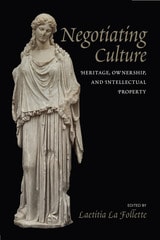
Negotiating Culture
Heritage, Ownership, and Intellectual PropertyLaetitia La Follette
University of Massachusetts Press, 2013
This provocative collection of essays—a series of case studies in cultural ownership by scholars from a range of fields—explores issues of cultural heritage and intellectual property in a variety of contexts, from contests over tangible artifacts as well as more abstract forms of culture such as language and oral traditions to current studies of DNA and genes that combine nature and culture, and even new, nonproprietary models for the sharing of digital technologies. Each chapter sets the debate in its historical and disciplinary context and suggests how the approaches to these issues are changing or should change.
One of the most innovative aspects of the volume is the way each author recognizes the social dimensions of group ownership and demonstrates the need for negotiation and new models. The collection as a whole thus challenges the reader to reevaluate traditional ways of thinking about cultural ownership and to examine the broader social contexts within which negotiation over the ownership of culture is taking place.
In addition to Laetitia La Follette, contributors include David Bollier, Stephen Clingman, Susan DiGiacomo, Oriol Pi-Sunyer, Margaret Speas, Banu Subramaniam, Joe Watkins, and H. Martin Wobst.
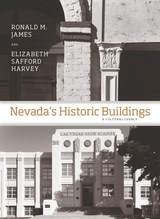
Nevada's Historic Buildings
A Cultural LegacyRonald M. James
University of Nevada Press, 2009
Nevada’s Historic Buildings highlights ninety of these buildings, describing them in the context of the state’s history and the character of the people who created and used them. Here are reminders of mining boomtowns, historic ranches, transportation, the divorce and gaming industries, the New Deal, and the innovation of Las Vegas’s post-modern aesthetic. These buildings provide a cross-section of Nevada’s rich historic and cultural heritage and their survival offers everyone the experience of touching the past.
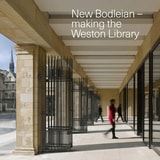
New Bodleian
Making the Weston LibraryEdited by the Bodleian Library
Bodleian Library Publishing, 2015
New Bodleian: The Making of the Weston Library tells the story of how the plans for the new Weston Library—as the New Bodleian is now known—were realized, describing in detail the architectural, academic, curatorial, and heritage considerations addressed, as well as the successful collaborations between clients and consultants. Among the updates introduced were enhanced public access, including new entrance spaces; redesigned reading rooms for the study of special collections; new teaching facilities; and state-of-the-art storage space for the library’s many treasures. With over one hundred color illustrations, the book sheds light on the challenges of meeting the needs of an internationally renowned, four-hundred-year-old institution in the twenty-first century.
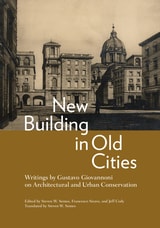
New Building in Old Cities
Writings by Gustavo Giovannoni on Architectural and Urban ConservationGustavo Giovannoni
J. Paul Getty Trust, The, 2024
The Italian architect, historian, and restorer Gustavo Giovannoni (1873–1947) was a key figure in the fields of architecture, urbanism, and conservation during the first half of the twentieth century. A traditionalist largely neglected by the proponents of modernist architecture following World War II, he remains little known internationally. His writings, however, until now unavailable in English, represent a significant step toward the full appreciation of the historic city and are directly relevant today to the protection of urban historic resources worldwide.
This abundantly illustrated critical anthology is a representative sample of Giovannoni’s seminal texts related to the appreciation, understanding, and planning of historic cities. The thirty readings, which appear with their original illustrations, are grouped into six parts organized around key concepts in Giovannoni’s conservation theory—urban building, respect for the setting or context, a thinning out of the urban fabric, conservation and restoration treatments, the grafting of the new upon the old, and reconstruction. Each part is preceded by an introduction, and each reading is prefaced by succinct remarks explaining the rationale for its selection and the principal matters covered. Six plate sections further illustrate the readings’ main concepts and themes.
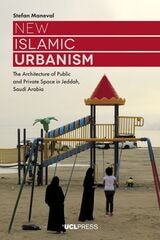
New Islamic Urbanism
The Architecture of Public and Private Space in Jeddah, Saudi ArabiaStefan Maneval
University College London, 2019
Combining Michael Warner’s concepts of publics and counterpublics with theories of space and sociological approaches to architecture, Stefan Maneval explores the concept of New Islamic Urbanism in Saudi Arabia, arguing that this architectural trend, which is characterized by an emphasis on privacy protection through high enclosures, gates, blinds, and tinted windows, constitutes for some an important element of piety. At the same time, it enables different conceptions of privacy, banned social practices, as well as the formation of publics and counterpublics.
Based on rich ethnographic data collected by the author, New Islamic Urbanism challenges normative assumptions on gender segregation in Muslim societies and provides a nuanced account of the meaning of publicness and privacy in Muslim contexts in general. It will be of particular interest to an academic readership in Middle East and Islamic studies, as well as in architecture, urban planning and anthropology.
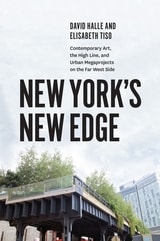
New York's New Edge
Contemporary Art, the High Line, and Urban Megaprojects on the Far West SideDavid Halle and Elisabeth Tiso
University of Chicago Press, 2014
David Halle and Elisabeth Tiso offer a deep analysis of the transforming district in New York’s New Edge, and the result is a new understanding of how we perceive and interpret culture and the city in New York’s gallery district. From individual interviews with gallery owners to the behind-the-scenes politics of preservation initiatives and megaprojects, the book provides an in-depth account of the developments, obstacles, successes, and failures of the area and the factors that have contributed to them.
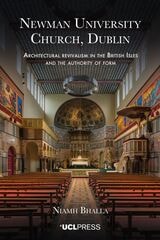
Newman University Church, Dublin
Architectural Revivalism in the British Isles and the Authority of FormNiamh Bhalla
University College London, 2024
Newman University Church, Dublin charts the first ever analysis of University Church’s significance within the history of Victorian revivalist architecture. Author Niamh Bhalla explores the relationship between the church’s context as the first Catholic university in Ireland and the ambiguity of its “early Christian” style, providing an effective lens to understand the architectural revivalism of the nineteenth century, particularly basilican and Byzantine revivalist architectures in the British Isles.
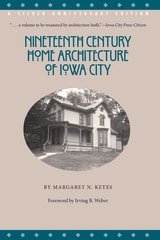
Nineteenth Century Home Architecture of Iowa City
A Silver Anniversary EditionMargaret N. Keyes
University of Iowa Press, 1993
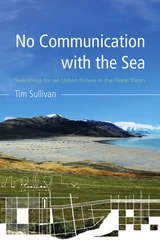
No Communication with the Sea
Searching for an Urban Future in the Great BasinTim Sullivan
University of Arizona Press, 2010
No Communication with the Sea is a journey through this urbanizing Great Basin landscape. Here, the land fosters illusions of limitless space and resources, but its space and resources are severely limited; its people live clustered in cities but are often reluctant to embrace urbanity. These tensions led journalist and urban planner Tim Sullivan to explore the developing centers and edges of the Great Basin cities and the ways some are trying to build livable and sustainable urban environments.
In this highly readable book of creative nonfiction, Sullivan employs a variety of methods—including interviews, research, travelogues, and narrative—to survey the harsh landscape for clues to the ways cities can adapt to their geography, topography, ecology, hydrography, history, and culture. No Communication with the Sea embarks on a quest for a livable future for the heart of the interior West. In the process, it both unearths the past and ponders the present and future Great Basin cities.
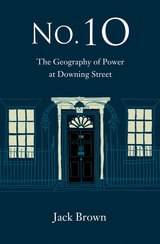
No. 10
The Geography of Power at Downing StreetJack Brown
Haus Publishing, 2019
Written by Number 10’s first ever ‘Researcher in Residence,’ with unprecedented access to people and papers, No. 10: The Geography of Power at Downing Street sheds new light on unexplored aspects of Prime Ministers’ lives. Jack Brown tells the story of the intimately entwined relationships between the house and its post-war residents, telling how each occupant’s use and modification of the building reveals their own values and approaches to the office of Prime Minister. The book reveals how and why Prime Ministers have stamped their personalities and philosophies upon Number 10 and how the building has directly affected the ability of some Prime Ministers to perform the role. Both fascinating and extremely revealing, No. 10 offers an intimate account of British political power and the building at its core. It is essential reading for anyone interested in the nature and history of British politics.
Nominal Constructions in Modern Greek
Implications for the Architecture of GrammarDimitra Kolliakou
CSLI, 2003
Non-Construction
An Architectural Gesture in Artistic ResearchRonny Hardliz
Diaphanes, 2021
Non-Design
Architecture, Liberalism, and the MarketAnthony Fontenot
University of Chicago Press, 2021
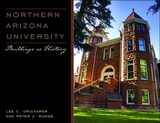
Northern Arizona University
Buildings as HistoryLee C. Drickamer and Peter J. Runge
University of Arizona Press, 2011
This book looks at the buildings that have graced the campus of Northern Arizona University from its opening in 1898 to the present. The school began with a single building, Old Main, and it was joined by five other structures prior to World War I. In the following decades the campus remained relatively small, expanding to approximately twenty-five structures by the late 1950s. During the tenure of President J. Lawrence Walkup (1957–1979), the university effectively doubled in size, spreading southward and adding more than forty buildings, including an entire south campus academic center. Since 1979 the campus has witnessed the addition of more than thirty structures, most as infill within the existing campus layout.
Arranged chronologically, this extensively illustrated volume briefly describes the history of every building that has been a part of the university’s physical layout. The authors describe various structural aspects of each building and provide entertaining and informative anecdotes about events and people associated with the structures. By combing the university’s archives, Drickamer and Runge have turned up photographs of each building as it looked shortly after construction and at present, providing a fascinating visual time lapse.
With more than two hundred images of campus buildings, many of them never before published, Northern Arizona University: Buildings as History provides a wonderful pictorial chronicle of the campus that will interest architectural historians as well as all those who have called NAU home.
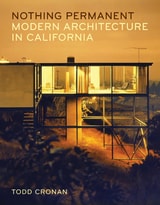
Nothing Permanent
Modern Architecture in CaliforniaTodd Cronan
University of Minnesota Press, 2023
A critical look at the competing motivations behind one of modern architecture’s most widely known and misunderstood movements
Although “mid-century modern” has evolved into a highly popular and ubiquitous architectural style, this term obscures the varied perspectives and approaches of its original practitioners. In Nothing Permanent, Todd Cronan displaces generalizations with a nuanced intellectual history of architectural innovation in California between 1920 and 1970, uncovering the conflicting intentions that would go on to reshape the future of American domestic life.
Focusing on four primary figures—R. M. Schindler, Richard Neutra, and Charles and Ray Eames—Nothing Permanent demonstrates how this prolific era of modern architecture in California, rather than constituting a homogenous movement, was propelled by disparate approaches and aims. Exemplified by the twin pillars of Schindler and Neutra and their respective ideological factions, these two groups of architects represent opposing poles of architectural intentionality, embodying divergent views about the dynamic between interior and exterior, the idea of permanence, and the extent to which architects could exercise control over the inhabitants of their structures.
Looking past California modernism’s surface-level idealization in present-day style guides, home decor publications, films, and television shows, Nothing Permanent details the intellectual, aesthetic, and practical debates that lie at the roots of this complex architectural moment. Extracting this period from its diffusion into visual culture, Cronan argues that mid-century architecture in California raised questions about the meaning of architecture and design that remain urgent today.