Results by title
64 books match the query 'Architecture and society' and 3 start with n
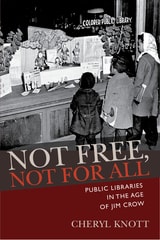
Not Free, Not for All
Public Libraries in the Age of Jim CrowCheryl Knott
University of Massachusetts Press, 2015
Winner of the 2016 Eliza Atkins Gleason Book Award and the 2016 Lillian Smith Book Award
Americans tend to imagine their public libraries as time-honored advocates of equitable access to information for all. Through much of the twentieth century, however, many black Americans were denied access to public libraries or allowed admittance only to separate and smaller buildings and collections. While scholars have examined and continue to uncover the history of school segregation, there has been much less research published on the segregation of public libraries in the Jim Crow South. In fact, much of the writing on public library history has failed to note these racial exclusions.
In Not Free, Not for All, Cheryl Knott traces the establishment, growth, and eventual demise of separate public libraries for African Americans in the South, disrupting the popular image of the American public library as historically welcoming readers from all walks of life. Using institutional records, contemporaneous newspaper and magazine articles, and other primary sources together with scholarly work in the fields of print culture and civil rights history, Knott reconstructs a complex story involving both animosity and cooperation among whites and blacks who valued what libraries had to offer. African American library advocates, staff, and users emerge as the creators of their own separate collections and services with both symbolic and material importance, even as they worked toward dismantling those very institutions during the era of desegregation.
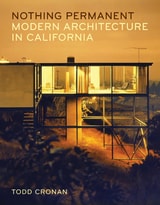
Nothing Permanent
Modern Architecture in CaliforniaTodd Cronan
University of Minnesota Press, 2023
A critical look at the competing motivations behind one of modern architecture’s most widely known and misunderstood movements
Although “mid-century modern” has evolved into a highly popular and ubiquitous architectural style, this term obscures the varied perspectives and approaches of its original practitioners. In Nothing Permanent, Todd Cronan displaces generalizations with a nuanced intellectual history of architectural innovation in California between 1920 and 1970, uncovering the conflicting intentions that would go on to reshape the future of American domestic life.
Focusing on four primary figures—R. M. Schindler, Richard Neutra, and Charles and Ray Eames—Nothing Permanent demonstrates how this prolific era of modern architecture in California, rather than constituting a homogenous movement, was propelled by disparate approaches and aims. Exemplified by the twin pillars of Schindler and Neutra and their respective ideological factions, these two groups of architects represent opposing poles of architectural intentionality, embodying divergent views about the dynamic between interior and exterior, the idea of permanence, and the extent to which architects could exercise control over the inhabitants of their structures.
Looking past California modernism’s surface-level idealization in present-day style guides, home decor publications, films, and television shows, Nothing Permanent details the intellectual, aesthetic, and practical debates that lie at the roots of this complex architectural moment. Extracting this period from its diffusion into visual culture, Cronan argues that mid-century architecture in California raised questions about the meaning of architecture and design that remain urgent today.
Novel Ecologies
Nature Remade and the Illusions of TechAllison Carruth
University of Chicago Press, 2025
Allison Carruth’s Novel Ecologies shows how the tech industry has taken up the wilderness mythologies that shaped one strain of American environmentalism over the last century. Calling this twenty-first-century environmental imagination Nature Remade, Carruth describes a distinctly West Coast framework that is at once nostalgic and futuristic. Through three case studies (synthetic wildlife, the digital cloud, and space colonization), the book shows Nature Remade to be a quasi-religious belief in venture capitalism and big tech. This paradigm thus imagines a future in which species, ecosystems, and entire planets are re-generated and re-created through engineering.
Novel Ecologies challenges the conviction that climate change and other environmental crises must be met with ever larger-scale forms of technological intervention. Against the new worlds conjured by Google, Meta, Open AI, Amazon, SpaceX, and a host of lesser-known start-ups, Carruth marshals writers and artists who imagine provisionally hopeful environmental futures while refusing to forget the histories that have made the world what it is. On this track of the book, Carruth discusses the works of Octavia Butler, Becky Chambers, Jennifer Egan, Ruth Ozeki, Craig Santos Perez, Tracy K. Smith, Jeff VanderMeer, Saya Woolfalk, and many more. Their novels, poems, installation artworks, and expressive media offer a speculative world built on livable communities rather than engineered lifeforms.