133 books match the query 'Argentina' and 4 start with n
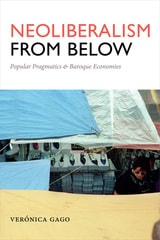
cover of Neoliberalism from Below: Popular Pragmatics and Baroque Economies

Neoliberalism from Below

Popular Pragmatics and Baroque Economies

Verónica Gago

Duke University Press, 2017

In Neoliberalism from Below—first published in Argentina in 2014—Verónica Gago examines how Latin American neoliberalism is propelled not just from above by international finance, corporations, and government, but also by the activities of migrant workers, vendors, sweatshop workers, and other marginalized groups. Using the massive illegal market La Salada in Buenos Aires as a point of departure, Gago shows how alternative economic practices, such as the sale of counterfeit goods produced in illegal textile factories, resist neoliberalism while simultaneously succumbing to its models of exploitative labor and production. Gago demonstrates how La Salada's economic dynamics mirror those found throughout urban Latin America. In so doing, she provides a new theory of neoliberalism and a nuanced view of the tense mix of calculation and freedom, obedience and resistance, individualism and community, and legality and illegality that fuels the increasingly powerful popular economies of the global South's large cities.
[more]
cover of News at Work: Imitation in an Age of Information Abundance

News at Work

Imitation in an Age of Information Abundance

Pablo J. Boczkowski

University of Chicago Press, 2010

Before news organizations began putting their content online, people got the news in print or on TV and almost always outside of the workplace. But nowadays, most of us keep an eye on the headlines from our desks at work, and we have become accustomed to instant access to a growing supply of constantly updated stories on the Web. This change in the amount of news available as well as how we consume it has been coupled with an unexpected development in editorial labor: rival news organizations can now keep tabs on the competition and imitate them, resulting in a decrease in the diversity of the news. Peeking inside the newsrooms where journalists create stories and the work settings where the public reads them, Pablo J. Boczkowski reveals why journalists contribute to the growing similarity of news—even though they dislike it—and why consumers acquiesce to a media system they find increasingly dissatisfying.

Comparing and contrasting two newspapers in Buenos Aires with similar developments in the United States, News at Work offers an enlightening perspective on living in a world with more information but less news.
[more]
cover of North of Patagonia

North of Patagonia

Johnny Payne

Northwestern University Press, 2001

This darkly humorous fourth novel by Johnny Payne takes us from the blues clubs and boxing rings of Chicago to the world of Kentucky harness racing and the hedonism of South Beach. Its characters--among them the black elites of Chicago and the white working stiffs of Hooftown--live by their wits, able to outfox everyone but themselves, and all the time borne up by big hopes and big hearts.
[more]
cover of Nurturing Doubt: From Mennonite Missionary to Anthropologist in the Argentine Chaco

Nurturing Doubt

From Mennonite Missionary to Anthropologist in the Argentine Chaco

Elmer S. Miller

University of Illinois Press, 1995

Unique in ethnography, Nurturing Doubt documents the transforming effects of field experiences on a young Mennonite who went to Argentina to work with the Toba, first as a missionary and later as an anthropologist. Elmer Miller insightfully probes the documents--diaries, field journals, and letters--of both his lives, revealing as he does the ways in which his perceptions of the Toba--and theirs of him--changed when his role changed. Deeply affected by an upbringing in which he had been taught that doubting was "sinful," Miller gradually found that he doubted not only the validity of the missionary mandate but also his ethnographic mandate and the whole practice of anthropology. His exploration of how his doubt was transformed from a negative activity into a positive philosophical attitude underscores the richness of his relationships with the Toba. In depicting the move from theological to anthropological discourse, Miller contributes to current debates over the form and purpose of ethnographic investigation and reporting.
 
 
[more]