Results by title
3258 books match the query 'Art' and 69 start with n
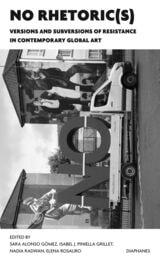
NO Rhetoric(s)
Versions and Subversions of Resistance in Contemporary Global ArtEdited by Sara Alonso Gómez, Isabel J. Piniella Grillet, Nadia Radwan, and Elena Rosauro
Diaphanes, 2021
NO Rhetoric(s) examines a subject intensely debated during the last three decades but rarely a topic of its own: art as an agent of resistance, whether as a rhetorical stance or critical strategy. In the face of today’s discourse on revolt and insurrection, it is necessary to ask whether the gesture of “negation” still has an emancipatory potential. NO Rhetoric(s) contributes a deeper understanding of the different logics of resistance at play between art and politics. Showcasing a diverse array of voices, this volume presents contributions on topics as varied as sexual dissidence, ecology, and geopolitics in the digital age. Through this interdisciplinary show of force, the collected authors, artists, and scholars shed light on how art approaches the most urgent issues facing today’s society.
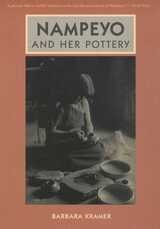
Nampeyo and Her Pottery
Barbara Kramer
University of Arizona Press, 1996

Nanoart
The Immateriality of ArtPaul Thomas
Intellect Books, 2013
Narrating the Catastrophe
An Artist's Dialogue with Deleuze and RicoeurJac Saorsa
Intellect Books, 2011
An extraordinary collaboration between contemporary art and critical discourse, Narrating the Catastrophe guides readers through unfamiliar textual landscapes where “being” is defined as an act rather than a form. Drawing on Paul Ricoeur’s notion of intersubjective narrative identity as well as the catastrophe theory of Gilles Deleuze, Jac Saorsa establishes an alternative perspective from which to interpret and engage with the world around us. A highly original—and visually appealing—take on a high-profile issue in contemporary critical debate, this book will appeal to all those interested in visual arts and philosophy.
Narrating the City
Mediated Representations of Architecture, Urban Forms and Social LifeEdited by Aysegül Akçay Kavakoglu, Türkan Nihan Haciömeroglu, and Lisa Landrum
Intellect Books, 2020
An analysis of the ways film and media create topographies of cities, architecture, and metropolitan experiences.
Narrating the City examines how film and related visual media offer insights and commentary on the city as both a constructed object and a lived social experience. It brings together filmmakers, architects, digital artists, designers, and media journalists who critically read, reinterpret, and create narratives of the city. Analyzing a variety of international films and placing them in dialogue with video art, photographic narratives, and emerging digital image-based technologies, the authors explore the expanding range of “mediated” narratives of contemporary architecture and urban culture from both a media and a sociological standpoint.
The authors explore how moving-image narratives can create cinematic topographies, presenting familiar cities and modes of seeing in unfamiliar ways. The authors then turn to the new age of digital image making and consumption, revealing new techniques of representation, mediation, and augmentation of sensorial reality for city dwellers. The book’s emphasis on narrative also offers insights into critical societal issues including cultural identity, diversity, memory, and spatial politics, as they are both informed by and represented in various media.

National Camera
Photography and Mexico’s Image EnvironmentRoberto Tejada
University of Minnesota Press, 2009
The “problem” of photography in Mexico, Tejada shows, reveals cross-cultural episodes that are rife with contradictions, especially in the complex terms of cultural and sexual difference. Analyzing such topics as territory, sexuality, and social and ethnic relations in image making, Tejada delves into the work of key figures including Manuel Alvarez Bravo, Edward Weston, Tina Modotti, Marius de Zayas, and Julien Levy, as well as the Agustín Víctor Casasola Archive, the Boystown photographs, and contemporary Mexican and Latina photo-based artists.
From the Mexican Revolution of 1910–1920 to the U.S.–Mexico borderlands of today, Tejada traces the connective thread that photography has provided between Mexican and U.S. American intellectual and cultural production and, in doing so, defines both nations.
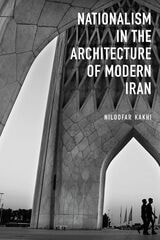
Nationalism in Architecture of Modern Iran
Niloofar Kakhi
Gingko, 2023
Nationalism in Architecture of Modern Iran is the first comprehensive book on modern architecture in Iran to be published in English. It addresses the relationship between nationalism and architecture in Iran and discusses the role Western architects played in the development of modern architecture in the country while introducing some of the most significant and recent projects in Iran. It investigates what it means to design a building that bears an Iranian or Islamic-Iranian identity and how to construct a conceptual platform for critically assessing representations of national identity in contemporary architecture. This book will directly help practicing architects and policymakers of the built environment, especially in Iran, as well as give a comprehensive understanding of the modern history of architecture in Iran to art historians and a broader audience. It introduces some of the most significant and recent projects in Iran for the first time.

Nationalismes, antisémitismes et débats autour de l’art juif
De quelques critiques d’art au temps de l’École de Paris (1925–1933)Alessandro Gallicchio
Diaphanes, 2023
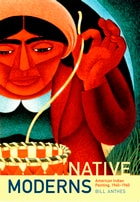
Native Moderns
American Indian Painting, 1940-1960Bill Anthes
Duke University Press, 2006
In the mid-twentieth century, Native artists began to produce work that reflected the accelerating integration of Indian communities into the national mainstream as well as, in many instances, their own experiences beyond Indian reservations as soldiers or students. During this period, a dynamic exchange among Native and non-Native collectors, artists, and writers emerged. Anthes describes the roles of several anthropologists in promoting modern Native art, the treatment of Native American “Primitivism” in the writing of the Jewish American critic and painter Barnett Newman, and the painter Yeffe Kimball’s brazen appropriation of a Native identity. While much attention has been paid to the inspiration Native American culture provided to non-Native modern artists, Anthes reveals a mutual cross-cultural exchange that enriched and transformed the art of both Natives and non-Natives.
Natura
Environmental Aesthetics After LandscapeEdited by Jens Andermann, Lisa Blackmore, and Dayron Carrillo Morell
Diaphanes, 2018
Natura takes up this challenge, exploring how recent activist practices and eco-artistic turns in Latin America can help us to reconfigure the categories of nature and the human. Moving from botanical explorations of early modernity, through the legacies of mid-twentieth-century landscape design, up to present struggles for the rights of nature and speculative post-human creations, the critical essays and visual contributions in this anthology use interdisciplinary encounters to reimagine the landscape and how we inhabit it.
Nature's Engraver
A Life of Thomas BewickJenny Uglow
University of Chicago Press, 2009
Thomas Bewick’s (1753–1828) History of British Birds was the first field guide for ordinary people, illustrated with woodcuts of astonishing accuracy and beauty. In Nature’s Engraver, Jenny Uglow tells the story of the farmer’s son from Tyneside who became one of Britain’s greatest and most popular engravers. It is a story of violent change, radical politics, lost ways of life, and the beauty of the wild—a journey to the beginning of our lasting obsession with the natural world.
“A refined and engaging biography, as beautifully wrought, in its way, as Bewick’s woodcuts.”—New York Times
“Uglow’s clear prose sparkles like Bewick’s River Tyne.”—Los Angeles Times
“This is a lovely book, not just in the quality and sympathy of the writing but in the care of its design and illustration. [Uglow] has turned a rich but undramatic life into a vignette as full of interest and details as one of Bewick’s own woodcuts.”—Sunday Telegraph
“A splendid biography. But it becomes an endearing one by the scattered presence of so many of Bewick’s woodcuts.”—Washington Post
“Another triumph for England’s most innovative biographer, and a marvelous treat for fans of Bewick’s beguiling work.”—Kirkus Reviews
Nature's Wild
Love, Sex, and Law in the CaribbeanAndil Gosine
Duke University Press, 2021
Duke University Press Scholars of Color First Book Award recipient
Navajo Beadwork
Architectures of LightEllen K. Moore
University of Arizona Press, 2003
Ellen Moore has written the first history of Navajo beadwork—belts and hatbands, baskets and necklaces—in a book that examines both the influence of Navajo beliefs in the creation of this art and the primacy of light and color in Navajo culture. Navajo Beadwork: Architectures of Light traces the evolution of the art as explained by traders, Navajo consultants, and Navajo beadworkers themselves. It also shares the visions, words, and art of 23 individual artists to reveal the influences on their creativity and show how they go about creating their designs.
As Moore reveals, Navajo beadwork is based on an aggregate of beliefs, categories, and symbols that are individually interpreted and transposed into beaded designs. Most designs are generated from close observation of light in the natural world, then structured according to either Navajo tradition or the newer spirituality of the Native American Church. For many beadworkers, creating designs taps deeply embedded beliefs so that beaded objects reflect their thoughts and prayers, their aesthetic sensibilities, and their sense of being Navajo—but above all, their attention to light and its properties.
No other book offers such an intimate view of this creative process, and its striking color plates attest to the wondrous results. Navajo Beadwork: Architectures of Light is a valuable record of ethnographic research and a rich source of artistic insight for lovers of beadwork and Native American art.
Navajo Textiles
The Crane Collection at the Denver Museum of Nature and ScienceLaurie D. Webster
University Press of Colorado, 2017
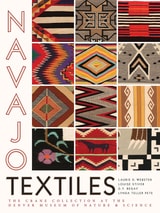
Navajo Textiles provides a nuanced account the Navajo weavings in the Crane Collection at the Denver Museum of Nature & Science—one of the largest collections of Navajo textiles in the world. Bringing together the work of anthropologists and indigenous artists, the book explores the Navajo rug trade in the mid-nineteenth century and changes in the Navajo textile market while highlighting the museum’s important, though still relatively unknown, collection of Navajo textiles.
In this unique collaboration among anthropologists, museums, and Navajo weavers, the authors provide a narrative of the acquisition of the Crane Collection and a history of Navajo weaving. Personal reflections and insights from foremost Navajo weavers D. Y. Begay and Lynda Teller Pete are also featured, and more than one hundred stunning full-color photographs of the textiles in the collection are accompanied by technical information about the materials and techniques used in their creation. An introduction by Ann Lane Hedlund documents the growing collaboration between Navajo weavers and museums in Navajo textile research.
The legacy of Navajo weaving is complex and intertwined with the history of the Diné themselves. Navajo Textiles makes the history and practice of Navajo weaving accessible to an audience of scholars and laypeople both within and outside the Diné community.
Navajo Textiles
The William Randolph Hearst CollectionNancy J. Blomberg
University of Arizona Press, 1988
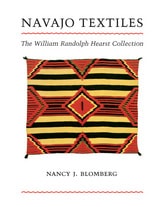
Over four decades he amassed a collection spanning more than a century of Navajo weaving and including nearly every major type produced from 1800 to 1920. Hearst's passion for American Indian artifacts was so strong that he had originally visualized his now-famous castle in San Simeon as a showplace for his Navajo textile collection. At a time when the Harvey Company was itself influencing the development of Indian handcrafts by opening up the tourist market, Hearst contributed to this influence by expressing his own artistic preference for rare and unusual pieces.
This catalogue raisonné, featuring nearly 200 illustrations, provides the general public with the first look at this important collection. Nancy Blomberg's narrative introduces the reader to the history of Navajo weaving and documents Hearst's role in its development. The heart of the book provides a detailed analysis of each textile: fibers, yarn types, dyes, and designs. Navajo Textiles thus constitutes an invaluable reference for scholars and collectors and will be enjoyed by anyone who appreciates these beautiful creations from the Navajo loom.
Navajo Weaving in the Late Twentieth Century
Kin, Community, and CollectorsAnn Lane Hedlund
University of Arizona Press, 2004
In testimony to this living art form, this book presents 74 dazzling color plates of Navajo rugs and wall hangings woven between 1971 and 1996. Drawn from a private southwestern collection, they represent the work of sixty of the finest native weavers in the American Southwest. The creations depicted here reflect a number of styles—revival, sandpainting, pictorial, miniature, sampler—and a number of major regional variations, from Ganado to Teec Nos Pos.
Textile authority Ann Hedlund provides an introductory narrative about the development of Navajo textile collecting—including the shift of attention from artifacts to art—and a brief review of the history of Navajo weaving. She then comments on the shaping of the particular collection represented in the book, offering a rich source of knowledge and insight for other collectors.
Explaining themes in Navajo weaving over the quarter-century represented by the Santa Fe Collection, Hedlund focuses on the development of modern rug designs and the influence on weavers of family, community, artistic identity, and the marketplace. She also introduces each section of plates with a description of the representative style, its significance, and the weavers who perpetuate and deviate from it. In addition to the textile plates, Hedlund’s color photographs show the families, landscapes, livestock, hogans, and looms that surround today’s Navajo weavers.
Navajo Weaving in the Late Twentieth Century explores many of the important connections that exist today among weavers through their families and neighbors, and the significant role that collectors play in perpetuating this dynamic art form. For all who appreciate American Indian art and culture, this book provides invaluable guidance to the fine points of collecting and a rich visual feast.
Navigating Artificial Intelligence for Cultural Heritage Organisations
Edited by Lise Jaillant, et al.
University College London, 2025
As artificial intelligence reshapes the cultural heritage sector, libraries, archives, and museums face novel opportunities and pressing ethical challenges. Navigating Artificial Intelligence for Cultural Heritage Organisations brings together leading experts from digital humanities, computer science, and information science to explore how AI-driven technologies transform the management and interpretation of digitized and born-digital records.
Through an examination of real-world case studies from the UK, US, and beyond, this volume provides significant insights into AI’s role in record management and text and data mining, while addressing issues of trust and risk in automated systems. Designed for heritage professionals, researchers, and information specialists, this book offers a timely guide to leveraging AI while also safeguarding the integrity and accessibility of cultural archives for the future.
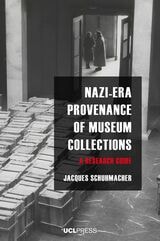
Nazi-Era Provenance of Museum Collections
A Research GuideJacques Schuhmacher
University College London, 2024
When we look at the artworks on display in museums, there is always a real possibility that some of these objects once belonged to victims of the Nazis—a possibility that has remained unacknowledged for far too long. Countless artworks were seized or forcibly sold by the Nazi regime, with many ending up in museum collections around the world, even in countries that actively fought to defeat Nazi Germany.
Nazi-Era Provenance of Museum Collections equips readers with the knowledge and strategies essential for confronting the shadow of the Nazi past in museum collections. Jacques Schuhmacher provides the vital historical orientation required to understand the Nazis’ complex campaign of systematic dispossession and extermination and highlights the current environment in which museum-based Nazi-era provenance research takes place. This book introduces readers to the research methods and resources that can be used to reveal the moving stories behind the objects. Provenance research not only seeks to recover erased names and experiences and to reinsert them into a historical record but also to ensure that the Nazis’ actions and worldview do not remain unchallenged in the galleries and storerooms of our museums today. It is a crucial resource for scholars, museum professionals, and anyone interested in understanding the ethical and historical implications of Nazi-looted art.

Nazi-Looted Art and Its Legacies
Andreas Huyssen, Anson Rabinbach, and Avinoam Shalem, special issue editors
Duke University Press, 2017
Special topic contributors. Konstantin Akinsha, Meike Hoffmann, Andreas Huyssen, Lawrence M. Kaye, Olaf Peters, Jonathan Petropoulos, Anson Rabinbach, Avinoam Shalem, Julia Voss, Amy Walsh
Necromedia
Marcel O'Gorman
University of Minnesota Press, 2015
In Necromedia, media activist Marcel O’Gorman takes aim at “the collusion of death and technology,” drawing on a broad arsenal that ranges from posthumanist philosophy and social psychology to digital art and handmade “objects-to-think-with.” Throughout, O’Gorman mixes philosophical speculation with artistic creation, personal memoir, and existential dread. He is not so much arguing against technoculture as documenting a struggle to embrace the technical essence of human being without permitting technology worshippers to have the last word on what it means to be human.
Inspired in part by the work of cultural anthropologist Ernest Becker, O’Gorman begins by suggesting that technology provides human beings with a cultural hero system built on the denial of death and a false promise of immortality. This theory adds an existential zest to the book, allowing the author not only to devise a creative diagnosis of what Bernard Stiegler has called the malaise of contemporary technoculture but also to contribute a potential therapy—one that requires embracing human finitude, infusing care into the process of technological production, and recognizing the vulnerability of all things, human and nonhuman. With this goal in mind, Necromedia prescribes new research practices in the humanities that involve both written work and the creation of objects-to-think-with that are designed to infiltrate and shape the technoculture that surrounds us.
Negative Exposures
Knowing What Not to Know in Contemporary ChinaMargaret Hillenbrand
Duke University Press, 2020
Neither God nor Master
Robert Bresson and Radical PoliticsBrian Price
University of Minnesota Press, 2010
Situating Bresson in radical and aesthetic political contexts, from surrealism to situationism, Neither God nor Master shows how his early style was a model for social resistance. We then see how, after May 1968, his films were in fact a series of reflections on the failure of revolution in France—especially as “failure” is understood in relation to Bresson’s chosen literary precursors, Dostoyevsky and Tolstoy, and Russian revolutionary culture of the nineteenth century.
Restoring Bresson to the radical political culture from which he emerged—and to which he remained faithful—Price offers a major revision of the reputation of one of the most celebrated figures in the history of French film. In doing so, he raises larger philosophical questions about the efficacy of revolutionary practices and questions about interpretation and metaphysical tendencies of film historical research that have, until now, gone largely untested.
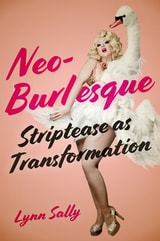
Neo-Burlesque
Striptease as TransformationLynn Sally
Rutgers University Press, 2022
Performance studies scholar and acclaimed burlesque artist Lynn Sally offers an inside look at the history, culture, and philosophy of New York’s neo-burlesque scene. Revealing how twenty-first century neo-burlesque is in constant dialogue with the classic burlesque of the nineteenth and twentieth centuries, she considers how today’s performers use camp to comment on preconceived notions of femininity. She also explores how the striptease performer directs the audience’s gaze, putting on layers of meaning while taking off layers of clothing.
Through detailed profiles of iconic neo-burlesque performers such as Dita Von Teese, Dirty Martini, Julie Atlas Muz, and World Famous *BOB*, this book makes the case for understanding neo-burlesque as a new sexual revolution. Yet it also examines the broader community of “Pro-Am” performers who use neo-burlesque as a liberating vehicle for self-expression. Raising important questions about what feminism looks like, Neo-Burlesque celebrates a revolutionary performing art and participatory culture whose acts have political reverberations, both onstage and off.
Neolithic Childhood
Art in a False Present, c. 1930Edited by Anselm Franke and Tom Holert
Diaphanes, 2018
Resonating at the heart of Neolithic Childhood. Art in a False Present, c. 1930 is the question whether art has present, past, and future functions. The modernist assertion of the autonomy of art was intended to render superfluous art’s social and religious functions. But what if the functionlessness of art comes under suspicion of being instrumentalized by bourgeois capitalism? This was an accusation that informed the anti-modernist critique of the avant-garde, and particularly of Surrealism. The objective throughout the crisis-ridden present of the 1920s to the 1940s was to reaffirm a once ubiquitous, but long-lost functionality—not only of art.
The publication accompanying the exhibition examines the strategies deployed in this reaffirmation. These include the surrealist Primitivism of an “Ethnology of the White Man” together with the excavation of the deep time of humanity—into the “Neolithic Childhood” mapped out by the notoriously anti-modernist Carl Einstein (1885-1940) as a hallucinatory retro-utopia. The volume brings together essays by the curators and academics involved in the project, primary texts by Carl Einstein and a comprehensive documentation of the exhibition including lists of works, texts on as well as images of numerous exhibits and finally installation views. At the center of the volume, a glossary discusses Carl Einstein’s own theoretical vocabulary as well as further associated terms, such as Autonomy, Formalism, Function, Gesture, Hallucination, Art, Metamorphosis, Primitivisms, Totality.
With contributions by: Irene Albers, Philipp Albers, Joyce S. Cheng, Rosa Eidelpes, Carl Einstein, Anselm Franke, Charles W. Haxthausen, Tom Holert, Sven Lütticken, Ulrike Müller, Jenny Nachtigall, David Quigley, Cornelius Reiber, Erhard Schüttpelz, Kerstin Stakemeier, Maria Stavrinaki, Elena Vogman, Zairong Xiang, Sebastian Zeidler
With reproductions of artworks by:
Jean (Hans) Arp, Willi Baumeister, Georges Braque, Brassaï, Claude Cahun, Lux T. Feininger, Max Ernst, Florence Henri, Barbara Hepworth, Hannah Höch, Heinrich Hoerle, Paul Klee, Germaine Krull, Helen Levitt, André Masson, Alexandra Povòrina, Gaston-Louis Roux, Kalifala Sidibé, Louis Soutter, Yves Tanguy, Toyen, Jindřich Štyrský, Raoul Ubac, Paule Vézelay and others.
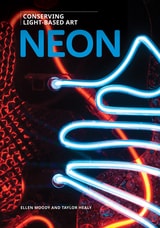
Neon
Ellen Moody
J. Paul Getty Trust, The, 0
The first of its kind, this authoritative open-access volume offers technical guidance and best practices on preserving, installing, and storing neon artworks.
Neon lighting first emerged as a cutting-edge technology in the late 19th century, illuminating the night sky with bright commercial signage. Artists soon began to test its potential, and figures like Chryssa, Bruce Nauman, Mary Weatherford, and Glenn Ligon created iconic works that established neon’s place in contemporary art. As the earliest neon artworks approach 100 years old, their conservation is crucial, yet preserving light-based art is absent from most conservation training programs. This publication fills that gap, offering an invaluable resource for professionals responsible for the care of neon.
Written by leading conservators working with light- and time-based art, this publication offers:
- Foundational knowledge of neon’s history, technology, and terminology.
- Best practices for preservation, installation, and storage, supported by step-by-step instructions, and conservation templates.
- Case studies examining challenges and solutions in exhibiting, repairing, and replicating neon artworks.
- In the online version, Informative, practical videos demonstrating repair and maintenance techniques.
Designed for conservators, curators, preparators, collectors, and cultural heritage professionals, this important volume offers essential guidance to those caring for neon artworks.
The free online edition of this open-access publication is available at getty.edu/publications/neon/ and includes zoomable illustrations, videos, and downloadable appendices. Also available are free PDF and EPUB downloads of the book. This publication was created using Quire, a multiformat publishing tool from Getty.
Neosentience
The Benevolence EngineBill Seaman and Otto E. Rossler
Intellect Books, 2011
Coined by artist and media researcher Bill Seaman, “neosentience” describes a new branch of scientific inquiry related to artificial intelligence. This volume explores the groundbreaking work of Seaman and theoretical physicist Otto E. Rossler in exploring the potential of an intelligent robotic entity possessed of a form of sentience that ever more closely resembles that of a human being. Individual chapters approach the concept from a range of disciplines, including psychology, neuroscience, linguistics, and the arts. Neosentience is a burgeoning area of interest, and this book encourages readers to reflect on how we experience and interpret the world, how memory works, and what it is to be human.

Nervous Systems
Art, Systems, and Politics since the 1960sJohanna Gosse and Timothy Stott, editors
Duke University Press, 2021
Contributors. Cristina Albu, Amanda Boetzkes, Brianne Cohen, Kris Cohen, Jaimey Hamilton Faris, Christine Filippone, Johanna Gosse, Francis Halsall, Judith Rodenbeck, Dawna Schuld, Luke Skrebowski, Timothy Stott, John Tyson
Network Aesthetics
Patrick Jagoda
University of Chicago Press, 2016
Each chapter considers how popular media and artistic forms make sense of decentralized network metaphors and infrastructures. Patrick Jagoda first examines narratives from the 1990s and 2000s, including the novel Underworld, the film Syriana, and the television series The Wire, all of which play with network forms to promote reflection on domestic crisis and imperial decline in contemporary America. Jagoda then looks at digital media that are interactive, nonlinear, and dependent on connected audiences to show how recent approaches, such as those in the videogame Journey, open up space for participatory and improvisational thought.
Contributing to fields as diverse as literary criticism, digital studies, media theory, and American studies, Network Aesthetics brilliantly demonstrates that, in today’s world, networks are something that can not only be known, but also felt, inhabited, and, crucially, transformed.
Never Alone, Except for Now
Art, Networks, PopulationsKris Cohen
Duke University Press, 2017
New African Cinema
Orlando, Valérie K
Rutgers University Press, 2017
Orlando illuminates the diverse themes evident in the works of filmmakers such as Ousmane Sembène’s Ceddo (Senegal, 1977), Sarah Maldoror’s Sambizanga (Angola, 1972), Assia Djebar’s La Nouba des femmes de Mont Chenoua (The Circle of women of Mount Chenoua, Algeria, 1978), Zézé Gamboa’s The Hero (Angola, 2004) and Abderrahmane Sissako’s Timbuktu (Mauritania, 2014), among others. Orlando also considers the influence of major African film schools and their traditions, as well as European and American influences on the marketing and distribution of African film. For those familiar with the polemics of African film, or new to them, Orlando offers a cogent analytical approach that is engaging.
New Growth
The Art and Texture of Black HairJasmine Nichole Cobb
Duke University Press, 2022
New Media Futures
The Rise of Women in the Digital ArtsEdited by Donna J. Cox, Ellen Sandor, and Janine Fron
University of Illinois Press, 2018
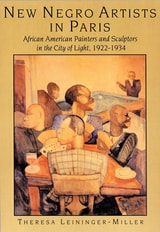
New Negro Artists in Paris
African American Painters and Sculptors in the City of Light, 1922-1934Leininger-Miller, Theresa
Rutgers University Press, 2001
These artists exhibited the works they created in Paris at prestigious salons in France and in the United States, winning fellowships, grants, and awards. Leininger-Miller argues that it was study abroad that won these artists critical acclaim, establishing their reputations as some of the most significant leaders of the New Negro movement in the visual arts. She begins her study with a history of the debut of African American artists in Paris, 1830–1914, then provides readers with rarely seen profiles of each of the six artists from their birth through the end of their time abroad. Finally, Leininger-Miller examines patterns and differences in these individuals’ backgrounds and development, their patronage in the United States and France, their shared experiences abroad, and the impact their study in Paris had on the rest of their careers.
New Perspective, Understanding, Awareness
Impacts of Arts Integration and Interdisciplinary PracticeGabriel Harp
A2RU Intervals, 2019
Learn more online at a2ru.org about A2RU programs, alliance partners, and how to become an A2RU partner. Discover insights and tools to support the arts and design in research universities. You can also search and browse A2RU conference abstracts, working session captures, and a wide array of supporting materials from A2RU and its alliance partnerships.
New Perspectives on Etruria and Early Rome
Sinclair Bell
University of Wisconsin Press, 2009
Paying tribute to Richard Daniel De Puma, a scholar who has made significant and influential contributions to Etruscan and Roman studies, the contributors to this collection echo the ambition and creativity of his work while offering an up-to-date survey of contemporary Etruscan scholarship. In surveying new developments in both fields, the work collected here represent the diverse, interdisciplinary interests of De Puma as well as areas of recent groundbreaking research.
New Perspectives on the Life and Art of Richard Crashaw
Edited by John R. Roberts
University of Missouri Press, 1990
Richard Crashaw (1612/13-1649) has been one of the most neglected, misunderstood, misread, and unappreciated of the so-called major metaphysical poets. Critics have long labeled Crashaw’s poetry “foreign,” “grotesque,: “deficient in judgment and taste,” and even “sexually perverse.” In recent years, however, Crashaw’s role in providing an understanding and appreciation of seventeenth century poetic theory and aesthetics has become increasingly more evident to literary scholars and critics. They now generally agree that his poetry occupies a permanent and significant position in the intellectual, religious, and literary history of his time.
This collection of ten original critical and historical essays on the life and art of Crashaw will serve as a further impetus to the renewed interest in Crashaw. In the introduction, John R. Roberts and Lorraine M. Roberts survey past Crashavian criticism, giving the reader an overall view of the critical response to Crashaw and his work. The introduction also signals new directions for future scholarship. Scholars, critics, and students of metaphysical, baroque, and religious poetry will find these essays engaging and insightful.
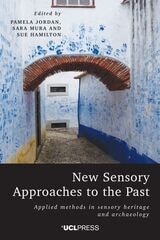
New Sensory Approaches to the Past
Applied Methods in Sensory Heritage and ArchaeologyEdited by Pamela Jordan, Sara Mura, and Sue Hamilton
University College London, 2025
In recent years, archaeologists and other researchers dealing with heritage sites have increasingly emphasized the fact that people in the past interacted with their natural and built environment through all of their senses. In turn, they have come to acknowledge the limits of research methods that rely solely on visual analysis. Presenting studies of historical environments from multiple fields, from archaeology to acoustics, through the lens of the senses, New Sensory Approaches to the Past showcases the latest developments in sensory research through real-world scenarios of human-environment connections. Interdisciplinary examples of diverse sensory in-situ studies will enable readers to replicate and enhance their own investigations. Further, the volume pushes beyond historically Western frameworks of sensory perception towards a more global understanding of the senses.
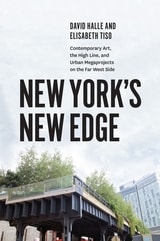
New York's New Edge
Contemporary Art, the High Line, and Urban Megaprojects on the Far West SideDavid Halle and Elisabeth Tiso
University of Chicago Press, 2014
David Halle and Elisabeth Tiso offer a deep analysis of the transforming district in New York’s New Edge, and the result is a new understanding of how we perceive and interpret culture and the city in New York’s gallery district. From individual interviews with gallery owners to the behind-the-scenes politics of preservation initiatives and megaprojects, the book provides an in-depth account of the developments, obstacles, successes, and failures of the area and the factors that have contributed to them.
New Zealand Cinema
Interpreting the PastEdited by Alistair Fox, Barry Keith Grant, and Hilary Radner
Intellect Books, 2011
New Zealand has produced one of the world’s most vibrant film cultures, a reflection of the country’s evolving history and the energy and resourcefulness of its people. From early silent features like The Te Kooti Trail to recent films such as River Queen, this book examines the role of the cinema of New Zealand in building a shared sense of national identity. The works of key directors, including Peter Jackson, Jane Campion, and Vincent Ward, are here introduced in a new light, and select films are given in-depth coverage. Among the most informative accounts of New Zealand’s fascinating national cinema, this will be a must for film scholars around the globe.
New Zealand Film and Television
Institution, Industry and Cultural ChangeTrisha Dunleavy and Hester Joyce
Intellect Books, 2011
Despite challenges arising from a limited population and the difficulty of obtaining adequate funding, both the film and television industries of New Zealand have been the source of significant achievements and profound cultural influence. Charting their emergence and subsequent development through five decades, New Zealand Film and Television looks at these two increasingly vibrant cultural and creative industries. While there is a growing body of academic work on film and television in New Zealand, relatively little exists that examines the specific cultural concerns, local industries, institutions, and policies involved, which this book addresses in full.
Nic Nicosia
By Nic Nicosia
University of Texas Press, 2012
Photographer and filmmaker Nic Nicosia makes pictures. Since the late 1970s, Nicosia has staged and constructed sets, objects, and situations to be photographed rather than to reproduce something that already exists. These conceptual fabrications have ranged from elaborate sets with live actors to dioramas and abstract constructions. Whether his pictures contain a disturbing suburban narrative, or are fabricated by the act of drawing, or are simply created by the use of common objects with dramatic lighting, the familiar thread of Nicosia’s unique vision and sensibility is always present.
Nic Nicosia is the first major publication of the artist’s work and covers his entire oeuvre through 2011. The catalog presents images from all of Nicosia’s major photographic series, including Domestic Dramas, Near (modern) Disasters, The Cast, Life as We Know It, Real Pictures, Love + Lust, Acts, Sex Acts, Untitled Landscapes, 365 SaFe Days, Untitled (drawing), Space Time Light, I See Light, and in the absence of others, as well as stills from the videos Middletown, Moving Picture, Middletown Morning, Cerchi E Quadratti, On Acting America, and 9 1/2 Hours to SaFe. Accompanying the catalog is an overview of Nicosia’s career by Michelle White, an interview with the artist by Sue Graze, and an original short story by Philipp Meyer that powerfully resonates with the sense of wonder and menace in Nicosia’s art.

Nigerian Video Films
Revised and Expanded EditionJonathan Haynes
Ohio University Press, 2000
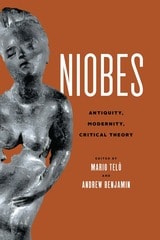
Niobes
Antiquity, Modernity, Critical TheoryEdited by Mario Telò and Andrew Benjamin
The Ohio State University Press, 2024
No Future
Queer Theory and the Death DriveLee Edelman
Duke University Press, 2004
Closely engaging with literary texts, Edelman makes a compelling case for imagining Scrooge without Tiny Tim and Silas Marner without little Eppie. Looking to Alfred Hitchcock’s films, he embraces two of the director’s most notorious creations: the sadistic Leonard of North by Northwest, who steps on the hand that holds the couple precariously above the abyss, and the terrifying title figures of The Birds, with their predilection for children. Edelman enlarges the reach of contemporary psychoanalytic theory as he brings it to bear not only on works of literature and film but also on such current political flashpoints as gay marriage and gay parenting. Throwing down the theoretical gauntlet, No Future reimagines queerness with a passion certain to spark an equally impassioned debate among its readers.
No Innocent Bystanders
Performance Art and AudienceFrazer Ward
Dartmouth College Press, 2012
No Laughing Matter
Visual Humor in Ideas of Race, Nationality, and EthnicityEdited by Angela Rosenthal, David Bindman, and Adrian W. B. Randolph
Dartmouth College Press, 2015
No Machos or Pop Stars
When the Leeds Art Experiment Went PunkGavin Butt
Duke University Press, 2022
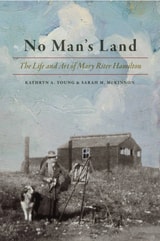
No Man's Land
The Life and Art of Mary Riter HamiltonKathryn A. Young
University of Manitoba Press, 2017
No More Nice Girls
Countercultural EssaysEllen Willis
University of Minnesota Press, 2012
With characteristic intelligence, wit, and feminist insight, Ellen Willis addresses democracy as she sees it: “a commitment to individual freedom and egalitarian self-government in every area of social, economic, and cultural life.” Moving between scholarly and down-to-earth activist writing styles, Willis confronts the conservative backlash that has slowly eroded democratic ideals and advances of the 1960s as well as the internal debates that have frequently splintered the left.
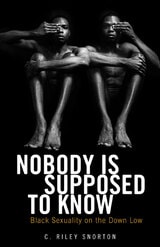
Nobody Is Supposed to Know
Black Sexuality on the Down LowC. Riley Snorton
University of Minnesota Press, 2014
Since the early 2000s, the phenomenon of the “down low”—black men who have sex with men as well as women and do not identify as gay, queer, or bisexual—has exploded in news media and popular culture, from the Oprah Winfrey Show to R & B singer R. Kelly’s hip hopera Trapped in the Closet. Most down-low stories are morality tales in which black men are either predators who risk infecting their unsuspecting female partners with HIV or victims of a pathological black culture that repudiates openly gay identities. In both cases, down-low narratives depict black men as sexually dangerous, duplicitous, promiscuous, and contaminated.
In Nobody Is Supposed to Know, C. Riley Snorton traces the emergence and circulation of the down low in contemporary media and popular culture to show how these portrayals reinforce troubling perceptions of black sexuality. Reworking Eve Sedgwick’s notion of the “glass closet,” Snorton advances a new theory of such representations in which black sexuality is marked by hypervisibility and confinement, spectacle and speculation. Through close readings of news, music, movies, television, and gossip blogs, Nobody Is Supposed to Know explores the contemporary genealogy, meaning, and functions of the down low.
Snorton examines how the down low links blackness and queerness in the popular imagination and how the down low is just one example of how media and popular culture surveil and police black sexuality. Looking at figures such as Ma Rainey, Bishop Eddie L. Long, J. L. King, and Will Smith, he ultimately contends that down-low narratives reveal the limits of current understandings of black sexuality.