Results by title
197 books match the query 'Arts' and 5 start with n

Nancy Hanks, An Intimate Portrait
The Creation of a National Commitment to the ArtsMichael Straight
Duke University Press, 1988
This biography captures the spirit and the flavor of Ms. Hanks's remarkable life, above all during the eight years in which she led the Endowment. Tracing her childhood in Florida and North Carolina through her achievements as a student leader at Duke University, Straight makes clear her conscious effort to find a path with more scope than the usual marriage-and-a-family when expected of Southern women. Nancy Hanks went to Washington and found a job with the Office of War Mobilization. She later worked with Nelson Rockefeller, who became governor of New York, a Republican party luminary, and vice president under Gerald Ford, in addition to being an heir to one of America's greatest fortunes. Her relationship with Rockefeller was crucial to her personal life, and his conception of government and its role and a lasting influence on her career.
Straight examines Nancy Hanks's leadership of the NEA and takes particular note of the intense debate over the role of government in fostering American artistic expression, an issue with roots running back through the New Deal to the early history of the United States. Nancy Hanks took a strong and activist role in the formulation and administration of a national arts policy, and her accomplishments have left an indelible mark on public support for arts in the United States. Straight, who worked closely with Ms. Hanks and admired her despite frequent policy disagreements, deals honestly with both the successes and failures of her efforts. His biography imparts a sense of the reasons why her many friends felt such loyalty to this complex and gifted woman.
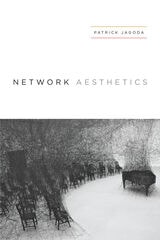
Network Aesthetics
Patrick Jagoda
University of Chicago Press, 2016
Each chapter considers how popular media and artistic forms make sense of decentralized network metaphors and infrastructures. Patrick Jagoda first examines narratives from the 1990s and 2000s, including the novel Underworld, the film Syriana, and the television series The Wire, all of which play with network forms to promote reflection on domestic crisis and imperial decline in contemporary America. Jagoda then looks at digital media that are interactive, nonlinear, and dependent on connected audiences to show how recent approaches, such as those in the videogame Journey, open up space for participatory and improvisational thought.
Contributing to fields as diverse as literary criticism, digital studies, media theory, and American studies, Network Aesthetics brilliantly demonstrates that, in today’s world, networks are something that can not only be known, but also felt, inhabited, and, crucially, transformed.
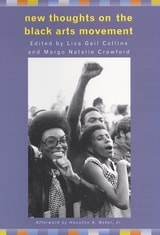
New Thoughts on the Black Arts Movement
Edited by Lisa Gail Collins and Margo Natalie Crawford
Rutgers University Press, 2006
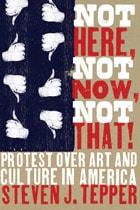
Not Here, Not Now, Not That!
Protest over Art and Culture in AmericaSteven J. Tepper
University of Chicago Press, 2011
In the late 1990s Angels in America,Tony Kushner’s epic play about homosexuality and AIDS in the Reagan era, toured the country, inspiring protests in a handful of cities while others received it warmly. Why do people fight over some works of art but not others? Not Here, Not Now, Not That! examines a wide range of controversies over films, books, paintings, sculptures, clothing, music, and television in dozens of cities across the country to find out what turns personal offense into public protest.
What Steven J. Tepper discovers is that these protests are always deeply rooted in local concerns. Furthermore, they are essential to the process of working out our differences in a civil society. To explore the local nature of public protests in detail, Tepper analyzes cases in seventy-one cities, including an in-depth look at Atlanta in the late 1990s, finding that debates there over memorials, public artworks, books, and parades served as a way for Atlantans to develop a vision of the future at a time of rapid growth and change.
Eschewing simplistic narratives that reduce public protests to political maneuvering, Not Here, Not Now, Not That! at last provides the social context necessary to fully understand this fascinating phenomenon.
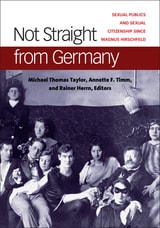
Not Straight from Germany
Sexual Publics and Sexual Citizenship since Magnus HirschfeldMichael Thomas Taylor, Annette F. Timm, and Rainer Herrn, Editors
University of Michigan Press, 2017
Two visual sourcebooks and catalog essays on an exhibition of contemporary artists’ responses to the Hirschfeld historical materials interrogate the modes of visual representation that Hirschfeld employed by re-imagining the public visibility of his institute from a contemporary perspective. The archival material includes stunning, never-before-published images from Hirschfeld’s institute that challenge many received ideas, while the scholarly and art catalog essays explore collaboration and dialogue as methods of research and activism that resonate beyond the academy to pressing issues of public concern.