Results by title
277 books match the query 'Biology' and 6 start with n
Natural Communities
Lee R. Dice
University of Michigan Press, 1952
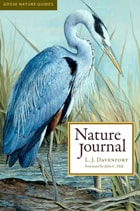
Nature Journal
L. J. Davenport, with a Foreword by John C. Hall
University of Alabama Press, 2010
Explore Nature. Record Wonder. Keep Your Own Journal.
Nature Journal is an innovative presentation of the best columns and photographs from L. J. Davenport’s popular column in Alabama Heritage magazine. Readers of the magazine have come to relish his artful and often witty descriptions of common species encountered in the Alabama outdoors. But Nature Journal is designed to be much more than a mere collection of entertaining essays; it is also an educational tool—a means of instructing and encouraging readers in the art of keeping a nature journal for themselves.
Each of the 25 chapters is a self-contained lesson in close observation of species morphology, behavior, and habitat; research in the literature; nondestructive capture of the subject by photography or drawing; and written description of the total observed natural phenomenon. At the end of each account, stimulating questions and gentle directives guide the reader into making his or her own observations and recordings.
This book is intended for broad nature-study use in Alabama and throughout the southeast by the general reader and nature enthusiast alike, as well as visitors to museums and outdoor centers, and students of nature and nature writing at the high school and college levels. Beautifully designed to look like a personal journal, it is a perfect gift and treasured keepsake for all lovers of the natural world.
Publication supported in part by Samford University
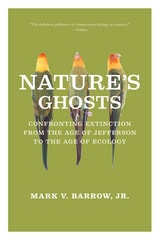
Nature's Ghosts
Confronting Extinction from the Age of Jefferson to the Age of EcologyMark V. Barrow, Jr.
University of Chicago Press, 2009
The rapid growth of the American environmental movement in recent decades obscures the fact that long before the first Earth Day and the passage of the Endangered Species Act, naturalists and concerned citizens recognized—and worried about—the problem of human-caused extinction.
As Mark V. Barrow reveals in Nature’s Ghosts, the threat of species loss has haunted Americans since the early days of the republic. From Thomas Jefferson’s day—when the fossil remains of such fantastic lost animals as the mastodon and the woolly mammoth were first reconstructed—through the pioneering conservation efforts of early naturalists like John James Audubon and John Muir, Barrow shows how Americans came to understand that it was not only possible for entire species to die out, but that humans themselves could be responsible for their extinction. With the destruction of the passenger pigeon and the precipitous decline of the bison, professional scientists and wildlife enthusiasts alike began to understand that even very common species were not safe from the juggernaut of modern, industrial society. That realization spawned public education and legislative campaigns that laid the foundation for the modern environmental movement and the preservation of such iconic creatures as the bald eagle, the California condor, and the whooping crane.
A sweeping, beautifully illustrated historical narrative that unites the fascinating stories of endangered animals and the dedicated individuals who have studied and struggled to protect them, Nature’s Ghosts offers an unprecedented view of what we’ve lost—and a stark reminder of the hard work of preservation still ahead.
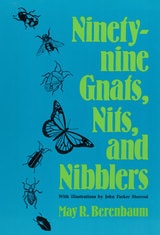
Ninety-nine Gnats, Nits, and Nibblers
May R. Berenbaum
University of Illinois Press, 1989
Why the "Jesus bug" can walk on water
How the katydid’s nighttime noise inspired romantic poetry
The trapping prowess of the hungry antlion
That disgusting thing chiggers do to eat your skin
A witty and educational guide that’s as accessible as the container of flour you should have closed more tightly, Ninety-nine Gnats, Nits, and Nibblers is the fascinating story of our million closest neighbors.
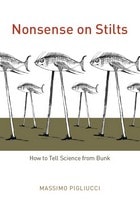
Nonsense on Stilts
How to Tell Science from BunkMassimo Pigliucci
University of Chicago Press, 2010
Recent polls suggest that fewer than 40 percent of Americans believe in Darwin’s theory of evolution, despite it being one of science’s best-established findings. More and more parents are refusing to vaccinate their children for fear it causes autism, though this link can been consistently disproved. And about 40 percent of Americans believe that the threat of global warming is exaggerated, despite near consensus in the scientific community that manmade climate change is real.
Why do people believe bunk? And what causes them to embrace such pseudoscientific beliefs and practices? Noted skeptic Massimo Pigliucci sets out to separate the fact from the fantasy in this entertaining exploration of the nature of science, the borderlands of fringe science, and—borrowing a famous phrase from philosopher Jeremy Bentham—the nonsense on stilts. Presenting case studies on a number of controversial topics, Pigliucci cuts through the ambiguity surrounding science to look more closely at how science is conducted, how it is disseminated, how it is interpreted, and what it means to our society. The result is in many ways a “taxonomy of bunk” that explores the intersection of science and culture at large.
No one—not the public intellectuals in the culture wars between defenders and detractors of science nor the believers of pseudoscience themselves—is spared Pigliucci’s incisive analysis. In the end, Nonsense on Stilts is a timely reminder of the need to maintain a line between expertise and assumption. Broad in scope and implication, it is also ultimately a captivating guide for the intelligent citizen who wishes to make up her own mind while navigating the perilous debates that will affect the future of our planet.
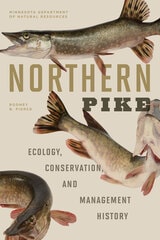
Northern Pike
Ecology, Conservation, and Management HistoryRodney B. Pierce
University of Minnesota Press, 2012
The northern pike—sometimes affectionately known as the “aquatic wolf”—is one of the most sought after and mythologized fishes in Minnesota, but until now there have been few books devoted to the history and ecological management of the species. Based on pioneering research carried out in Minnesota by leading pike specialist Rodney B. Pierce, Northern Pike Ecology, Conservation, and Management History is the most complete collection of information to date on the species, for everyone from scientists and conservation biologists to general readers and recreational anglers.
A tremendously important game fish and resource both in Minnesota and throughout the northern hemisphere, northern pike populations directly reflect local geology and human influence, playing a key role in the health of freshwater ecosystems. As urbanization spreads and the human population continues to grow, pike populations face increasing pressure, requiring new ways of looking at and managing the species. In Minnesota, groundbreaking work has been conducted on northern pike: analyses of stocking success and investigations into the relationships within fish communities, the management of rearing marshes, environmental effects on natural production, the genetics of northern pike, and strategies for scientifically monitoring pike. The state has been a leader in developing fishing regulations to help restore large pike, among many other measures designed to ensure the future quantity and health of a key species in Minnesota’s waterways.
Weaving significant historical scientific literature and technical details together with his own research, Pierce’s benchmark study documents and synthesizes the long history of northern pike management and describes the latest efforts being taken to better understand and manage this critical and renowned species.