Results by title
384 books match the query 'Black Studies (Global)' and 3 start with n
New African Cinema
Orlando, Valérie K
Rutgers University Press, 2017
New African Cinema examines the pressing social, cultural, economic, and historical issues explored by African filmmakers from the early post-colonial years into the new millennium. Offering an overview of the development of postcolonial African cinema since the 1960s, Valérie K. Orlando highlights the variations in content and themes that reflect the socio-cultural and political environments of filmmakers and the cultures they depict in their films.
Orlando illuminates the diverse themes evident in the works of filmmakers such as Ousmane Sembène’s Ceddo (Senegal, 1977), Sarah Maldoror’s Sambizanga (Angola, 1972), Assia Djebar’s La Nouba des femmes de Mont Chenoua (The Circle of women of Mount Chenoua, Algeria, 1978), Zézé Gamboa’s The Hero (Angola, 2004) and Abderrahmane Sissako’s Timbuktu (Mauritania, 2014), among others. Orlando also considers the influence of major African film schools and their traditions, as well as European and American influences on the marketing and distribution of African film. For those familiar with the polemics of African film, or new to them, Orlando offers a cogent analytical approach that is engaging.
Orlando illuminates the diverse themes evident in the works of filmmakers such as Ousmane Sembène’s Ceddo (Senegal, 1977), Sarah Maldoror’s Sambizanga (Angola, 1972), Assia Djebar’s La Nouba des femmes de Mont Chenoua (The Circle of women of Mount Chenoua, Algeria, 1978), Zézé Gamboa’s The Hero (Angola, 2004) and Abderrahmane Sissako’s Timbuktu (Mauritania, 2014), among others. Orlando also considers the influence of major African film schools and their traditions, as well as European and American influences on the marketing and distribution of African film. For those familiar with the polemics of African film, or new to them, Orlando offers a cogent analytical approach that is engaging.
[more]
New Frontiers in the Study of the Global African Diaspora
Between Uncharted Themes and Alternative RepresentationsRita Kiki Edozie
Michigan State University Press, 2018
This anthology presents a new study of the worldwide African diaspora by bringing together diverse, multidisciplinary scholarship to address the connectedness of Black subject identities, experiences, issues, themes, and topics, applying them dynamically to diverse locations of the Blackworld—Latin America, the Caribbean, Africa, and the United States. The book underscores three dimensions of African diaspora study. First is a global approach to the African diaspora, showing how globalism underscores the distinctive role that Africa plays in contributing to world history. Second is the extension of African diaspora study in a geographical scope to more robust inclusions of not only the African continent but also to uncharted paths and discoveries of lesser-known diaspora experiences and identities in Latin America and the Caribbean. Third is the illustration of universal unwritten cultural representations of humanities in the African diasporas that show the distinctive humanities’ disciplinary representations of Black diaspora imaginaries and subjectivities. The contributing authors inductively apply these themes to focus the reader’s attention on contemporary localized issues and historical arenas of the African diaspora. They engage their findings to critically analyze the broader norms and dimensions that characterize a given set of interrelated criteria that have come to establish parameters that increasingly standardize African diaspora studies.
[more]
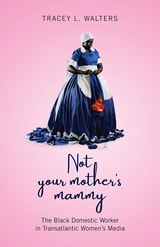
Not Your Mother's Mammy
The Black Domestic Worker in Transatlantic Women’s MediaTracey L Walters
Rutgers University Press, 2021
Not Your Mother’s Mammy examines how black artists of the African diaspora, many of them former domestics, reconstruct the black female subjectivities of domestics in fiction, film, and visual and performance art. In doing so, they undermine one-dimensional images of black domestics as victims lacking voice and agency and prove domestic workers are more than the aprons they wear. An analysis of selected media by Alice Childress, Nandi Keyi, Victoria Brown, Kara Walker, Mikalene Thomas, Rene Cox, Lynn Nottage, and others provides examples of generations of domestics who challenged their performative roles of subservience by engaging in subversive actions contradicting the image of the deferential black maid. Through verbal confrontation, mobilization, passive resistance, and performance, black domestics find their voices, exercise their power, and maintain their dignity in the face of humiliation. Not Your Mother’s Mammy brings to life stories of domestics often neglected in academic studies, such as the complexity of interracial homoerotic relationships between workers and employers, or the mental health challenges of domestics that lead to depression and suicide. In line with international movements like #MeToo and #timesup, the women in these stories demand to be heard.
[more]