Results by title
53 books match the query 'Bodies' and 3 start with n

Native To The Nation
Disciplining Landscapes And Bodies In AustraliaAllaine Cerwonka
University of Minnesota Press, 2004
In a world increasingly marked by migration and dislocation, the question of displacement, and of establishing a sense of belonging, has become ever more common and ever more urgent. But what of those who stay in place? How do people who remain in their place of origin or ancestral homeland rearticulate a sense of connection, of belonging, when ownership of the territory they occupy is contested? Focusing on Australia, Allaine Cerwonka examines the physical and narrative spatial practices by which people reclaim territory in the wake of postcolonial claims to land by indigenous people and new immigration of “foreigners.” As a multicultural, postcolonial nation whose claims to land until recently were premised on the notion of the continent as “empty” (terra nullius), Australia offers an especially rich lens for understanding the reterritorialization of the nation-state in an era of globalization. To this end, Native to the Nation provides a multisited ethnography of two communities in Melbourne, the Fitzroy Police Station and the East Melbourne Garden Club, allowing us to see how bodies are managed and nations physically constructed in everyday confrontations and cultivations. Allaine Cerwonka is assistant professor of women’s studies and political science at Georgia State University.
[more]
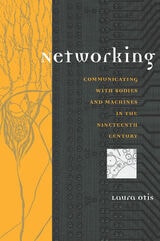
Networking
Communicating with Bodies and Machines in the Nineteenth CenturyLaura Otis
University of Michigan Press, 2011
This compelling new interdisciplinary study investigates the scientific and cultural roots of contemporary conceptions of the network, including computer information systems, the human nervous system, and communications technology. Laura Otis, neuroscientist, literary scholar, and recent recipient of a MacArthur Fellowship, demonstrates that the image of the network is centuries old; it is by no means a modern notion. Placing current comparisons of nerve and computer networks in perspective, Otis explores early analogies linking nerves and telegraphs and demonstrates the influence that nineteenth-century neurobiologists, engineers, and fiction writers influenced each other's ideas about communication.
The interdisciplinary sweep of this book is impressive. Otis focuses simultaneously on literary works by such authors as George Eliot, Bram Stoker, Henry James, and Mark Twain and on the scientific and technological achievements of such pioneers as Luigi Galvani, Hermann von Helmholtz, Charles Babbage, Samuel Morse, and Werner von Siemens.
This unique juxtaposition of physiology, engineering, and literature reveals the common thoughts shared by writers in widely diverse fields and suggests that our current comparisons of nerve and computer networks may not only enhance but shape our understanding of both neurobiology and technology.
Highly accessible and jargon-free, Networking will appeal to general readers as well as to scholars in the fields of interdisciplinary studies, nineteenth-century literature, and the history of science and technology.
Laura Otis is Associate Professor of English, Hofstra University. In 2000, she was awarded a MacArthur Foundation Fellowship for her interdisciplinary studies of literature and science. Her previous books include Membranes: Metaphors of Invasion in Nineteenth-Century Literature, Science, and Politics and Organic Memory: History and the Body in the Late Nineteenth and Early Twentieth Centuries.
[more]
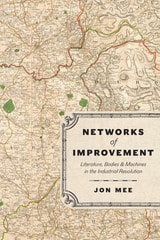
Networks of Improvement
Literature, Bodies, and Machines in the Industrial RevolutionJon Mee
University of Chicago Press, 2023
A new literary-cultural history of the Industrial Revolution in Britain from the late eighteenth to the mid-nineteenth centuries.
Working against the stubbornly persistent image of “dark satanic mills,” in many ways so characteristic of literary Romanticism, Jon Mee provides a fresh, revisionary account of the Industrial Revolution as a story of unintended consequences. In Networks of Improvement, Mee reads a wide range of texts—economic, medical, and more conventionally “literary”—with a focus on their circulation through networks and institutions. Mee shows how a project of enlightened liberal reform articulated in Britain’s emerging manufacturing towns led to unexpectedly coercive forms of machine productivity, a pattern that might be seen repeating in the digital technologies of our own time. Instead of treating the Industrial Revolution as Romanticism’s “other,” Mee shows how writing, practices, and institutions emanating from these industrial towns developed a new kind of knowledge economy, one where local literary and philosophical societies served as important transmission hubs for the circulation of knowledge.
Working against the stubbornly persistent image of “dark satanic mills,” in many ways so characteristic of literary Romanticism, Jon Mee provides a fresh, revisionary account of the Industrial Revolution as a story of unintended consequences. In Networks of Improvement, Mee reads a wide range of texts—economic, medical, and more conventionally “literary”—with a focus on their circulation through networks and institutions. Mee shows how a project of enlightened liberal reform articulated in Britain’s emerging manufacturing towns led to unexpectedly coercive forms of machine productivity, a pattern that might be seen repeating in the digital technologies of our own time. Instead of treating the Industrial Revolution as Romanticism’s “other,” Mee shows how writing, practices, and institutions emanating from these industrial towns developed a new kind of knowledge economy, one where local literary and philosophical societies served as important transmission hubs for the circulation of knowledge.
[more]