Results by title
81 books match the query 'Boston' and 2 start with n
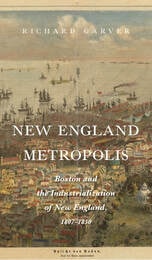
New England Metropolis
Boston and the Industrialization of New England, 1807–1850Richard Garver
University of Massachusetts Press, 2026
At the outset of the nineteenth century, Boston was at its zenith as a maritime city even as New England was in decline. Many struggling farmers abandoned the area for more promising opportunities to the west. Yet by 1850, New England had been transformed into one of the most industrialized regions in the world. Former agricultural villages had become specialized manufacturing towns producing consumer goods for sale, and Boston merchant capitalists had established textile complexes that produced fabrics in huge quantities. Although Boston had been superseded by New York as a trading center, it thrived not only as a financial market but as an exchange hub in which these hinterland manufacturers acquired raw materials, capital, sales services, and transportation. With Boston at its metropolitan center, New England was transformed into an industrial geography that was unique nationally and internationally.
New England Metropolis demonstrates that, in contrast to the course of industrialization in other regions of the country, New England’s transformation was driven by entrepreneurs in hundreds of rural villages and towns and by and Boston merchant capitalists who recruited underemployed agricultural household members to produce consumer goods for sale beyond the region, including in the slave economies of the South and the Caribbean. As Boston merchants adapted commercial, financial and transportation infrastructure they had developed to serve overseas trade to the needs of the region's manufacturers, industrialization halted New England’s decline and, by 1850, had propelled it to prosperity.
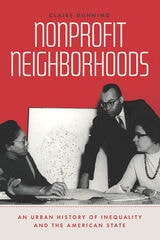
Nonprofit Neighborhoods
An Urban History of Inequality and the American StateClaire Dunning
University of Chicago Press, 2022
Nonprofits serving a range of municipal and cultural needs are now so ubiquitous in US cities, it can be difficult to envision a time when they were more limited in number, size, and influence. Turning back the clock, however, uncovers both an illuminating story of how the nonprofit sector became such a dominant force in American society, as well as a troubling one of why this growth occurred alongside persistent poverty and widening inequality. Claire Dunning’s book connects these two stories in histories of race, democracy, and capitalism, revealing how the federal government funded and deputized nonprofits to help individuals in need, and in so doing avoided addressing the structural inequities that necessitated such action in the first place.
Nonprofit Neighborhoods begins after World War II, when suburbanization, segregation, and deindustrialization inaugurated an era of urban policymaking that applied private solutions to public problems. Dunning introduces readers to the activists, corporate executives, and politicians who advocated addressing poverty and racial exclusion through local organizations, while also raising provocative questions about the politics and possibilities of social change. The lessons of Nonprofit Neighborhoods exceed the bounds of Boston, where the story unfolds, providing a timely history of the shift from urban crisis to urban renaissance for anyone concerned about American inequality—past, present, or future.