Results by title
547 books match the query 'California' and 15 start with n
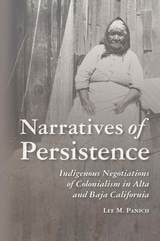
Narratives of Persistence
Indigenous Negotiations of Colonialism in Alta and Baja CaliforniaLee M. Panich
University of Arizona Press, 2020
The Ohlone of the San Francisco Bay area and the Paipai of northern Baja California occupy opposite ends of the spectrum of Native Californian identities. Or so it would appear. While the Ohlone lack popular recognition and official acknowledgement from the United States government, the Paipai occupy a large reserve and celebrate their ongoing cultural traditions throughout Baja California and southern California. Yet the two groups share a similar colonial history: entanglements with early European explorers, labor and enculturation at Spanish missions, and sustained interactions with American and Mexican settler colonialism.
Based on fifteen years of archaeological and historical research in the two regions, Narratives of Persistence charts the remarkable persistence of the Ohlone and Paipai alongside a synthesis of Native Californian endurance over the past five centuries. As the case studies demonstrate, Ohlone and Paipai people made intelligent and culturally appropriate choices to cope with the impact of colonialism on their communities, even as they took different pathways to the present day.
Lee M. Panich illustrates how changes in Native identity and practice within these colonial contexts were made to best conduct the groups’ lives within shifting sets of colonial constraints. He draws connections between the events and processes of the deeper past and the way the Ohlone and Paipai today understand their own histories and identities, offering a model for how scholars of Indigenous histories may think about the connections between the past and the present.
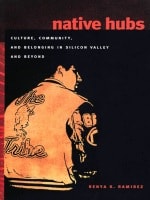
Native Hubs
Culture, Community, and Belonging in Silicon Valley and BeyondRenya K. Ramirez
Duke University Press, 2007
Ramirez’s ethnography revolves around the Paiute American activist Laverne Roberts’s notion of the “hub,” a space that allows for the creation of a sense of belonging away from a geographic center. Ramirez describes “hub-making” activities in Silicon Valley, including sweat lodge ceremonies, powwows, and American Indian Alliance meetings, gatherings at which urban Indians reinforce bonds of social belonging and forge intertribal alliances. She examines the struggle of the Muwekma Ohlone, a tribe aboriginal to the San Francisco Bay area, to maintain a sense of community without a land base and to be recognized as a tribe by the federal government. She considers the crucial role of Native women within urban indigenous communities; a 2004 meeting in which Native Americans from Mexico and the United States discussed cross-border indigenous rights activism; and the ways that young Native Americans in Silicon Valley experience race and ethnicity, especially in relation to the area’s large Chicano community. A unique and important exploration of diaspora, transnationalism, identity, belonging, and community, Native Hubs is intended for scholars and activists alike.
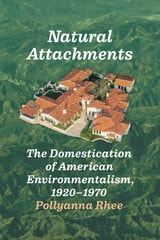
Natural Attachments
The Domestication of American Environmentalism, 1920–1970Pollyanna Rhee
University of Chicago Press, 2025
A massive oil spill in the Pacific Ocean near Santa Barbara, California, in 1969 quickly became a landmark in the history of American environmentalism, helping to inspire the creation of both the Environmental Protection Agency and Earth Day. But what role did the history of Santa Barbara itself play in this? As Pollyanna Rhee shows, the city’s past and demographics were essential to the portrayal of the oil spill as momentous. Moreover, well-off and influential Santa Barbarans were positioned to “domesticate” the larger environmental movement by embodying the argument that individual homes and families—not society as a whole—needed protection from environmental abuses. This soon would put environmental rhetoric and power to fundamentally conservative—not radical—ends.
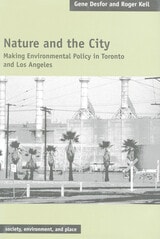
Nature and the City
Making Environmental Policy in Toronto and Los AngelesGene Desfor and Roger Keil
University of Arizona Press, 2004
The book emphasizes ‘subaltern’ environmental justice concerns as instrumental in shaping the policy process. Looking back to the 1990s—when ecological modernization began to emerge as a dominant approach to environmental policy and theory—Desfor and Keil examine four case studies: restoration of the Don River in Toronto, cleanup of contaminated soil in Toronto, regeneration of the Los Angeles River, and air pollution reduction in Los Angeles. In each case, they show that local constituencies can develop political strategies that create alternatives to ecological modernization. When environmental policies appear to have been produced through solely technical exercises, they warn, one must be suspicious about the removal of contention from the process.
In the face of economic and environmental processes that have been increasingly influenced by neo-liberalism and globalization, Desfor and Keil’s analysis posits that continuing modernization of industrial capitalist societies entails a measure of deliberate change to societal relationships with nature in cities. Their book shows that environmental policies are about much more than green capitalism or the technical mastery of problems; they are about how future urban generations live their lives with sustainability and justice.

Nature on the Edge
Lessons for the Biosphere from the California CoastBruce A. Byers
Oregon State University Press, 2024
In compelling dispatches from the edge of the continent, Byers explores topics ranging from butterflies to scrub jays, from salmon to whales. He describes the natural history, ecology, and evolution of key species and ecosystems in scientifically sound but accessible language, and notes that despite all we know, fascinating ecological mysteries still abound. Byers also surveys ecocentric philosophies and worldviews rooted in these places and argues for their importance in developing a more harmonious and sustainable relationship between humans and our home planet.
UNESCO biosphere reserves are laboratories for understanding how humans affect ecosystems and models for how we can heal the human-nature relationship. While the biosphere concept and network has existed for fifty years now, it is still not well-known by the general public. Today, the US has twenty-eight biosphere reserves. By focusing on two beloved sites in California, Byers draws attention to the important work being done in these reserves around the world, with the goal of inspiring readers to reflection, action, and hope in the face of climate change, biodiversity loss, and other environmental challenges.
Negotiating Conquest
Gender and Power in California, 1770s to 1880sMiroslava Chávez-García
University of Arizona Press, 2004
Negotiating Conquest begins with an examination of how gender and ethnicity shaped the policies and practices of the Spanish conquest, showing that Hispanic women, marriage, and the family played a central role in producing a stable society on Mexico’s northernmost frontier. It then examines how gender, law, property, and ethnicity shaped social and class relations among Mexicans and native peoples, focusing particularly on how women dealt with the gender-, class-, and ethnic-based hierarchies that gave Mexican men patriarchal authority. With the American takeover in 1846, the text’s focus shifts to how the imposition of foreign legal, economic, linguistic, and cultural norms affected the status of Mexican women, male-female relations, and the family. Addressing such issues as divorce, legitimacy, and inheritance, it describes the manner in which the conquest weakened the economic position of both Mexican women and men while at the same time increasing the leverage of Mexican women in their personal and social relationships with men.
Drawing on archival materials—including dozens of legal cases—that have been largely ignored by other scholars, Chávez-García examines federal, state, and municipal laws across many periods in order to reveal how women used changing laws, institutions, and norms governing property, marriage and sexuality, and family relations to assert and protect their rights. By showing that mexicanas contested the limits of male rule and insisted that patriarchal relationships be based on reciprocity, Negotiating Conquest expands our knowledge of how patriarchy functioned and evolved as it reveals the ways in which conquest can transform social relationships in both family and community.
Net Values
Environmental, Economic, and Social Entanglements in the Gulf of CaliforniaNicole D. Peterson
University of Arizona Press, 2025
In Loreto, Baja California Sur, Mexico, artisanal fishing families and staff of Loreto Bay National Park face an array of choices as tourism, environmental concerns, and economic precarity challenge livelihoods and natural resource availability. In Net Values, Nicole D. Peterson offers a critical examination of how the idea of “choice” is understood, and what it means for policies, planning, and programs to ignore the social, political, economic, and cultural contexts surrounding these choices.
Anchored by more than twenty years of research, Peterson provides insight into the fishing community of Loreto and reveals an important role in decision-making that diverges from previous studies. She argues that decisions about fishing, natural resource management, and other aspects of life are influenced by context, values, and expectations in ways that go beyond the typical psychological or cognitive theories of choice. Instead, Net Values highlights the ways that choices are constrained and enabled by values and expectations of cultures, histories, relationships, and experiences, both personal and shared. Peterson answers questions such as “why do the fishermen fish?” or “what is the marine park staff doing?” These decisions and choices are related to the larger implication addressed by this book: that in order to make effective policies around natural resource management and other issues, we must understand how those potential policies interact with the decision processes already underway.
Divided into five chapters, Net Values is rich in ethnographic detail, drawing from real people to inform the narratives, chapters, and theoretical elaboration. Peterson’s interactions with fishers such as Don Javier and his family and friends support the ideas offered around choice, values, and strategies, connecting ideas to real experiences.
Newcomers
Gentrification and Its DiscontentsMatthew L. Schuerman
University of Chicago Press, 2019
In Newcomers, journalist Matthew L. Schuerman explains how a phenomenon that began with good intentions has turned into one of the most vexing social problems of our time. He builds a national story using focused histories of northwest Brooklyn, San Francisco’s Mission District, and the onetime site of Chicago’s Cabrini-Green housing project, revealing both the commonalities among all three and the place-specific drivers of change. Schuerman argues that gentrification has become a too-easy flashpoint for all kinds of quasi-populist rage and pro-growth boosterism. In Newcomers, he doesn’t condemn gentrifiers as a whole, but rather articulates what it is they actually do, showing not only how community development can turn foul, but also instances when a “better” neighborhood truly results from changes that are good. Schuerman draws no easy conclusions, using his keen reportorial eye to create sharp, but fair, portraits of the people caught up in gentrification, the people who cause it, and its effects on the lives of everyone who calls a city home.
No Middle Ground
How Informal Party Organizations Control Nominations and Polarize LegislaturesSeth E. Masket
University of Michigan Press, 2011
"This is a fascinating book. It is one of the best studies of the ways that parties and politics get conducted in any American state. Masket shows that legislators can be perfectly content without parties that control agendas and does a terrific job of explaining the transition from free-wheeling legislators to rigidly partisan voting blocs."
---Sam Popkin, University of California at San Diego
"No Middle Ground makes a significant contribution to the study of American parties and legislative politics."
---Matthew Green, Catholic University of America
Despite concerns about the debilitating effects of partisanship on democratic government, in recent years political parties have gained strength in state governments as well as in Washington. Whereas political machines of the past manipulated votes, today's machines determine which candidates can credibly compete in a primary.
Focusing on the history and politics of California, Seth E. Masket reveals how these machines evolved and how they stay in power by directing money, endorsements, and expertise to favored candidates, who often tend toward the ideological extreme. Masket argues that politicians are not inherently partisan. Instead, partisanship is thrust upon them by actors outside the government with the power to manipulate primary elections.
Seth E. Masket is Associate Professor of Political Science at the University of Denver.

No One Knows Their Names
Screenwriters in HollywoodJorja Prover
University of Wisconsin Press, 1994
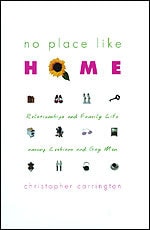
No Place Like Home
Relationships and Family Life among Lesbians and Gay MenChristopher Carrington
University of Chicago Press, 1999
"Carefully separating stereotype from reality, Carrington investigates family in the gay and lesbian community. Relying upon interviews and observation, the author analyzes the loves and routings of 52 diverse lesbian, gay, and bisexual couples in the Bay area. . . . [He] closes the work with a discussion of the raging same-sex marriage debate and posits an enlightened solution to this dilemma." —Library Journal
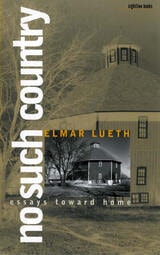
No Such Country
Essays toward HomeElmar Lueth
University of Iowa Press, 2002
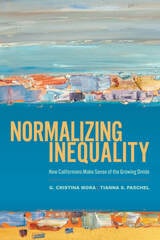
Normalizing Inequality
How Californians Make Sense of the Growing DivideG. Cristina Mora
Russell Sage Foundation, 2026
California has long been mythologized as the quintessential land of opportunity and reinvention—a place where anyone, regardless of origin, can forge a new life and realize their aspirations. Yet beneath this gilded narrative lies a starker reality: California ranks among the most unequal states in one of the world's most unequal countries, where the middle class finds itself increasingly squeezed. Economic inequality is not an anomaly but part of a broader global phenomenon, as disparities deepen across the world. While we know a lot about its contours, its evolution over time and its intersections with race and immigration, we understand far less about how ordinary people interpret and internalize it. In Normalizing Inequality, sociologists G. Cristina Mora and Tianna S. Paschel illuminate how middle-class Californians perceive and come to accept the inequalities that surround them.
Drawing on extensive interviews and surveys, Mora and Paschel uncover a profound paradox at the heart of middle-class consciousness. They find that Californians are keenly aware of the systemic causes of inequality—they recognize policies engineered to benefit the wealthy, they acknowledge how structural racism makes it hard for some groups to get ahead—yet they consistently minimize these forces. Instead, they gravitate toward explanations rooted in individualism, moral character, and the idea that things are worse in other places. Racism and racial inequality in California become palatable when framed as "not as bad as the South." Immigrant exploitation, however severe, transforms into evidence of the American Dream fulfilled simply upon arrival. Economic pressures that displace others become surmountable through personal industriousness and forbearance.
These beliefs about inequality grow more troubling still. Middle-class Californians sometimes blame disempowered people for their circumstances—acknowledging structural barriers facing homeless and undocumented populations while simultaneously faulting them for insufficient drive or criminal behavior that compounds their difficulties. When contemplating California's future, interviewees envision economic prosperity propelled by technological innovation, yet remain curiously unconcerned with how present inequalities might shape that tomorrow. Their imagined future is one where White and Asian American populations thrive, while Black, Latino, and economically marginalized Californians either vanish through displacement or fade into irrelevance. As respondents use these interpretive frameworks to make sense of inequality, they lean heavily on California's foundational narratives of opportunity, sanctuary and multiracial promise.
Normalizing Inequality offers an incisive examination of how ordinary citizens make sense of inequality and, through that very process of sense-making, how they tolerate and passively reproduce the conditions they often claim to deplore.
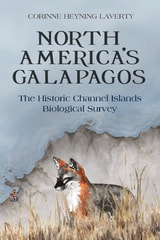
North America's Galapagos
The Historic Channel Islands Biological SurveyCorinne Heyning Laverty
University of Utah Press, 2019
This untold saga of adventure, discovery, and goals abandoned is juxtaposed against the fresh successes of a new generation of Channel Island scholars. Engagingly written, North America’s Galapagos illuminates the scientific process and reveals remarkable modern discoveries that are rewriting archaeological textbooks and unraveling the answer to the age-old question: how and when were the Americas populated?
Anyone interested in the work conducted behind closed museum doors will want to read this book—so will history buffs, environmentalists, scientists, and general readers curious about our world.
Visit the author's website: https://www.channelislandscalifornia.com/

Nothing Permanent
Modern Architecture in CaliforniaTodd Cronan
University of Minnesota Press, 2023
A critical look at the competing motivations behind one of modern architecture’s most widely known and misunderstood movements
Although “mid-century modern” has evolved into a highly popular and ubiquitous architectural style, this term obscures the varied perspectives and approaches of its original practitioners. In Nothing Permanent, Todd Cronan displaces generalizations with a nuanced intellectual history of architectural innovation in California between 1920 and 1970, uncovering the conflicting intentions that would go on to reshape the future of American domestic life.
Focusing on four primary figures—R. M. Schindler, Richard Neutra, and Charles and Ray Eames—Nothing Permanent demonstrates how this prolific era of modern architecture in California, rather than constituting a homogenous movement, was propelled by disparate approaches and aims. Exemplified by the twin pillars of Schindler and Neutra and their respective ideological factions, these two groups of architects represent opposing poles of architectural intentionality, embodying divergent views about the dynamic between interior and exterior, the idea of permanence, and the extent to which architects could exercise control over the inhabitants of their structures.
Looking past California modernism’s surface-level idealization in present-day style guides, home decor publications, films, and television shows, Nothing Permanent details the intellectual, aesthetic, and practical debates that lie at the roots of this complex architectural moment. Extracting this period from its diffusion into visual culture, Cronan argues that mid-century architecture in California raised questions about the meaning of architecture and design that remain urgent today.