475 books match the query 'Catholic' and 5 start with n
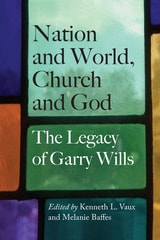
cover of Nation and World, Church and God: The Legacy of Garry Wills

Nation and World, Church and God

The Legacy of Garry Wills

Edited by Kenneth L. Vaux and Melanie Baffes

Northwestern University Press, 2014

Garry Wills is the polymathic public intellectual bemoaned as missing from American letters. A professor emeritus at Northwestern University, he has built upon his early studies in classics and patristics, while bringing his considerable intellect to bear on American culture, politics, and religion, notably through provocative articles and books on wars, past and present presidents, and the Catholic Church Wills has distinguished himself in the crowded field of Civil War history; fearlessly taken on the legacies of Richard Nixon and Ronald Reagan, among other presidents; and offered a critical voice in many fraught ethical discussions, especially in the areas of war and peace.

Nation and World, Church and God gathers original critical reflections by leading writers and scholars on Garry Wills’s life work. Organized around the themes of “Classics,” “Civil War,” “War and Peace,” and “Theology, Church, and the Arts,” the book reflects the cultural acumen, fine-grained political analysis, ethical candor, and theological wisdom of one of America’s most prolific writers.
[more]
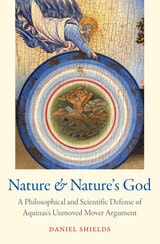
cover of Nature and Nature's God: A Philosophical and Scientific Defense of Aquinas' Unmoved Mover Argument

Nature and Nature's God

A Philosophical and Scientific Defense of Aquinas' Unmoved Mover Argument

Daniel Shields

Catholic University of America Press, 2023

Aquinas’ first proof for God’s existence is usually interpreted as a metaphysical argument immune to any objections coming from empirical science. Connections to Aquinas’ own historical understanding of physics and cosmology are ignored or downplayed. Nature and Nature's God proposes a natural philosophical interpretation of Aquinas’ argument more sensitive to the broader context of Aquinas’ work and yielding a more historically accurate account of the argument. Paradoxically, the book also shows that, on such an interpretation, Aquinas’ argument is not only consistent with modern science, but actually confirmed by the history of science, from classical mechanics through 19th century thermodynamics to contemporary cosmology. The first part of the book considers Aquinas’ argument in its historical context, exploring the key principles that everything in motion is moved by something else and that an infinite regress of causes is impossible. The structure of the First Way is analyzed and the argument is connected both with Aquinas’ Third Way—a new interpretation of which is also proposed—and Aquinas’ second proof from motion in the Summa contra Gentiles. To complete the account of what natural philosophy—prior to metaphysics—can demonstrate about God, a chapter on Aquinas’ teleological argument (the Fifth Way) is also included. The second part of the book tracks the history of modern science from Copernicus to today, showing how Aquinas’ argument fared at each major turn. The first chapter shows how Newton’s understanding of inertia and conservation of momentum supports the idea that motion cannot continue forever without God’s causality, and integrates a modern understanding of inertia and gravity with the principles of Thomistic natural philosophy. The second chapter considers the first and second laws of thermodynamics, showing how they too support Aquinas’ contention that motion cannot continue forever without God’s causality. This chapter also discusses statistical mechanics and contemporary cosmology, demonstrating that science continues to support Aquinas’ unmoved mover argument. The final chapter turns to modern biology as well as cosmological fine-tuning to show that modern science also continues to support Aquinas’ teleological argument. The result is not only a satisfying defense of Aquinas’ natural philosophical proofs for God’s existence, but a primer on the broader project of integrating Thomistic natural philosophy with modern science.
[more]
cover of New Considerations of the Doctrinal Differences Between Catholics and Protestants: A Defense of My Symbolism Against the Objections of Ferdinad Christian Baur in Tübingen

New Considerations of the Doctrinal Differences Between Catholics and Protestants

A Defense of My Symbolism Against the Objections of Ferdinad Christian Baur in Tübingen

Johann Adam Möhler

Catholic University of America Press, 2027
When Johann Adam Möhler published Symbolism in 1832, one commentator called it “the severest blow ever dealt to Protestantism.” It elicited a flurry of responses from both Protestants and Catholics, and the reactions ranged from praise to confusion and outrage. The most substantial answer came from Ferdinand Christian Baur, who published an entire monograph refuting Möhler. In response, Möhler not only began revising Symbolism, but also issued his own book-length response, New Considerations, which defended Catholic religion against Baur’s caricatures. After his untimely death at age forty-two, the fate of Möhler’s work lay largely in the hands of publishers and loyal readers, who for a time issued editions of the New Considerations as the second volume of Symbolism. This trend ended in the twentieth century when New Considerations went out of print. Now, for the first time, it has been translated into English, and readers can see how Möhler, the greatest German Catholic theologian of his century, understood Catholicism and its most essential differences to Protestantism. Grant Kaplan’s excellent and artful translation also provides an introduction that puts Möhler’s final work in its context and explains its abiding relevance for Catholic theology and for contemporary ecumenism.
[more]
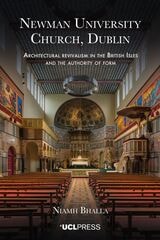
cover of Newman University Church, Dublin: Architectural Revivalism in the British Isles and the Authority of Form

Newman University Church, Dublin

Architectural Revivalism in the British Isles and the Authority of Form

Niamh Bhalla

University College London, 2024

The first-ever account of the historic relationship between the church and early architecture in Dublin.

Newman University Church, Dublin charts the first ever analysis of University Church’s significance within the history of Victorian revivalist architecture. Author Niamh Bhalla explores the relationship between the church’s context as the first Catholic university in Ireland and the ambiguity of its “early Christian” style, providing an effective lens to understand the architectural revivalism of the nineteenth century, particularly basilican and Byzantine revivalist architectures in the British Isles.
[more]
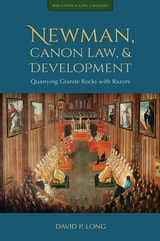
cover of Newman, Canon Law and Development: Quarrying Granite Rocks with Razors

Newman, Canon Law and Development

Quarrying Granite Rocks with Razors

David P. Long

Catholic University of America Press, 2024

John Henry Newman is well-known as a theologian, philosopher, historian, writer, University rector, and poet, but can he also be associated with the field of canon law? When Newman first proposed the possibility of doctrinal development as proof that the Catholic faith was free from corruption and error, he claimed “the Church is declared to be the great and special support of the Truth, her various functionaries are said to be means towards the settlement of diversities and of uncertainty of doctrine, and securing unity of faith.” For Newman, these various functionaries included not only apostles, prophets, evangelists, and pastors, but also theologians and, as is argued in this work, canon lawyers. While Newman and doctrinal development have become well-explored topics in the field of theology, there has been little scholarship on how Newman’s thoughts on doctrinal development can influence current canon law and Church governance. David Long addresses that lacuna by offering a systematic analysis of Newman’s concept of development within current canonical practice. It starts by tracing Newman’s notions of personal judgment, public discussion, and episcopal moderation, followed by a presentation of the current canonical understanding of the theologian, and finally an application of the connection between Newman’s theory on development and present canonical legislation as it involves the role of the theologian. By undertaking such an application, and by creating a model for discussion that preserves both development and Tradition, this work humbly proposes a valuable model for understanding the theologian’s contribution within the life of the contemporary Church in ways not previously explored.
[more]