Results by title
260 books match the query 'Central America' and 4 start with n
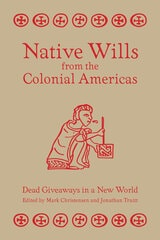
Native Wills from the Colonial Americas
Dead Giveaways in a New WorldMark Z. Christensen and Jonathan Truitt
University of Utah Press, 2015
Native Wills from the Colonial Americas showcases new testamentary sources from the sixteenth to the eighteenth centuries. It provides readers with translations and analyses of wills written in Spanish, Nahuatl, Yucatec Maya, K’iche’ Maya, Mixtec, and Wampanoag.
Divided into three thematic sections, the book provides insights and details that further our understanding of indigenous life in the Americas under colonial rule. Part One employs testaments to highlight the women of Native America and the ways their lives frequently challenged prescribed gender roles and statuses. Part Two uses testaments to illustrate the strategies of the elite in both negotiating and maintaining their power in a colonial, Spanish world. Part Three contributes to our understanding of the individual and collective nature of death by extracting from wills the importance of conversion, kinship, and societal ties in the colonial Americas. Capturing individual voices during dramatic periods of change, the documents presented here help us understand how cultures both adapt and persist.

Nicaragua's Mosquito Shore
The Years of British and American PresenceCraig L. Dozier
University of Alabama Press, 1985
An essential interdisciplinary study of culture, history, and identity on Nicaragua’s Caribbean frontier.
Separated from Nicaragua’s Pacific plain by mountains, the Atlantic coastal plain extends between 70 and 100 miles into the interior. Early Spanish settlers were ousted by the British, who engaged in the mahogany trade, and who also hoped for trade with Americans seeking a short route to California. In 1850, with the signing of the Clayton-Bulwer Treaty, the U.S. and Britain agreed that neither country would seek to acquire exclusive control over a Nicaraguan canal. Plans for the development of a Nicaraguan canal had a marked influence on the region for the next 100 years.
During the second half of the 19th century both rubber and bananas were produced commercially in eastern Nicaragua, and the Standard Fruit Company of New Orleans became the larges single commercial influence in the region. The first over American intervention in eastern Nicaragua occurred in 1912, when a contingent of Marines was dispatched to protect American commercial interests. The Marines remained for thirteen years.
Dozier develops the history of the current political troubles in Nicaragua, which had their origin in the early 1930s and which center about the control of the rich area inhabited by the Mosquitos. His book presents the historical background for the tragic events that are taking place in that region.
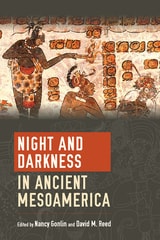
Night and Darkness in Ancient Mesoamerica
Nancy Gonlin
University Press of Colorado, 2021
The anthropological study of night and darkness enriches and strengthens the understanding of human behavior, power, economy, and the supernatural. In eleven case studies featuring the residents of Teotihuacan, the Classic period Maya, inhabitants of Rio Ulúa, and the Aztecs, the authors challenge archaeologists to consider the influence of the ignored dimension of the night and the role and expression of darkness on ancient behavior. Chapters examine the significance of eclipses, burials, tombs, and natural phenomena considered to be portals to the underworld; animals hunted at twilight; the use and ritual meaning of blindfolds; night-blooming plants; nocturnal foodways; fuel sources and lighting technology; and other connected practices.
Night and Darkness in Ancient Mesoamerica expands the scope of published research and media on the archaeology of the night. The book will be of interest to those who study the humanistic, anthropological, and archaeological aspects of the Aztec, Maya, Teotihuacanos, and southeastern Mesoamericans, as well as sensory archaeology, art history, material culture studies, anthropological archaeology, paleonutrition, socioeconomics, sociopolitics, epigraphy, mortuary studies, volcanology, and paleoethnobotany.
Contributors: Jeremy Coltman, Christine Dixon, Rachel Egan, Kirby Farah, Carolyn Freiwald, Nancy Gonlin, Julia Hendon, Cecelia Klein, Jeanne Lopiparo, Brian McKee, Jan Marie Olson, David M. Reed, Payson Sheets, Venicia Slotten, Michael Thomason, Randolph Widmer, W. Scott Zeleznik
No Boundaries
Transnational Latino Gangs and American Law EnforcementTom Diaz
University of Michigan Press, 2011
"Tom Diaz has worn out some shoe leather, much like a good detective, in gathering facts, not myths or urban legends. As a result he has produced an accurate and comprehensive look at a grave and present danger to our society."
---From the foreword by Chris Swecker, former Assistant Director of the FBI and former head of the FBI's Criminal Investigative Division
No Boundaries is a disturbing account of what many consider the "next Mafia"---Latino crime gangs. Like the Mafia, these gangs operate an international network, consider violence a routine matter, and defy U.S. law enforcement at every level. Also, the gangs spawn kingpins such as the notorious Nelson Martinez Varela Comandari, who nearly became the first "Latin godfather" in the United States.
Focusing on the Los Angeles–based Mara Salvatrucha (MS-13) and the 18th Street Gang, and the Chicago-based Latin Kings, Tom Diaz describes how neighborhood gangs evolved into extremely brutal, sophisticated criminal enterprises and how local and federal authorities have struggled to suppress them. As he makes clear, the problem of transnational Latino gangs involves complex national and international issues, such as racial tensions, immigration policy, conflict in Latin America, and world economic pressures.
Tom Diaz is a lawyer, author, and public speaker who conducts research on gun policy and violence for the Violence Policy Center, a Washington, D.C.–based think tank. He has covered national security affairs for the Washington Times and served as counsel to the U.S. House Subcommittee on Crime and Criminal Justice from 1993 to 1997.
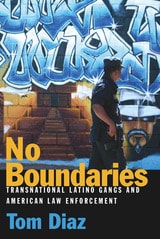
Cover photograph: Tegucigalpa, Honduras: A policeman passes by a graffiti of the Mara Salvatrucha "MS-13" (juvenile gang) at the entrance of the unit where members of the gang are kept imprisoned in the National Penitentiary in Tamara, 30 km north of Tegucigalpa, February 1, 2006. © Elmer Martinez/AFP/Getty Images