Results by title
480 books match the query 'Chicago' and 10 start with n
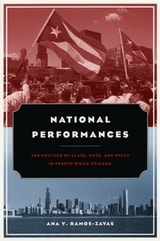
National Performances
The Politics of Class, Race, and Space in Puerto Rican ChicagoAna Y. Ramos-Zayas
University of Chicago Press, 2003
Drawing on extensive ethnographic research, Ramos-Zayas shows how the performance of Puerto Rican nationalism in Chicago serves as a critique of social inequality, colonialism, and imperialism, allowing barrio residents and others to challenge the notion that upward social mobility is equally available to all Americans—or all Puerto Ricans. Paradoxically, however, these activists' efforts also promote upward social mobility, overturning previous notions that resentment and marginalization are the main results of nationalist strategies.
Ramos-Zayas's groundbreaking work allows her here to offer one of the most original and complex analyses of contemporary nationalism and Latino identity in the United States.
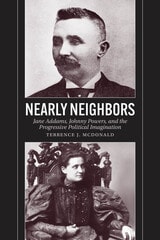
Nearly Neighbors
Jane Addams, Johnny Powers, and the Progressive Political ImaginationTerrence J. McDonald
University of Chicago Press, 2026
Jane Addams was full of courage and goodwill when she opened Hull House in Chicago’s Nineteenth Ward in 1889. However, she failed to understand that her immigrant neighbors had been well-organized around mostly Catholic churches and schools for decades before her arrival. Her ultimate political rival, Johnny Powers, grew up in this culture but was no ethnic hero or deep political thinker. Nearly Neighbors is the first book to provide a contextualized history of their encounter, embedding it in the social and political culture and structures of Chicago and the Nineteenth Ward in the 1890s.
Terrence J. McDonald provides a crucial analysis of two pivotal figures in Chicago’s political history, in part by providing the first detailed assessment of Powers’s life and practices, but also by demonstrating Addams’s misconception of him and her neighbors—and why it matters for understanding her Progressive work overall. In both her political work and writings, Addams saw her ethnic neighbors as bundles of economic need, rather than bearers of ethnic culture. At the same time, she was recruited by elite allies into causes that appeared to be opposed by her neighbors. These views and practices permitted Powers to win in their climactic political battle in 1898 simply by claiming to be the neighborhood defender against Addams and her “downtown” allies. Nearly Neighbors offers a new way of understanding Addams and the complicated legacy of her famous political work and writings.
Negotiating Latinidad
Intralatina/o Lives in ChicagoFrances R. Aparicio
University of Illinois Press, 2019
Neoliberal Chicago
Edited by Larry Bennett, Roberta Garner, and Euan Hague
University of Illinois Press, 2017
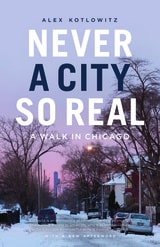
Never a City So Real
A Walk in ChicagoAlex Kotlowitz
University of Chicago Press, 2019
The book is a tour of the people of Chicago, those who have been Kotlowitz’s guide into this city’s – and by inference, this country’s – heart. Chicago, after all, is America’s city. Kotlowitz introduces us to the owner of a West Side soul food restaurant who believes in second chances, a steelworker turned history teacher, the “Diego Rivera of the projects,” and the lawyers and defendants who populate Chicago’s Criminal Courts Building. These empathic, intimate stories chronicle the city’s soul, its lifeblood.
This new edition features a new afterword from the author, which examines the state of the city today as seen from the double-paned windows of a pawnshop. Ultimately, Never a City So Real is a love letter to Chicago, a place that Kotlowitz describes as “a place that can tie me up in knots but a place that has been my muse, my friend, my joy.”
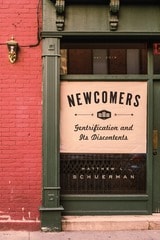
Newcomers
Gentrification and Its DiscontentsMatthew L. Schuerman
University of Chicago Press, 2019
In Newcomers, journalist Matthew L. Schuerman explains how a phenomenon that began with good intentions has turned into one of the most vexing social problems of our time. He builds a national story using focused histories of northwest Brooklyn, San Francisco’s Mission District, and the onetime site of Chicago’s Cabrini-Green housing project, revealing both the commonalities among all three and the place-specific drivers of change. Schuerman argues that gentrification has become a too-easy flashpoint for all kinds of quasi-populist rage and pro-growth boosterism. In Newcomers, he doesn’t condemn gentrifiers as a whole, but rather articulates what it is they actually do, showing not only how community development can turn foul, but also instances when a “better” neighborhood truly results from changes that are good. Schuerman draws no easy conclusions, using his keen reportorial eye to create sharp, but fair, portraits of the people caught up in gentrification, the people who cause it, and its effects on the lives of everyone who calls a city home.
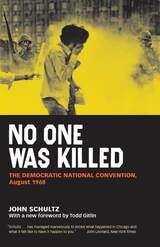
No One Was Killed
The Democratic National Convention, August 1968John Schultz
University of Chicago Press, 2009
While other writers contemplated the events of the 1968 Chicago riots from the safety of their hotel rooms, John Schultz was in the city streets, being threatened by police, choking on tear gas, and listening to all the rage, fear, and confusion around him. The result, No One Was Killed, is his account of the contradictions and chaos of convention week, the adrenalin, the sense of drama and history, and how the mainstream press was getting it all wrong.
"A more valuable factual record of events than the city’s white paper, the Walker Report, and Theodore B. White’s Making of a President combined."—Book Week
"As a reporter making distinctions between Yippie, hippie, New Leftist, McCarthyite, police, and National Guard, Schultz is perceptive; he excels in describing such diverse personalities as Julian Bond and Eugene McCarthy."—Library Journal
"High on my short list of true, lasting, inspired evocations of those whacked-out days when the country was fighting a phantasmagorical war (with real corpses), and police under orders were beating up demonstrators who looked at them funny."—Todd Gitlin, from the foreword
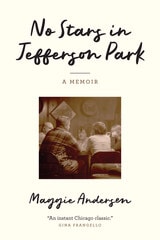
No Stars in Jefferson Park
A MemoirMaggie Andersen
Northwestern University Press, 2026
A Chicagoan’s coming-of-age memoir finds courage in the face of immense loss
In her early twenties, Maggie Andersen was a founding ensemble member of Chicago’s storied Gift Theatre with her then-boyfriend, Michael Patrick Thornton. But after a series of spinal strokes left Thornton paralyzed, Andersen made the heart-wrenching decision to leave him, along with their growing company and, later, her beloved city. No Stars in Jefferson Park alternates between two narratives: the energy and excitement of making art in Chicago’s thriving storefront theater scene and the devastating day-to-day realities of rehabilitation and rebuilding—and somewhere in the middle finding the courage to choose yourself.
Over the past twenty-plus years, the Gift—now performing in the working-class neighborhood of Portage Park—has become one of the most vital storefront theaters in Chicago, with Thornton’s career taking him to Hollywood and Broadway. But Andersen’s story has brought her back home. No Stars in Jefferson Park is a testament to lifelong friendship, a love letter to Chicago, and a profound coming-of-age story about the pain and necessity of putting yourself first.
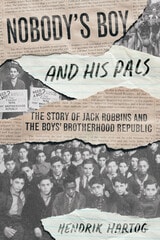
Nobody's Boy and His Pals
The Story of Jack Robbins and the Boys’ Brotherhood RepublicHendrik Hartog
University of Chicago Press, 2024
In 1914, social reformer Jack Robbins and a group of adolescent boys in Chicago founded the Boys’ Brotherhood Republic, an unconventional and unusual institution. During a moral panic about delinquent boys, Robbins did not seek to rehabilitate and/or punish wayward youths. Instead, the boys governed themselves, democratically and with compassion for one another, and lived by their mantra “So long as there are boys in trouble, we too are in trouble.” For nearly thirty years, Robbins was their “supervisor,” and the will he drafted in the late 1950s suggests that he continued to care about forgotten boys, even as the political and legal contexts that shaped children’s lives changed dramatically.
Nobody’s Boy and His Pals is a lively investigation that challenges our ideas about the history of American childhood and the law. Scouring the archives for traces of the elusive Jack Robbins, Hendrik Hartog examines the legal histories of Progressive reform, childhood, criminality, repression, and free speech. The curiosity of Robbins’s story is compounded by the legal challenges to his will, which wound up establishing the extent to which last wishes must conform to dominant social values. Filled with persistent mysteries and surprising connections, Nobody’s Boy and His Pals illuminates themes of childhood and adolescence, race and ethnicity, sexuality, wealth and poverty, and civil liberties, across the American Century.
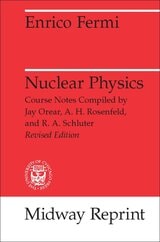
Nuclear Physics
A Course Given by Enrico Fermi at the University of ChicagoEnrico Fermi
University of Chicago Press, 1974
"The compilers of this publication may be warmly congratulated. . . . The scope of this course is amazing: within 240 pages it ranges from the general properties of atomic nuclei and nuclear forces to mesons and cosmic rays, and includes an account of fission and elementary pile theory. . . . The course addresses itself to experimenters rather than to specialists in nuclear theory, although the latter will also greatly profit from its study on account of the sound emphasis laid everywhere on the experimental approach to problems. . . . There is a copious supply of problems."—Proceedings of the Physical Society
"Only a relatively few students are privileged to attend Professor Fermi's brilliant lectures at the University of Chicago; it is therefore a distinct contribution to the followers of nuclear science that his lecture material has been systematically organized in a publication and made available to a much wider audience."—Nucelonics