236 books match the query 'Children's Studies' and 4 start with n
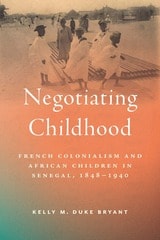
cover of Negotiating Childhood: French Colonialism and African Children in Senegal, 1848–1940

Negotiating Childhood

French Colonialism and African Children in Senegal, 1848–1940

Kelly M. Duke Bryant

University of Massachusetts Press, 2026

A groundbreaking study of the meaning of childhood in French colonial Senegal

Negotiating Childhood explores how colonial child protection policies and African children’s responses to them produced new ways of defining, measuring, documenting, and experiencing childhood in the French colony of Senegal from 1848 to 1940. In this groundbreaking book, Kelly M. Duke Bryant takes the scholarship in new directions, offering to a literature dominated by studies of British colonies in the twentieth century a study of childhood in a French colony from the immediate post-emancipation period through the 1930s. This focus allows her to complicate the generally accepted timeline of child protection in colonial Africa and question other assumptions about children’s history on the continent.

This deeply researched work uses a wide range of sources to examine children’s experiences in spaces where they encountered French discipline and surveillance, such as wardship courts, public streets, schools, juvenile reformatories, and vaccine clinics. The book shows not only how these spaces re-ordered African childhood, but also how children themselves shaped and limited French efforts to impose order, especially when the state depended on African children’s cooperation to make good on rhetoric about child “protection.” It also charts the rise of documentation in children’s lives, as colonial representatives recorded names, ages, and other details about the African children with whom they interacted. Tracing the “documented” child back to the early colonial period, Negotiating Childhood historicizes the emergence of identity documentation—so crucial to our contemporary world—and questions the naturalness of the very idea of the “child.”
[more]
cover of Neighborhood Poverty: Context and Consequences for Children

Neighborhood Poverty

Context and Consequences for Children

Jeanne Brooks-Gunn

Russell Sage Foundation, 1997
Perhaps the most alarming phenomenon in American cities has been the transformation of many neighborhoods into isolated ghettos where poverty is the norm and violent crime, drug use, out-of-wedlock births, and soaring school dropout rates are rampant. Public concern over these destitute areas has focused on their most vulnerable inhabitants—children and adolescents. How profoundly does neighborhood poverty endanger their well-being and development? Is the influence of neighborhood more powerful than that of the family? Neighborhood Poverty: Context and Consequences for Children approaches these questions with an insightful and wide-ranging investigation into the effect of community poverty on children's physical health, cognitive and verbal abilities, educational attainment, and social adjustment. This two-volume set offers the most current research and analysis from experts in the fields of child development, social psychology, sociology and economics. Drawing from national and city-based sources, Volume I reports the empirical evidence concerning the relationship between children and community. As the essays demonstrate, poverty entails a host of problems that affects the quality of educational, recreational, and child care services. Poor neighborhoods usually share other negative features—particularly racial segregation and a preponderance of single mother families—that may adversely affect children. Yet children are not equally susceptible to the pitfalls of deprived communities. Neighborhood has different effects depending on a child's age, race, and gender, while parenting techniques and a family's degree of community involvement also serve as mitigating factors. Volume II incorporates empirical data on neighborhood poverty into discussions of policy and program development. The contributors point to promising community initiatives and suggest methods to strengthen neighborhood-based service programs for children. Several essays analyze the conceptual and methodological issues surrounding the measurement of neighborhood characteristics. These essays focus on the need to expand scientific insight into urban poverty by drawing on broader pools of ethnographic, epidemiological, and quantitative data. Volume II explores the possibilities for a richer and more well-rounded understanding of neighborhood and poverty issues. To grasp the human cost of poverty, we must clearly understand how living in distressed neighborhoods impairs children's ability to function at every level. Neighborhood Poverty explores the multiple and complex paths between community, family, and childhood development. These two volumes provide and indispensible guide for social policy and demonstrate the power of interdisciplinary social science to probe complex social issues.
[more]
cover of Neighborhood Poverty: Policy Implications in Studying Neighborhoods

Neighborhood Poverty

Policy Implications in Studying Neighborhoods

Jeanne Brooks-Gunn

Russell Sage Foundation, 1997

Perhaps the most alarming phenomenon in American cities has been the transformation of many neighborhoods into isolated ghettos where poverty is the norm and violent crime, drug use, out-of-wedlock births, and soaring school dropout rates are rampant. Public concern over these destitute areas has focused on their most vulnerable inhabitants—children and adolescents. How profoundly does neighborhood poverty endanger their well-being and development? Is the influence of neighborhood more powerful than that of the family? Neighborhood Poverty approaches these questions with an insightful and wide-ranging investigation into the effect of community poverty on children's physical health, cognitive and verbal abilities, educational attainment, and social adjustment. This two-volume set offers the most current research and analysis from experts in the fields of child development, social psychology, sociology and economics. Drawing from national and city-based sources, Volume I reports the empirical evidence concerning the relationship between children and community. As the essays demonstrate, poverty entails a host of problems that affects the quality of educational, recreational, and child care services.Poor neighborhoods usually share other negative features—particularly racial segregation and a preponderance of single mother families—that may adversely affect children. Yet children are not equally susceptible to the pitfalls of deprived communities. Neighborhood has different effects depending on a child's age, race, and gender, while parenting techniques and a family's degree of community involvement also serve as mitigating factors. Volume II incorporates empirical data on neighborhood poverty into discussions of policy and program development. The contributors point to promising community initiatives and suggest methods to strengthen neighborhood-based service programs for children. Several essays analyze the conceptual and methodological issues surrounding the measurement of neighborhood characteristics. These essays focus on the need to expand scientific insight into urban poverty by drawing on broader pools of ethnographic, epidemiological, and quantitative data. Volume II explores the possibilities for a richer and more well-rounded understanding of neighborhood and poverty issues. To grasp the human cost of poverty, we must clearly understand how living in distressed neighborhoods impairs children's ability to function at every level. Neighborhood Poverty explores the multiple and complex paths between community, family, and childhood development. These two volumes provide and indispensable guide for social policy and demonstrate the power of interdisciplinary social science to probe complex social issues.
[more]
cover of Not in Front of the Children: 'Indecency,' Censorship, and the Innocence of Youth

Not in Front of the Children

'Indecency,' Censorship, and the Innocence of Youth

Heins, Marjorie

Rutgers University Press, 2007

From Huckleberry Finn to Harry Potter, from Internet filters to the v-chip, censorship exercised on behalf of children and adolescents is often based on the assumption that they must be protected from “indecent” information that might harm their development—whether in art, in literature, or on a Web site. But where does this assumption come from, and is it true? 

In Not in Front of the Children, Marjorie Heins explores the fascinating history of “indecency” laws and other restrictions aimed at protecting youth. From Plato’s argument for rigid censorship, through Victorian laws aimed at repressing libidinous thoughts, to contemporary battles over sex education in public schools and violence in the media, Heins guides us through what became, and remains, an ideological minefield. With fascinating examples drawn from around the globe, she suggests that the “harm to minors” argument rests on shaky foundations.

[more]