208 books match the query 'Christian Church' and 5 start with n
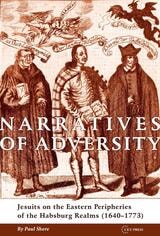
cover of Narratives of Adversity: Jesuits on the Eastern Peripheries of the Habsburg Realms (1640–1773)

Narratives of Adversity

Jesuits on the Eastern Peripheries of the Habsburg Realms (1640–1773)

Paul J. Shore

Central European University Press, 2012
Addresses the experience of Jesuit missionaries, teachers and writers along the peripheries of the Habsburg lands, which stretched to Moldavia, Ukraine, Serbia and Wallachia, and which were continually torn with ethnic tensions. The time scale of the study is from the "high tide" of the Society (often labeled "the first multinational corporation") in the fourth decade of the seventeenth century, until its suppression in 1773 by Pope Clement XIV. The book examines several of the communities situated along the periphery and the records that they left behind about their interactions with the local populations. It constructs a vivid picture of Jesuit life on the frontier that is built up in mosaic fashion and livened by compelling anecdotes. The Jesuits of Royal Hungary exercised a baroque expression modeled after the larger western cities of the Habsburg lands, which was a fragile splendor in part defined by the need to defend Catholicism from the hostility of Orthodox, Lutherans, Calvinists, and others.
[more]
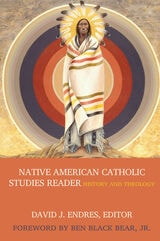
cover of Native American Catholic Studies Reader: History and Theology

Native American Catholic Studies Reader

History and Theology

David J. Endres

Catholic University of America Press, 2022

Before there was an immigrant American Church, there was a Native American Church. The Native American Catholic Studies Reader offers an introduction to the story of how Native American Catholicism has developed over the centuries, beginning with the age of the missions and leading to inculturated, indigenous forms of religious expression. Though the Native-Christian relationship could be marked by tension, coercion, and even violence, the Christian faith took root among Native Americans and for those who accepted it and bequeathed it to future generations it became not an imposition, but a way of expressing Native identity. From the perspective of historians and theologians, the Native American Catholic Studies Reader offers a curated collection of essays divided into three sections: education and evangelization; tradition and transition; and Native American lives. Contributors include scholars currently working in the field: Mark Clatterbuck, Damian Costello, Conor J. Donnan, Ross Enochs, Allan Greer, Mark G. Thiel, and Christopher Vecsey, as well as selections from a past generation: Gerald McKevitt, SJ, and Carl F. Starkloff, SJ. These contributions explore the interaction of missionaries and tribal leaders, the relationship of traditional Native cosmology and religiosity to Christianity, and the role of geography and tribal consciousness in accepting and maintaining indigenous and religious identities. These readings highlight the state of the emergent field of Native-Catholic studies and suggest further avenues for research and publication. For scholars, teachers, and students, the Native American Catholic Studies Reader explores how the faith of the American Church’s eldest members became a means of expressing and celebrating language, family, and tribe.
[more]
cover of New Considerations of the Doctrinal Differences Between Catholics and Protestants: A Defense of My Symbolism Against the Objections of Ferdinad Christian Baur in Tübingen

New Considerations of the Doctrinal Differences Between Catholics and Protestants

A Defense of My Symbolism Against the Objections of Ferdinad Christian Baur in Tübingen

Johann Adam Möhler

Catholic University of America Press, 2027
When Johann Adam Möhler published Symbolism in 1832, one commentator called it “the severest blow ever dealt to Protestantism.” It elicited a flurry of responses from both Protestants and Catholics, and the reactions ranged from praise to confusion and outrage. The most substantial answer came from Ferdinand Christian Baur, who published an entire monograph refuting Möhler. In response, Möhler not only began revising Symbolism, but also issued his own book-length response, New Considerations, which defended Catholic religion against Baur’s caricatures. After his untimely death at age forty-two, the fate of Möhler’s work lay largely in the hands of publishers and loyal readers, who for a time issued editions of the New Considerations as the second volume of Symbolism. This trend ended in the twentieth century when New Considerations went out of print. Now, for the first time, it has been translated into English, and readers can see how Möhler, the greatest German Catholic theologian of his century, understood Catholicism and its most essential differences to Protestantism. Grant Kaplan’s excellent and artful translation also provides an introduction that puts Möhler’s final work in its context and explains its abiding relevance for Catholic theology and for contemporary ecumenism.
[more]
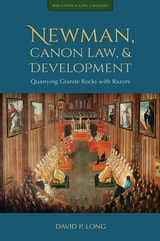
cover of Newman, Canon Law and Development: Quarrying Granite Rocks with Razors

Newman, Canon Law and Development

Quarrying Granite Rocks with Razors

David P. Long

Catholic University of America Press, 2024
John Henry Newman is well-known as a theologian, philosopher, historian, writer, University rector, and poet, but can he also be associated with the field of canon law? When Newman first proposed the possibility of doctrinal development as proof that the Catholic faith was free from corruption and error, he claimed “the Church is declared to be the great and special support of the Truth, her various functionaries are said to be means towards the settlement of diversities and of uncertainty of doctrine, and securing unity of faith.” For Newman, these various functionaries included not only apostles, prophets, evangelists, and pastors, but also theologians and, as is argued in this work, canon lawyers. While Newman and doctrinal development have become well-explored topics in the field of theology, there has been little scholarship on how Newman’s thoughts on doctrinal development can influence current canon law and Church governance. David Long addresses that lacuna by offering a systematic analysis of Newman’s concept of development within current canonical practice. It starts by tracing Newman’s notions of personal judgment, public discussion, and episcopal moderation, followed by a presentation of the current canonical understanding of the theologian, and finally an application of the connection between Newman’s theory on development and present canonical legislation as it involves the role of the theologian. By undertaking such an application, and by creating a model for discussion that preserves both development and Tradition, this work humbly proposes a valuable model for understanding the theologian’s contribution within the life of the contemporary Church in ways not previously explored.
[more]
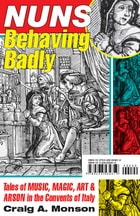
cover of Nuns Behaving Badly: Tales of Music, Magic, Art, and Arson in the Convents of Italy

Nuns Behaving Badly

Tales of Music, Magic, Art, and Arson in the Convents of Italy

Craig A. Monson

University of Chicago Press, 2010

Witchcraft. Arson. Going AWOL. Some nuns in sixteenth- and seventeenth-century Italy strayed far from the paradigms of monastic life. Cloistered in convents, subjected to stifling hierarchy, repressed, and occasionally persecuted by their male superiors, these women circumvented authority in sometimes extraordinary ways. But tales of their transgressions have long been buried in the Vatican Secret Archive. That is, until now.

In Nuns Behaving Badly, Craig A. Monson resurrects forgotten tales and restores to life the long-silent voices of these cloistered heroines. Here we meet nuns who dared speak out about physical assault and sexual impropriety (some real, some imagined). Others were only guilty of misjudgment or defacing valuable artwork that offended their sensibilities. But what unites the women and their stories is the challenges they faced: these were women trying to find their way within the Catholicism of their day and through the strict limits it imposed on them. Monson introduces us to women who were occasionally desperate to flee cloistered life, as when an entire community conspired to torch their convent and be set free. But more often, he shows us nuns just trying to live their lives. When they were crossed—by powerful priests who claimed to know what was best for them—bad behavior could escalate from mere troublemaking to open confrontation.

In resurrecting these long-forgotten tales and trials, Monson also draws attention to the predicament of modern religious women, whose “misbehavior”—seeking ordination as priests or refusing to give up their endowments to pay for priestly wrongdoing in their own archdioceses—continues even today. The nuns of early modern Italy, Monson shows, set the standard for religious transgression in their own age—and beyond.

[more]