Results by title
173 books match the query 'Collective Memory' and 4 start with n
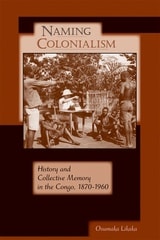
Naming Colonialism
History and Collective Memory in the Congo, 1870–1960Osumaka Likaka
University of Wisconsin Press, 2009
What’s in a name? As Osumaka Likaka argues in this illuminating study, the names that Congolese villagers gave to European colonizers reveal much about how Africans experienced and reacted to colonialism. The arrival of explorers, missionaries, administrators, and company agents allowed Africans to observe Westerners’ physical appearances, behavior, and cultural practices at close range—often resulting in subtle yet trenchant critiques. By naming Europeans, Africans turned a universal practice into a local mnemonic system, recording and preserving the village’s understanding of colonialism in the form of pithy verbal expressions that were easy to remember and transmit across localities, regions, and generations.
Methodologically innovative, Naming Colonialism advances a new approach that shows how a cultural process—the naming of Europeans—can provide a point of entry into economic and social histories. Drawing on archival documents and oral interviews, Likaka encounters and analyzes a welter of coded fragments. The vivid epithets Congolese gave to rubber company agents—“the home burner,” “Leopard,” “Beat, beat,” “The hippopotamus-hide whip”—clearly conveyed the violence that underpinned colonial extractive economies. Other names were subtler, hinting at derogatory meaning by way of riddles, metaphors, or symbols to which the Europeans were oblivious. Africans thus emerge from this study as autonomous actors whose capacity to observe, categorize, and evaluate reverses our usual optic, providing a critical window on Central African colonialism in its local and regional dimensions.
Methodologically innovative, Naming Colonialism advances a new approach that shows how a cultural process—the naming of Europeans—can provide a point of entry into economic and social histories. Drawing on archival documents and oral interviews, Likaka encounters and analyzes a welter of coded fragments. The vivid epithets Congolese gave to rubber company agents—“the home burner,” “Leopard,” “Beat, beat,” “The hippopotamus-hide whip”—clearly conveyed the violence that underpinned colonial extractive economies. Other names were subtler, hinting at derogatory meaning by way of riddles, metaphors, or symbols to which the Europeans were oblivious. Africans thus emerge from this study as autonomous actors whose capacity to observe, categorize, and evaluate reverses our usual optic, providing a critical window on Central African colonialism in its local and regional dimensions.
[more]
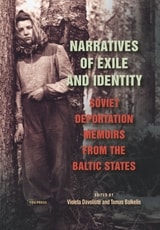
Narratives of Exile and Identity
Soviet Deportation Memoirs from the Baltic StatesTomas Balkelis
Central European University Press, 2018
In an innovative effort to situate Baltic testimonies to the Gulag in the broader international context of research on displacement and memory, scholars from the Baltic States, Western Europe, Canada, and the United States seek answers to the following questions: Do different groups of deportees experience deportation differently? How do the accounts of women, children and men differ in their representation? Do various ethnic groups remember the past differently: how do they use historical and cultural paradigms to structure their experience in unique ways? The scholars researched the archives, read testimonies, interviewed former deportees, and examined artifacts of memory produced since the late 1980s, applying crossdisciplinary approaches used at the study of the Holocaust testimonies; the testimonies of women have received a particular emphasis. The essays in the book also examine the issues of transmittance, commemoration and public uses of the memory of deportations in contemporary social, cultural and political contexts of Baltic societies, including the reflection of Gulag legacy in literature, the cinema and museums.
[more]
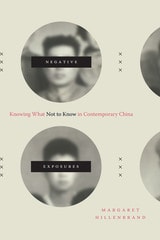
Negative Exposures
Knowing What Not to Know in Contemporary ChinaMargaret Hillenbrand
Duke University Press, 2020
When nations decide to disown their troubled pasts, how does this strategic disavowal harden into social fact? In Negative Exposures, Margaret Hillenbrand investigates the erasure of key aspects of such momentous events as the Nanjing Massacre, the Cultural Revolution, and the Tiananmen Square protests from the Chinese historical consciousness, not due to amnesia or censorship but through the operations of public secrecy. Knowing what not to know, she argues, has many stakeholders, willing and otherwise, who keep quiet to protect themselves or their families out of shame, pragmatism, or the palliative effects of silence. Hillenbrand shows how secrecy works as a powerful structuring force in Chinese society, one hiding in plain sight, and identifies aesthetic artifacts that serve as modes of reckoning against this phenomenon. She analyses the proliferation of photo-forms—remediations of well-known photographs of troubling historical events rendered in such media as paint, celluloid, fabric, digital imagery, and tattoos—as imaginative spaces in which the shadows of secrecy are provocatively outlined.
[more]
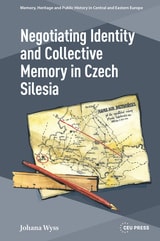
Negotiating Identity and Collective Memory in Czech Silesia
Johana Wyss
Central European University Press, 2026
This study offers an ethnographic exploration of how memory, identity, and history are contested in the city of Opava and the surrounding Hlu.ín area – former sites of Austrian and Prussian rule shaped by post-imperial legacies, displacement, and shifting national narratives. Drawing on extensive fieldwork, the book investigates how local communities navigate dominant Czech nationalism and vernacular Silesian identities through memorials, oral histories, cultural expression, and tourism. Chapters explore themes such as Wehrmacht legacies, linguistic politics, and the branding of Silesian cuisine, revealing how cultural memory is selectively preserved, silenced, or commodified. Through rich case studies, the book highlights the tensions between official discourses and grassroots memory practices, showing how identity in this Central European borderland is continually reconstructed. Blending theoretical depth with lived experience, this study offers new insight into the role of collective memory in shaping belonging in post-imperial, post-socialist Europe.
[more]