Results by title
212 books match the query 'Colonial Period (1600-1775)' and 4 start with n

Native American Slavery in the Seventeenth Century
Arne Bialuschewski, special issue editor
Duke University Press, 2017
Contributors. Carolyn Arena, Arne Bialuschewski, Linford D. Fisher, George Edward Milne, Andrés Reséndez
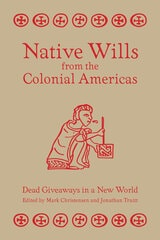
Native Wills from the Colonial Americas
Dead Giveaways in a New WorldMark Z. Christensen and Jonathan Truitt
University of Utah Press, 2015
Native Wills from the Colonial Americas showcases new testamentary sources from the sixteenth to the eighteenth centuries. It provides readers with translations and analyses of wills written in Spanish, Nahuatl, Yucatec Maya, K’iche’ Maya, Mixtec, and Wampanoag.
Divided into three thematic sections, the book provides insights and details that further our understanding of indigenous life in the Americas under colonial rule. Part One employs testaments to highlight the women of Native America and the ways their lives frequently challenged prescribed gender roles and statuses. Part Two uses testaments to illustrate the strategies of the elite in both negotiating and maintaining their power in a colonial, Spanish world. Part Three contributes to our understanding of the individual and collective nature of death by extracting from wills the importance of conversion, kinship, and societal ties in the colonial Americas. Capturing individual voices during dramatic periods of change, the documents presented here help us understand how cultures both adapt and persist.
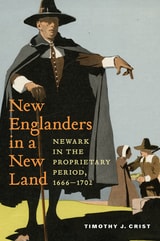
New Englanders in a New Land
Newark in the Proprietary Period, 1666-1702Timothy J. Crist
Rutgers University Press, 2027
New England Puritans from the former New Haven Colony settled Newark in 1666. Their fierce determination to establish scripture-based government in a close-knit township, with community control over admitting new inhabitants, often put them in direct conflict with New Jersey's proprietary government. Newark's egalitarian system for allocating land diverged sharply from the proprietors' headright approach, adapted from the West Indies and Carolina, that rewarded settler use of indentured servants and enslaved labor with larger distributions of land.
This study provides a fresh interpretation of the founding and settlement of Newark as a self-contained New England community, including their negotiations with Native Americans, formation of godly self-government, gradual allocation of township land, and introduction of slavery. To implement their New England way, Newarkers resisted the proprietary government to the point of rebellion, bringing into stark relief the inherent conflict between two sources of authority, one scriptural and community-based and the other royal and proprietary, and two systems of land distribution.
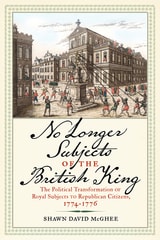
No Longer Subjects of the British King
The Political Transformation of Royal Subjects to Republican Citizens, 1774–1776Shawn David McGhee
Westholme Publishing, 2024
Historian Shawn McGhee offers a fresh perspective on the origins of American political identity. No Longer Subjects of the British King: The Political Transformation of Royal Subjects to Republican Citizens, 1774-1776reveals the crucial process by which the Continental Association organized American towns and counties into a protonational community of suffering to protect political identities they felt under threat. This work further demonstrates how those sacrificing for the common cause severed their bonds of allegiance to the British king and separated from the broader imperial nation. In this crucible of austerity, they formed an American political community, completing the political transformation from subject to citizen.